Listen to this Post
Introduction:
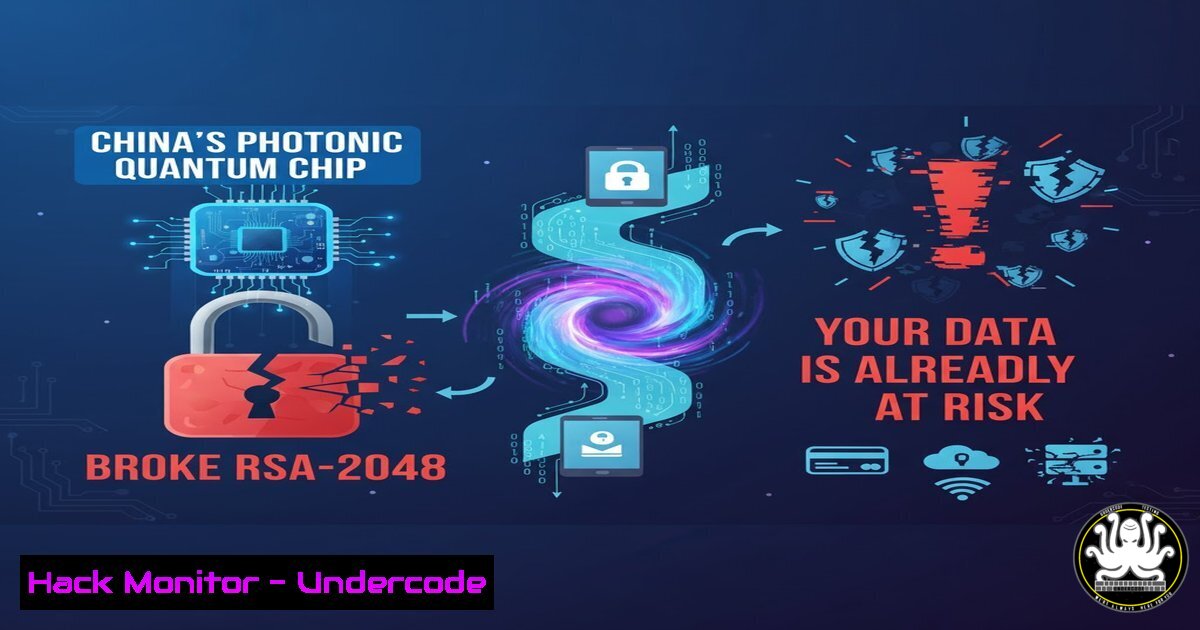
A groundbreaking photonic quantum chip developed in China has reportedly shattered the foundational security of the internet by successfully factoring integers central to RSA-2048 encryption. This advancement, long theorized as the “cryptographic doomsday” scenario, moves quantum computing threats from a distant theoretical risk to an imminent and tangible danger. Organizations must immediately transition from assessing quantum vulnerability to actively implementing cryptographic agility and post-quantum cryptography (PQC) to protect sensitive data.
Learning Objectives:
- Understand the specific threat that photonic quantum computing poses to current asymmetric encryption standards like RSA and ECC.
- Learn how to inventory and classify cryptographic assets vulnerable to a cryptographically relevant quantum computer (CRQC).
- Implement initial steps towards cryptographic agility by integrating PQC standards into your IT environment.
You Should Know:
1. The Quantum Threat to Public-Key Cryptography
The core of modern secure communication—from HTTPS websites to encrypted emails—relies on public-key cryptography. Algorithms like RSA depend on the computational difficulty of factoring large prime numbers, a task that would take classical computers thousands of years. A photonic quantum chip, leveraging quantum phenomena like superposition and entanglement, can run algorithms like Shor’s algorithm. This algorithm efficiently factors these large numbers, rendering RSA-2048 and similar encryption schemes virtually useless. The recent demonstration suggests that photonic approaches, which use light (photons) instead of electric currents, may overcome some of the stability and scalability issues of other quantum computing methods, accelerating the timeline for a practical attack.
2. Immediate Action: Cryptographic Asset Inventory
You cannot protect what you do not know. Before any migration, you must discover all systems using cryptographic keys vulnerable to quantum attacks.
Step-by-step guide:
Step 1: Identify Critical Data & Systems. Pinpoint where your most sensitive data resides (e.g., customer databases, intellectual property stores, financial records) and what systems protect it.
Step 2: Scan for Cryptographic Protocols. Use network scanning and asset management tools to find services using RSA or Elliptic-Curve Cryptography (ECC).
Linux Command Example (Using `nmap`):
nmap -sV --script ssl-enum-ciphers <target_ip_or_domain>
This command identifies the SSL/TLS ciphers in use, revealing if a service relies on RSA for key exchange.
Step 3: Audit Code and Configurations. Search through application code, configuration files, and API settings for explicit mentions of cryptographic algorithms (e.g., RSA, EC, SHA1WithRSA). Use tools like `grep` or specialized SAST (Static Application Security Testing) tools.
3. Implementing Post-Quantum Cryptography (PQC) Today
The U.S. National Institute of Standards and Technology (NIST) has selected a suite of PQC algorithms designed to be resistant to both classical and quantum computer attacks. These include CRYSTALS-Kyber for key establishment and CRYSTALS-Dilithium for digital signatures.
Step-by-step guide:
Step 1: Leverage Hybrid Implementations. Many TLS libraries now support “hybrid” key exchange, which combines a traditional algorithm (like ECDHE) with a PQC algorithm (like Kyber). This provides security even if one of the algorithms is broken.
Step 2: Test with OpenSSL.
Linux Command Example: Modern versions of OpenSSL (3.2+) support hybrid key exchange. You can generate a hybrid certificate or configure your server to offer hybrid cipher suites.
Code Snippet (Conceptual OpenSSL Configuration):
 In your Apache SSL configuration
SSLCipherSuite ECDHE-ECDSA-AES128-GCM-SHA256:ECDHE-RSA-AES128-GCM-SHA256:ECDHE-ECDSA-KYBER-768-RSA-SHA256
Step 3: Pilot with Non-Critical Services. Begin deploying PQC on internal or less critical systems to monitor for performance impacts and compatibility issues before a full-scale rollout.
4. Hardening Systems for the Quantum Era: Crypto-Agility
Cryptographic agility is the ability to swiftly update cryptographic algorithms, parameters, and implementations without needing to overhaul entire systems. It is the primary defense against unforeseen cryptographic breaks.
Step-by-step guide:
Step 1: Abstract Cryptographic Operations. Avoid hard-coding specific algorithms. Instead, use abstraction layers or libraries that allow you to swap out the underlying cryptography via configuration changes.
Step 2: Implement Key and Certificate Lifecycle Management. Establish automated processes for key rotation and certificate renewal. This makes the future transition to PQC certificates a routine operational task rather than a massive, panic-driven project.
Step 3: Use Configuration Management Tools. Tools like Ansible, Puppet, or Chef can be used to push new cryptographic policies across your entire estate consistently.
Windows Command Example (Using PowerShell for Registry):
 Disable old, weak protocols like SSLv3 system-wide
New-Item 'HKLM:\SYSTEM\CurrentControlSet\Control\SecurityProviders\SCHANNEL\Protocols\SSL 3.0\Server' -Force
Set-ItemProperty 'HKLM:\SYSTEM\CurrentControlSet\Control\SecurityProviders\SCHANNEL\Protocols\SSL 3.0\Server' -Name 'Enabled' -Value '0'
- The “Harvest Now, Decrypt Later” Attack and Data Mitigation
Adversaries are likely already executing “Harvest Now, Decrypt Later” (HNDL) attacks. They are intercepting and storing encrypted data today, with the intention of decrypting it once a powerful enough quantum computer is available. Any data encrypted with RSA/ECC that has long-term sensitivity is a primary target.
Step-by-step guide:
Step 1: Classify Data by Longevity and Sensitivity. Identify which data has a shelf-life longer than the expected advent of CRQCs (e.g., 10-30 years). This includes government secrets, health records, and intellectual property.
Step 2: Re-encrypt with Quantum-Resistant Algorithms. For data at rest that falls into the above category, begin the process of decrypting it with the old key and re-encrypting it using a PQC algorithm or a strong symmetric key.
Conceptual Code Snippet (Using a PQC Library):
 Pseudo-code using a PQC library
from pqcrypto.kem.kyber import generate_keypair, encrypt, decrypt

Generate a new Kyber keypair
public_key, secret_key = generate_keypair()
 Encrypt data with the public key
ciphertext, shared_secret = encrypt(public_key)
 Decrypt data with the secret key
decrypted_shared_secret = decrypt(secret_key, ciphertext)
Step 3: Enhance Perimeter Security. Strengthen network monitoring (NDR) and access controls to detect and prevent large-scale data exfiltration attempts, thereby reducing the amount of data an adversary can harvest.
What Undercode Say:
- The timeline for the quantum apocalypse has been radically shortened. This is not a drill; it is a five-alarm fire for global infosec. The demonstration of a photonic chip breaking RSA signifies a paradigm shift from physics experiments to applied engineering in the quantum domain.
- The most immediate and insidious threat is not the direct attack, but the HNDL campaign that has almost certainly been underway for years. Every organization must operate under the assumption that their encrypted data in transit has been harvested and is waiting to be decrypted.
The photonic approach to quantum computing is particularly concerning because it potentially offers a more stable and scalable path to practical systems compared to superconductor-based qubits. While the exact details and scalability of this specific chip are not fully public, the proof-of-concept is a clear signal to the industry. The cost of inaction has skyrocketed. Organizations that delay their PQC migration plans are making a conscious decision to leave their crown-jewel data exposed to a future attack that is now inevitable.
Prediction:
Within the next 3-5 years, we will witness the first public demonstration of a quantum computer breaking RSA-2048 on a meaningful timescale (days/weeks, not years), not just as a lab experiment. This will trigger a global, panic-driven rush to PQC, causing shortages in expertise and potential compatibility breakdowns in critical infrastructure. Nation-state actors will achieve cryptographically relevant quantum capabilities within 10 years, leading to the silent decryption of decades of harvested diplomatic, military, and industrial communications, irrevocably altering the global balance of power. The companies and governments that begin their transition today will be the only ones standing secure in the post-quantum world.
🎯Let’s Practice For Free:
IT/Security Reporter URL:
Reported By: Keith King – Hackers Feeds
Extra Hub: Undercode MoN
Basic Verification: Pass ✅


