Listen to this Post
Introduction:
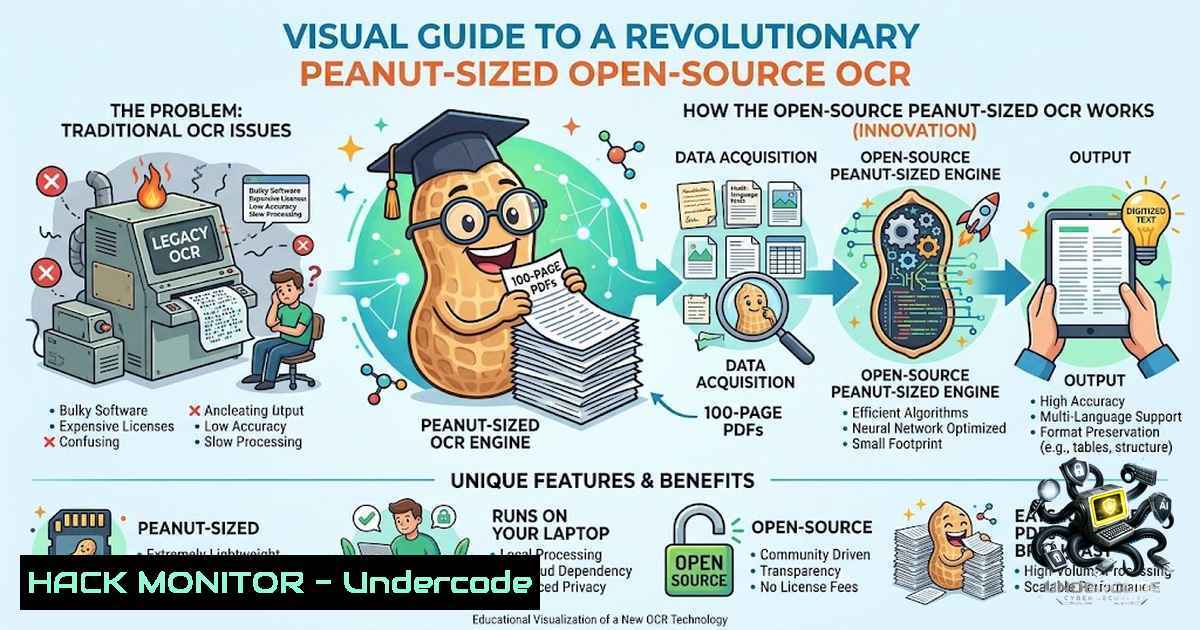
The document parsing landscape has been quietly suffering from a collective amnesia problem. Traditional OCR pipelines—whether cloud-based giants like AWS Textract, Google Vision, or Azure Document Intelligence—process documents page-by-page, clearing memory between each page and losing the thread that binds a document together. This fragmentation becomes particularly painful when dealing with tables that span page breaks, footnotes that wander, or contextual relationships that demand continuity. Enter Unlimited-OCR, Baidu’s 3-billion-parameter open-source marvel that does what no OCR model has done before: parse an entire 100-page PDF in a single forward pass with a constant memory footprint, all while running locally on your own hardware. With a 32K token context window, multilingual support out of the box, and a staggering 93.92% on the OmniDocBench v1.6 benchmark—6.22 percentage points above the DeepSeek-OCR baseline—this model represents a paradigm shift in how we think about document understanding.
Learning Objectives:
- Understand the architectural innovation behind Reference Sliding Window Attention (R-SWA) and how it maintains constant KV cache during long-sequence generation
- Learn to deploy Unlimited-OCR locally using Transformers, vLLM, SGLang, Docker, or Ollama with step-by-step implementation guides
- Master practical optimization techniques for production-grade document parsing across Linux and Windows environments, including hardware requirements and performance tuning
You Should Know:
- The R-SWA Revolution: How Unlimited-OCR Cures AI Amnesia
Traditional transformer-based OCR models suffer from a fatal flaw: the KV cache grows linearly with every token generated. By page 10 of a long document, decoding slows noticeably; by page 20, you’re either out of memory or quality degrades because attention is spread too thin. The industry workaround has been chunking—process one page, dump the cache, process the next—but this breaks cross-page context and turns a coherent document into fragmented pieces.
Unlimited-OCR’s breakthrough lies in Reference Sliding Window Attention (R-SWA), a mechanism inspired by how humans copy-typists work: you don’t hold every word you’ve already typed in your head; you hold the last sentence or two and keep glancing back at the source document. R-SWA replaces every attention layer in the decoder with a fixed-size sliding window that maintains constant KV cache throughout the entire decoding process. The visual tokens from the encoder remain permanently accessible as reference points, while only the most recent 128 output tokens are kept in the attention window. The result is a cache that stays flat whether you’re on token 500 or token 30,000.
The architecture builds directly on DeepSeek-OCR’s DeepEncoder—a cascaded SAM-ViT-B + CLIP-L design that achieves 16× token compression, reducing a 1024×1024 page to roughly 256 visual tokens. Unlimited-OCR doesn’t reinvent the encoder; it solves the problem DeepSeek-OCR couldn’t: the decoder-side KV cache explosion. This is why the technical report references DeepSeek-OCR 40 times—not as competition, but as a foundation being extended.
2. Running Unlimited-OCR with Hugging Face Transformers
The simplest way to get started is with the official Transformers implementation. Here’s a complete setup guide for Linux (with Windows WSL2 equivalents):
Prerequisites (Linux):
 Create isolated environment with Python 3.12.3
python3.12 -m venv unlimited-ocr-env
source unlimited-ocr-env/bin/activate
pip install --upgrade pip

Install pinned dependencies (tested stack)
pip install torch==2.10.0 torchvision==0.25.0 transformers==4.57.1 \
Pillow==12.1.1 matplotlib==3.10.8 einops==0.8.2 addict==2.4.0 \
easydict==1.13 pymupdf==1.27.2.2 psutil==7.2.2
Windows (WSL2) Equivalent:
 In WSL2 Ubuntu instance
python3.12 -m venv unlimited-ocr-env
source unlimited-ocr-env/bin/activate
 Same pip install commands as above
The Core Inference Script:
import os
import torch
from transformers import AutoModel, AutoTokenizer

model_name = 'baidu/Unlimited-OCR'
tokenizer = AutoTokenizer.from_pretrained(
model_name,
trust_remote_code=True
)
model = AutoModel.from_pretrained(
model_name,
trust_remote_code=True,
use_safetensors=True,
torch_dtype=torch.bfloat16,
)
model = model.eval().cuda()

Single image with "gundam" config (base_size=1024, image_size=640, crop_mode=True)
model.infer(
tokenizer,
prompt='<image>document parsing.',
image_file='your_document.jpg',
output_path='./output',
base_size=1024,
image_size=640,
crop_mode=True,
max_length=32768,
no_repeat_ngram_size=35,
ngram_window=128,
save_results=True,
)

Multi-page PDF (automatically uses "base" config: image_size=1024, crop_mode=False)
model.infer_multi(
tokenizer,
prompt='<image>document parsing.',
pdf_file='100_page_manual.pdf',
output_path='./output',
max_length=32768,
)
Critical Security Note: The `trust_remote_code=True` flag executes repository code locally. For production deployments, pin a specific revision, review the modeling files, and use use_safetensors=True.
3. Deploying with vLLM for Production Throughput
For high-throughput production environments, vLLM offers OpenAI-compatible API serving with optimized inference:
 Install vLLM
pip install vllm

Start the vLLM server
vllm serve "baidu/Unlimited-OCR"
Calling the API (Linux/macOS/WSL):
curl -X POST "http://localhost:8000/v1/completions" \
-H "Content-Type: application/json" \
--data '{
"model": "baidu/Unlimited-OCR",
"prompt": "<image>document parsing.",
"max_tokens": 32768,
"temperature": 0.1
}'
Docker Deployment (Cross-Platform):
 Default CUDA 13.0 image
docker pull vllm/vllm-openai:unlimited-ocr

For Hopper GPUs (CUDA 12.9)
docker pull vllm/vllm-openai:unlimited-ocr-hopper

Run with GPU access
docker run --gpus all -p 8000:8000 vllm/vllm-openai:unlimited-ocr
Hardware Requirements: A single 12GB+ NVIDIA GPU (RTX 3060 12GB, 4070, or higher) is sufficient. The BF16 weights are approximately 6.7GB, with the 32K context and vision tokens fitting comfortably within 12GB of VRAM. CPU-only inference is not officially supported, though community GGUF quantizations exist for llama.cpp.
4. Leveraging GGUF Quantizations for Resource-Constrained Environments
The community has produced GGUF quantizations that enable running Unlimited-OCR on more modest hardware through llama.cpp:
 Download the model and vision projector
huggingface-cli download sahilchachra/Unlimited-OCR-GGUF \
--include "Unlimited-OCR-Q4_K_M.gguf" \
--include "mmproj-Unlimited-OCR-f16.gguf" \
--local-dir ./unlimited-ocr-gguf
Critical Build Requirement: Stock llama.cpp cannot load these files. You must build the DeepSeek-OCR-aware PR branch:
git clone https://github.com/ggml-org/llama.cpp
cd llama.cpp
git fetch origin pull/17400/head:pr-17400
git checkout pr-17400
make -j
Recommended Quantizations:
- Q4_K_M (1.82 GB): Best overall size/quality trade-off
- Q8_0 (2.91 GB): Near-lossless quality
- IQ4_XS (1.53 GB): Optimized for ARM/edge devices
5. Performance Benchmarks and Real-World Validation
The numbers speak for themselves. On OmniDocBench v1.6, Unlimited-OCR achieves 93.92%综合 score, establishing a new SOTA. The improvements across specific metrics are equally impressive:
| Metric | DeepSeek-OCR | Unlimited-OCR | Improvement |
|–|–||-|
| Text Edit Distance | 0.073 | 0.038 | -47.9% |
| Formula CDM | 83.37 | 92.61 | +11.1% |
| Table TEDS | 84.97 | 90.93 | +7.0% |
In long-document scenarios, the model maintains an edit distance below 0.11 even past 40 pages, with Distinct-35 metrics hovering around 97%. Real-world inference speed shows a 12.7% improvement over DeepSeek-OCR in typical scenarios, expanding to 35% faster when output length reaches 6000 tokens.
Community testing has validated the model’s multilingual capabilities, with users confirming solid Cyrillic support and successful parsing of handwritten calculus exams into clean LaTeX. However, practitioners should note that the model struggles with skewed scans and table structures that cross page breaks—exactly the edge cases where R-SWA’s sliding window might lose structural continuity.
6. Data Governance and the Privacy Advantage
Perhaps the most compelling argument for Unlimited-OCR isn’t technical—it’s regulatory. As Rodrigo Chagas astutely observed, “The real unlock isn’t cost…it’s that regulated clients often can’t send the documents out at all, so on-prem changes what’s allowed, not just what’s cheap”. Traditional cloud OCR services (Textract, Google Vision, Azure Doc Intelligence) cost between $1.50 and $15 per 1,000 pages. Unlimited-OCR runs on your machine. For free. Forever.
For organizations handling sensitive data—medical records, financial documents, legal contracts, or government IDs—the ability to keep everything on-premises isn’t just a cost-saving measure; it’s a compliance requirement. The MIT license further eliminates commercial use barriers, making this a genuinely enterprise-ready solution.
7. Practical Limitations and Mitigation Strategies
Sridhar Seshan’s observation about hardware requirements is worth heeding: “This model is great, but it wasn’t good on CPU, GPU or faster processor is required for general users”. The official repository does not support CPU or Apple Silicon. For teams without NVIDIA GPUs, consider:
- Cloud GPU instances: AWS G4/G5, Azure NC-series, or Google Cloud A2 instances
- Community quantizations: GGUF (llama.cpp) or MLX (Apple Silicon) variants
- Baidu Cloud hosted API: Available for those who prefer managed infrastructure
The `trust_remote_code` security consideration cannot be overstated. Treat this like running any downloaded executable—review the code, pin revisions, and isolate the environment. Temporary file storage also matters: PDF-to-image conversion creates page images on disk. For sensitive documents, ensure temp directories are controlled and encrypted.
What Undercode Say:
- Local-first OCR isn’t just cheaper—it’s transformative for regulated industries. The privacy and compliance benefits of on-premises deployment outweigh any marginal accuracy trade-offs. Organizations that previously couldn’t use cloud OCR at all now have a viable alternative.
- R-SWA represents a fundamental advance in attention mechanisms, not just an OCR-specific hack. The paper explicitly notes R-SWA’s applicability to ASR, translation, and any long-horizon transcription task. This is architecture-level innovation with implications far beyond document parsing.
The convergence of three trends makes Unlimited-OCR particularly significant: the relentless push for on-device AI, the growing regulatory scrutiny of cloud data processing, and the maturing of mixture-of-experts architectures that deliver 3B-parameter capability with 500M-parameter compute cost. With 1.9 million Hugging Face downloads and counting, this isn’t a fringe experiment—it’s a mainstream shift.
Prediction:
- +1 Expect rapid adoption in financial services, healthcare, and legal sectors where data sovereignty is non-1egotiable. The MIT license removes procurement friction, enabling grassroots adoption before enterprise standardization.
- +1 The R-SWA mechanism will be adapted for other sequence-to-sequence tasks within 12 months. The paper’s explicit mention of ASR and translation applications signals Baidu’s intent to generalize this innovation beyond OCR.
- -1 The hardware barrier (NVIDIA GPU required) will slow adoption in CPU-only environments. While GGUF quantizations help, the official lack of CPU support creates a bifurcation between GPU-enabled teams and everyone else.
- +1 Competitive pressure will force cloud OCR providers to either acquire similar technology or dramatically reduce pricing. The $1.50–$15 per 1,000 pages model becomes unsustainable when a free, locally-run alternative exists.
- +1 The open-source ecosystem will produce specialized fine-tunes for specific domains (medical charts, legal contracts, scientific papers) within 6 months, further widening the capability gap between open and closed OCR solutions.
▶️ Related Video (74% Match):
🎯Let’s Practice For Free:
🎓 Live Courses & Certifications:
Join Undercode Academy for Verified Certifications
🚀 Request a Custom Project:
Secure, high-velocity infrastructure and disruptive technological engineering. Contact our engineering team for high-tier development and proprietary systems:
[email protected]
💎 Smart Architecture | 🛡️ Secure by Design | ⭐ Trusted by Thousands
IT/Security Reporter URL:
Reported By: Ahmed Islam01 – Hackers Feeds
Extra Hub: Undercode MoN
Basic Verification: Pass ✅


