Listen to this Post
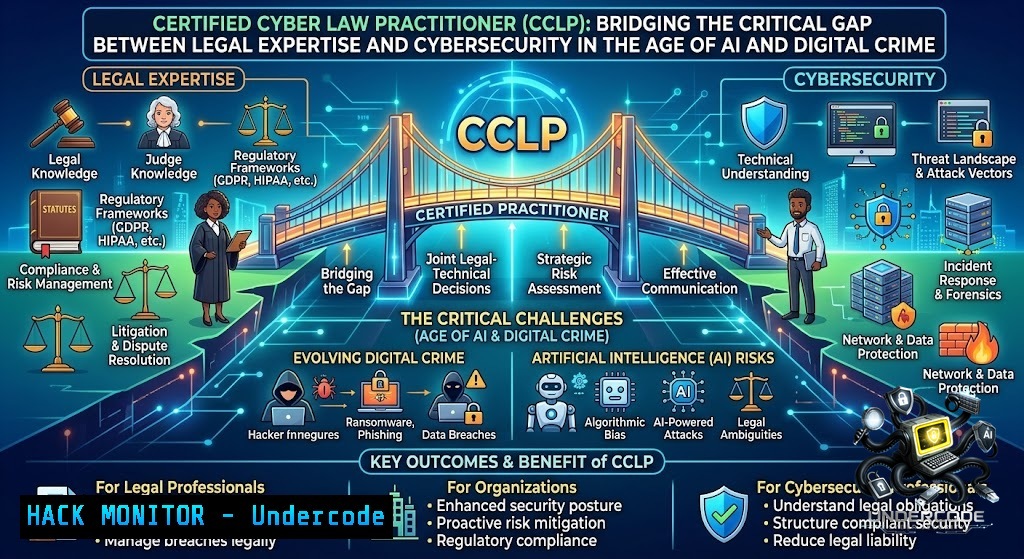
Introduction:
The digital landscape is evolving at an unprecedented pace, with cybercrime, data breaches, artificial intelligence, and digital privacy concerns reshaping our society. In this complex environment, legal professionals are no longer optional participants but essential guardians of the digital frontier. The Certified Cyber Law Practitioner (CCLP) certification, offered by the Future Crime Research Foundation (FCRF) Academy, represents a critical step in equipping legal minds with the technical and legal expertise needed to navigate this new reality. This program is designed to bridge the gap between law and technology, ensuring that innovation is supported by strong legal and ethical foundations.
Learning Objectives:
- Master the legal frameworks governing cyberspace, including the Information Technology Act, 2000, and the Digital Personal Data Protection Act, 2023.
- Develop practical skills in cybercrime investigation, electronic evidence handling, and digital forensics.
- Acquire proficiency in Open Source Intelligence (OSINT) and threat intelligence to proactively identify and mitigate cyber threats.
You Should Know:
- Understanding the Legal Arsenal: IT Act and DPDP Act
The cornerstone of India’s cyber law framework is the Information Technology Act, 2000, which has been significantly amended over the years, most recently to address emerging challenges. The Act provides the legal basis for electronic governance, defines cyber offenses, and establishes the framework for intermediary liability. Complementing this is the Digital Personal Data Protection Act, 2023 (DPDP Act), which creates a comprehensive framework for the protection of digital personal data.
Step-by-step guide to understanding and applying these laws:
- Familiarize yourself with the IT Act: Study the key sections related to cyber offenses (e.g., Section 43 for unauthorized access, Section 66 for computer-related offenses) and intermediary liability (Section 79).
- Understand the DPDP Act: Focus on the definition of “digital personal data,” the rights of data principals, and the obligations of data fiduciaries.
- Identify applicability: Determine if your organization or client is subject to these laws based on the nature of data processing and the location of data subjects.
- Implement compliance measures: Develop and implement policies and procedures to ensure compliance with both Acts, including data protection impact assessments and breach notification protocols.
- Stay updated: Monitor legislative amendments and judicial interpretations, as both Acts are subject to ongoing refinement.
2. Mastering Cybercrime Investigation and Electronic Evidence
The investigation of cybercrimes requires a structured approach to identify, collect, preserve, and analyze electronic evidence. This process is critical for building a legally admissible case. The CCLP program provides rigorous training in these areas, guiding participants from foundational principles to sophisticated investigative techniques.
Step-by-step guide to handling electronic evidence:
- Preparation: Establish an incident response plan and ensure that all tools and procedures are in place before an incident occurs.
- Preservation: Immediately secure the crime scene (the digital device or network) to prevent the alteration or destruction of evidence. Use write-blockers when creating forensic images.
- Acquisition: Create a bit-for-bit copy (forensic image) of the storage media using tools like `dd` (Linux) or FTK Imager (Windows).
– Linux command: `sudo dd if=/dev/sda of=/path/to/image.dd bs=4096 conv=noerror,sync`
– Windows command (using FTK Imager): Use the GUI to select the source drive and create a forensic image in a format like E01 or DD.
4. Examination: Analyze the forensic image using specialized tools to recover deleted files, examine file metadata, and identify relevant artifacts.
5. Analysis: Correlate the findings from the examination to build a timeline of events and establish the sequence of actions.
6. Reporting: Document the entire process, findings, and conclusions in a clear, concise, and legally defensible report.
- Leveraging Open Source Intelligence (OSINT) and Threat Intelligence
OSINT involves collecting and analyzing information from publicly available sources to support cybercrime investigations and threat intelligence efforts. Threat intelligence, on the other hand, is the knowledge that allows an organization to understand and mitigate cyber threats. Both are essential skills for a modern cyber law practitioner.
Step-by-step guide to conducting OSINT and threat intelligence:
- Define your objective: Clearly state what you are looking for (e.g., information about a threat actor, a compromised asset, or a security vulnerability).
- Identify sources: Determine which publicly available sources are relevant, such as search engines, social media platforms, public databases, and specialized OSINT tools.
- Collect data: Use tools and techniques to gather information from these sources. Examples include:
– theHarvester: `theHarvester -d example.com -b google` (to gather emails and subdomains).
– Shodan: `shodan search “port: 22″` (to find devices with port 22 open).
– SpiderFoot: Use the GUI or CLI to automate OSINT collection from over 100 sources.
4. Analyze data: Correlate and analyze the collected data to identify patterns, connections, and actionable intelligence.
5. Disseminate: Share the intelligence with relevant stakeholders in a timely and understandable format.
6. Integrate with compliance: Embed threat intelligence sharing into legal and compliance frameworks.
4. Digital Forensics and Incident Response (DFIR)
DFIR is a specialized field that combines digital forensics (the investigation of digital evidence) with incident response (the process of managing a security incident). The CCLP program covers this area, preparing practitioners to handle complex incidents involving cloud, synthetic media, and darknet environments.
Step-by-step guide to a basic DFIR process:
- Triage: Quickly assess the situation to determine the scope and severity of the incident.
- Containment: Isolate affected systems to prevent the incident from spreading.
- Eradication: Remove the root cause of the incident (e.g., malware, backdoors).
- Recovery: Restore affected systems and data from clean backups.
- Lessons Learned: Conduct a post-incident review to identify improvements to security controls and incident response procedures.
- Forensic Analysis: In parallel, conduct a deep forensic analysis of affected systems to understand the attacker’s actions and gather evidence for legal proceedings.
5. Practical Commands for Investigation
Cyber law practitioners often need to work closely with technical teams or perform basic investigations themselves. Proficiency in certain Linux and Windows commands is invaluable.
Linux Commands:
- Network Connections: `netstat -tulpn` or `ss -tulpn` (list all listening ports and established connections).
- Running Processes: `ps auxf` (display a tree of all running processes).
- Logged-in Users: `who -a` or `w` (show who is logged in and what they are doing).
- File System Discovery: `find / -1ame “.conf” 2>/dev/null` (find all `.conf` files).
- System Logs: `journalctl -xe` (view system logs) or `tail -f /var/log/syslog` (follow the system log in real-time).
Windows Commands (PowerShell):
- Network Connections: `Get-1etTCPConnection` (list all TCP connections).
- Running Processes: `Get-Process` or `tasklist` (list all running processes).
- Logged-in Users: `query user` or `qwinsta` (show logged-in users).
- File System Discovery: `Get-ChildItem -Path C:\ -Recurse -Filter .conf -ErrorAction SilentlyContinue` (find all `.conf` files).
- System Logs: `Get-WinEvent -LogName Security -MaxEvents 50` (retrieve the last 50 security events).
What Undercode Say:
- The CCLP certification is a vital credential for legal professionals seeking to specialize in the intersection of law and technology.
- The program’s comprehensive curriculum, covering the IT Act, DPDP Act, cybercrime investigation, and digital forensics, provides a holistic understanding of the digital legal landscape.
- The emphasis on practical skills, such as OSINT and threat intelligence, ensures that practitioners are not just legal scholars but also effective cyber defenders.
- As cyber threats become more sophisticated, the demand for professionals who can navigate both the legal and technical aspects of cybersecurity will only increase.
- The CCLP program is a proactive response to India’s growing need for a skilled workforce capable of upholding digital justice.
Expected Output:
The integration of legal expertise with technical proficiency is no longer a luxury but a necessity in the modern digital age. The CCLP certification from the FCRF Academy equips legal professionals with the knowledge and skills to lead in this domain, ensuring that innovation is supported by robust legal and ethical frameworks. By mastering the legal frameworks, investigation techniques, and intelligence gathering methods outlined above, practitioners can effectively contribute to a safer, more secure, and legally resilient digital ecosystem.
Prediction:
- +1 The CCLP program and similar certifications will become industry standards for legal professionals in the cybersecurity domain, driving a new wave of specialized legal expertise.
- +1 The increasing focus on data protection and privacy will lead to a surge in demand for professionals who can interpret and apply laws like the DPDP Act, creating new career opportunities.
- -1 The rapid evolution of technology, particularly in AI and synthetic media, will continuously challenge existing legal frameworks, requiring constant upskilling and adaptation from practitioners.
- +1 The bridge between law and technology will foster greater collaboration between legal and technical teams, leading to more robust and holistic security postures for organizations.
- -1 The sophistication of cybercrime, including the use of AI and darknet markets, will make investigations more complex, necessitating advanced skills in digital forensics and OSINT.
- +1 The global nature of cyber threats will drive the harmonization of cyber laws across jurisdictions, creating a need for practitioners with a deep understanding of international legal frameworks.
▶️ Related Video (64% Match):
🎯Let’s Practice For Free:
🎓 Live Courses & Certifications:
Join Undercode Academy for Verified Certifications
🚀 Request a Custom Project:
Secure, high-velocity infrastructure and disruptive technological engineering. Contact our engineering team for high-tier development and proprietary systems:
[email protected]
💎 Smart Architecture | 🛡️ Secure by Design | ⭐ Trusted by Thousands
IT/Security Reporter URL:
Reported By: Sachin Gill – Hackers Feeds
Extra Hub: Undercode MoN
Basic Verification: Pass ✅


