Listen to this Post
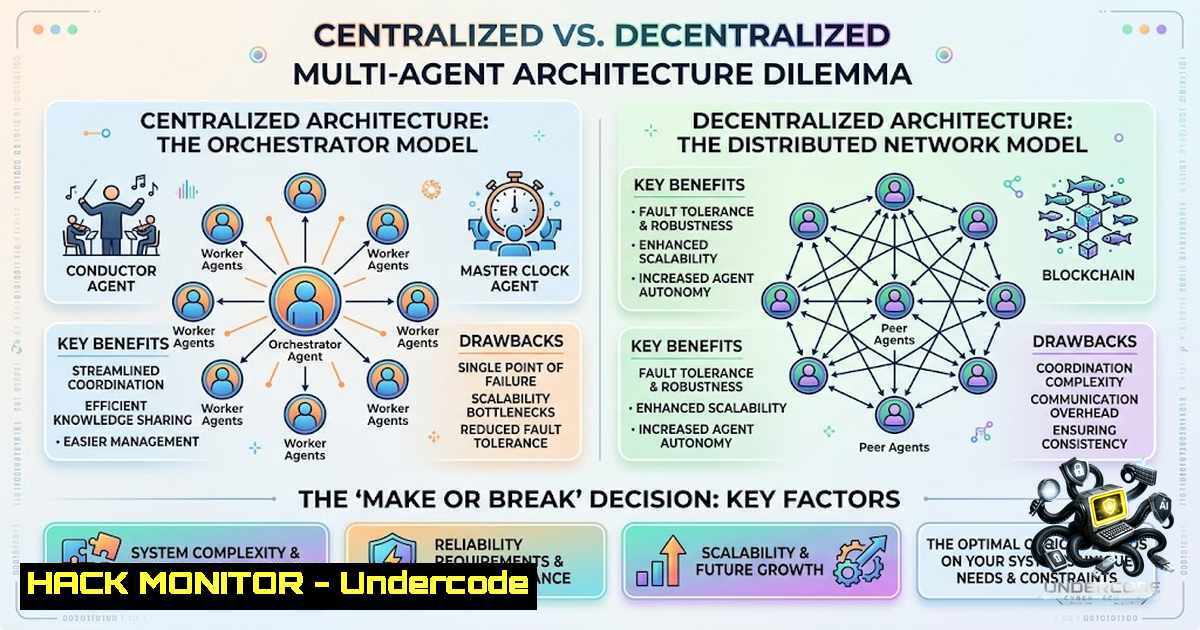
Introduction:
The rise of production-grade Large Language Model (LLM) applications has pushed system design beyond monolithic APIs into the complex world of multi-agent collaboration. As AI engineers build autonomous systems capable of complex reasoning—such as automated code review, legal document analysis, or financial fraud detection—the architectural choice between a centralized “god” orchestrator and a decentralized “swarm” of agents emerges as the most critical non-functional decision. This choice defines not only system throughput but also your ability to debug, recover from failures, and guarantee correctness in high-stakes environments.
Learning Objectives:
- Understand the trade-offs between centralized orchestration and decentralized coordination in multi-agent LLM systems.
- Learn how to implement a centralized coordinator using Python, FastAPI, and asynchronous task queues.
- Explore failure recovery patterns and debugging strategies for complex agent workflows.
- Identify when to pivot to a decentralized architecture based on scalability and fault tolerance requirements.
- The Orchestrator Pattern: Building Your Centralized “Air Traffic Control”
In a centralized architecture, a single Coordinator Agent acts as the “brain” that maintains a global state, dispatches tasks to specialized worker agents, collects their outputs, and determines the next step in the workflow. This pattern is akin to a conductor leading an orchestra—every musician plays only when the conductor signals them.
Step‑by‑step guide to building a centralized code review system:
To implement this, we can leverage a message broker (like Redis) and a task queue (like Celery) to manage execution flows.
 coordinator.py (Python)
from celery import Celery
import json
from typing import Dict, List

app = Celery('coordinator', broker='redis://localhost:6379/0')

class CentralizedCoordinator:
def <strong>init</strong>(self):
self.state = {
"review_id": None,
"files": [],
"current_step": "init",
"agent_responses": {}
}

def start_review(self, pr_data: Dict):
self.state["review_id"] = pr_data["id"]
self.state["files"] = pr_data["changed_files"]
 Dispatch to syntax agent
self.dispatch_agent.delay("syntax", pr_data["changed_files"])
return self.state

@app.task(bind=True)
def dispatch_agent(self, agent_type: str, payload: List[bash]):
 Logic to route to specific agent
if agent_type == "syntax":
 Call to SyntaxCheckerAgent
result = SyntaxCheckerAgent().analyze(payload)
elif agent_type == "security":
result = SecurityAgent().scan(payload)
 Callback to update state
self.collect_result(result)

def collect_result(self, result):
 Update state and decide next step
self.state["agent_responses"][result["agent"]] = result["findings"]
if len(self.state["agent_responses"]) == len(self.state["files"]):
self.compile_report()
Linux/Windows Commands for Environment Setup:
To run this locally, you need Redis. On Linux/WSL:
sudo apt-get update && sudo apt-get install redis-server
sudo systemctl start redis
pip install celery redis fastapi uvicorn
On Windows (via PowerShell with Chocolatey):
choco install redis-64
redis-server --service-install
net start Redis
Tutorial: Debugging Agent Failures
To replay a failure, you must log every state transition. Use structured logging (JSON) with request IDs. If the coordinator crashes, you can restart the process by rehydrating the state from the last known checkpoint stored in Redis or a database.
2. The Decentralized Swarm: Embracing Chaotic Resilience
Decentralized architectures rely on peer-to-peer communication. Agents broadcast events (e.g., “I found a security flaw”) and react to events from others. This is often implemented using pub/sub patterns or message buses like Kafka. While this removes the single point of failure, it introduces the “emergent behavior” problem—the system can do things you didn’t explicitly code for.
Step‑by‑step guide for a decentralized event bus setup:
Instead of a coordinator, each agent subscribes to a specific event type. For example, a “CodeQualityAgent” subscribes to `file_uploaded` events.
 event_bus.py
import pika
import json

class EventBus:
def <strong>init</strong>(self, host='localhost'):
self.connection = pika.BlockingConnection(pika.ConnectionParameters(host))
self.channel = self.connection.channel()
self.channel.exchange_declare(exchange='agent_bus', exchange_type='topic')

def publish(self, routing_key: str, message: dict):
self.channel.basic_publish(
exchange='agent_bus',
routing_key=routing_key,
body=json.dumps(message)
)

Agent Example
class SecurityAgent:
def <strong>init</strong>(self):
self.setup_listener()

def setup_listener(self):
self.channel.queue_bind(exchange='agent_bus', queue='security_queue', routing_key='file.')
self.channel.basic_consume(queue='security_queue', on_message_callback=self.on_event)

def on_event(self, ch, method, properties, body):
data = json.loads(body)
 Perform security scan
if method.routing_key == "file.uploaded":
self.scan(data["content"])
 If a critical vulnerability is found, publish a new event
self.publish("security.alert", {"file": data["name"], "severity": "critical"})
Key Takeaway on Handling Schema Changes:
If your agents communicate directly, you must version your schemas (e.g., message_v1, message_v2) to avoid crashes. Consider using Protocol Buffers or Avro for strict schema validation.
3. The “Bottleneck” Reality: Scaling the Centralized Coordinator
The most cited drawback of centralization is performance scaling. In a typical LLM application, agents may take 5–20 seconds to process a prompt. If the coordinator waits synchronously for each response, it creates a massive tail latency.
Tutorial: Asynchronous orchestration with asyncio
Instead of synchronous calls, use `asyncio.gather` to dispatch to multiple agents concurrently.
import asyncio
import aiohttp

class AsyncCoordinator:
async def dispatch_parallel(self, agents_prompts: list):
async with aiohttp.ClientSession() as session:
tasks = []
for agent_data in agents_prompts:
task = self.call_agent(session, agent_data)
tasks.append(task)
results = await asyncio.gather(tasks, return_exceptions=True)
 Handle failures gracefully
return results
Windows/Linux Command for Monitoring Bottlenecks:
Use `httpx` or `ngrok` to monitor API latency. On Linux, you can use `htop` to see CPU/Memory usage of the coordinator process.
 Install htop
sudo apt install htop
htop
- Resilience Engineering: Handling the Single Point of Failure
If the centralized coordinator crashes, you lose the “full context.” To mitigate this, implement a “State Replay” mechanism. Save the current step and the payload to a persistent log (e.g., `journalctl` style). When the coordinator restarts, it reads the log and resumes processing.
Step‑by‑step guide to implementing checkpoints:
- Before dispatching: Write the state (step_id, payload, agent_name) to a SQLite database or a file.
- On restart: Check the database for any “pending” states. If a task was dispatched but no result is stored, re-dispatch.
- Idempotency: Ensure agents can handle duplicate requests without causing side effects (e.g., duplicate comments on a PR).
-- SQLite Schema for Checkpoints
CREATE TABLE orchestrator_state (
id TEXT PRIMARY KEY,
step_id INTEGER,
agent_name TEXT,
payload_json TEXT,
status TEXT DEFAULT 'PENDING'
);
Tutorial: Testing Failure Recovery
Kill the coordinator process using `CTRL+C` or `kill -9` during a long-running review. Verify that the system recovers without losing the review context.
- API Security and Cloud Hardening in Agentic Systems
When agents access external APIs (e.g., GitHub API for code reviews, or OpenAI for LLM inference), you must secure credentials. Use Azure Key Vault or AWS Secrets Manager to rotate tokens. For the centralized coordinator, ensure it uses least-privilege IAM roles.
API Security Checklist:
- Input Validation: Sanitize all agent outputs before feeding them back into the LLM to prevent prompt injection.
- Rate Limiting: Implement token buckets to prevent one agent from exhausting API quotas.
- Vulnerability Exploitation: Consider the “Tool Calling” attack where an agent is tricked into executing malicious code. Never execute shell commands directly from agent suggestions without human approval.
- Mitigation: Deploy a “Guardrail Agent” that scans prompts for PII and executable patterns before they reach the core LLM.
6. Windows vs Linux: Cross-Platform Deployment Considerations
While Linux is the primary host for containerized agents (Docker/Kubernetes), your local development environment might be Windows. Use Docker Desktop to ensure parity.
– Linux: Ideal for `gunicorn` + `uvicorn` deployment. Use `systemd` to restart the coordinator automatically.
– Windows: Use `py -m venv` for virtual environments. For task queues, consider using `memurai` (a Windows-1ative Redis clone) for development.
Command to run the coordinator on a Linux server:
gunicorn -w 4 -k uvicorn.workers.UvicornWorker coordinator:app --bind 0.0.0.0:8000
Command to manage Windows services:
New-Service -1ame "CoordinatorService" -BinaryPathName "C:\path\to\python.exe -m uvicorn coordinator:app --host 0.0.0.0 --port 8000"
What Undercode Say:
- Key Takeaway 1: “Correctness over throughput” is a valid business rationale for choosing centralized orchestration. If your application handles code reviews or legal compliance, the ability to trace a decision path is more valuable than shaving off a few milliseconds of latency.
- Key Takeaway 2: The architecture decision is a bet on which failure mode you “can tolerate.” Centralized systems fail spectacularly but predictably; decentralized systems fail subtly but gracefully (partial failures).
Analysis:
The post highlights a fundamental truth in system design: there is no silver bullet. For AI engineers building multi-agent systems, the coordinator is often a “post‑hoc” addition after seeing the chaos of agent-to-agent communication. However, the trade-off is that the coordinator becomes a dependency magnet—every new feature requires modifying the coordinator logic. Decentralization offers agility but requires a deep investment in observability (distributed tracing) and contract testing. The “cost” of each option is defined by the team’s operational maturity. A junior team will struggle with debugging emergent behavior, while a senior team might struggle with scaling a monolithic coordinator. Ultimately, I would recommend starting centralized for MVPs and planning a migration to decentralization only when the system hits 10+ agents and throughput demands force the shift.
Prediction:
- +1 The rise of purpose-built orchestrators (e.g., LangGraph, AutoGen) will abstract away this decision, offering hybrid models where you can swap orchestration strategies via configuration flags.
- +1 Observability tools (OpenTelemetry for traces) will become mandatory for decentralized systems, transforming “emergent behavior” from a bug into a feature by visualizing the causality graph.
- -1 We will see a wave of security breaches where decentralized agents, lacking a central authority, execute actions based on hallucinated events from compromised peers, necessitating stricter identity verification in agent-to-agent communication.
▶️ Related Video (78% Match):
🎯Let’s Practice For Free:
🎓 Live Courses & Certifications:
Join Undercode Academy for Verified Certifications
🚀 Request a Custom Project:
Secure, high-velocity infrastructure and disruptive technological engineering. Contact our engineering team for high-tier development and proprietary systems:
[email protected]
💎 Smart Architecture | 🛡️ Secure by Design | ⭐ Trusted by Thousands
IT/Security Reporter URL:
Reported By: Prisha Singla – Hackers Feeds
Extra Hub: Undercode MoN
Basic Verification: Pass ✅


