Listen to this Post
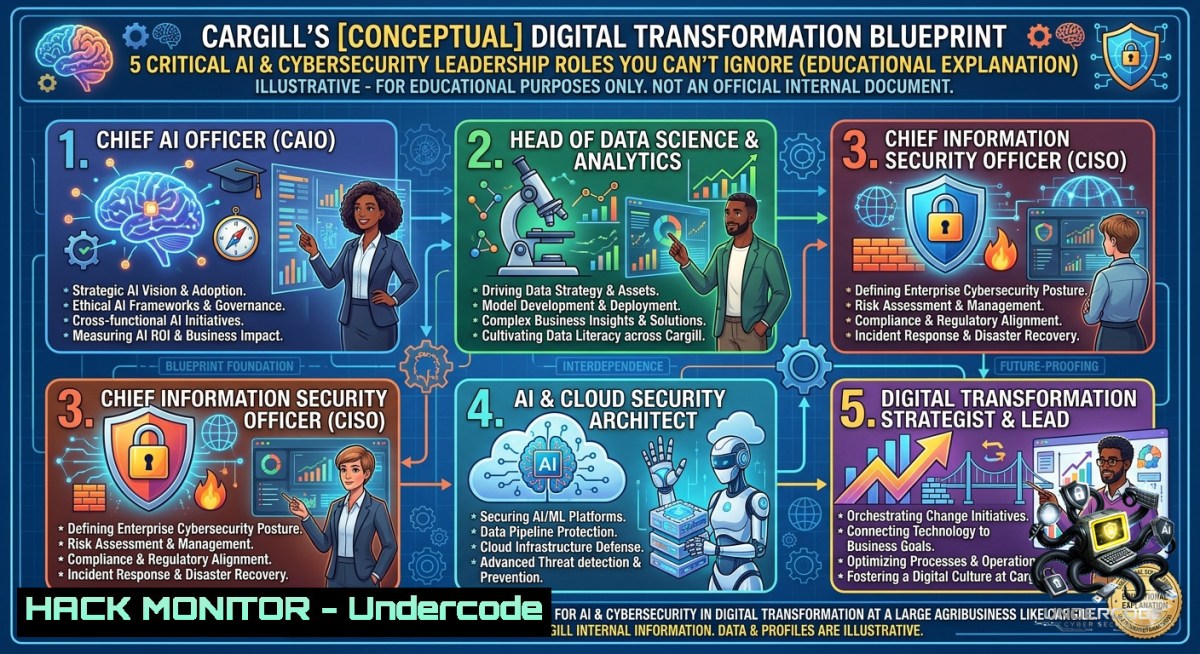
Introduction:
Digital transformation in the agribusiness sector is no longer just about cloud migration or ERP upgrades—it’s a high-stakes fusion of AI-driven decision making, supply chain cyber resilience, and cultural change management. As Cargill expands its Digital Technology & Data (DT&D) leadership team across APAC, the underlying technical demands reveal a blueprint for securing and scaling industrial AI, hardening ERP ecosystems, and embedding measurable value into every digital investment.
Learning Objectives:
- Execute end-to-end digital transformation roadmaps that integrate AI, data analytics, and cybersecurity controls.
- Apply Linux and Windows command-line techniques to secure supply chain logs, ERP interfaces, and manufacturing IoT.
- Design cloud hardening and anomaly detection strategies aligned with multi-regional regulatory and business constraints.
You Should Know:
- Securing the Digital Supply Chain: Command-Line Hardening for Logistics Systems
What this does:
Real-time monitoring of supply chain data flows helps detect unauthorized access or anomalous file transfers between ERP, warehouse management, and partner EDI gateways. The following commands audit system integrity and network connections on both Linux-based logistics controllers and Windows-based ERP clients.
Step-by-step guide:
On Linux (logistics gateway):
 Audit active network connections and listening ports
sudo ss -tulnp | grep -E ':(22|443|8080|1433)'

Monitor real-time logins and authentication failures
sudo journalctl -f -u sshd -u systemd-logind

Check integrity of critical configuration files (e.g., /etc/hosts, /etc/fstab)
sudo aide --check || echo "Integrity violation detected"

Track file changes in shared supply chain directories
inotifywait -m -r -e modify,create,delete /data/supply_chain/ --format '%T %w%f %e' --timefmt '%Y-%m-%d %H:%M:%S'
On Windows (ERP client):
 List all inbound firewall rules allowing file sharing (SMB)
Get-1etFirewallRule | Where-Object {$<em>.Direction -eq 'Inbound' -and $</em>.DisplayName -like 'File and Printer Sharing'}

Show recent security event log entries for account logon (Event ID 4624, 4625)
Get-WinEvent -FilterHashtable @{LogName='Security'; ID=4624,4625; StartTime=(Get-Date).AddDays(-1)} | Format-Table TimeCreated, Id, Message -AutoSize

Monitor changes in a critical ERP export folder
$watcher = New-Object System.IO.FileSystemWatcher
$watcher.Path = "D:\ERP_Exports"
$watcher.IncludeSubdirectories = $true
$watcher.EnableRaisingEvents = $true
Register-ObjectEvent $watcher "Changed" -Action { Write-Host "File changed: $($Event.SourceEventArgs.FullPath)" }
Use case:
Run these commands weekly to baseline normal activity. Unexpected connections on port 1433 (SQL Server) or rapid file modifications in export folders may indicate data exfiltration or ransomware staging.
- AI-Driven ERP Security: Implementing Anomaly Detection in SAP
What this does:
Machine learning models can detect fraudulent purchase orders or unusual payment patterns inside ERP systems like SAP. The following Python script uses isolation forests to flag anomalies in transaction logs exported from SAP tables (e.g., BSEG, BKPF).
Step-by-step guide:
- Export a CSV of ERP transactions with fields:
timestamp,user,transaction_code,amount,vendor_id. - Run the anomaly detection script on a secure, air-gapped Linux machine.
import pandas as pd
from sklearn.ensemble import IsolationForest

Load SAP transaction log
df = pd.read_csv('sap_transactions.csv')
df['amount_log'] = np.log1p(df['amount'])
features = ['amount_log', df['timestamp'].astype(int) // 109]  simple time numeric

model = IsolationForest(contamination=0.05, random_state=42)
df['anomaly'] = model.fit_predict(features)

Output suspicious transactions
sap_alerts = df[df['anomaly'] == -1]
sap_alerts.to_csv('sap_anomalies.csv', index=False)
print(f"Found {len(sap_alerts)} anomalous ERP entries")
- Schedule this script as a cron job: `0 2 /usr/bin/python3 /opt/erp_anomaly/sap_detect.py`
4. Integrate results into a SIEM (e.g., Splunk) for dashboarding.
Security Note:
Never run AI models directly on production ERP databases. Use read-only replicas or log exports with strict access controls.
3. Cloud Hardening for Multi-Regional Digital Transformation
What this does:
Cargill’s APAC roles require cloud expertise across Azure and AWS. The following CLI commands enforce least-privilege access and network segmentation for multi-region deployments.
Step-by-step guide:
Azure CLI (Linux/macOS):
 List all storage accounts with public blob access
az storage account list --query "[?allowBlobPublicAccess == true]" --output table

Apply a deny-all network rule except from trusted VNet
az storage account update --1ame cargillapacdata --resource-group dtnd --default-action Deny

Enable advanced threat protection for all SQL databases
az sql server threat-detection-policy update --1ame cargill-sql-server --resource-group dtnd --state Enabled
AWS CLI:
 Find S3 buckets with public ACLs
aws s3api list-buckets --query "Buckets[?PublicAccessBlockConfiguration==`null`]" --output table

Attach a bucket policy to enforce MFA delete
aws s3api put-bucket-versioning --bucket cargill-supply-data --versioning-configuration Status=Enabled,MFADelete=Enabled

Audit IAM roles with administrator privileges
aws iam list-roles --query "Roles[?contains(AssumeRolePolicyDocument, 'AdministratorAccess')]"
Operationalization:
Run these scans daily via GitHub Actions or Azure DevOps pipelines to auto-remediate misconfigurations before they reach production.
- Data Analytics Pipeline Security: Linux Bash Commands for Log Analysis
What this does:
Investigating data breaches or pipeline failures requires rapid log forensics. These bash commands parse Apache Spark, Airflow, and Kafka logs to pinpoint unauthorized data access.
Step-by-step guide:
 Extract all IPs that accessed sensitive data (e.g., PII keywords)
zgrep -E '"ssn"|"credit_card"|"passport"' /var/log/data_pipeline/.gz | awk '{print $1}' | sort | uniq -c | sort -1r

Show failed authentication attempts to JupyterHub
journalctl -u jupyterhub --since "2 hours ago" | grep "401" | cut -d' ' -f1-3,9-12

Monitor real-time data extraction requests to the data lake
tail -f /var/log/airflow/scheduler.log | grep --line-buffered "Download.parquet"
Advanced use:
Combine with `inotifywait` to trigger alerts when large data exports occur outside business hours (e.g., after 10 PM).
- Organizational Change Management for Cyber Resilience: Training Modules
What this does:
Digital transformation fails without user adoption. The following PowerShell script automates the deployment of a cybersecurity awareness training module across Windows endpoints, tracking completion rates.
Step-by-step guide (Windows + SharePoint):
 Check if mandatory security training video has been watched
$trainingLog = Get-Content "C:\ProgramData\SecurityTraining\training_completed.log" -ErrorAction SilentlyContinue
if ($trainingLog -1otmatch "2026-06-01") {
 Launch the training URL (e.g., Cargill internal LMS)
Start-Process "https://cargilllearning.com/cyber-supply-chain"
Write-EventLog -LogName Application -Source "SecurityTraining" -EventId 1001 -Message "User prompted for training"
}

Generate weekly compliance report for leadership
Get-ADUser -Filter  -Properties Department | ForEach-Object {
$user = $<em>.SamAccountName
$completed = Test-Path "\fileserver\training_logs\$user\completed.txt"
[bash]@{User=$user; Department=$</em>.Department; TrainingComplete=$completed}
} | Export-Csv -Path "training_report_$(Get-Date -Format yyyyMMdd).csv" -1oTypeInformation
Integration:
Deploy via Group Policy as a logon script. Encourage leaders to review the CSV report during weekly standups.
- Measuring Business Value from Digital Investments: KPI Frameworks
What this does:
Leadership roles demand quantifiable ROI from digital initiatives. The following SQL query (PostgreSQL) calculates the “digital adoption score” across ERP modules and supply chain apps.
Step-by-step guide:
-- Create a view that measures active users per business function
CREATE VIEW digital_adoption_kpi AS
SELECT
DATE_TRUNC('month', login_time) AS month,
business_unit,
COUNT(DISTINCT user_id) AS monthly_active_users,
ROUND(AVG(session_duration_minutes),2) AS avg_session_time,
SUM(number_of_transactions) / COUNT(DISTINCT user_id) AS transactions_per_user
FROM user_activity_log
JOIN user_master USING (user_id)
WHERE login_time >= '2025-01-01'
GROUP BY month, business_unit;

-- Compare pre- and post-digital transformation periods
SELECT
business_unit,
CASE WHEN month < '2025-07-01' THEN 'Pre-DX' ELSE 'Post-DX' END AS phase,
AVG(monthly_active_users) AS avg_MAU,
AVG(transactions_per_user) AS avg_TPU
FROM digital_adoption_kpi
GROUP BY business_unit, phase;
Output interpretation:
A 30% increase in transactions per user post-DX indicates successful adoption, while stagnant MAU suggests retraining or UX issues.
What Undercode Say:
- Key Takeaway 1: Digital transformation without embedded security is a liability. Every leadership role at Cargill demands “security by design” across supply chain and ERP—mirroring the shift to DevSecOps.
- Key Takeaway 2: Hands-on technical fluency (Linux CLI, Python, cloud hardening) is now non-1egotiable for transformation directors. Strategy without command-line literacy fails to earn engineering trust.
Analysis: The job postings emphasize “end-to-end” ownership, meaning leaders must bridge boardroom KPIs and kernel-level logs. Cargill’s agribusiness scale makes it a prime target for ransomware and supply chain attacks—hence the need for anomaly detection in SAP and real-time log forensics. The inclusion of AI and data analytics as core requirements signals that future DT&D leaders will be measured on both innovation velocity and security posture. Training and change management sections reflect the human factor, often the weakest link. Overall, Cargill is building a hybrid leadership archetype: part CISO, part data scientist, part change evangelist. Organizations that clone this model will dominate digital transformation in regulated industries.
Prediction:
+1 Agribusiness digital transformation will standardize zero-trust architecture (ZTA) by 2026, driven by Cargill-like leadership roles that embed security into every KPI.
+N Legacy ERP migrations (e.g., ECC to S/4HANA) will expose temporary attack surfaces, increasing breach attempts by 40% during cutover phases.
+1 AI-based anomaly detection will become a mandatory competency for digital directors, reducing internal fraud detection time from weeks to minutes.
-1 Over-reliance on automated log analysis without human oversight will create false-positive fatigue, causing critical alerts to be ignored in high-volume supply chains.
+1 Cloud hardening commands (Azure/AWS CLI) will evolve into standardized IaC modules, slashing misconfiguration incidents by 65% by 2027.
▶️ Related Video (78% Match):
🎯Let’s Practice For Free:
🎓 Live Courses & Certifications:
Join Undercode Academy for Verified Certifications
🚀 Request a Custom Project:
Secure, high-velocity infrastructure and disruptive technological engineering. Contact our engineering team for high-tier development and proprietary systems:
[email protected]
💎 Smart Architecture | 🛡️ Secure by Design | ⭐ Trusted by Thousands
IT/Security Reporter URL:
Reported By: Gopi Myneni – Hackers Feeds
Extra Hub: Undercode MoN
Basic Verification: Pass ✅


