
Listen to this Post
Introduction:
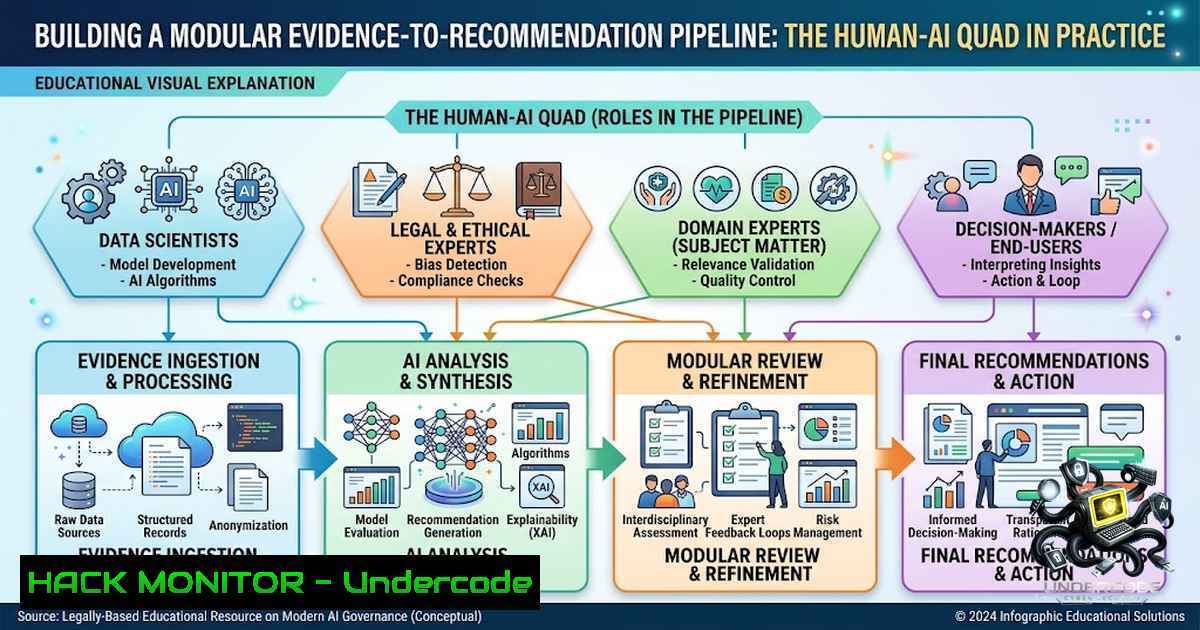
The integration of Large Language Models (LLMs) into operational workflows often suffers from a “black box” problem, where decisions are made without clear traceability to source data. Scott Rausch’s proposal for a modular evidence-to-recommendation pipeline addresses this by moving beyond simple prompt engineering to a structured, graph-based architecture that grounds AI reasoning in formal ontologies and retrievable evidence. This article deconstructs that blueprint, providing a technical implementation guide for building a human-AI collaborative system that ensures every recommendation is auditable and linked to specific job data, task constraints, and external benchmarks.
Learning Objectives & Secrets:
- Objective 1: Implement a Multi-Layer Ingestion and Extraction Architecture – Learn to build a document ingestion layer that parses job descriptions, task lists, and artifacts to extract structured entities like roles, decisions, constraints, and dependencies using NLP and LLM-based extraction.
- Secret Objective 2: Integrate a Formal Work Ontology with Graph Databases – Discover how to map extracted entities to a controlled work ontology (e.g., Human/AI relationship categories) and store them in Neo4j with provenance, enabling complex dependency and capability-fit analysis using graph queries.
- Secret Objective 3: Establish End-to-End Traceability and Confidence Scoring – Master the implementation of a GraphRAG/LlamaIndex layer that synthesizes internal graph data with external research and uses Python-based Bayesian logic to calculate confidence scores, ensuring every recommendation is backed by evidence.
You Should Know:
1. Document Ingestion and Entity Extraction Layer
This first layer transforms unstructured job artifacts (PDFs, text files, wikis) into structured data that the pipeline can consume. The goal is to extract specific entities: job titles, tasks, roles, decision points, input/output artifacts, constraints (time, resources), and task dependencies. This is achieved using a combination of spaCy for initial Named Entity Recognition (NER) and a more powerful LLM (OpenAI or Anthropic) via LangGraph for disambiguation and complex relationship extraction.
- Step 1: Set up a Python environment with
spacy,langgraph,openai, and `pypdf` for parsing. Load your documents. - Step 2: Define a LangGraph state that holds document chunks. Create a node for preprocessing (text cleaning and chunking).
- Step 3: Create an extraction node that prompts an LLM with a schema (JSON structure) to extract the defined entities. Use function calling for structured outputs.
- Step 4: Implement a validation node that uses `pydantic` to ensure the extracted data conforms to your schema before committing it to the next layer.
- Command (Linux/macOS): `pip install spacy langgraph openai pypdf pydantic python-dotenv`
– Command (Windows): `py -m pip install spacy langgraph openai pypdf pydantic python-dotenv`
– Tutorial Snippet: Use LangGraph’s `StateGraph` to chain these nodes. This ensures each document is processed systematically, with the ability to interrupt or debug specific extraction steps.
2. Formal Work Ontology and Knowledge Graph Construction
Storing extracted entities in a flat database loses their inherent relationships. This stage leverages a formal work ontology (like a customized version of the MIT Process Handbook) to define relationships between tasks, roles, and decisions. This ontology is then instantiated as a knowledge graph in Neo4j, where nodes represent entities (e.g., Job, Task, Decision, InputArtifact) and edges represent relationships (e.g., REQUIRES, PRECEDES, PERFORMED_BY). Crucially, every node and edge is tagged with provenance (source document, timestamp) and a confidence score from the extraction step.
- Step 1: Design your ontology. Define node labels and relationship types. For example, `(Task)-[:REQUIRES]->(Artifact)` and
(Task)-[:PERFORMED_BY]->(Role). - Step 2: Install Neo4j (Desktop or Docker) and set up the database. Use the Bolt protocol for connection.
- Step 3: Write a Python script using the `neo4j` driver to parse the structured JSON output from the extraction layer and generate Cypher queries to create the graph.
- Step 4: Implement a deduplication and merging logic to avoid creating duplicate nodes for the same entity across different documents.
- Command (Linux/macOS): `pip install neo4j`
– Command (Windows): `py -m pip install neo4j`
– Tutorial Snippet: When creating nodes, attach a `provenance` property as a dictionary{source_file: "file1.pdf", extracted_at: timestamp}. For relationships, add a `confidence` property. This allows for future audits and recalculations.
3. Hybrid Storage with PostgreSQL, Supabase, and pgvector
While Neo4j excels at relationship traversal, it is less efficient for storing large text blobs and performing semantic searches. This module uses PostgreSQL (or Supabase for managed cloud) with the `pgvector` extension. This setup stores the source document raw text, embeddings generated from the text (using models like text-embedding-ada-002), assessment records, and versioned outputs of the extraction process. The embedding allows for semantic search across documents, enabling retrieval-augmented generation (RAG).
- Step 1: Create a PostgreSQL database and enable the `pgvector` extension. `CREATE EXTENSION IF NOT EXISTS vector;`
– Step 2: Design a table `documents` with columnsid, `content` (TEXT), `embedding` (VECTOR(1536)), and `metadata` (JSONB). Also, create tables for `assessments` andoutputs. - Step 3: Write a Python function to generate an embedding for each document chunk and insert it into the database using the `psycopg2` driver.
- Step 4: Implement a retrieval function that converts a user query into an embedding and performs a cosine similarity search using the `<->` operator in SQL.
- Command (Linux/macOS): `CREATE EXTENSION vector;`
– Command (Windows): Same SQL command within your PostgreSQL client. - Tutorial Snippet: To query for similar documents:
SELECT content, 1 - (embedding <=> query_embedding) AS similarity FROM documents ORDER BY similarity DESC LIMIT 5;. This is crucial for GraphRAG and evidence grounding.
4. External Research Layer with Search APIs
To provide current and evidence-based recommendations, the pipeline must fetch external data. This module integrates with APIs like Exa, Tavily, or Perplexity to query for current AI/ML capabilities, benchmark scores (MLPerf, SQuAD), and best practices. This ensures recommendations are not solely based on internal data or a frozen LLM knowledge base.
- Step 1: Obtain API keys for your chosen service (e.g., Tavily API key).
- Step 2: Write a Python service that takes a query (e.g., “best LLM for SQL generation 2026”) and calls the API.
- Step 3: Parse the API response to extract relevant snippets, URLs, and dates. Store this result as a new node in Neo4j (e.g.,
ExternalEvidence) connected to the relevant `Task` or `Decision` node. - Step 4: Implement a caching mechanism to prevent redundant API calls for the same query.
- Command (Linux/macOS): `pip install tavily-python`
– Command (Windows): `py -m pip install tavily-python`
– Tutorial Snippet: Tavily search: `client = TavilyClient(api_key=”YOUR_KEY”)` thenresponse = client.search(query="AI benchmarks 2026", search_depth="advanced"). Integrate the `results` into your knowledge graph.
5. Graph Analytics and Scoring with Bayesian Logic
This is the “secret sauce” that prevents the LLM from being the final judge. Instead, graph analytics (using Neo4j’s Graph Data Science library) and a Bayesian scoring model perform objective analysis. The system calculates dependency depth, coupling strength between tasks, capability-fit for AI based on external benchmarks, and uncertainty scores based on the provenance and consistency of the evidence. This approach yields a score that is mathematically and logically derived, not just a subjective LLM assessment.
- Step 1: Write Cypher queries to traverse the graph and calculate metrics. For example,
MATCH path = shortestPath((t:Task)-[:REQUIRES|PRECEDES]->(o:Task)) RETURN path. This gives dependency chain length. - Step 2: Export relevant graph data as a table (using Python’s `networkx` or
pandas). - Step 3: Implement a Bayesian network in Python using
pgmpy. Define nodes asTask_Complexity,Capability_Score,Uncertainty. Use the evidence from the graph and external benchmarks to set conditional probability distributions. - Step 4: Run inference to calculate the posterior probability of a successful AI-Human collaboration for a given task.
- Command (Linux/macOS): `pip install networkx pgmpy`
– Command (Windows): `py -m pip install networkx pgmpy`
– Tutorial Snippet:model = BayesianModel([('Complexity', 'Success'), ('Capability', 'Success'), ('Evidence_Quality', 'Uncertainty')]). Update the model with data from your Neo4j analytics.
6. GraphRAG and Synthesis via LlamaIndex
This layer bridges the structured knowledge graph and the unstructured external/internal documents. Using LlamaIndex’s KnowledgeGraphIndex, the system retrieves relevant subgraphs from Neo4j and uses them as context for an LLM to generate a synthesis. This is more powerful than simple vector RAG because it leverages the relationships (e.g., prerequisites, dependencies) to provide a deeper, more connected understanding for the final recommendation.
- Step 1: Install LlamaIndex and its Neo4j and OpenAI integrations.
pip install llama-index llama-index-graph-stores-1eo4j llama-index-llms-openai. - Step 2: Configure the `Neo4jPropertyGraphStore` to connect to your existing Neo4j instance.
- Step 3: Build the `KnowledgeGraphIndex` from your extracted graph.
- Step 4: Create a query engine that uses the graph store to retrieve relevant nodes and relationships around a specific job or role, and feed this context to an LLM for synthesis.
- Command (Linux/macOS): `pip install llama-index llama-index-graph-stores-1eo4j llama-index-llms-openai`
– Command (Windows): `py -m pip install llama-index llama-index-graph-stores-1eo4j llama-index-llms-openai`
– Tutorial Snippet: `graph_store = Neo4jPropertyGraphStore(username=”neo4j”, password=”pass”, url=”bolt://localhost:7687″)` thenindex = KnowledgeGraphIndex.from_documents(documents, graph_store=graph_store). This creates a retriever that can fetch precise subgraphs.
7. Exposing Services and User Interface
The final component makes the analysis accessible. FastAPI is used to create RESTful endpoints for triggering assessments and fetching results. A modern React/Next.js frontend visualizes the decomposed job, the knowledge graph, evidence links, and the final Human/AI/Dyad recommendations. Each recommendation card must have a direct link back to the supporting evidence (document ID, graph path, or external URL) to ensure transparency.
- Step 1: Write FastAPI routes for endpoints like `/assess_job` and
/get_recommendations/{job_id}. - Step 2: Create a frontend component that uses the `react-force-graph` library to display the Neo4j graph interactively.
- Step 3: Implement a UI element (e.g., a timeline or accordion) that maps each recommendation step to its source evidence, using the provenance metadata stored in Neo4j and PostgreSQL.
- Step 4: Deploy the FastAPI app using `uvicorn` and serve the React build via a web server.
- Command (Linux/macOS): `uvicorn main:app –reload` and `npm run build`
– Command (Windows): `uvicorn main:app –reload` and `npm run build`
– Tutorial Snippet: In FastAPI, a response model could include `recommendation` andevidence_chain:[{step: "Find API key", evidence: [doc_id: 123, node_id: "neo4j-456"]}]. The frontend can then highlight the relevant graph nodes when a user clicks on a recommendation.
What Undercode Say:
- Key Takeaway 1: The power of this architecture lies in moving judgment from a single LLM call to a distributed system where deterministic graph algorithms and Bayesian inference handle the core logic, effectively mitigating hallucination and bias. The LLM becomes a translator and synthesizer, not the oracle.
- Key Takeaway 2: Traceability is the cornerstone of trust in AI systems. By building a pipeline where every piece of advice is linked to a specific document, graph node, or external source, the system becomes a decision-support tool that augments human expertise rather than one that attempts to replace it.
Analysis: Rausch’s plan directly addresses the critical enterprise challenge of “explainable AI.” The blueprint is not just theoretical; it leverages mature technologies (Neo4j, PostgreSQL, LangGraph) to create a robust, production-ready system. The deliberate use of a formal ontology and Python for analytical scoring is a vital step, ensuring the AI’s outputs are constrained by logic and data, not just pattern recognition. This approach is particularly relevant for security roles where understanding the provenance of a risk assessment is as important as the assessment itself. It creates a recursive, self-auditing loop that can adapt as new capabilities and data are ingested, promising a significant reduction in operational risk for AI-driven decisions.
Prediction:
- +1 This modular architecture will become the standard template for building responsible AI agents in regulated industries, as it inherently provides the compliance and audit trails required by frameworks like NIST and GDPR.
- -1 The complexity of integrating and maintaining this seven-layer architecture will be a significant barrier to adoption for smaller organizations, potentially widening the capability gap between large enterprises and SMBs.
- +1 The use of GraphRAG and formal ontologies will lead to a new class of “intelligent process mining” tools that can dynamically simulate and optimize workflows based on live data and AI capability benchmarks.
- -1 Without careful implementation, the provenance and confidence scoring mechanisms can be gamed, where malicious or biased data could be injected at the ingestion layer, poisoning the entire graph if strict validation is not enforced.
- +1 This approach will accelerate the evolution of Human-AI collaboration by clearly defining roles and tasks, moving from generic “AI assistant” interactions to specialized, verified “AI colleague” relationships with specific, measurable accountabilities.
▶️ Related Video (88% Match):
🎯Let’s Practice For Free:
🎓 Live Courses & Certifications:
Join Undercode Academy for Verified Certifications
🚀 Request a Custom Project:
Secure, high-velocity infrastructure and disruptive technological engineering. Contact our engineering team for high-tier development and proprietary systems:
[email protected]
💎 Smart Architecture | 🛡️ Secure by Design | ⭐ Trusted by Thousands
IT/Security Reporter URL:
Reported By: https://lnkd.in/p/dXX_hxjN – Hackers Feeds
Extra Hub: Undercode MoN
Basic Verification: Pass ✅


