Listen to this Post
Introduction:
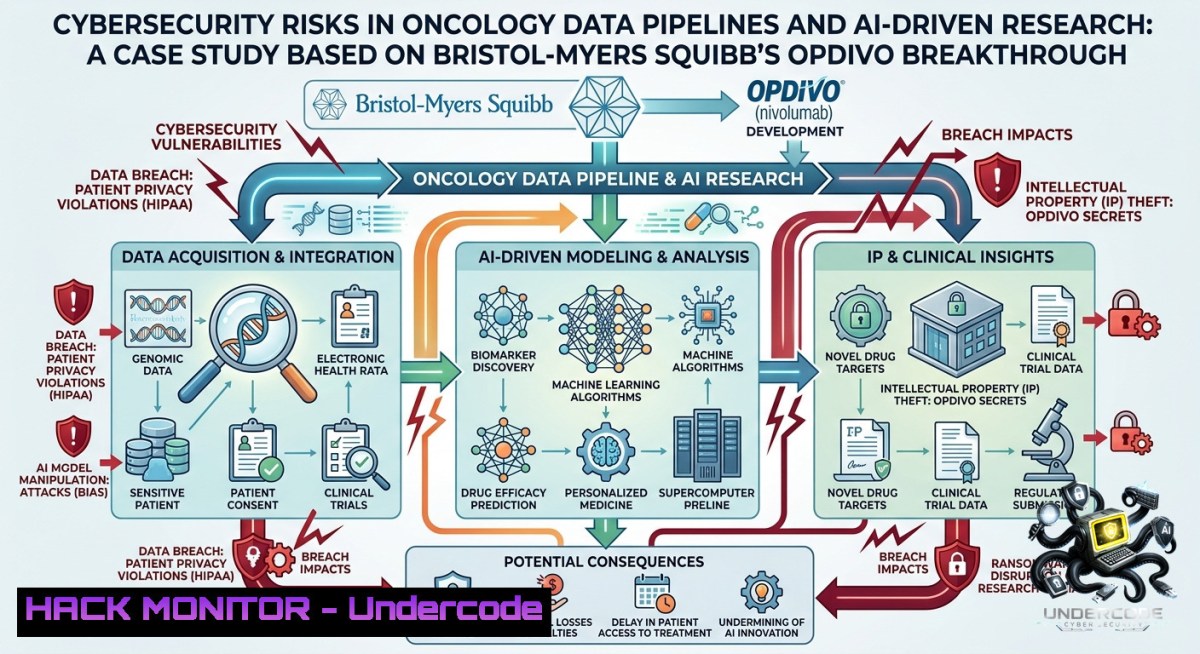
Bristol‑Myers Squibb’s announcement that Opdivo® (nivolumab) in combination with AVD has received an expanded EU label for frontline advanced classical Hodgkin lymphoma (cHL) represents a major clinical milestone. Behind this breakthrough lies a massive ecosystem of clinical‑trial data, genomic sequences, and real‑world evidence that must be collected, shared, and analysed across borders. This reliance on cross‑institutional data pipelines and AI‑powered analytics makes oncology research an increasingly attractive target for cyber‑adversaries, from ransomware gangs that can disrupt cancer treatment to state‑sponsored actors seeking to exfiltrate sensitive patient information.
Learning Objectives:
– Understand the specific cybersecurity threats that emerge when AI and machine learning are applied to sensitive oncology datasets (including genomics, imaging, and clinical‑trial records).
– Learn practical Linux, Windows, and cloud‑hardening commands to secure healthcare data pipelines, detect anomalies, and respond to incidents in research environments.
– Identify relevant cybersecurity training resources and compliance frameworks (HIPAA, OWASP, Zero Trust) for professionals working at the intersection of IT, AI, and life sciences.
You Should Know:
1. Why AI‑Driven Oncology Research Creates New Attack Surfaces
The move towards federated learning and privacy‑preserving machine learning in cancer research is accelerating. For example, TNO is developing multi‑party computation solutions that allow multiple healthcare organisations to analyse sensitive data without ever centralising it. Meanwhile, MITRE’s April 2026 reports warn that cloud‑connected medical devices face “cascading ransomware risk,” citing an incident where a cloud service disruption affected cancer treatment at more than 170 facilities.
Step‑by‑Step Guide to Securing AI Research Pipelines
Step 1: Assess the data flow. Map every touchpoint where patient data (e.g., imaging, genomics) is ingested, processed, or shared. Use network scanning to identify exposed ports and services.
 Linux - discover open ports and running services
sudo nmap -sV -p- localhost
sudo ss -tulpn

 Windows PowerShell - list listening ports and associated processes
Get-1etTCPConnection | Where-Object {$_.State -eq "Listen"} | Select-Object LocalPort, OwningProcess
Get-Process -Id (Get-1etTCPConnection -State Listen).OwningProcess | Select-Object ProcessName, Id
Step 2: Harden access controls to clinical‑trial platforms. Apply the principle of least privilege and enforce multi‑factor authentication for all research databases and API endpoints.
 Linux - verify file permissions on sensitive directories (e.g., containing trial data)
ls -la /path/to/research/data
 Windows - use icacls to review and tighten folder permissions
icacls "D:\ClinicalTrials\Opdivo_Data" /grant "ResearchGroup:(OI)(CI)RX" /remove "Everyone"
Step 3: Monitor for anomalous data exfiltration. Configure intrusion detection and log aggregation to spot unusually large or frequent data transfers.
 Linux - real‑time monitoring of network connections
sudo iftop -i eth0
 Log all outgoing connections for later analysis
sudo tcpdump -i eth0 -w exfil_capture.pcap

 Windows - monitor outbound connections with PowerShell
Get-1etTCPConnection -State Established | Group-Object RemoteAddress | Sort-Object Count -Descending
Step 4: Validate the security of external libraries and AI frameworks. Many research pipelines import Python or R packages that may contain backdoors or vulnerabilities. Run software composition analysis regularly.
 Linux - check installed Python packages for known vulnerabilities
pip list --outdated
safety check --json
 Windows - scan a Python environment
cd C:\ResearchEnv\Scripts; .\pip.exe list --outdated
2. Healthcare API Security: OAuth, SMART, and HIPAA Compliance
Modern oncology research increasingly relies on APIs to exchange data between electronic health records (EHRs), clinical‑trial management systems, and AI modelling platforms. The NHS England Digital guidance stresses that when software connects to NHS APIs handling sensitive patient data, organisations must “store the values in a secure vault, restrict access, audit who looks at the values, and never write unencrypted values to storage”. The OWASP Top 10 for 2025 still lists injection vulnerabilities as a major threat, with SQL injection and command injection remaining common exploit vectors.
Step‑by‑Step Guide to Securing a Healthcare API Endpoint
Step 1: Enforce OAuth 2.0 with SMART on FHIR scopes. Never use API keys alone; require short‑lived access tokens with fine‑grained permissions.
 Use curl to request a token from the authorisation server
curl -X POST https://auth.hospital.org/token \
-H "Content-Type: application/x-www-form-urlencoded" \
-d "grant_type=client_credentials&client_id=research_app&client_secret=&scope=patient/Oncology.read"
Step 2: Validate all input parameters to prevent injection attacks. In Python (a common language for AI research), use parameterised queries and input validation.
 Vulnerable (SQL injection risk)
query = f"SELECT  FROM trials WHERE trial_id = '{user_input}'"

 Safe (parameterised)
cursor.execute("SELECT  FROM trials WHERE trial_id = %s", (user_input,))
Step 3: Implement rate limiting and bot mitigation. Attackers may try to brute‑force API endpoints to exfiltrate bulk data. Use a reverse proxy or API gateway to enforce limits.
 Example nginx rate‑limiting configuration for an oncology data API
limit_req_zone $binary_remote_addr zone=oncology_api:10m rate=10r/m;
server {
location /api/v1/patientdata {
limit_req zone=oncology_api burst=5 nodelay;
proxy_pass http://research_backend;
}
}
Step 4: Ensure TLS 1.3 is enforced for all data in transit. Disable older, insecure protocols and cipher suites.
 Linux - test TLS configuration using openssl
openssl s_client -connect api.research.org:443 -tls1_3
 Windows PowerShell - check SSL/TLS settings
[Net.ServicePointManager]::SecurityProtocol
3. Cloud Hardening for Multi‑Institutional Genomic Data Sharing
The growing use of blockchain and homomorphic encryption in cancer research adds new layers of complexity. Studies have proposed convolutional neural networks that operate directly on homomorphically encrypted genomic data, eliminating the need to ever decrypt sensitive patient information. Similarly, private blockchain frameworks combined with federated learning are being tested for lung cancer prediction, ensuring data integrity and non‑repudiation across multiple sites.
Step‑by‑Step Guide to Hardening a Cloud‑Based Research Environment (AWS Example)
Step 1: Enforce encryption at rest and in transit. All research buckets and databases must use server‑side encryption with customer‑managed keys (CMKs).
 AWS CLI - create an encrypted S3 bucket for genomic data
aws s3api create-bucket --bucket onc-research-data --region eu-west-1
aws s3api put-bucket-encryption --bucket onc-research-data \
--server-side-encryption-configuration '{
"Rules": [
{"ApplyServerSideEncryptionByDefault": {"SSEAlgorithm": "AES256"}}
]
}'
Step 2: Deploy a Zero Trust architecture. Assume that the network is already compromised. Use micro‑segmentation and continuous verification.
 Terraform snippet: define a network policy that denies all east‑west traffic unless explicitly allowed
resource "kubernetes_network_policy" "deny_all_egress" {
metadata { name = "default-deny-egress" }
spec {
pod_selector {}
policy_types = ["Egress"]
egress { {} }
}
}
Step 3: Set up automated vulnerability scanning of container images. Many research platforms run Jupyter notebooks or R‑studio inside containers; these images must be scanned before deployment.
 Using Trivy to scan a Docker image for known CVEs
trivy image python:3.9-slim
 Windows PowerShell (using Docker Desktop)
docker run --rm aquasec/trivy image python:3.9-slim
Step 4: Implement strict logging and alerting for any access to clinical‑trial data. Use cloud‑native services to trigger alerts when unusual patterns are detected (e.g., a user downloading 10,000 records at 3 AM).
 AWS CloudWatch alarm that triggers on high data‑transfer volume
aws cloudwatch put-metric-alarm --alarm-1ame "HighDataEgress" \
--metric-1ame "BytesTransferred" --1amespace "AWS/S3" \
--statistic Sum --period 300 --threshold 1000000000 \
--comparison-operator GreaterThanThreshold
4. Incident Response for Healthcare and Research Environments
The 2026 MITRE analysis warns that “shared‑responsibility gaps between device makers, health systems, and cloud providers leave patient care exposed”. Therefore, every organisation involved in cancer research must have a tested incident response plan that addresses both data breaches and ransomware that could cripple clinical operations.
Step‑by‑Step Guide to Initial Triage and Evidence Collection
Step 1: Isolate affected systems without destroying volatile evidence. On Linux, capture memory and running processes before disconnecting the network.
 Linux DFIR - collect memory image (requires LiME or fmem)
sudo insmod ./lime.ko "path=/tmp/memory.dump format=lime"
 Capture network connections and processes
sudo netstat -tunap > net_connections.txt
ps auxf > process_tree.txt
 Windows PowerShell - capture running processes and network state
Get-Process | Export-Csv -Path processes.csv
Get-1etTCPConnection | Export-Csv -Path connections.csv
Step 2: Collect logs from critical sources. Ensure that authentication logs, API access logs, and cloud audit trails are preserved.
 Linux - preserve systemd journal and auth logs
sudo journalctl --since "2 hours ago" > syslog_export.txt
sudo cp /var/log/auth.log /evidence/
 Windows - export Security Event Log (especially Event ID 4624 for logons)
wevtutil epl Security C:\evidence\SecurityLog.evtx
Step 3: Search for indicators of compromise (IOCs) related to research data. Look for suspicious processes, unexpected scheduled tasks, or large outbound transfers.
 Linux - find recently modified files in research directories
find /home/researcher/data -type f -mmin -30 -ls
 Windows - use PowerShell to hunt for suspicious scheduled tasks
Get-ScheduledTask | Where-Object {$_.State -1e "Disabled"} | ForEach-Object {
$action = $_.Actions[bash].Execute
if ($action -match "powershell|cmd|wscript") { $_ }
}
Step 4: Communicate with internal and external stakeholders without exposing patient data. Have a pre‑approved communication template that acknowledges the incident without disclosing protected health information (PHI).
5. Training and Certification Pathways for Cybersecurity in Life Sciences
The convergence of IT, AI, and healthcare requires specialised training. The NHS offers a “907 Cyber security 2026” mandatory module for all staff, as well as a Level 4 Cyber Security Technologist Apprenticeship starting in September 2026. For deeper technical skills, the “Cybersecurity in Healthcare (Hospitals & Care Centres)” MOOC covers social engineering, data breaches, and technology risks. Professionals seeking formal credentials can pursue graduate certificates in Health Information and Cybersecurity, which cover legal, ethical, and operational concerns alongside threat response.
Recommended Hands‑On Labs and Tooling
– Vulnerability scanning and remediation: Use Tenable on a Linux VM to perform authenticated scans, inject manual vulnerabilities, and progressively harden the system across five phases.
– Brute‑force attack simulation: Set up a Kali Linux lab with Medusa to simulate password spraying against FTP, web (DVWA), and SMB services, then implement mitigation strategies.
– API security testing: Reproduce a CORS misconfiguration exploit on a PortSwigger lab to exfiltrate an administrator API key, then apply proper origin validation.
– Windows threat hunting: Deploy PowerScan to run PowerShell script blocks across a network range or Active Directory domain for reconnaissance, post‑exploitation detection, and hunting.
What Undercode Say:
– The drug approval is only half the story: Opdivo’s expanded label is a clinical victory, but the real‑world value depends on secure, uninterrupted access to the data that proved its efficacy. Any compromise of the underlying clinical‑trial or genomic databases can delay treatment, erode patient trust, and violate regulations such as HIPAA and GDPR.
– AI without governance is a liability: While federated learning and homomorphic encryption promise privacy‑preserving analysis, they also introduce new attack surfaces — from poisoned models to side‑channel attacks on encrypted data. Organisations must invest in both the mathematics of secure computation and the operational security of their research pipelines.
– Cybersecurity is patient safety: As MITRE’s 2026 reports make clear, a cloud outage or ransomware attack can directly disrupt cancer treatment at scale. This shifts cybersecurity from a compliance exercise to a core patient‑safety function, demanding board‑level attention and cross‑disciplinary collaboration between clinicians, data scientists, and IT security teams.
Prediction:
– -1 The trend toward multi‑institutional AI models without standardised security frameworks will likely lead to at least one high‑profile data leak or ransomware event in the oncology research sector within the next 18 months, potentially delaying a major drug approval.
– +1 Conversely, the adoption of privacy‑enhancing technologies (multi‑party computation, blockchain, homomorphic encryption) will accelerate, driven by both regulatory pressure and the tangible benefits seen in early‑adopter cancer research networks — eventually enabling larger, more diverse datasets without compromising patient privacy.
▶️ Related Video (82% Match):
🎯Let’s Practice For Free:
🎓 Live Courses & Certifications:
[Join Undercode Academy for Verified Certifications](https://undercode.co.uk/certifications/)
🚀 Request a Custom Project:
Secure, high-velocity infrastructure and disruptive technological engineering. Contact our engineering team for high-tier development and proprietary systems:
[[email protected]](mailto:[email protected])
💎 Smart Architecture | 🛡️ Secure by Design | ⭐ Trusted by Thousands
IT/Security Reporter URL:
Reported By: [Larvol Cancerresearch](https://www.linkedin.com/posts/larvol-cancerresearch-cancerdata-share-7467190955012620290-aWHG/) – Hackers Feeds
Extra Hub: Undercode MoN
Basic Verification: Pass ✅
🔐JOIN OUR CYBER WORLD [ CVE News • HackMonitor • UndercodeNews ]
[💬 Whatsapp](https://undercode.help/whatsapp) | [💬 Telegram](https://t.me/UndercodeCommunity)
📢 Follow UndercodeTesting & Stay Tuned:
[𝕏 formerly Twitter 🐦](https://x.com/undercodeupdate) | [@ Threads](https://www.threads.net/@undercodetesting) | [🔗 Linkedin](https://www.linkedin.com/company/undercodetesting/) | [🦋BlueSky](https://bsky.app/profile/undercode.bsky.social)


