
Listen to this Post
Introduction:
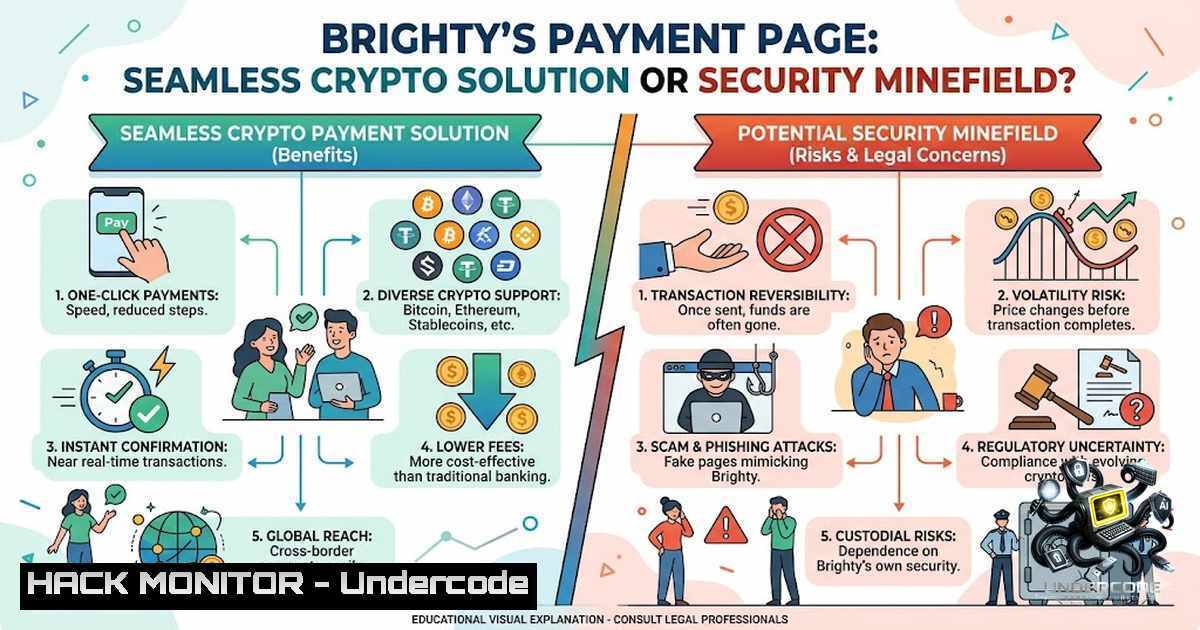
The cryptocurrency industry has long struggled with a fundamental usability problem: the friction of requiring both parties to have the same wallet or app installed to complete a transaction. Brighty App’s new payment page feature aims to eliminate this barrier by allowing users to generate a shareable link that opens in any browser, enabling payers to scan a QR code and send funds from whatever wallet they already use. While this innovation significantly lowers the barrier to crypto adoption, it also introduces a new attack surface that demands scrutiny from a cybersecurity perspective.
Learning Objectives:
- Understand the architecture and functionality of Brighty’s browser-based payment page feature.
- Identify the security implications, risks, and vulnerabilities associated with link-based crypto payment systems.
- Learn practical security measures and command-line techniques to audit, monitor, and secure such payment infrastructures.
You Should Know:
- How Brighty’s Payment Page Works: A Technical Breakdown
The core innovation of Brighty’s payment page is its ability to decouple the payer from the Brighty ecosystem. Instead of requiring the sender to download the Brighty app, create an account, and navigate a complex interface, the recipient simply shares a unique URL. When the payer opens this link in a browser (optimized for Chrome, Edge, and Safari), they are presented with a payment interface that includes a QR code. Scanning this code with any compatible crypto wallet initiates a transaction directly to the recipient’s Brighty wallet.
This architecture relies on several backend components:
- Link Generation: A unique, cryptographically secure identifier is generated for each payment request, encoding the recipient’s wallet address, the requested amount (if any), and a timestamp.
- QR Code Encoding: The payment details are encoded into a QR code, typically following the `bitcoin:` or `ethereum:` URI schemes, which most wallets can parse.
- Frontend Interface: A lightweight, responsive web page that displays the payment details and the QR code.
- Backend API: Handles link validation, status checking, and potentially webhook notifications for payment confirmations.
From a security standpoint, the primary concern is the integrity and confidentiality of the generated link. If an attacker can intercept or guess a valid link, they could redirect funds or harvest sensitive information.
2. Security Implications and Attack Vectors
While Brighty claims to use “advanced encryption, multi-factor authentication, and proactive monitoring systems”, the introduction of a browser-based payment page creates several new attack vectors:
- Link Interception and Man-in-the-Middle (MITM) Attacks: If the payment link is transmitted over an insecure channel (e.g., email, SMS, or unencrypted messaging apps), an attacker could intercept it and replace the recipient’s wallet address with their own. This is a classic “address replacement” attack.
- Phishing and Social Engineering: Attackers could create convincing clones of Brighty’s payment page to steal wallet credentials or private keys. Users must be vigilant and verify the domain.
- QR Code Spoofing: A malicious actor could generate a QR code that looks identical but points to a different wallet address.
- Cross-Site Scripting (XSS) and Web Vulnerabilities: The payment page itself could be vulnerable to XSS, allowing attackers to inject malicious scripts that steal session cookies or redirect users to phishing sites.
To mitigate these risks, Brighty should implement:
- HTTPS with HSTS: Enforce secure connections to prevent MITM attacks.
- Content Security Policy (CSP): Restrict the sources from which scripts can be loaded.
- Subresource Integrity (SRI): Ensure that loaded scripts haven’t been tampered with.
- Regular Security Audits: Independent penetration testing of the web application.
3. Step-by-Step Guide: Auditing a Crypto Payment Link
Security professionals and system administrators can audit the security of such payment links using a combination of tools and commands. Here’s a practical guide:
Step 1: Analyze the Link Structure
 Use curl to inspect the HTTP response headers and the page source
curl -I https://brightyapp.go.link/fC17w
curl -L https://brightyapp.go.link/fC17w | head -1 100
This reveals the redirection chain, the server type, and the initial HTML structure. Look for exposed API endpoints, JavaScript libraries, and potential vulnerabilities.
Step 2: Check SSL/TLS Configuration
 Use openssl to check the certificate details
openssl s_client -connect brightyapp.go.link:443 -servername brightyapp.go.link
Verify the certificate’s validity, issuer, and the cipher suites used. Weak ciphers or outdated protocols (e.g., TLS 1.0) are red flags.
Step 3: Scan for Open Ports and Services
 Use nmap to scan for open ports
nmap -sV -p- brightyapp.go.link
This identifies any exposed services that could be entry points for attackers.
Step 4: Test for Common Web Vulnerabilities
- SQL Injection: Use tools like `sqlmap` to test for injection points in the URL parameters.
- XSS: Inject `` into any input fields or URL parameters.
- Directory Traversal: Attempt to access sensitive files like `/etc/passwd` or `.env` using `../` sequences.
Step 5: Monitor Network Traffic
 Use tcpdump to capture network traffic for analysis
tcpdump -i eth0 -w payment_traffic.pcap
Analyze the captured traffic with Wireshark to detect any unencrypted sensitive data transmission.
4. Hardening the Payment Infrastructure
For organizations implementing similar payment features, the following hardening measures are essential:
- API Security: Implement rate limiting, input validation, and authentication for all API endpoints. Use API keys with least-privilege access.
- Cloud Hardening: If deployed on AWS, Azure, or GCP, ensure that security groups, IAM roles, and network ACLs are properly configured. Enable VPC flow logs for monitoring.
- Secrets Management: Store API keys, database credentials, and encryption keys in a secure vault like HashiCorp Vault, never in environment variables or code repositories.
- Logging and Monitoring: Centralize logs using a SIEM (Security Information and Event Management) system. Set up alerts for anomalous activities, such as multiple failed payment attempts or unusual geographic access patterns.
- Incident Response Plan: Have a clear plan for responding to security incidents, including link compromise, wallet theft, or data breaches.
5. Compliance and Regulatory Considerations
Brighty states that it adheres to European financial regulations and maintains fully segregated accounts with institutional-grade infrastructure. However, the legal landscape for crypto-assets is evolving rapidly. Organizations must stay abreast of regulations like the Markets in Crypto-Assets (MiCA) regulation in the EU. Compliance involves:
– Know Your Customer (KYC) and Anti-Money Laundering (AML): Implement robust identity verification and transaction monitoring.
– Data Privacy: Comply with GDPR and other data protection laws regarding the handling of personal information.
– Proof of Reserves: Regularly audit holdings through an independent process to assure users that their assets are genuinely backed.
What Undercode Say:
- Key Takeaway 1: Brighty’s payment page feature is a significant step toward mainstream crypto adoption by removing the friction of requiring both parties to have the same app. However, this convenience comes with increased security risks that must be proactively managed.
- Key Takeaway 2: The security of such systems hinges on robust encryption, secure coding practices, and continuous monitoring. Organizations must adopt a defense-in-depth strategy, including regular audits, penetration testing, and employee security awareness training.
Analysis:
Brighty’s approach to simplifying crypto payments is commendable, but it also highlights the perennial tension between usability and security in the fintech space. The payment page feature, while user-friendly, essentially creates a new attack surface that malicious actors will inevitably target. The reliance on a browser-based interface introduces web-specific vulnerabilities such as XSS, CSRF, and phishing risks that are less prevalent in native mobile apps. Moreover, the use of short-lived, shareable links raises concerns about link expiration, replay attacks, and the potential for unauthorized access if the link is leaked. Brighty’s claims of using “advanced encryption” and “proactive monitoring” are reassuring, but the true test lies in the implementation. The recent blacklist alert with a trust score of 35/100 serves as a stark reminder that trust in the crypto space is fragile and must be earned through transparency, third-party audits, and a proven track record of security.
Prediction:
- +1: The payment page feature will drive significant user adoption, particularly among freelancers, remote workers, and businesses that regularly receive crypto payments, as it removes a major friction point.
- -1: We will see a surge in phishing campaigns and social engineering attacks targeting Brighty users, leveraging fake payment pages and malicious QR codes to steal funds.
- -1: Regulatory scrutiny will intensify, with authorities demanding greater transparency and security measures for such link-based payment systems, potentially leading to compliance challenges for Brighty.
- +1: Brighty’s proactive security measures, including independent Proof of Reserves and institutional-grade custody with Fireblocks, will help build trust and differentiate it from less secure competitors.
- -1: The inherent volatility of cryptocurrencies will remain a significant risk for users, and the ease of payment could lead to impulsive transactions without proper risk assessment.
▶️ Related Video (82% Match):
🎯Let’s Practice For Free:
🎓 Live Courses & Certifications:
Join Undercode Academy for Verified Certifications
🚀 Request a Custom Project:
Secure, high-velocity infrastructure and disruptive technological engineering. Contact our engineering team for high-tier development and proprietary systems:
[email protected]
💎 Smart Architecture | 🛡️ Secure by Design | ⭐ Trusted by Thousands
IT/Security Reporter URL:
Reported By: Your Brighty – Hackers Feeds
Extra Hub: Undercode MoN
Basic Verification: Pass ✅


