
Listen to this Post
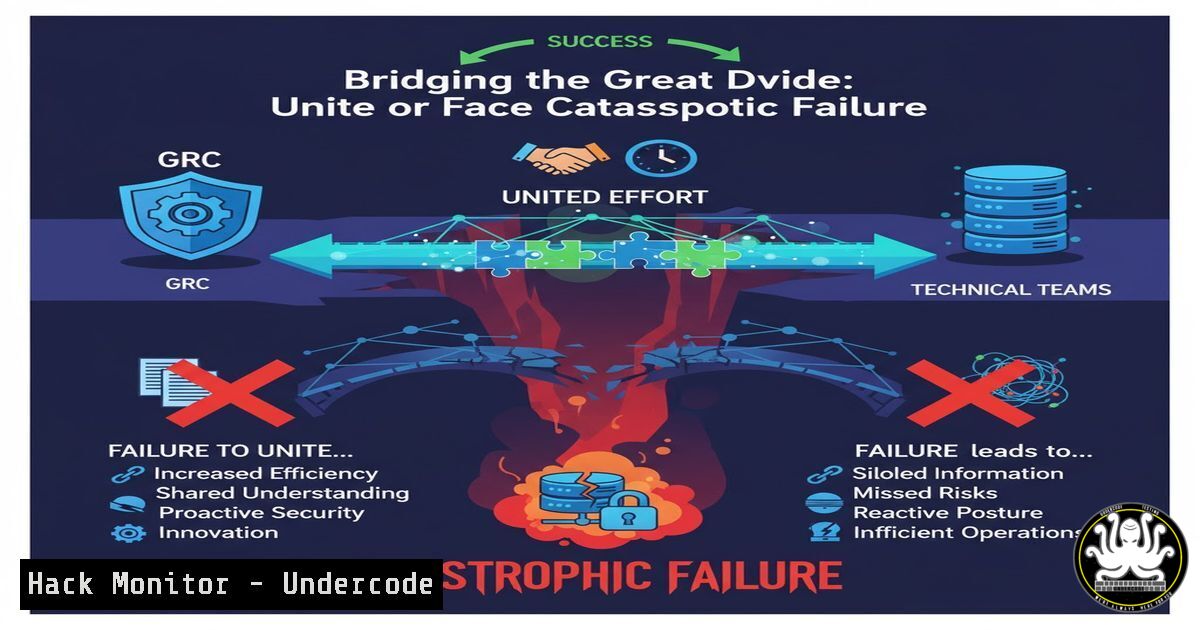
Introduction:
The cybersecurity landscape is fractured by a silent war between Governance, Risk, and Compliance (GRC) professionals and technical operations teams. This schism, where GRC is often perceived as a rigid, non-technical obstacle, creates critical security gaps and operational inefficiencies. Achieving true cyber resilience demands a strategic fusion of policy and practicality, uniting these disciplines into a cohesive defense force.
Learning Objectives:
- Understand the root causes of friction between GRC analysts and technical teams like SOCs.
- Learn practical, technical steps to translate framework requirements into actionable, feasible configurations.
- Develop strategies for continuous collaboration to ensure security policies are both compliant and operationally sound.
You Should Know:
1. The Communication Chasm: From Policy to Practice
The core issue often begins with GRC analysts mandating controls without consulting the teams responsible for their implementation. A policy demanding “Access log retention: 24 months” is useless if the engineering team lacks the storage capacity or the SOC hasn’t configured their SIEM to parse that volume of data effectively. This top-down approach breeds resentment and non-compliance.
Step‑by‑step guide explaining what this does and how to use it.
Step 1: Pre-Policy Technical Assessment. Before drafting a policy, form a cross-functional team with GRC, SOC, and systems engineering.
Step 2: Feasibility Analysis. For each proposed control, conduct a technical deep-dive. For the log retention example, this means running commands to audit current log volumes and storage.
Linux Command: ` Check total size of log files in /var/log over the last 30 days
find /var/log -type f -mtime -30 -exec ls -lh {} \; | awk ‘{print $5, $9}’ | sort -hr`
Windows Command (PowerShell): Get total size of Event Logs
<h2 style="color: yellow;">Get-WinEvent -ListLog | Measure-Object -Property FileSize -Sum
Step 3: Collaborative Policy Drafting. Draft the policy with the technical teams. The final version might read: “Access logs shall be retained for 24 months, with hot storage (e.g., SIEM) for 90 days and archived to cold storage for the remainder, based on the current estimated growth of 50GB/month.”
2. Demystifying Technical Controls for GRC
The accusation that “GRC analysts aren’t really technical” is a vulnerability. GRC professionals must possess enough technical knowledge to understand the implications of the controls they mandate. For instance, writing an encryption policy requires knowing the difference between AES-256 and RSA-4096 and where each is appropriately applied.
Step‑by‑step guide explaining what this does and how to use it.
Step 1: Control Deep-Dive. When a control like “data-at-rest encryption” is required, GRC analysts should research the common implementations.
Step 2: Practical Verification. Don’t just take a developer’s word for it. Learn to verify basic configurations.
Example: Checking Database Encryption (PostgreSQL): `SELECT datname, pg_size_pretty(pg_database_size(datname)) as size, datistemplate FROM pg_database WHERE datistemplate = false;`
Example: Verifying TLS Version on a Web Server (Using OpenSSL): `openssl s_client -connect example.com:443 -tls1_2` This command tests if the server supports TLS 1.2.
Step 3: Documenting the “How”. The policy should reference the specific, agreed-upon technical standard, e.g., “Data-at-rest encryption shall be implemented using LUKS2 (Linux) or BitLocker (Windows) with XTS-AES-256 mode.”
3. Framework Tuning: Making Standards Work for You
Frameworks like NIST and ISO 27001 are guides, not holy texts. Blindly implementing every control without considering your organization’s specific architecture and risk appetite is a recipe for failure. The key is to “tweak” the framework.
Step‑by‑step guide explaining what this does and how to use it.
Step 1: Risk-Based Scoping. Conduct a formal risk assessment to identify your crown jewels. Not all assets require the same level of control.
Step 2: Control Substitution & Compensating Controls. If a prescribed control is not feasible, document a compensating control that achieves the same security objective. For example, if you cannot implement a specific web application firewall (WAF) rule due to false positives, a combination of stricter input validation in the code and more frequent penetration testing might be an acceptable alternative.
Step 3: Continuous Monitoring and Adjustment. Use a tool like Wazuh or Osquery to continuously monitor the effectiveness of your controls.
Example Osquery Command to Check for Unencrypted Volumes: `SELECT name, encryption_status FROM bitlocker_info;`
4. Building a Shared Language with the SOC
The Security Operations Center is GRC’s eyes and ears. A policy that doesn’t align with the SOC’s monitoring capabilities is a paper tiger. GRC must understand what the SOC can actually see and respond to.
Step‑by‑step guide explaining what this does and how to use it.
Step 1: Joint Tabletop Exercises. Run through incident scenarios together. The GRC team provides the policy, and the SOC demonstrates how they would detect and respond based on their current tooling.
Step 2: SIEM Use Case Development. Collaborate on building SIEM alerts. The GRC analyst defines the policy violation (e.g., “multiple failed logins from a foreign country”), and the SOC engineer writes the corresponding correlation rule (e.g., in Splunk SPL or Elasticsearch KQL).
Step 3: Feedback Loop for False Positives. Establish a formal process where the SOC can report policy-mandated controls that generate excessive noise, allowing for policy refinement.
5. Automating Compliance Evidence Collection
Much of the friction comes from the manual, audit-time scramble for evidence. Automating this process demonstrates technical competence and builds trust with engineering teams who are no longer burdened with repetitive requests.
Step‑by‑step guide explaining what this does and how to use it.
Step 1: Identify Key Controls for Automation. Start with controls that are easily measurable, such as system hardening benchmarks.
Step 2: Implement Configuration Management Tools. Use tools like Ansible, Chef, or Puppet to enforce and report on compliance states.
Example Ansible Playbook Snippet to check if password expiration is configured:
- name: Check password expiration for all users
hosts: all
tasks:
- name: Ensure /etc/login.defs has PASS_MAX_DAYS set to 90
ansible.builtin.lineinfile:
path: /etc/login.defs
regexp: '^PASS_MAX_DAYS'
line: 'PASS_MAX_DAYS 90'
Step 3: Integrate with a Dashboard. Pipe the output of these automated checks into a GRC dashboard (e.g., using Splunk or a custom Grafana panel) to provide real-time compliance status, moving from point-in-time audits to continuous compliance.
What Undercode Say:
- Collaboration is a Security Control. The failure to integrate GRC with technical operations is as critical a vulnerability as an unpatched server. It creates a systemic weakness that attackers can exploit.
- Pragmatism Over Dogma. The most secure organization is not the one that blindly follows a framework, but the one that intelligently adapts it to its unique environment, ensuring controls are both effective and operable.
The post from Adeoluwa Obadofin highlights a critical cultural and operational flaw in many security programs. The perception of GRC as a non-technical, obstructive force is a significant threat to an organization’s security posture. True security is not achieved by simply checking boxes on a compliance sheet but by building a culture where policy and technical implementation are in constant, reinforcing dialogue. When GRC understands the technical constraints and the SOC understands the business risks behind the policies, security transitions from a cost center to a strategic, enabling function. The future belongs to organizations that can dissolve this divide, creating “purple teams” for defense as well as offense.
Prediction:
The escalating complexity of cloud-native architectures and AI integration will render rigid, siloed security models completely obsolete. Organizations that fail to bridge the GRC-technical divide will face increased regulatory fines, more frequent breaches due to misconfigured controls, and an inability to keep pace with evolving threats. Conversely, those that foster a unified “DevSecOpsGRC” culture will achieve a significant competitive advantage, enabling faster, more secure innovation and robust cyber resilience that is both auditable and operational.
🎯Let’s Practice For Free:
IT/Security Reporter URL:
Reported By: Adeoluwa Obadofin – Hackers Feeds
Extra Hub: Undercode MoN
Basic Verification: Pass ✅


