Listen to this Post
Introduction:
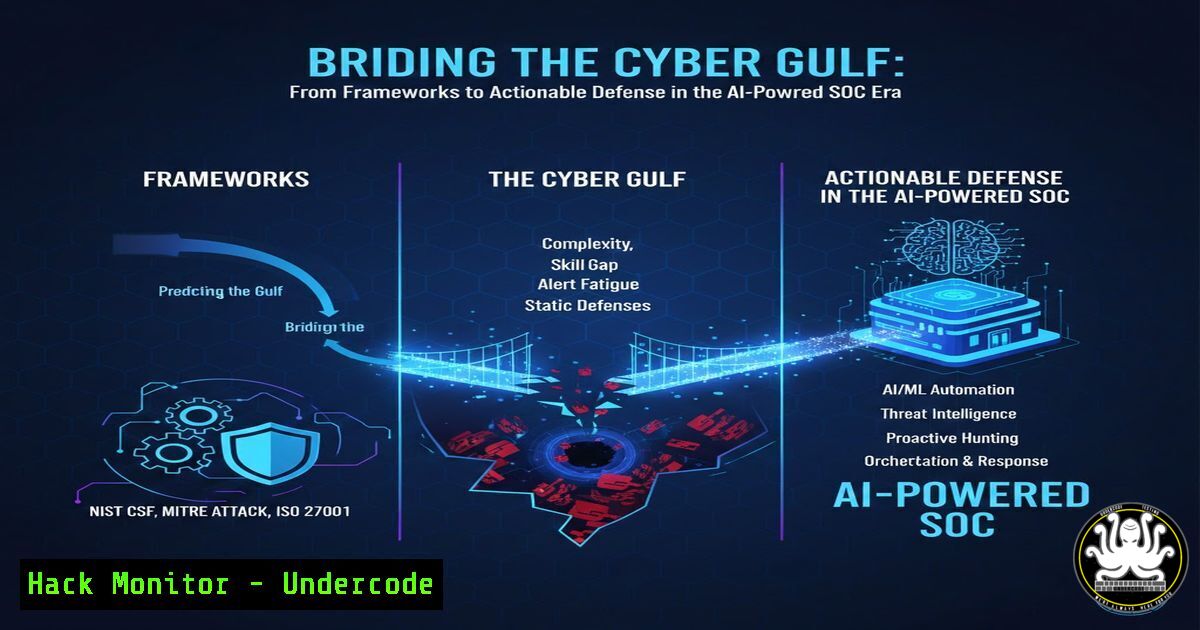
The modern Security Operations Center (SOC) is often caught in a paradox: armed with extensive frameworks and tools, yet frequently failing to stop determined attackers. As highlighted in recent expert discussions, this chasm exists because security teams frequently prioritize compliance and alert volume, while adversaries singularly focus on outcomes like credential theft and system compromise. This article deconstructs this critical gap and provides a technical blueprint for shifting from passive detection to active, early disruption by integrating tactical frameworks, comprehensive logging, and strategic AI augmentation.
Learning Objectives:
- Understand and implement the practical synergy between the MITRE ATT&CK® Framework and the Cyber Kill Chain for actionable defense.
- Configure critical logging across Windows, Linux, and cloud APIs to detect “living off the land” (LotL) attacks.
- Harden identity and access management to mitigate the 68% of incidents stemming from human factors.
- Integrate AI into SOC workflows to accelerate structured analysis without replacing human critical thinking.
- Develop metrics that measure security outcomes (where attackers are stopped) over security output (alert count).
You Should Know:
1. From Theoretical Frameworks to Tactical SIEM Detection
Frameworks like NIST or ISO 27001 provide essential structure but are meaningless if their controls don’t translate into concrete SIEM detection rules. The disconnect creates a dangerous illusion of security.
Step‑by‑step guide:
- Map Control to Tactic: Select a control (e.g., “Protect against malware”). Map it to the MITRE ATT&CK Tactic `Execution` (T1059 – Command and Scripting Interpreter).
- Identify Relevant Data Source: Determine the log source needed. For command execution, this is typically Windows Security Event Logs (Event ID 4688) or Linux audit logs (via
auditd). - Craft a Detection Rule: Create a SIEM correlation rule. For example, detect `powershell.exe` or `bash` execution with suspicious flags.
Example Sigma Rule (YAML for SIEMs):
title: Suspicious PowerShell Execution - Encoded Command
logsource:
product: windows
service: security
detection:
selection:
EventID: 4688
CommandLine|contains: '-EncodedCommand'
condition: selection
4. Validate & Tune: Test the rule in a lab, check false positive rates, and refine it. The goal is to have every framework control linked to one or more validated detection analytics.
- Operationalizing MITRE ATT&CK with the Cyber Kill Chain
MITRE ATT&CK explains how an attack step is performed, while the Lockheed Martin Cyber Kill Chain explains where in the attack lifecycle it occurs. Used together, they guide both detection and disruption.
Step‑by‑step guide:
- Attacker Emulation: Use a tool like `Caldera` or `Atomic Red Team` to simulate a specific ATT&CK technique (e.g., T1078 – Valid Accounts).
Example Atomic Red Team test for T1078.004 - Cloud Accounts
atomic-red-team.exe atomic-t1078-004
- Map to Kill Chain Stage: The technique “Valid Accounts” falls primarily in the Initial Foothold and Persistence stages of the Kill Chain.
- Identify Disruption Point: Ask: “Where is the earliest stage we can detect and stop this?” For stolen cloud credentials, this might be at the “Reconnaissance” stage by detecting anomalous Graph API calls.
- Implement Stage-Specific Controls: For the Delivery stage (phishing), implement technical controls beyond training: deploy an API-based sandbox like `Cuckoo` for email attachment analysis.
Submit a suspicious file to Cuckoo Sandbox API
curl -H "Authorization: Bearer YOUR_TOKEN" -F [email protected] http://cuckoo-host:8090/tasks/create/file
3. Mandatory Logging: The Foundation of Detection
Without proper logs, security tools are blind. Attackers exploit unlogged actions, especially in LotL attacks using native tools like PowerShell, WMI, or cloud APIs.
Step‑by‑step guide for critical logging:
Windows (PowerShell Module Logging):
Open Administrative PowerShell and run:
 Enable Module Logging for all modules
$Path = 'HKLM:\SOFTWARE\Policies\Microsoft\Windows\PowerShell\ModuleLogging'
New-Item -Path $Path -Force
Set-ItemProperty -Path $Path -Name 'EnableModuleLogging' -Value 1
New-Item -Path "$Path\ModuleNames" -Force
Set-ItemProperty -Path "$Path\ModuleNames" -Name '' -Value ''
This logs all PowerShell module activity to Event ID 4103.
Linux (`auditd` for Command Auditing):
 Monitor execution of critical binaries like wget/curl
sudo auditctl -a always,exit -F arch=b64 -S execve -F path=/usr/bin/wget -F key=lotl_web_download
sudo auditctl -a always,exit -F arch=b64 -S execve -F path=/usr/bin/curl -F key=lotl_web_download
 View logs
sudo ausearch -k lotl_web_download
Cloud (Microsoft Graph API Auditing): In Azure AD/M365, ensure `AuditLog.Read.All` is enabled and ingested into your SIEM. Alert on Application-type sign-ins with high volume or unusual permissions.
- Hardening the Human Factor: Stopping 68% of Incidents
Most breaches start with phishing, weak passwords, lack of MFA, and over-privileged accounts. Technical enforcement is non-negotiable.
Step‑by‑step guide:
- Enforce MFA Conditional Access (Azure AD Example): Create a CA policy that blocks legacy authentication and requires MFA for all users from outside the corporate network.
- Implement Just-In-Time (JIT) Privileged Access: Use `Azure AD PIM` or `Thycotic` to elevate admin rights only when needed, for a limited time.
Example: Request activation of a role in Azure AD PIM (conceptual)
Open-AzureADMSPrivilegedRoleAssignmentRequest -ProviderId aadRoles -ResourceId <tenantId> -RoleDefinitionId <roleId> -SubjectId <userId> -Type UserAdd -AssignmentState Active -ScheduleExpirationType AfterDuration -Duration "2:00:00"
- Deploy Passwordless Authentication: Where possible, move to FIDO2 security keys or Windows Hello for Business to eliminate the password attack vector entirely.
-
Integrating AI for Structure and Speed, Not Replacement
AI should accelerate the SOC analyst’s workflow by adding structure to chaos—prioritizing alerts, linking related events, and summarizing incidents—not by making autonomous “block” decisions without context.
Step‑by‑step guide for SOC AI integration:
- Start with Data Enrichment: Use an AI service (e.g., Azure Sentinel ML, Splunk ES) to automatically enrich IP addresses, domains, and hashes with threat intelligence scores.
- Implement Anomaly Detection: Deploy built-in UEBA (User and Entity Behavior Analytics) to baseline normal user behavior and flag deviations (e.g., a user downloading 10x their usual data volume).
- Use AI for Incident Summarization: Leverage tools like `TheHive` with Cortex analyzers or ChatGPT-integrated plugins to auto-generate initial incident reports from alert data, saving analysts hours.
What Undercode Say:
- Outcomes Over Output: The primary metric for any SOC must shift from “alerts handled per day” to “percentage of Kill Chain stages where we have high-confidence detection and disruption capabilities.” Measure defensive coverage in terms of adversary progression, not ticket closure.
- AI as a Force Multiplier, Not a Panacea: Artificial Intelligence excels at processing vast datasets and surfacing patterns, but it cannot replicate human intuition, context, and ethical reasoning. The most resilient SOCs will use AI to handle the predictable, freeing human experts to investigate the novel and complex.
The insights reveal an industry at an inflection point. Defenders are moving beyond checklist security towards a dynamic, intelligence-driven posture. The emphasis on early disruption over perfect investigation acknowledges that stopping an attacker at the initial access stage is exponentially cheaper and more effective than a full-scale breach response. The integration of AI, when done to augment human analytical speed and reduce fatigue, represents the only scalable path forward given the talent shortage.
Prediction:
In the next 24-36 months, we will witness the rise of the “Autonomous SOC Assistant.” This AI agent will not replace analysts but will act as a tireless tier-0, automatically validating low-complexity alerts, executing standardized containment playbooks (like disabling a compromised user via API), and gathering initial forensic data. This will force attackers to develop increasingly sophisticated “AI-aware” evasion techniques, specifically designed to behave in ways that appear benign to machine learning models, sparking a new arms race in adversarial AI within the cybersecurity domain. The organizations that win will be those that most effectively weave human strategic oversight with automated tactical execution.
▶️ Related Video (80% Match):
🎯Let’s Practice For Free:
IT/Security Reporter URL:
Reported By: Masumi Jain – Hackers Feeds
Extra Hub: Undercode MoN
Basic Verification: Pass ✅


