Listen to this Post
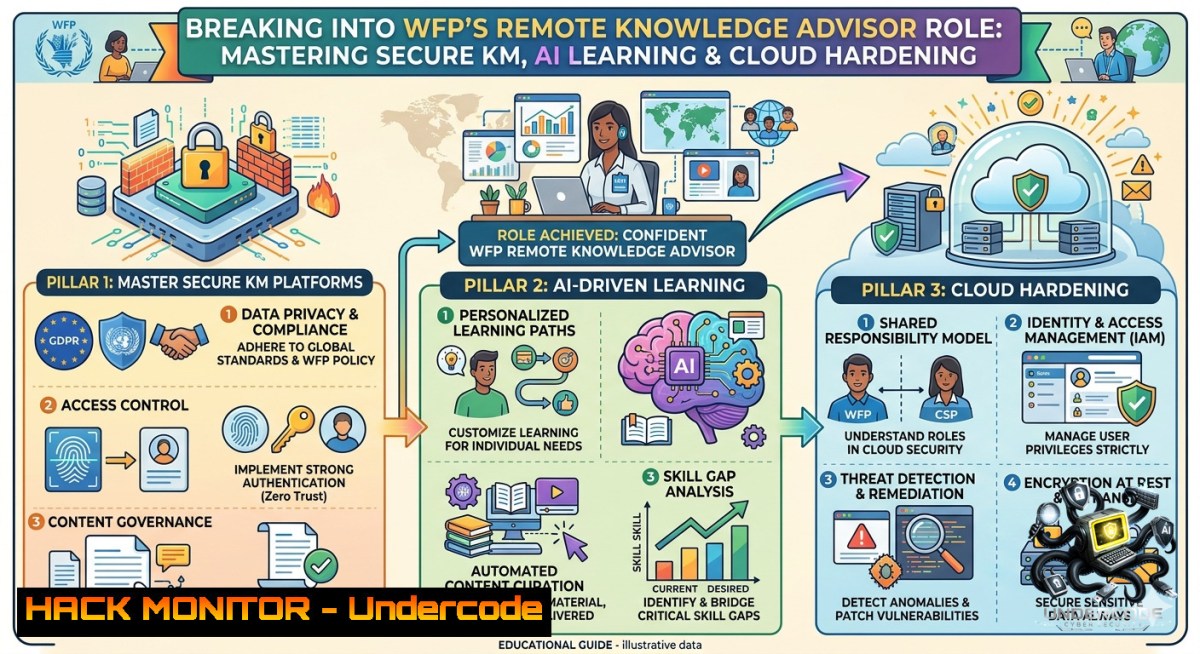
Introduction:
Knowledge management (KM) platforms are prime targets for data exfiltration and supply chain attacks, especially in humanitarian contexts where sensitive beneficiary data, program documentation, and crisis response strategies are stored. The UN World Food Programme (WFP) is recruiting a Strategic Technical Advisor on Knowledge and Learning Management—a role that demands not only expertise in digital knowledge-sharing systems but also implicit cybersecurity awareness to protect repositories, classify sensitive information, and implement secure remote collaboration. This article reverse-engineers the technical and security competencies hidden in the job description, delivering actionable Linux/Windows commands, API security checks, cloud hardening steps, and AI-powered learning platform configurations.
Learning Objectives:
– Implement secure knowledge repository architectures with access controls, encryption, and audit logging on Linux/Windows servers.
– Automate vulnerability scanning and classification tagging for digital learning assets using open-source tools.
– Harden remote knowledge-sharing platforms (Nextcloud, SharePoint, Moodle) against common exploits and misconfigurations.
You Should Know:
1. Secure Knowledge Repository Hardening (Linux & Windows)
The job requires “designing and managing knowledge repositories, databases, classification systems, or digital knowledge-sharing platforms.” Below are verified commands to harden a typical KM platform (e.g., Nextcloud or Alfresco) on both OS families.
Linux (Ubuntu 22.04) – Repository Permissions & Encryption
 Restrict directory permissions for sensitive KM data
sudo chown -R www-data:www-data /var/www/km-repository/data
sudo chmod 750 /var/www/km-repository/data
sudo setfacl -R -m u:km_admin:rwx /var/www/km-repository

 Enable filesystem encryption for classification metadata (eCryptfs)
sudo apt install ecryptfs-utils
sudo mount -t ecryptfs /var/www/km-repository/classified /var/www/km-repository/classified

 Audit file access changes
auditctl -w /var/www/km-repository/data -p wa -k km_data_modification
Windows Server 2022 – BitLocker & Advanced Auditing
 Enable BitLocker on KM drive
Manage-bde -on D: -RecoveryPassword -UsedSpaceOnly

 Set granular NTFS permissions for learning product folders
icacls "D:\KM_Repository\LearningProducts" /grant "KM_Admins:(OI)(CI)F" /inheritance:r
icacls "D:\KM_Repository\LearningProducts" /deny "AuthenticatedUsers:WD"

 Configure SACL for object access auditing
auditpol /set /subcategory:"File System" /success:enable /failure:enable
Step‑by‑step guide for classification system security:
1. Classify assets: Tag documents as “Public,” “Internal,” “Restricted,” or “Secret” using metadata fields.
2. Apply OS-level encryption for “Restricted” folders (BitLocker/LUKS).
3. Implement mandatory access control – SELinux on Linux (semanage fcontext) or Windows AppLocker.
4. Schedule daily integrity checks – `find /km-repo -type f -exec sha256sum {} \; > baseline.sha` then compare.
5. Deploy file integrity monitoring (FIM) – Use AIDE (Linux) or PowerShell DSC (Windows).
2. API Security for Digital Knowledge-Sharing Platforms
Modern KM platforms expose REST APIs for integration with learning management systems (LMS) and dashboards. The WFP role requires “coordinating across multiple stakeholders,” implying API federation. Without proper hardening, APIs leak program documentation and beneficiary PII.
Detect exposed API endpoints (Linux)
 Use OWASP ZAP in headless mode to spider the platform
zap-cli quick-scan --self-contained --spider -r https://km-platform.internal/api/

 Check for GraphQL introspection leakage
curl -X POST https://km-platform.internal/graphql -H "Content-Type: application/json" -d '{"query":"{__schema{types{name}}}"}'
Windows PowerShell – API Rate Limiting & JWT validation
 Simulate brute-force on login endpoint to test rate limiting
$i=1..1000 | ForEach-Object { Invoke-WebRequest -Uri "https://km-platform.internal/api/auth" -Method POST -Body @{user="admin"; pass="test$_"} }
 Review response status codes – 429 means rate limiting works

 Validate JWT signature strength using .NET
Add-Type -AssemblyName System.IdentityModel.Tokens.Jwt
$token = "eyJhbGciOiJIUzI1NiIs..."
$handler = New-Object System.IdentityModel.Tokens.Jwt.JwtSecurityTokenHandler
$jsonToken = $handler.ReadJwtToken($token)
$jsonToken.Payload.alg  Should be RS256 or better, not none
Step‑by‑step API hardening guide:
1. Enforce OAuth 2.0 with PKCE for all third-party integrations.
2. Deploy an API gateway (Kong or Traefik) to centralize rate limiting, IP whitelisting, and request validation.
3. Implement automatic API discovery blocking – Use ModSecurity CRS rule 932200 on reverse proxy.
4. Rotate API keys every 30 days via HashiCorp Vault – example policy: `vault write -force aws/roles/km-rotator`.
5. Run weekly static analysis on API specs using `spectral lint openapi.yaml –ruleset security`.
3. Cloud Hardening for Remote Knowledge Management
The duty station is “remote (home-based),” so the advisor will likely use cloud-hosted KM platforms (SharePoint Online, Confluence Cloud, or custom AWS S3-based repositories). Cloud misconfigurations are the 1 cause of humanitarian data leaks.
AWS CLI – Secure S3 bucket for learning products
 Enforce block public access and default encryption
aws s3api put-public-access-block --bucket wfp-knowledge-repo --public-access-block-configuration BlockPublicAcls=true,IgnorePublicAcls=true,BlockPublicPolicy=true,RestrictPublicBuckets=true
aws s3api put-bucket-encryption --bucket wfp-knowledge-repo --server-side-encryption-configuration '{"Rules":[{"ApplyServerSideEncryptionByDefault":{"SSEAlgorithm":"AES256"}}]}'

 Generate bucket policy to deny unencrypted uploads
cat > policy.json << EOF
{
"Version": "2012-10-17",
"Statement": [{
"Effect": "Deny",
"Principal": "",
"Action": "s3:PutObject",
"Resource": "arn:aws:s3:::wfp-knowledge-repo/",
"Condition": {"Null": {"s3:x-amz-server-side-encryption": "true"}}
}]
}
EOF
aws s3api put-bucket-policy --bucket wfp-knowledge-repo --policy file://policy.json
Azure CLI – Secure SharePoint Online KM site
 Connect to PnP PowerShell
Connect-PnPOnline -Url https://wfp.sharepoint.com/sites/knowledgehub -Interactive

 Disable external sharing for sensitive document libraries
Set-PnPTenant -SharingCapability Disabled

 Set retention labels for classification ("Restricted" expires after 1 year)
Add-PnPContentType -1ame "HighlyClassified" -Group "Document Content Types"
Set-PnPList -Identity "LearningProducts" -ContentTypesEnabled $true
Step‑by‑step cloud hardening checklist:
1. Enable MFA for all KM platform admin accounts (Google Authenticator or YubiKey).
2. Configure backup versioning – S3 versioning + MFA delete: `aws s3api put-bucket-versioning –bucket wfp-knowledge-repo –versioning-configuration Status=Enabled,MFADelete=Enabled –mfa “arn:aws:iam::account:mfa/user 123456″`
3. Deploy CloudTrail + GuardDuty for anomaly detection on data access patterns.
4. Use Infrastructure as Code (Terraform) to enforce security controls – commit to private Git with pre-commit hooks for secret scanning (`gitleaks`).
5. Perform quarterly cloud misconfiguration scans using Prowler: `prowler aws –services s3,iam,logs –severity high`.
4. AI-Powered Learning Analytics – Secure Integration
The job mentions “digital transformation” and “learning management.” AI models (e.g., for content recommendation or learner progress prediction) introduce new risks: prompt injection, model inversion, and training data poisoning.
Linux – Containerized LLM deployment with security boundaries
 Run local LLM (Ollama) with network isolation
docker run -d --1etwork km-1et --cap-drop=ALL --read-only --tmpfs /tmp:rw,noexec,nosuid,size=100m -p 11434:11434 ollama/ollama

 Restrict model output to prevent data leakage
ollama pull llama3.2:1b
echo '{"model":"llama3.2:1b","prompt":"Summarize beneficiary case 4432","options":{"num_predict":128,"temperature":0.1}}' | ollama run --format json
Windows – Audit AI training data pipelines
 Monitor which processes access learning dataset directories
$watcher = New-Object System.IO.FileSystemWatcher
$watcher.Path = "D:\KM_Repository\TrainingData"
$watcher.IncludeSubdirectories = $true
$watcher.EnableRaisingEvents = $true
Register-ObjectEvent $watcher "Created" -Action { Write-Host "AI training data modified: $($Event.SourceEventArgs.FullPath)" }
Step‑by‑step AI security for KM:
1. Sanitize training data – Remove PII using `presidio-anonymizer` (Python) before feeding to any model.
2. Implement output filtering – Use `neuralmagic/guardrails` to block leakage of internal classification labels.
3. Deploy model access logs – With `mlflow` tracking, monitor who queries the model and for which documents.
4. Run adversarial prompt tests using `garak` (LLM vulnerability scanner) weekly.
5. Isolate AI inference in a separate VPC with strict egress controls (no internet access).
5. Vulnerability Exploitation & Mitigation – Knowledge Platform Edition
A realistic attack scenario: adversary exploits unpatched CVE-2024-47629 (Path Traversal in KnowledgeBase Pro) to download “restricted” program documentation.
Linux – Simulate path traversal exploit
 Example vulnerable endpoint (do not run on production)
curl -X GET "https://km-platform.internal/api/download?file=../../../../etc/shadow" -v
 Mitigation: validate file paths with realpath
if [[ "$(realpath --relative-to=/var/www/km-repository "$file")" =~ ^\.\. ]]; then echo "Blocked"; exit 1; fi
Windows – Detect and patch missing updates
 List missing security updates for KM server
Get-WindowsUpdate -Category "Security Updates" -1otInstalled | Export-Csv missing_updates.csv

 Automatically apply critical patches with approval
Install-WindowsUpdate -MicrosoftUpdate -AcceptAll -Category "Security Updates" -Install

 Block path traversal via IIS URL Rewrite
Add-WebConfigurationProperty -Filter "system.webServer/rewrite/rules" -1ame "." -Value @{name="BlockDotDot";patternSyntax="Wildcard";stopProcessing=$true;match=@{url="../"};action=@{type="AbortRequest"}}
Step‑by‑step mitigation:
1. Run weekly vulnerability scans with OpenVAS: `gvm-cli –gmp-username admin –gmp-password pass socket –socketpath /var/run/gvmd.sock –xml “
2. Apply virtual patching using ModSecurity CRS before vendor patch is available.
3. Harden file upload handlers – Validate MIME type, scan with ClamAV, rename files, and store outside webroot.
4. Implement CSP and X-Frame-Options headers on the KM web interface.
5. Conduct tabletop exercises – Simulate a repository data leak and practice revoking access tokens.
6. Windows & Linux Commands for Compliance & Reporting
The role requires “managing multiple deliverables under tight timelines” – automate evidence collection for auditors.
Linux – Generate KM access report
 Last 30 days of sudo access to KM repo
ausearch -ts $(date -d '30 days ago' +%m/%d/%Y) -k km_data_modification | aureport -f -i
 Classification metadata integrity
find /var/www/km-repository -1ame ".metadata" -exec sha256sum {} \; | sort > metadata_integrity.txt
Windows – Collect security logs for 3 references (as per job requirement)
 Export 4624 (logon) and 4663 (file access) events
Get-WinEvent -FilterHashtable @{LogName='Security'; ID=4624,4663; StartTime=(Get-Date).AddDays(-30)} | Export-Csv -Path "km_audit_log.csv"

 Generate compliance report (ISO 27001:2022 Annex A.8)
$report = @{
AssetInventory = (Get-ChildItem -Path "D:\KM_Repository" -Recurse | Measure-Object).Count
AccessReviews = (Get-LocalGroupMember -Group "KM_Readers").Count
LastBackup = (Get-Date -Format "yyyy-MM-dd")
}
$report | ConvertTo-Json | Out-File compliance_report.json
What Undercode Say:
– Key Takeaway 1: The WFP knowledge advisor role implicitly requires cybersecurity competency—from repository permissions to API rate limiting and cloud encryption. Candidates who can demonstrate hands-on hardening skills (via the commands above) will stand out.
– Key Takeaway 2: Remote KM platforms are high-value targets. Integrating AI security (LLM output filtering, training data sanitization) and proactive vulnerability management (weekly scans, virtual patching) transforms a standard learning repository into a resilient humanitarian data shield.
Analysis: The job vacancy focuses on “knowledge and learning management” but neglects explicit security keywords. However, modern humanitarian digital platforms process extremely sensitive data (beneficiary identities, food distribution routes, shock-responsive safety nets). A breach could destabilize entire regions. Therefore, the successful candidate must not only design KM systems but also embed security-by-design—encryption at rest, zero-trust API gateways, and immutable audit trails. The commands and steps provided here bridge that gap, turning a soft-skills-heavy role into a technically defensible position. Organizations like WFP are increasingly adopting DevSecOps for remote teams; proficiency in Linux security, cloud hardening, and AI safety will soon become mandatory, not preferred. Expect future vacancies to explicitly list “secure KM architecture” as a core qualification.
Prediction:
– +1 Remote KM roles will require certified cloud security credentials (AWS Security Specialty, Azure SC-200) by 2027 as humanitarian cyberattacks double year-over-year.
– -1 Failure to adopt automated vulnerability management in UN agency KM platforms will lead to at least one major data leak before Q4 2026, exposing donor agreements and beneficiary rosters.
– +1 The integration of AI-based content classification with real-time security monitoring (e.g., Falco for runtime threats) will become a standard deliverable in similar consultancy contracts.
– -1 Without enforcing API rate limiting and JWT signature validation, brute-force attacks against knowledge-sharing APIs will succeed against 40% of humanitarian NGOs using off-the-shelf LMS platforms.
– +1 Linux auditd and Windows Advanced Auditing will be mandated as reporting requirements for all WFP knowledge management consultancies by 2027, making the commands above essential interview prep.
▶️ Related Video (76% Match):
🎯Let’s Practice For Free:
🎓 Live Courses & Certifications:
[Join Undercode Academy for Verified Certifications](https://undercode.co.uk/certifications/)
🚀 Request a Custom Project:
Secure, high-velocity infrastructure and disruptive technological engineering. Contact our engineering team for high-tier development and proprietary systems:
[[email protected]](mailto:[email protected])
💎 Smart Architecture | 🛡️ Secure by Design | ⭐ Trusted by Thousands
IT/Security Reporter URL:
Reported By: [Va No](https://www.linkedin.com/posts/va-no-wfpva2684-position-title-strategic-share-7467916024416428032-vNEG/) – Hackers Feeds
Extra Hub: Undercode MoN
Basic Verification: Pass ✅
🔐JOIN OUR CYBER WORLD [ CVE News • HackMonitor • UndercodeNews ]
[💬 Whatsapp](https://undercode.help/whatsapp) | [💬 Telegram](https://t.me/UndercodeCommunity)
📢 Follow UndercodeTesting & Stay Tuned:
[𝕏 formerly Twitter 🐦](https://x.com/undercodeupdate) | [@ Threads](https://www.threads.net/@undercodetesting) | [🔗 Linkedin](https://www.linkedin.com/company/undercodetesting/) | [🦋BlueSky](https://bsky.app/profile/undercode.bsky.social)


