
Listen to this Post
Introduction:
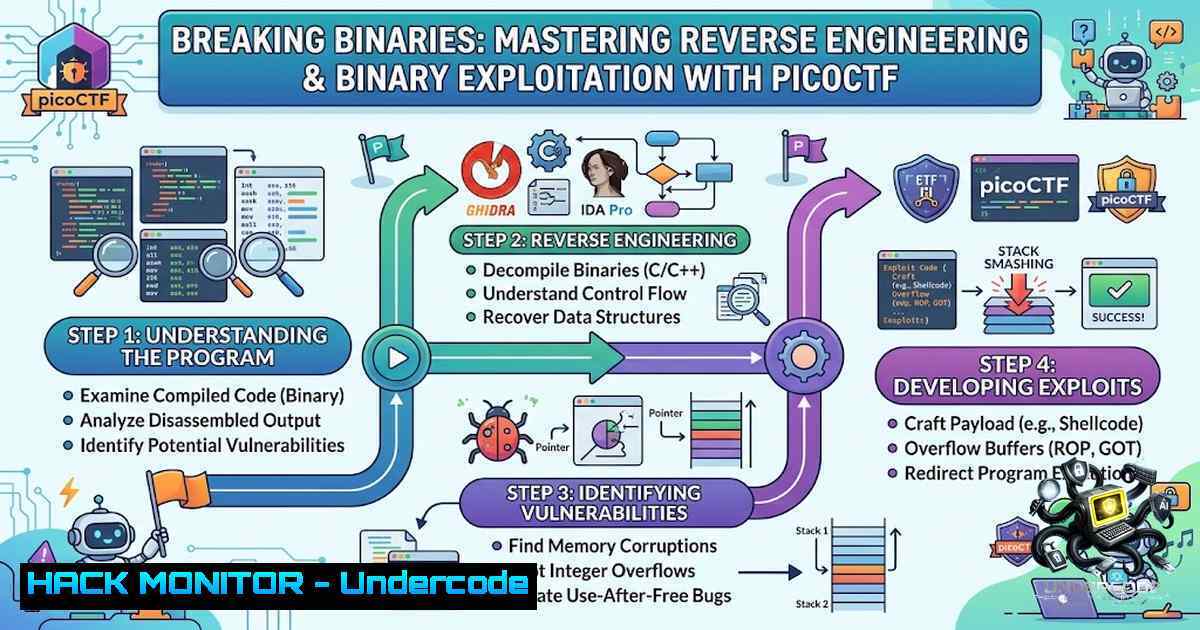
The cybersecurity landscape is rapidly evolving, and with the rise of complex software ecosystems, understanding low-level system architecture has become non-1egotiable for security professionals. Binary exploitation and reverse engineering form the bedrock of advanced vulnerability research, allowing analysts to dissect compiled programs, understand memory corruption, and uncover hidden flaws that high-level languages often abstract away. This technical deep-dive explores the core methodologies of reverse engineering, stack-based exploitation, and control-flow hijacking, using picoCTF challenges as a practical framework for developing these indispensable offensive security skills.
Learning Objectives & Secrets:
- Objective 1: Analyze Compiled Binaries – Master the use of disassemblers and decompilers like Ghidra and IDA Pro to translate machine code into human-readable pseudo-code, enabling rapid identification of critical functions and vulnerability points.
- Objective 2 Secret Tip: Manual Stack Tracking – Instead of relying solely on automated tools, manually track the stack pointer (ESP/RSP) and base pointer (EBP/RBP) during program execution using a debugger. This reveals how local variables are laid out and exactly where input data is copied, making buffer overflows significantly easier to spot.
- Objective 3 Secret Tip: Signature Scanning – When dealing with stripped binaries, use signature scanning to identify standard C library functions. Looking for `push ebp; mov ebp, esp` or specific byte sequences can quickly pinpoint
printf,strcpy, or `memcpy` without relying on symbol tables.
You Should Know:
1. Understanding Compiler Translation & Memory Layout
Modern compilers transform human-readable C/C++ code into assembly instructions and organize them into memory segments: Text (code), Data, BSS (uninitialized data), Heap, and Stack. The stack, which grows downwards on x86 architectures, stores local variables, function parameters, and return addresses. A vulnerability occurs when a program writes data past the boundaries of a fixed-length buffer on the stack, overwriting the saved return address. To verify this manually, use the following Linux commands to inspect binary properties:
Linux:
– `file ./challenge` – Determines the file type, architecture (e.g., 32-bit, 64-bit), and whether the binary is stripped.
– `checksec ./challenge` – A crucial tool that displays security mitigations (NX, PIE, Canaries, RELRO). For instance, `checksec –file=challenge` will output a clear table indicating enabled protections.
– `objdump -d ./challenge -M intel` – Disassembles the binary in Intel syntax, showing the assembly instructions alongside machine code, which is essential for reverse engineering logic.
Windows:
– `dumpbin /HEADERS challenge.exe` – Provides detailed PE header information, entry point, and section characteristics.
– `ida64.exe challenge.exe` – Launching IDA Pro for static analysis allows you to rename variables and add comments for deeper understanding.
Step‑by‑step guide:
Step 1: Run `file` and `checksec` on your target binary to understand its architecture and security context.
Step 2: Open the binary in a disassembler (Ghidra or IDA). Locate the `main` function.
Step 3: Identify the strcpy, gets, or `scanf` calls that move user-controlled input into a stack buffer.
Step 4: Calculate the offset from the start of the buffer to the return address. This is often discovered using `gdb` and pattern strings (pattern_create).
Step 5: Test the overflow by sending a long input string to confirm a segmentation fault.
- Reverse Engineering with String Analysis & Control Flow
Reverse engineering often begins with static analysis. Searching for hardcoded strings like “Password:” or “Access Denied” can lead you directly to the authentication logic. In the picoCTF challenge “Bypass me,” the vulnerability likely involved a hardcoded password comparison or a flawed conditional jump. By analyzing the control flow graph, you can identify where the decision to accept or reject a password occurs.
Linux:
– `strings ./challenge | grep -i “password”` – Extracts printable characters and filters for password-related words, revealing interesting strings.
– `objdump -d ./challenge | grep -A 10 “cmp”` – Searches for `cmp` instructions and displays surrounding assembly to locate conditional jumps.
– `ltrace ./challenge` – Tracks library calls, showing comparisons like `strcmp(user_input, “secret”)` in real-time.
Windows:
– `findstr /R “password” challenge.exe` – A similar string search within the binary file.
– Using Ghidra’s “Search for Immediate” to locate specific values (like the password `0x41` for ‘A’) can help trace data dependencies.
Step‑by‑step guide:
Step 1: Run `strings` to capture any meaningful text embedded in the binary.
Step 2: Follow the `strcmp` or `memcmp` results by examining the `ZF` (Zero Flag). In assembly, `je` (jump equal) branches when the comparison returns 0.
Step 3: Patch the binary: Change `je` to `jne` to invert the condition, or replace the password string in memory with a known value.
Step 4: For non-patched solution, simulate the logic to derive the correct password by understanding the transformation functions (e.g., base64 encoding or XOR).
- Binary Exploitation: Stack Overflows & Return Oriented Programming (ROP)
Buffer overflows remain a classic exploitation vector. When a program uses unsafe functions like `gets` orstrcpy, an attacker can overwrite the return address to redirect execution flow. In modern systems, NX (No-Execute) prevents arbitrary shellcode execution on the stack. However, Return Oriented Programming (ROP) bypasses this by chaining small instruction sequences (gadgets) ending inret, allowing execution of code from existing executable segments.
Linux:
– `python3 -c “print(‘A’64 + ‘\xef\xbe\xad\xde’)” | ./challenge` – Demonstrates overwriting the return address with a placeholder value (in little-endian).
– Use GDB with `pattern offset` to precisely determine the offset: `gdb ./challenge` -> `run` -> `pattern create 100` -> feed pattern -> pattern offset $eip.
Windows:
- Using `Immunity Debugger` with `mona.py` to find the exact offset and generate ROP chains against Windows protections.
– `!mona findmsp` is used to locate the offset of the EIP register after a crash.
Step‑by‑step guide:
Step 1: Identify the overflow point with `gdb` by creating a cyclic pattern.
Step 2: Determine the exact number of bytes needed to overwrite the return address.
Step 3: For NX bypass, use `ROPgadget` to find `pop rdi; ret` gadgets (64-bit) or similar for calling system("/bin/sh").
Step 4: Craft a payload that overwrites the return address with the address of the ROP gadget chain, executing a shell.
4. Writing Custom Exploits with Python (pwntools)
Automation is key in modern CTF exploitation. pwntools simplifies remote and local exploitation, allowing you to reliably send payloads and receive output.
Code Snippet (Python pwntools for a simple ret2win exploit):
from pwn import
context.binary = './challenge'  Set the binary
p = process('./challenge')
 Calculate offset (e.g., 64 bytes to return address)
payload = b'A'  64 + p64(0x4006b0)  Address of win function
p.sendline(payload)
p.interactive()
Step‑by‑step guide:
Step 1: Install `pwntools` via `pip install pwntools`.
Step 2: Write a script that connects locally using `process()` and remotely using remote('host', port).
Step 3: Use `recvuntil()` to wait for prompts and `send()` to send payloads.
Step 4: Test the exploit locally first before deploying it remotely.
- Hardening Techniques & Mitigation Bypasses (Canaries & PIE)
Modern compilers include stack canaries (stack cookies) that are checked before a function returns. If the canary is corrupted, the program terminates. To bypass this, a leak of the canary is required (often through a format string vulnerability). Alternatively, if PIE (Position Independent Executable) is disabled, the binary base address is static, simplifying ROP. If PIE is enabled, absolute addresses are randomized, requiring a memory leak to calculate offsets.
Linux:
– `echo 0 > /proc/sys/kernel/randomize_va_space` – Disables ASLR for testing, though this should only be done in isolated lab environments.
– `readelf -h ./challenge | grep “Type”` – Checks if the binary is DYN (PIE enabled) or EXEC (PIE disabled).
Step‑by‑step guide:
Step 1: Check for a canary via the output of checksec. If a canary is present, locate a memory leak vulnerability.
Step 2: Extract the canary from the leak and include it in your overflow payload correctly.
Step 3: For PIE, brute force the base address in 16-bit increments (roughly 4096 attempts) or use a partial overwrite technique if addresses share common prefixes.
What Undercode Say:
- Key Takeaway 1: The shift from high-level web security to low-level binary analysis provides a holistic understanding of how data moves and is manipulated, enabling more robust secure coding practices.
- Key Takeaway 2: Tools like Ghidra and pwntools are just enablers; the real skill lies in “mental debugging”—visualizing the stack and heap states in real-time to predict exploitation outcomes.
Analysis: The picoCTF grind demonstrates a structured approach to mastering core offensive security domains. By focusing on binaries with deliberately vulnerable functions, practitioners internalize memory management pitfalls that often translate to real-world CVE discoveries. The combination of static analysis (reverse engineering) and dynamic analysis (pwn/exploitation) is the golden ratio for vulnerability research. Furthermore, the inclusion of ROP and mitigation bypasses signifies an advanced maturity, reflecting the current industry demand for engineers who can patch or defeat kernel-level protections. As automated scanners evolve, the ability to manually dissect and mutate assembly code remains the definitive differentiator between script kiddies and elite penetration testers.
Prediction:
+1 The increasing adoption of Rust and memory-safe languages will shift CTF challenges toward logic bugs and type confusion rather than classic stack overflows, demanding a new layer of abstract reasoning.
-P NX and ASLR are becoming default on all major operating systems, meaning future binary exploitation will heavily rely on side-channel and information leaks, making exploitation a multi-stage reconnaissance process.
+1 WebAssembly (WASM) is emerging as the new binary target, offering a cross-platform exploitation surface that blends traditional reverse engineering with modern web application security.
▶️ Related Video (88% Match):
🎯Let’s Practice For Free:
🎓 Live Courses & Certifications:
Join Undercode Academy for Verified Certifications
🚀 Request a Custom Project:
Secure, high-velocity infrastructure and disruptive technological engineering. Contact our engineering team for high-tier development and proprietary systems:
[email protected]
💎 Smart Architecture | 🛡️ Secure by Design | ⭐ Trusted by Thousands
IT/Security Reporter URL:
Reported By: https://lnkd.in/p/e8xiRaci – Hackers Feeds
Extra Hub: Undercode MoN
Basic Verification: Pass ✅


