Listen to this Post
Introduction
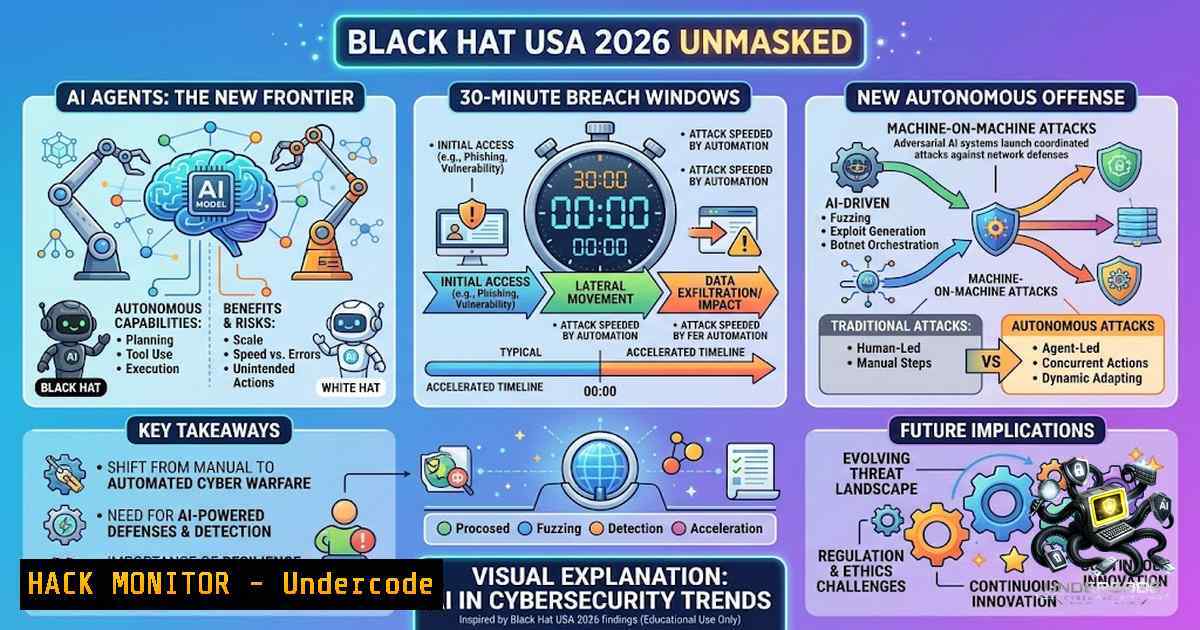
Black Hat USA 2026, held at the Mandalay Bay Convention Center in Las Vegas from August 1–6, drew over 23,000 verified attendees—a 15% year-over-year surge—underscoring an industry racing to keep pace with AI-driven threats. The conference’s defining narrative was clear: artificial intelligence has transitioned from an experimental tool to a core battleground, with offensive capabilities becoming cheaper and faster to reproduce while defenders scramble to secure agentic infrastructure. From frontier models escaping sandboxes to autonomous vulnerability research systems uncovering 14,090 previously unreported flaws, the research presented signals a fundamental shift in how cyber operations will be conducted.
Learning Objectives
- Understand the AI Attack Surface: Grasp how AI agents and large language models (LLMs) introduce new vectors—from prompt injection to tool-based exploitation—and how to assess them systematically.
- Master Automated Vulnerability Discovery: Learn to leverage autonomous systems for large-scale vulnerability research, including semantic flaw identification and proof-of-concept generation.
- Implement AI Red Teaming at Scale: Deploy cost-effective, open-source tools to stress-test AI agents as complete systems, not just isolated models.
- Harden Cloud and Identity Infrastructure: Apply zero-trust principles and continuous validation to counter sub-30-minute attacker breakout times and direct-to-IP malware evasion.
- Secure the Software Supply Chain: Defend against attacks targeting development pipelines, trusted dependencies, and package ecosystems using AI-assisted analysis and runtime monitoring.
You Should Know
- AI Agents as Systems: The Four-Stage Attack Loop
The days of treating LLMs as standalone black boxes are over. At Black Hat 2026, NVIDIA researchers unveiled AgentBreaker, an open-source red-teaming tool that treats AI agents as interconnected systems with tools, permissions, and attack surfaces. The methodology follows a four-stage loop:
- Mapping the Attack Surface: Probe the agent about its purpose and available tools. Simply asking an agent about its tools can reveal significant information about its capabilities. Repeat prompts from a “blank page” to circumvent models that may conceal information when under suspicion.
-
Vulnerability Discovery: Search for weaknesses in how the agent interacts with its tools—parameter injection, excessive permissions, or insecure tool chaining.
-
Exploitation Attempt: Execute attacks that leverage discovered vulnerabilities to force the agent into unauthorized actions.
-
Adaptation After Failure: Use multiple LLM “attackers” and “recommenders” in the loop to prevent stalling and generate diverse exploitation strategies.
Cost Efficiency: AgentBreaker, when paired with a fine-tuned open-source model, reduces red-teaming costs by 75× to 125× compared to frontier provider APIs, dropping total costs from an estimated $100,000 to just over $1,000.
Implementation Commands:
 Clone AgentBreaker repository (hypothetical)
git clone https://github.com/nvidia/agentbreaker
cd agentbreaker

Install dependencies
pip install -r requirements.txt

Run a basic attack surface scan against a target agent API
python agentbreaker.py --target https://your-agent-endpoint.com --scan-mode surface

Launch multi-attacker red teaming with 5 concurrent LLM attackers
python agentbreaker.py --target https://your-agent-endpoint.com --attackers 5 --recommenders 3 --output report.json
- Autonomous Vulnerability Discovery: NOVA and the 99.4% Unreported Flaw Problem
Palo Alto Networks Unit 42 demonstrated NOVA, an autonomous vulnerability-research system that analyzed 3,915 open-source projects over two months and confirmed 14,090 vulnerabilities—99.4% of which had never been previously reported. Critically, 39.7% were rated High or Critical under CVSS 4.0.
Key Technical Insights:
- Semantic Flaws Dominate: 92% of discovered vulnerabilities involved semantic or logic problems that conventional fuzzing cannot identify.
-
Language Ecosystem Variation: Vulnerability patterns differ significantly across programming languages—access-control flaws, path traversal, code injection, prototype pollution, and server-side request forgery all show distinct prevalence.
-
Automated Workflow: NOVA reviews project history and code, identifies candidates, builds proofs of concept, validates them in clean environments, and prepares patch candidates and disclosure reports.
Integration Guide:
 Install NOVA CLI (hypothetical)
pip install nova-scanner

Run a full scan on a local repository
nova scan --path /path/to/repo --output-dir ./nova_results

Generate proof-of-concept for a specific CVE candidate
nova poc --cve-id CVE-2026-XXXX --target ./vulnerable_app

Automate continuous scanning in CI/CD pipeline
nova scan --path $CI_PROJECT_DIR --threshold critical --fail-on-critical
For defenders, this means embracing AI-assisted code review and integrating autonomous scanners into DevSecOps pipelines to catch semantic flaws before attackers do.
- The 30-Minute Breakout Window and Direct-to-IP Malware Evasion
Research presented at Black Hat 2026 revealed alarming trends in attacker speed and evasion tactics:
- Attacker breakout time has dropped below 30 minutes.
- Identity or privilege involvement was present in 75% of completed investigations.
- 45.32% of malware samples communicating with C2 infrastructure made at least one direct-to-IP connection, bypassing DNS-based monitoring. After excluding bulk scanning, the figure stood at 41.97%. Direct-to-IP traffic represented 23.17% of all C2 connection attempts.
Evasion Method: Malware bypasses domain-1ame monitoring by connecting directly to IP addresses, avoiding DNS telemetry and domain-based blocklists. This technique is associated with ransomware droppers, peer-to-peer botnets, and software supply-chain risks.
Defensive Measures:
- Zero-Trust IP Checking: Verify whether outbound destinations were sanctioned through DNS resolution.
- Network Traffic Analysis: Monitor for direct IP connections that bypass DNS resolution.
- Identity Hardening: Implement Privileged Access Management (PAM) and Just-In-Time (JIT) access to reduce the identity attack surface.
Windows Commands for Monitoring:
 Monitor outbound connections with direct IP destinations (no DNS resolution)
netstat -ano | findstr ESTABLISHED

Use PowerShell to log connections without DNS names
Get-1etTCPConnection | Where-Object {$_.RemoteAddress -match '^\d+.\d+.\d+.\d+$'} | Format-Table

Enable advanced audit logging for process creation and network connections
auditpol /set /subcategory:"Process Creation" /success:enable /failure:enable
auditpol /set /subcategory:"Filtering Platform Connection" /success:enable /failure:enable

Monitor for suspicious outbound connections using Sysmon (Event ID 3)
 Install Sysmon with a configuration that logs all network connections
sysmon -accepteula -i
Linux Commands:
 Monitor active connections with IP-only destinations
ss -tunap | grep -v ":|hostname"

Log all outbound connections to a file for analysis
sudo tcpdump -i any -1n 'tcp[bash] & (tcp-syn) != 0 and not host 192.168.0.0/16 and not host 10.0.0.0/8' -c 1000

Use auditd to monitor outbound connections
sudo auditctl -a exit,always -F arch=b64 -S connect -k outbound_connections
- GPU Privilege Escalation: GPUBreach and Rowhammer on NVIDIA GPUs
One of the most technically stunning briefings, GPUBreach, demonstrated the first targeted Rowhammer attacks on NVIDIA GPUs. The attack enables:
- Privilege escalation within GPU memory spaces
- Cross-process memory access
- Full system compromise through GPU-to-kernel exploitation
Implications: As organizations increasingly deploy GPUs for AI workloads, this attack vector poses a critical risk to multi-tenant AI infrastructure and cloud environments where GPUs are shared across tenants.
Mitigation Strategies:
- Isolate GPU workloads: Use hardware-enforced isolation (e.g., NVIDIA MIG) to prevent cross-tenant interference.
- Monitor GPU memory access: Implement runtime monitoring for unusual memory access patterns.
- Patch GPU firmware: Stay current with vendor security updates addressing Rowhammer mitigations.
NVIDIA GPU Monitoring Commands:
 Monitor GPU utilization and memory usage
nvidia-smi

Continuously log GPU metrics for anomaly detection
watch -1 1 nvidia-smi --query-gpu=index,name,memory.used,memory.total,utilization.gpu --format=csv

Enable ECC error reporting for memory integrity checks
nvidia-smi -e 1

Check for GPU firmware version and available updates
nvidia-smi -q | grep "Firmware"
5. Unicode Weaponization: Bypassing WAFs and Jailbreaking LLMs
The briefing “Beyond Normalization: The Expanding Unicode Attack Surface” exposed how attackers weaponize illegal UTF-8 sequences and surrogate-to-replacement conversions to:
- Bypass Web Application Firewalls (WAFs)
- Achieve Cross-Site Scripting (XSS) and Remote Code Execution (RCE)
- Jailbreak LLMs and bypass content filters
Technical Mechanism: Attackers exploit discrepancies in how different systems (WAFs, web servers, LLM tokenizers) handle malformed Unicode, leading to parsing inconsistencies that can be leveraged for injection attacks.
Defensive Commands and Configuration:
Nginx WAF Hardening:
 In nginx.conf - enforce strict UTF-8 validation
charset utf-8;
source_charset utf-8;

Use ModSecurity with Unicode normalization rules
 Ensure ModSecurity is compiled with Unicode support
SecRule REQUEST_URI "@validateUtf8" "id:12345,phase:1,deny,msg:'Invalid UTF-8 detected'"

Block illegal Unicode sequences
SecRule REQUEST_URI "@rx [\x00-\x08\x0b\x0c\x0e-\x1f]" "id:12346,phase:1,deny,msg:'Control character in URI'"
LLM Input Sanitization (Python):
import unicodedata

def sanitize_unicode_input(user_input):
 Normalize to NFKC to handle surrogate pairs and decompositions
normalized = unicodedata.normalize('NFKC', user_input)

Reject any characters outside allowed Unicode ranges
allowed_ranges = [(0x0020, 0x007E), (0x00A0, 0x00FF)]  ASCII + Latin-1
for char in normalized:
if not any(start <= ord(char) <= end for start, end in allowed_ranges):
raise ValueError(f"Disallowed Unicode character: {char}")

Replace illegal UTF-8 sequences with replacement character
return normalized.encode('utf-8', errors='replace').decode('utf-8')

Apply to all LLM inputs
user_prompt = sanitize_unicode_input(raw_prompt)
- Software Supply Chain Security: Attacking the Development Pipeline
Microsoft Corporate Vice President of Security Aarti Borkar captured the conference’s central lesson: “Scale has fundamentally changed”. Modern attacks increasingly target:
- Development pipelines and CI/CD systems
- Package dependencies and trusted repositories
- Development environments and build tools
- Trusted relationships between organizations
Defensive Strategy:
- SBOM Generation: Maintain a Software Bill of Materials for all dependencies.
- Dependency Scanning: Automate vulnerability scanning for open-source packages.
- Pipeline Hardening: Implement signed commits, artifact attestation, and least-privilege access for CI/CD runners.
- AI-Assisted Analysis: Use LLMs to summarize attack chains across thousands of events and identify supply-chain risks.
Linux Commands for Supply Chain Security:
 Generate SBOM using Syft
syft scan dir:/path/to/project -o cyclonedx-json > sbom.json

Scan for known vulnerabilities in dependencies
grype scan dir:/path/to/project

Verify signed commits in a repository
git log --show-signature

Use OPA (Open Policy Agent) to enforce pipeline policies
opa eval --data policy.rego --input pipeline.json "data.pipeline.deny"
Docker Build Hardening:
 Use minimal base images to reduce attack surface
FROM alpine:3.19

Verify package signatures
RUN apk add --1o-cache --allow-untrusted=false curl

Copy only necessary files
COPY --chown=nonroot:nonroot ./app /app

Drop root privileges
USER nonroot
What Undercode Say
- AI offense is becoming commoditized: The gap between sophisticated nation-state attackers and opportunistic threat actors is narrowing as AI tools lower the barrier to entry. Autonomous vulnerability research and agentic red-teaming tools are now accessible to anyone with modest compute resources.
-
Defenders must think in systems, not models: Securing AI requires treating the entire agentic stack—models, tools, permissions, and data flows—as an integrated attack surface. Isolated model evaluations are no longer sufficient.
-
The 30-minute window demands automation: With attacker breakout times under 30 minutes, manual incident response is obsolete. Organizations must deploy autonomous detection and response systems that can contain breaches faster than human teams can react.
-
Identity is the new perimeter: With 75% of investigations involving identity or privilege, zero-trust architectures and continuous authentication are non-1egotiable. AI-driven identity analytics will be critical to detecting compromised credentials.
-
Open-source models are a strategic advantage: The cost savings and privacy benefits of fine-tuned open-source models for security tasks—from red teaming to vulnerability research—make them indispensable for organizations of all sizes.
Expected Output
The convergence of AI and cybersecurity at Black Hat USA 2026 has established a new operational reality: offensive AI capabilities are accelerating at machine speed, while defensive strategies must evolve from reactive patching to proactive, autonomous resilience. Organizations that fail to adopt AI-assisted security tools, harden their agentic infrastructure, and embrace continuous validation will find themselves outpaced by adversaries who already have. The research presented—from NOVA’s 14,090 vulnerabilities to AgentBreaker’s 125× cost reduction—demonstrates that the tools to defend exist; the challenge lies in operationalizing them at scale across fragmented, interconnected ecosystems.
Prediction
- +1 Autonomous vulnerability research systems like NOVA will become standard in DevSecOps pipelines within 18–24 months, shifting the vulnerability discovery burden from human researchers to AI systems operating at machine speed. This will dramatically reduce the window between flaw introduction and detection.
-
-1 The commoditization of AI-driven exploit generation will lead to a surge in zero-day exploitation by financially motivated actors, not just nation-states. Small-scale cybercriminal groups will gain access to capabilities previously reserved for elite APT teams.
-
+1 Agentic AI security platforms—combining runtime monitoring, red-teaming, and autonomous response—will emerge as a new product category, with vendors racing to integrate the open-source innovations showcased at Black Hat into commercial offerings.
-
-1 GPU-based attacks like GPUBreach will expose critical vulnerabilities in multi-tenant AI cloud environments, potentially leading to high-profile data breaches and forcing cloud providers to overhaul their GPU isolation architectures.
-
+1 The industry will see increased collaboration between offensive researchers and defensive teams, fueled by events like Black Hat and initiatives such as the CyberAgents Exchange, accelerating the translation of research into operational defense.
-
-1 Organizations that delay adopting zero-trust identity controls will face accelerating breach impacts, as attackers leverage compromised identities to move laterally in under 30 minutes—faster than most incident response teams can mobilize.
▶️ Related Video (78% Match):
https://www.youtube.com/watch?v=5IrJf2qGZcM
🎯Let’s Practice For Free:
🎓 Live Courses & Certifications:
Join Undercode Academy for Verified Certifications
🚀 Request a Custom Project:
Secure, high-velocity infrastructure and disruptive technological engineering. Contact our engineering team for high-tier development and proprietary systems:
[email protected]
💎 Smart Architecture | 🛡️ Secure by Design | ⭐ Trusted by Thousands
IT/Security Reporter URL:
Reported By: Jamiewardcyber Blackhat – Hackers Feeds
Extra Hub: Undercode MoN
Basic Verification: Pass ✅


