
Listen to this Post
Introduction:
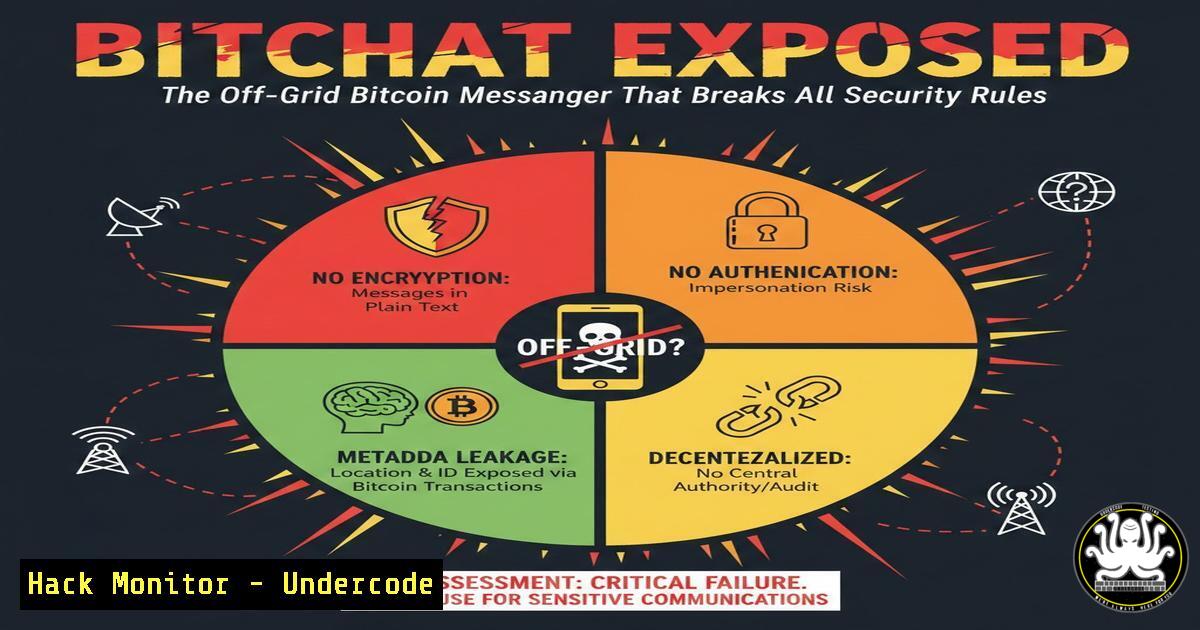
In a move that has sent ripples through both the cybersecurity and fintech sectors, Jack Dorsey’s latest project, Bitchat, proposes a radical shift in how we perceive digital communication and value transfer. By leveraging Bluetooth mesh networks, the application facilitates peer-to-peer Bitcoin transactions and encrypted messaging without relying on the internet, cellular infrastructure, or centralized servers. While this innovation promises uncensorable communication and financial sovereignty in disconnected environments, a deep dive into its architecture reveals critical security vulnerabilities that challenge the very foundations of secure, offline digital finance.
Learning Objectives:
- Objective 1: Understand the architecture and security implications of Bluetooth Mesh networks in decentralized applications.
- Objective 2: Analyze the cryptographic flaws, specifically the lack of Perfect Forward Secrecy (PFS) and susceptibility to Man-in-the-Middle (MitM) attacks.
- Objective 3: Explore command-line tools and verification techniques for auditing offline transaction security and mesh network integrity.
You Should Know:
1. The Anatomy of an Off-Grid Mesh Network
Bitchat operates by creating a decentralized mesh network using Bluetooth Low Energy (BLE). Each device acts as both a client and a node, relaying messages and transactions to nearby devices without a central server . This “store and forward” model allows data to hop between devices within a range of approximately 30 to 300 meters, effectively creating a network that thrives on physical proximity . For cybersecurity professionals, this raises immediate red flags regarding traffic interception and node trust.
Step‑by‑step guide: Analyzing BLE Mesh Traffic on Linux
To understand the data being transmitted, security researchers can use a standard Linux distribution with a Bluetooth adapter.
1. Enable Monitoring Mode: First, ensure your Bluetooth adapter supports monitoring. Use `hciconfig` to identify your device (e.g., hci0). Stop the Bluetooth service and enable raw packet capture:
sudo systemctl stop bluetooth
sudo hciconfig hci0 down
sudo hciconfig hci0 up
2. Capture BLE Packets: Use `btmon` (Bluetooth Monitor) to capture live traffic. This tool provides a hexadecimal and human-readable dump of BLE activity.
sudo btmon
3. Analyze Packet Structure: Look for packets advertising the Bitchat service. Analysts can filter for specific UUIDs or raw data patterns to identify transaction initiation or message payloads, allowing them to map the network topology and identify node relationships.
- Cryptographic Protocols: From Weekend Project to Noise Framework
Initially, Bitchat’s encryption relied on static key exchanges using Curve25519 and AES-GCM, which critics quickly identified as vulnerable to identity spoofing due to the absence of Perfect Forward Secrecy (PFS) . In response, Dorsey committed to adopting the Noise Protocol Framework, a more robust foundation for cryptographic protocols . However, the early implementation highlighted a crucial lesson: even end-to-end encryption claims are meaningless without proper authentication and key rotation mechanisms.
Step‑by‑step guide: Verifying Protocol Security with Test Vectors
Security engineers can verify a protocol’s implementation using test vectors to ensure it meets specifications like the Noise Framework.
1. Retrieve Test Vectors: Download the official Noise Protocol test vectors from the IETF or the Noise project’s official repository. These vectors contain inputs and expected outputs for handshake patterns like `XX` or IK.
2. Simulate the Handshake: Using a scripting language like Python with cryptographic libraries, simulate the handshake process. For example, to test the `Noise_XX_25519_AESGCM_SHA256` pattern, you would run:
 Pseudo-code for testing handshake validity
from cryptography.hazmat.primitives.asymmetric import x25519
 Compare derived session keys against official test vectors
assert(derived_key == expected_key_from_vector)
3. Audit for Forward Secrecy: Ensure that the derived session keys are ephemeral. If compromising the device’s long-term private key allows an attacker to decrypt past sessions, PFS is not implemented.
3. The Double-Spend Dilemma in Offline Transactions
While Bitchat enables the sending of Bitcoin payments offline, it inherits the fundamental problem of decentralized offline finance: double-spending. In an online environment, nodes validate transactions against the ledger. Offline, a malicious actor could send the same Bitcoin UTXO (Unspent Transaction Output) to multiple recipients within the mesh network, with no immediate way to verify which transaction is valid until one party eventually connects to the internet and broadcasts it to the blockchain . This risk severely limits its utility for high-value, real-time commerce.
Step‑by‑step guide: Simulating a Double-Spend Attempt
Understanding this vulnerability is key. In a lab environment, security researchers can simulate this by creating a local regtest (regression test) Bitcoin network.
1. Setup Bitcoin Core in Regtest Mode: This allows you to create a private blockchain where you control block generation.
bitcoind -regtest -daemon
bitcoin-cli -regtest createwallet "test"
bitcoin-cli -regtest -generate 101
2. Create a UTXO: Generate a new address and send funds to it. Note the TXID.
ADDR1=$(bitcoin-cli -regtest getnewaddress)
TXID=$(bitcoin-cli -regtest sendtoaddress $ADDR1 1)
3. Construct Conflicting Transactions: Create two different raw transactions spending the same UTXO to two different addresses.
bitcoin-cli -regtest createrawtransaction '[{"txid":"'$TXID'","vout":0}]' '{"'$ADDR2'":0.5,"'$ADDR3'":0.4999}'
In a real Bitchat scenario, these two conflicting transactions would propagate through the mesh, demonstrating how a recipient might accept payment for goods only to find the funds invalid upon eventual on-chain settlement.
4. Identity Spoofing and the MitM Attack Vector
The most immediate threat discovered in Bitchat’s early code was the ability for an attacker to perform a Man-in-the-Middle (MitM) attack. Because the initial authentication mechanism was flawed, an adversary within Bluetooth range could impersonate a trusted contact, intercepting and modifying messages or transaction requests without either party realizing the communication was compromised . This vulnerability exploits the very nature of mesh networks, where every node is a potential relay.
Step‑by‑step guide: Testing MitM Vulnerability with BetterCAP
Security professionals can test the resilience of such apps using frameworks like BetterCAP on Linux.
1. Enable Bluetooth Interface: Start BetterCAP and enable the Bluetooth module.
sudo bettercap -eval "set bluetooth.interface hci0; bluetooth.recon on"
2. Target Pairing Process: During a simulated Bitchat pairing session, use BetterCAP to attempt to inject malicious packets or replay captured handshake data. If the application accepts a replayed or spoofed public key without out-of-band verification (like comparing safety numbers), it is vulnerable.
3. Injection Attempt: Use the `ble.enum` and `ble.write` commands to interact with discovered GATT (Generic Attribute Profile) services, attempting to write malicious data to a characteristic used for key exchange.
5. Compliance and Regulatory Visibility
From a governance perspective, Bitchat presents a nightmare scenario for regulators. Financial frameworks like AML (Anti-Money Laundering) and KYC (Know Your Customer) rely on network-level visibility and centralized points of control. Allan Duarte noted in the original discussion that Bitchat “removes that assumption entirely,” making transactions invisible to traditional infrastructure and effectively ungovernable . For CISOs and compliance officers, this highlights the emerging challenge of “shadow finance” operating outside corporate network perimeters.
6. Hardening Mobile Endpoints for Mesh Participation
Given the risks, if an organization were to experiment with such technology, endpoint hardening is non-negotiable. Devices must be configured to prevent data leakage if they fall into the wrong hands, as they now hold the keys to both communication and value transfer. Bitchat includes an emergency wipe feature (triple-tap to clear data), but this is a reactive measure .
Step‑by‑step guide: iOS Security Configuration for High-Risk Environments
- Enable USB Restricted Mode: In iOS settings, ensure that USB accessories are blocked if the device has been locked for over an hour. This prevents forensic tools from accessing data via physical connection.
- Configure MDM Restrictions: If using Mobile Device Management (MDM), push a configuration profile that disables Bluetooth advertising when the screen is locked and enforces the use of a complex alphanumeric passcode.
- Network Isolation: Implement a VPN that activates on-demand for all apps. While Bitchat bypasses the internet, a VPN ensures that if the device does connect to an untrusted Wi-Fi network for other apps, the traffic is encrypted to a corporate gateway, preventing local lateral attacks.
What Undercode Say:
- Innovation vs. Security Maturity: Bitchat is a textbook example of “move fast and break things” applied to secure communications. While the pivot to the Noise protocol is commendable, the initial weekend-project approach to cryptography could endanger users in high-stakes environments like protests or disaster zones.
- Offline Finance Requires New Trust Models: The double-spend problem proves that simply moving blockchain transactions offline without a reputation or insurance layer is insufficient. Solutions like reputation-weighted loan networks, as proposed in recent academic papers, are necessary to bridge the gap between offline convenience and on-chain finality .
Analysis: Bitchat forces the cybersecurity community to confront a future where data and value move outside traditional perimeters. The tools we use to monitor networks—firewalls, SIEMs, DLP—are rendered blind. The focus must shift to endpoint security, cryptographic agility, and user education. Dorsey’s project, despite its flaws, is a stress test for the industry. It asks whether we can secure a network that isn’t really a network in the traditional sense, but a dynamic, organic mesh of human proximity. The answer will define the next decade of digital privacy and financial sovereignty.
Prediction:
We will likely see a bifurcation in the development of offline mesh technologies. On one hand, open-source, privacy-focused projects will continue to evolve, albeit slowly, as they grapple with complex cryptographic challenges without centralized funding. On the other hand, we can expect nation-states and large corporations to develop proprietary, hardened versions of this technology for military, disaster recovery, and industrial IoT applications. This will create a “mesh divide,” where the most secure offline communication tools are only available to those with significant resources, leaving the public with accessible but potentially vulnerable alternatives. The cat-and-mouse game of intercepting mesh communications will become a new frontier in electronic surveillance and counter-surveillance.
▶️ Related Video (86% Match):
🎯Let’s Practice For Free:
IT/Security Reporter URL:
Reported By: Https: – Hackers Feeds
Extra Hub: Undercode MoN
Basic Verification: Pass ✅


