
Listen to this Post
Introduction:
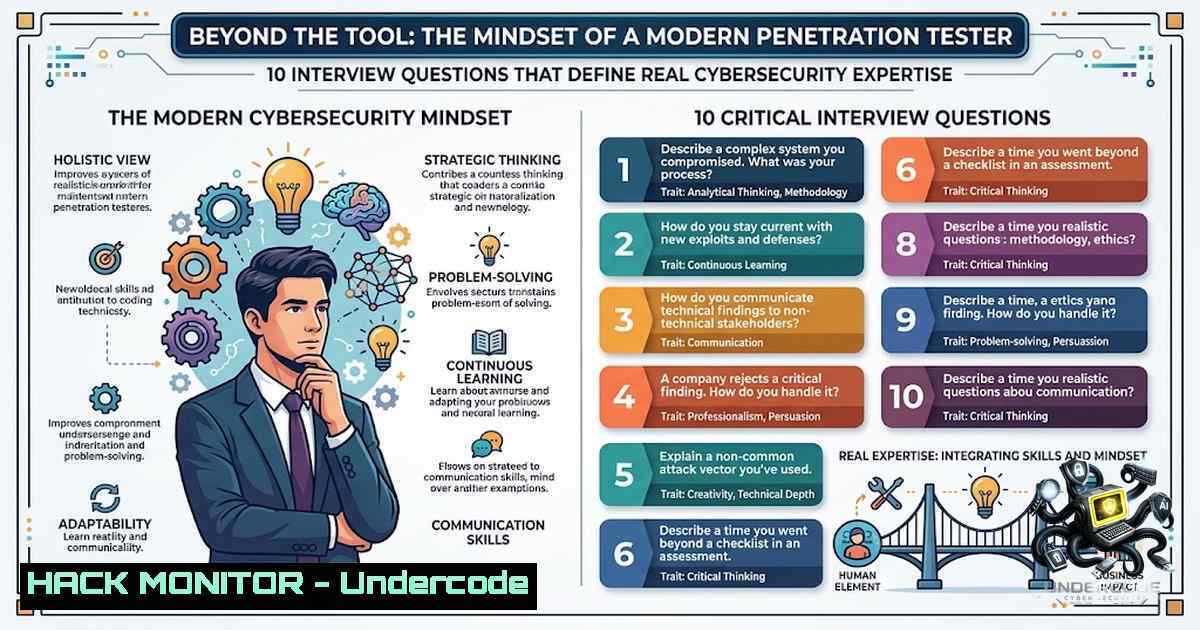
The cybersecurity industry is saturated with tool-centric professionals who can run a vulnerability scanner but lack the critical thinking to interpret results within a business context. A recent technical interview framework shared by a veteran IT leader challenges this norm, presenting a scenario-based evaluation that prioritizes problem-solving methodology over memorized command syntax. This approach reveals a fundamental truth: ethical hacking is not about knowing the most tools, but about understanding how to think like an adversary while operating as a responsible defender.
Learning Objectives & Secrets:
- Objective 1: Master Reconnaissance and Attack Surface Mapping – Learn to move beyond basic port scanning to perform deep service enumeration and version detection.
- Objective 2 Secret: Risk-Validated Exploitation – Understand the critical difference between finding a vulnerability and safely validating it in a production environment without causing disruption.
- Objective 3 Secret: Business-Centric Communication – Develop the ability to translate complex technical risks into clear, actionable business language for non-technical stakeholders and skeptical IT teams.
You Should Know:
1. Reconnaissance and Initial Attack Surface Analysis
The foundation of any penetration test is a thorough reconnaissance phase. While many candidates start with an Nmap scan, the real expertise lies in interpreting the results. When you discover an open port, the immediate next step isn’t exploitation; it is service fingerprinting and understanding the application logic. For example, finding port 8080 open isn’t enough—you must determine if it’s a Tomcat server, an Apache proxy, or a custom application. This involves banner grabbing and sending specific probes to identify the exact version.
Step‑by‑Step Guide for Service Enumeration:
- Linux Command for Version Detection: Use `nmap -sV -sC -O -p- -oA service_enum
` to perform comprehensive version detection and OS fingerprinting. The `-sC` flag runs default scripts, which are crucial for initial discovery. - Windows Command for Banner Grabbing: On Windows, you can use `telnet
80` followed by `HEAD / HTTP/1.0` to grab the server header, or use PowerShell: `Test-1etConnection -Port 80 ` followed by a `Send-TcpRequest` script to read the banner. - Analyzing Results: Create a matrix of services and their versions (e.g., Apache 2.4.49, OpenSSH 7.2p2). Cross-reference these with public CVE databases to prioritize high-risk services.
- Directory Bruteforcing: Use `gobuster dir -u http://
-w /usr/share/wordlists/dirb/common.txt -t 50` to discover hidden directories that expand the attack surface. -
Web Application Security Testing – SQL Injection and Logic Flaws
When suspecting a SQL injection vulnerability, the goal is to confirm the flaw without damaging the database. This requires controlled testing using specialized tools and manual payloads. The focus is on using Boolean-based and time-based techniques to avoid destructive DROP or UPDATE commands.
Step‑by‑Step Guide for Safe SQL Injection Testing:
- Manual Verification: Insert a simple payload like `’ OR ‘1’=’1` into a search bar or login form. Monitor the application’s response time and error messages.
- Automated Confirmation with SQLMap: Use `sqlmap -u “http://target.com/page?id=1” –batch –level=5 –risk=3 –technique=BEUST` to test for specific techniques. The `–batch` flag uses default options to avoid interactive prompts, which is safer for new testers.
- Burp Suite Proxy Setup: Configure your browser to route traffic through Burp Suite (default port 8080). Intercept the request and send it to Repeater to manually craft and re-send the payload.
- Using Burp Intruder: For fuzzing, send the request to Intruder, select the parameter for the payload position, and load a payload list like `SQLi-XSS-payloads.txt` to automate the injection process.
- Exploitation (Proof of Concept): If the database is vulnerable, extract a benign piece of information like the database version using
' UNION SELECT @@version --, rather than extracting entire tables.
3. Authentication, Authorization, and Session Management
Testing a login page involves more than just checking if the username ‘admin’ works. It requires a deep dive into how the application handles sessions, privilege escalation, and access control. The objective is to identify flaws in business logic that allow a standard user to act as an administrator.
Step‑by‑Step Guide for Authentication Testing:
- Session Management Testing: Use Burp Suite to analyze the session cookie (e.g.,
JSESSIONID). Check if it has theHttpOnly,Secure, and `SameSite` attributes. Use an extension like “Cookie-Editor” to manually modify the cookie and see if the application accepts arbitrary values. - Privilege Escalation: After logging in as a low-privileged user, change the URL parameters or hidden form fields to access admin endpoints (e.g., change `user_id=123` to
user_id=1). - Authorization Bypass: Test for Insecure Direct Object References (IDOR) by attempting to access resources like `/profile.php?user=admin` to view or modify data without proper permissions.
- Authentication Bypass: Test for brute-force protection by sending multiple login attempts with varying usernames and passwords using the Intruder tool. Look for password reset functionalities that can be used to take over an account.
- Tool Configuration: For OWASP ZAP, use the “Forced Browse” or “Fuzzer” to test for these flaws. The automation script can be set to run against a list of common admin directories.
-
Vulnerability Prioritization – Separating Noise from Critical Risk
A typical scan might return 50 vulnerabilities, but treating them all with the same urgency is a recipe for disaster. Prioritization is a skill that separates junior testers from senior consultants. The CVSS score is a good starting point, but it must be weighed against the business context and exploitability.
Step‑by‑Step Guide for Risk Prioritization:
- Calculate CVSS: Use the NVD calculator to determine the base score. A vulnerability with a 9.8 CVSS score is critical, but if the asset is a test server, its priority is low.
- Determine Business Impact: Analyze the asset’s role. Is it a public-facing e-commerce server or an internal employee portal? The “Confidentiality, Integrity, Availability” (CIA) triad must be mapped to the business.
- Assess Exploitability: Check if a public exploit exists (e.g., on Exploit-DB). A vulnerability with a CVSS of 7.5 but no working exploit may be less risky than a CVSS 6.5 vulnerability with a readily available Metasploit module.
- Create a Priority Matrix: Use a spreadsheet to categorize vulnerabilities as Critical (Remote Code Execution), High (SQL Injection), Medium (Information Disclosure), and Low (Missing Security Headers).
- Reporting: In your report, explicitly state the “Priority” column based on this analysis, not just the CVSS score.
5. Technical Communication and Risk Translation
Finding a critical vulnerability is only half the battle. The other half is convincing the client’s IT team, who may be defensive or skeptical, that the risk is real. This requires moving away from technical jargon to business language. For instance, instead of saying “You have a SQL injection,” say “An attacker can dump your entire customer database, leading to significant GDPR fines and reputational damage.”
Step‑by‑Step Guide for Effective Risk Communication:
- Prepare Technical Evidence: Gather clear, reproducible steps (PoC) that demonstrate the vulnerability. Use screenshots and video to show the exploit in action.
- Translate to Business Terms: Explain the “so what?” factor. If it’s a file upload vulnerability, explain that an attacker could upload a web shell, gain full control of the server, and shut down the website during peak sales hours.
- Use the “1:3:1” Rule: For every vulnerability, provide 1 sentence of technical detail, 3 sentences of business impact, and 1 sentence of a clear remediation suggestion.
- Handling Denials: If the client denies the risk, offer to organize a live demonstration in a controlled staging environment (if possible) or walk them through the exploitation logic step-by-step.
- Documentation: Include a “Risk vs. Business Impact” section in the final report.
-
The Complete Pentest Lifecycle – Remediation and Retesting
The job doesn’t end when the report is delivered. The most valuable pentesters guide the remediation process and perform retesting to verify that the fixes are effective. This ensures that the risk is actually eliminated, not just patched superficially.
Step‑by‑Step Guide for Remediation and Retesting:
- Provide Remediation Code Snippets: For an SQL injection, provide a parameterized query code sample for the language the application uses (e.g., Python `psycopg2` or Java
PreparedStatement). - Apply Patch Management: For OS vulnerabilities, advise on updating Linux packages (
sudo apt update && sudo apt upgrade) or applying Windows critical updates viaWSUS. - Configuration Hardening: For web server vulnerabilities, provide hardening guides (e.g., for Apache, disable unnecessary modules; for Nginx, enforce strong TLS configurations).
- Retesting Script: After the client applies the patches, re-run your automated tools (Nmap, OpenVAS) and manually re-test the specific endpoints where the vulnerabilities were found.
- Update the Report: Mark the vulnerabilities as “Resolved” or “Mitigated” and provide a “Retest Result” to confirm the fix.
What Undercode Say:
- Key Takeaway 1: The core of penetration testing is not about tool proficiency but about the tester’s thought process and ability to adapt to complex, real-world scenarios.
- Key Takeaway 2: Effective risk management is a holistic process that involves finding vulnerabilities, validating them safely, and communicating the business impact clearly to ensure they are fixed.
The interview questions provided highlight a critical gap in the industry: many aspiring pentesters focus on learning how to use a tool rather than understanding the underlying attack mechanics. A true security professional is defined by their ability to ask the right questions, prioritize risks based on business context, and guide the remediation process. This methodology transforms a tester from a “vulnerability finder” into a trusted security advisor. The emphasis on communication is particularly relevant, as the ability to articulate risk is often what differentiates a good report from a great one. Ultimately, the goal is to reduce risk, not just to check a compliance box.
Prediction:
- +1 As AI and automation tools become more prevalent, the demand for human penetration testers with strong communication and risk assessment skills will increase significantly. Organizations will realize that AI can find vulnerabilities, but only humans can contextualize them.
- +1 The industry will see a shift in certification curricula away from pure tool-based exams and toward scenario-based, hands-on simulations that test decision-making under pressure.
- -1 There is a risk that organizations may become overly reliant on automated scanners and ignore the need for manual testing, leading to a rise in complex, logic-based flaws being exploited by sophisticated attackers.
- -1 The cybersecurity skills shortage will continue to widen if companies do not change their hiring criteria to prioritize mindset and soft skills over the number of certifications a candidate possesses.
▶️ Related Video (70% Match):
🎯Let’s Practice For Free:
🎓 Live Courses & Certifications:
Join Undercode Academy for Verified Certifications
🚀 Request a Custom Project:
Secure, high-velocity infrastructure and disruptive technological engineering. Contact our engineering team for high-tier development and proprietary systems:
[email protected]
💎 Smart Architecture | 🛡️ Secure by Design | ⭐ Trusted by Thousands
IT/Security Reporter URL:
Reported By: https://lnkd.in/p/ewBS-fT4 – Hackers Feeds
Extra Hub: Undercode MoN
Basic Verification: Pass ✅


