Listen to this Post
Introduction:
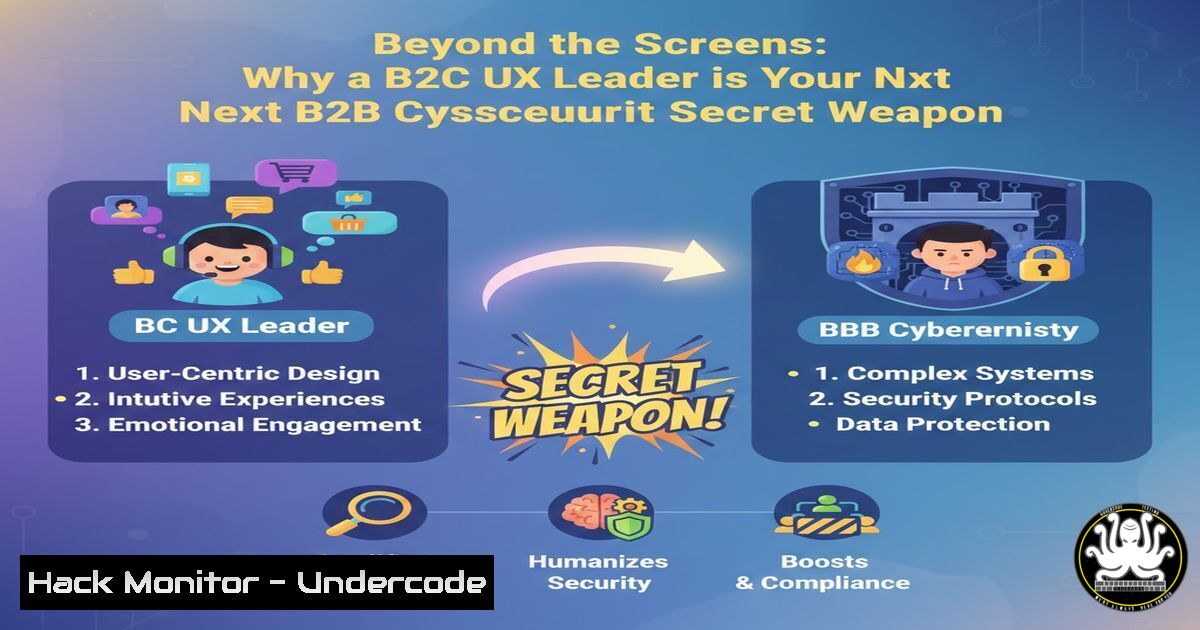
In the high-stakes realm of B2B cybersecurity and enterprise IT, user experience (UX) is often relegated to a secondary concern behind features and compliance. However, this mindset creates a critical vulnerability: complex security dashboards and IT management platforms with poor UX become attack surfaces of friction, leading to dangerous user workarounds, misconfigurations, and alert fatigue. The paradigm is shifting, and the strategic hire of a Head of UX with a consumer (B2C) background is emerging as a potent, unconventional strategy to harden your human layer and drive adoption of secure practices.
Learning Objectives:
- Understand why B2C UX principles are critical for reducing human-error security risks in enterprise tools.
- Learn how to integrate UX metrics into your DevSecOps and IT service management lifecycle.
- Discover technical and process changes to implement consumer-grade usability in B2B security products.
You Should Know:
- The Human Firewall is Failing: UX as a Security Control
The first line of defense in any organization is its users. A confusing Identity and Access Management (IAM) portal or a convoluted Security Information and Event Management (SIEM) interface doesn’t just frustrate—it incentivizes risky behavior. Users may share credentials to bypass a difficult login flow, ignore critical alerts buried in noise, or misconfigure cloud storage buckets due to unclear settings.
Step-by-step guide:
Conduct a UX Security Audit: Map key user journeys in your critical internal tools (e.g., VPN access, admin consoles, ticketing systems).
Identify Friction Points: Use session recording tools (with proper privacy controls) or conduct user interviews to find where employees struggle or create “shadow IT” solutions.
Implement Gradual Improvements: For an IAM portal, simplify the login flow. Implement Single Sign-On (SSO) to reduce password fatigue. For an admin panel, use feature flags to roll out a clearer UI incrementally. A B2C-trained leader will champion this by tying UX improvements to security KPIs like reduced help-desk tickets for access issues or faster mean-time-to-acknowledge (MTTA) for security alerts.
- From Alert Fatigue to Actionable Insight: Designing for SOC Analysts
Security Operations Center (SOC) analysts are bombarded with thousands of alerts daily. A poorly designed interface contributes to burnout and critical misses. B2C UX leaders excel at information hierarchy and reducing cognitive load—skills directly transferable to building analyst-centric dashboards.
Step-by-step guide:
Aggregate and Prioritize: Use the ELK Stack (Elasticsearch, Logstash, Kibana) or Splunk to centralize logs. A B2C UX approach would then design Kibana/Splunk visualizations that surface the top 5 critical attack patterns instead of a raw log dump.
Create Clear Visual Workflows: Design dashboards with a clear visual narrative. For example, a “Phishing Campaign Overview” dashboard should immediately show: Emails Blocked, Users Clicked, Remediation Actions Taken—all in one glance.
Automate Triage with Playbooks: Integrate with SOAR platforms. The UX role is to design the playbook editor and execution interface to be as intuitive as a consumer workflow builder (like IFTTT or Zapier), encouraging analysts to build and use automation.
- API Security & Developer Experience: The Onboarding Funnel
Your API is a core B2B product. If the documentation and authentication flow are cumbersome, developers will seek insecure shortcuts. B2C leaders understand the “first-time user experience” (FTUE) profoundly.
Step-by-step guide:
Revamp API Documentation: Use tools like Swagger UI or Redoc to generate interactive docs. A B2C lens insists on including one-click “Copy cURL Command” buttons, pre-populated API keys for sandboxes, and real-world code snippets in multiple languages.
Simplify Authentication: Implement and clearly document OAuth 2.0 flows. Provide a simple web-based “Get Token” playground. Example for a quick test:
 Clear, documented curl command to get a bearer token
curl -X POST https://api.yourcompany.com/v1/auth/token \
-H "Content-Type: application/json" \
-d '{"api_key": "your_sandbox_key", "secret": "your_sandbox_secret"}'
Monitor for UX-Driven Security Issues: Track metrics like time-to-first-successful-API-call and use API gateways to detect developers hardcoding secrets in client-side code due to complex setup.
4. Cloud Hardening Through Intuitive Governance
Cloud security platforms (CSPM) like AWS Config, Azure Policy, or Wiz are powerful but notoriously complex. A UX leader can drive the creation of simplified, role-based interfaces that make secure configuration the default, easy path.
Step-by-step guide:
Build Self-Service Security Portals: Use infrastructure as code (IaC) templates (Terraform, CloudFormation) pre-configured with security best practices. The UX is a curated internal “App Store” where developers can provision a “Hardened PostgreSQL DB” or “Secure S3 Bucket” with one click.
Implement Clear Compliance Dashboards: Instead of spreading compliance status across multiple tools, create a single-pane-of-glass dashboard using data pulled from cloud APIs. Use green/yellow/red status indicators and plain-language explanations of risks (e.g., “Storage bucket is publicly accessible”).
Automate Remediation with Approval Flows: Design simple approval workflows for exception requests. Use tools like Jira Service Desk or Saviynt, but apply B2C form design principles to keep them quick and clear.
5. Training & Phishing Simulations That Actually Engage
Security awareness training fails when it’s a tedious checkbox exercise. B2C product leaders know how to build engaging, gamified learning experiences.
Step-by-step guide:
Develop Micro-learning Modules: Break training into 2–3 minute videos or interactive modules. Use relatable scenarios instead of technical jargon.
Create Realistic, Phased Phishing Campaigns: Use platforms like KnowBe4. Start with obvious phishing emails and progress to sophisticated spear-phishing模仿. A B2C approach focuses on the feedback given after a click—turning the moment of failure into an immediate, constructive learning opportunity with a clear explanation of the red flags.
Track Engagement, Not Just Completion: Move beyond “90% completed training.” Measure click-through rates on simulated phishing over time, and survey user sentiment on training materials. A/B test different training formats to see what drives real behavioral change.
What Undercode Say:
- UX is an Exploit Surface: A poorly designed enterprise interface is not just an inconvenience; it’s a vulnerability that adversaries indirectly exploit through user error and avoidance.
- The Talent Crossover is Strategic: Hiring a B2C UX leader for a B2B cybersecurity or IT role is not a gamble on domain knowledge; it’s a deliberate acquisition of skills in driving adoption, reducing friction, and creating metric-obsessed accountability—all of which are required to mature a security program from a cost center to a business enabler.
The analysis suggests that the industry’s focus on technical controls has neglected the human-interaction layer, creating a gap between security capability and security utility. A leader trained in environments where user abandonment has an immediate revenue impact instinctively translates that urgency to environments where abandonment (of secure processes) has a delayed but catastrophic risk impact. They force the organization to measure what matters: user compliance velocity, tool adoption rates, and reduction in procedural workarounds. This bridges the final mile of security implementation.
Prediction:
Within three years, “Security UX” or “DevSecOps UX” will emerge as a defined specialization. CISOs will have UX metrics (e.g., Secure Task Completion Rate, Policy Comprehension Score) alongside traditional vuln metrics on their board reports. The most successful B2B cybersecurity and IT vendors will be those who hire B2C talent to make their powerful platforms intuitively usable, turning superior user experience into a primary competitive differentiator and a genuine security control. The failure to do so will leave organizations with powerful tools that their teams simply refuse to use correctly.
▶️ Related Video (78% Match):
🎯Let’s Practice For Free:
IT/Security Reporter URL:
Reported By: Laveena Lobo – Hackers Feeds
Extra Hub: Undercode MoN
Basic Verification: Pass ✅


