Listen to this Post
Introduction:
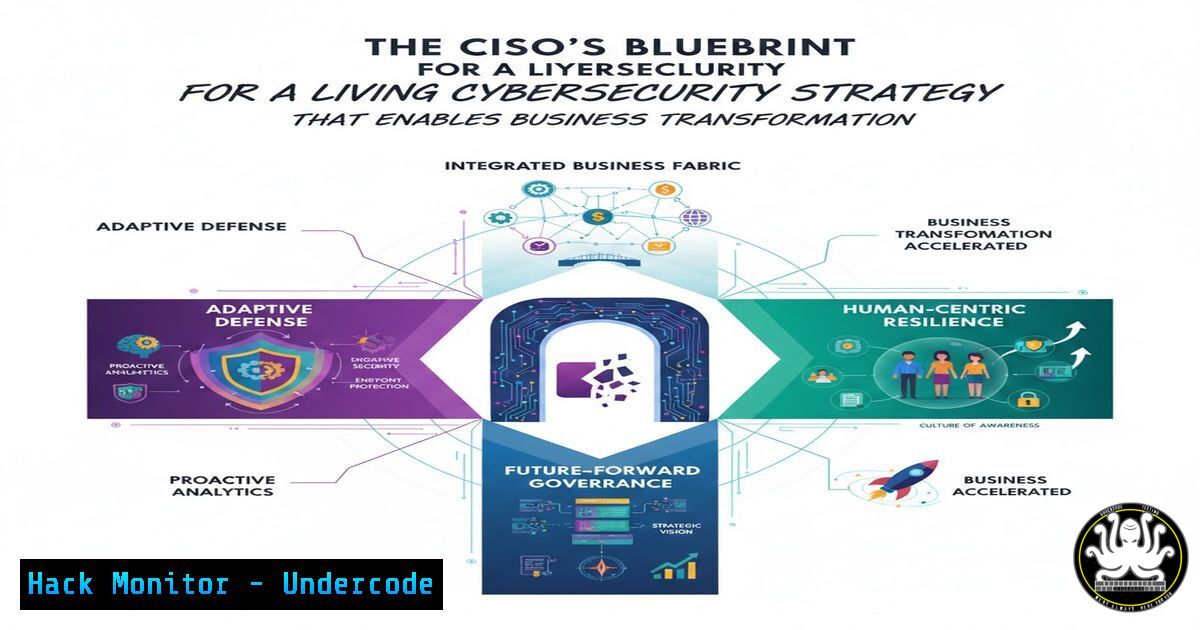
In today’s dynamic digital landscape, a static cybersecurity strategy is a liability. As articulated by a Global CISO, strategy is not a “once-and-done” artifact but a living framework that must evolve in lockstep with business objectives, threat intelligence, and technological change. This article deconstructs the modern CISO’s approach, moving beyond technical controls to establish cybersecurity as a measurable business enabler through disciplined strategic planning, transparent communication, and outcome-focused execution.
Learning Objectives:
- Learn how to translate business strategy into concrete cybersecurity Objectives and Key Results (OKRs).
- Understand the critical importance of explicitly defining strategic focus areas, dependencies, and risk trade-offs.
- Master techniques for maintaining stakeholder alignment and accountability through continuous strategy communication.
You Should Know:
- From Business Goals to Cyber OKRs: The Alignment Engine
A resilient cybersecurity posture starts with explicit alignment to the business portfolio. The modern CISO’s first step is a ruthless assessment of the corporate strategy to identify new risks, deprecated legacy systems, and emerging technology stacks that require protection.
Step‑by‑step guide:
- Extract Business Initiatives: Collaborate with the C-suite and board to document the company’s 12-24 month strategic goals (e.g., “Launch Product X in Cloud Y,” “Complete merger with Company Z”).
- Conduct a Cyber-Strategy Workshop: For each business initiative, facilitate sessions with your leadership team to identify:
Dependencies: What critical assets (data, apps, infrastructure) are involved?
Threat Landscape Shift: How do new initiatives alter the attack surface (e.g., new APIs, third-party integrations)?
Explicit Gaps: Where do current controls fail to cover the new risk? - Formulate OKRs: Transform the analysis into Objectives and Key Results.
Objective (Qualitative): “Secure the launch of Product X on AWS without introducing supply chain vulnerabilities.”
Key Results (Quantitative):
“Achieve 100% inventory and vulnerability scan of all Product X microservices prior to launch.”
“Implement and enforce IAM policies following the principle of least privilege for all production workloads by
."
 "Conduct three red-team exercises targeting the new product API by Q3."

<ol>
<li>Strategic Scoping: The Art of Deliberate Focus (and De‑Focus)
A strategy is defined as much by what you choose not to do. "Sharpening priorities" requires making hard decisions on resource allocation, implicitly managing risk through calculated trade-offs.</li>
</ol>

<h2 style="color: yellow;">Step‑by‑step guide:</h2>

<ol>
<li>Inventory Current Projects: List all active and planned security projects.</li>
<li>Apply the Eisenhower Matrix: Categorize each project as:
Urgent & Important: (Do) Critical vulnerability remediation, incident response.
Important, Not Urgent: (Plan) The strategic OKRs from above.
Urgent, Not Important: (Delegate) Can this be automated or handled by IT ops?
Not Urgent & Not Important: (Delete) Legacy projects no longer aligned to business direction.</li>
<li>Document the "Not Now" List: Formally, and transparently, communicate to stakeholders which legacy systems will receive only baseline security, which projects are deferred, and the risk acceptance rationale. This clears "strategy debt."</li>
</ol>

<h2 style="color: yellow;">3. Mapping Dependencies and Gaps: The Pre‑Mortem Analysis</h2>

Making dependencies explicit prevents catastrophic failures. This is a technical deep-dive that informs your OKRs and resource requests.

<h2 style="color: yellow;">Step‑by‑step guide:</h2>

<ol>
<li>Architectural Dependency Mapping: Use tools to visualize relationships.
Linux Command: Use `nmap` and `ss` to map network services: `sudo nmap -sV -O --top-ports 100 <target_subnet>` followed by `ss -tulpn` on critical servers to identify listening ports and connected services.
Cloud (AWS CLI): Use `aws ec2 describe-instances` and `aws securityhub get-findings` to correlate assets with vulnerabilities.</li>
<li>Gap Analysis Against Frameworks: Map current controls against a standard like the NIST CSF or MITRE ATT&CK. Identify where you have no coverage for specific tactics (e.g., TA0006 - Credential Access).</li>
<li>Create a Risk‑Based Roadmap: Prioritize gap closures based on business criticality and threat intelligence. This becomes the backbone of your technical execution plan.</li>
</ol>

<h2 style="color: yellow;">4. Operationalizing with Transparency: The Accountability Dashboard</h2>

Regular communication of strategy and OKRs builds trust and accountability. This is done through dynamic, data-driven reporting.

<h2 style="color: yellow;">Step‑by‑step guide:</h2>

<ol>
<li>Build an Executive Dashboard: Move beyond compliance checklists. Visualize:
OKR progress (e.g., "% of critical assets enrolled in EDR").
Mean Time to Detect (MTTD) & Mean Time to Respond (MTTR).
Risk exposure trends (e.g., "Unpatched Critical Severity CVEs over time").</li>
</ol>

<h2 style="color: yellow;">2. Automate Data Aggregation:</h2>

Example Script Snippet (Python using APIs): Create a script to pull data from your SIEM (e.g., Splunk), vulnerability scanner (e.g., Tenable.io), and ticketing system (e.g., Jira) to auto-generate KR metrics.
[bash]
 Pseudo-code example for KR tracking
import requests
tenable_api_key = 'YOUR_API_KEY'
url = 'https://cloud.tenable.com/workbenches/vulnerabilities'
headers = {'X-ApiKeys': f'accessKey={tenable_api_key};secretKey=...'}
response = requests.get(url, headers=headers)
vuln_data = response.json()
 Calculate percentage of critical assets scanned
3. Schedule Cadenced Reviews: Present the dashboard in monthly business reviews and quarterly board meetings, focusing on business risk, not just technical metrics.
- Evolving with the Threat Landscape: The Continuous Intelligence Loop
A “living” strategy integrates threat intelligence to validate and adjust priorities. This connects external threats to your internal posture.
Step‑by‑step guide:
- Subscribe to Threat Feeds: Integrate industry-specific (e.g., FS-ISAC) and technical (e.g., CISA’s Automated Indicator Sharing) feeds into your SIEM.
- Conduct Threat Modeling Sessions: For each major business initiative, reconvene the team to model new threats using frameworks like STRIDE.
- Validate Controls with Purple Teaming: Continuously test your detection and response OKRs.
Example Simulated Attack (Linux): Test credential dumping detection by executing a Mimikatz-like technique in a controlled environment: `sudo grep -r “password” /etc /home –include=.{config,txt,env} 2>/dev/null | head -5`
Windows Command (in lab): Use `mimikatz.exe` (authorized testing only) to test LSASS protection and your EDR’s ability to log and alert.
What Undercode Say:
Strategy is a Dynamic Process, Not a Static Document: The most significant vulnerability may be an outdated strategy. The CISO’s role is to institutionalize a continuous cycle of assessment, alignment, and communication.
Transparency Drives Enablement: By explicitly communicating priorities, dependencies, and accepted risks, cybersecurity shifts from being perceived as a business inhibitor to a trusted partner that facilitates informed decision-making and innovation.
The disciplined approach outlined transforms cybersecurity from a cost center fighting the last war into a strategic function that anticipates and mitigates the risks of the business’s next move. It replaces opacity with measurable outcomes, fostering a culture of shared responsibility where security is baked into the fabric of digital transformation.
Prediction:
The CISOs who master this living-strategy methodology will become pivotal drivers of competitive advantage and resilience. As AI adoption accelerates, creating new and opaque attack surfaces, the ability to rapidly contextualize AI risks within business objectives and communicate them effectively to the board will separate industry leaders from the disrupted. The future CISO will leverage AI not just for defense, but as an analytical engine to simulate business-impact scenarios, dynamically adjust OKRs in real-time, and prove cybersecurity’s ROI as the ultimate business enabler.
▶️ Related Video (78% Match):
🎯Let’s Practice For Free:
IT/Security Reporter URL:
Reported By: Rubenchacon Eaton – Hackers Feeds
Extra Hub: Undercode MoN
Basic Verification: Pass ✅


