Listen to this Post
Introduction:
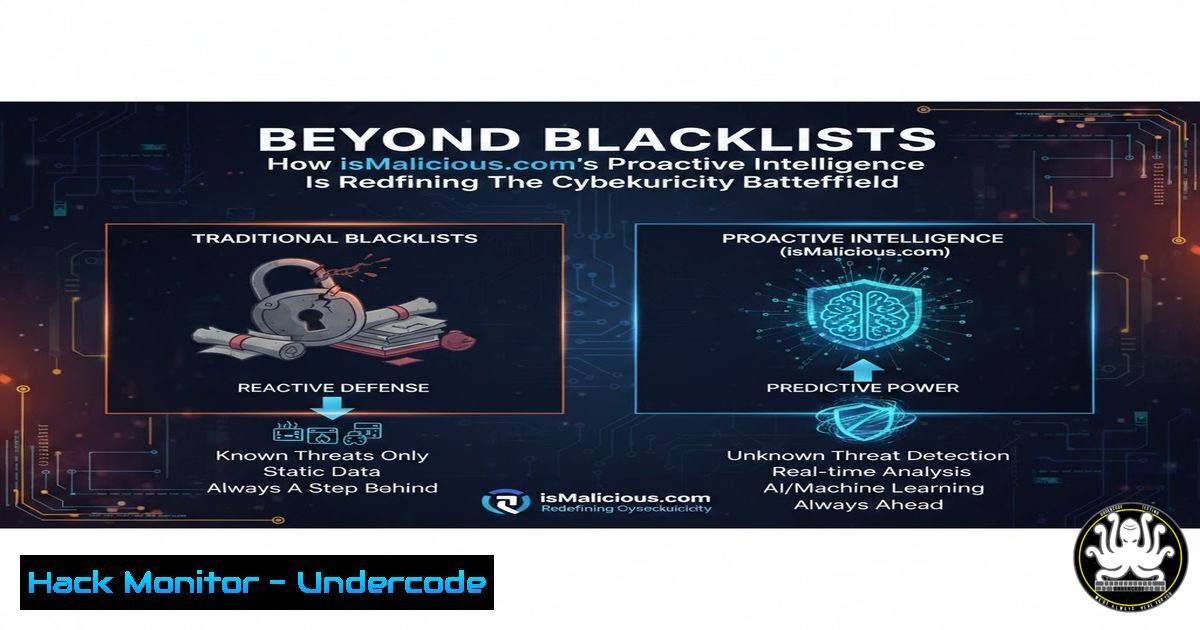
The cybersecurity landscape is shifting from easily spotted phishing attempts to sophisticated attacks that bypass traditional defenses using valid SSL certificates and pixel-perfect replicas of legitimate sites. Tools relying on known threat databases are inherently reactive, creating a dangerous detection gap. ismalicious.com confronts this by employing real-time, behavioral analysis and multi-source intelligence aggregation to identify threats before they are widely cataloged, offering a proactive shield for modern digital infrastructure.
Learning Objectives:
- Understand the critical limitations of signature-based, blacklist-dependent security tools in the face of novel and sophisticated social engineering attacks.
- Learn how to implement and use the isMalicious CLI tool and API for real-time threat intelligence, integrating proactive checks into security workflows.
- Gain practical knowledge for configuring asset monitoring, interpreting enriched threat reports, and mapping indicators to the MITRE ATT&CK framework for improved incident response.
- The Fundamental Flaw: Reactive vs. Proactive Threat Detection
Traditional security often operates like a wanted poster—it only catches criminals already in the system. Static blacklists and signature-based tools (like many legacy antivirus and email filters) can only block threats that have been previously identified, analyzed, and added to a database. This leaves a critical window of exposure for zero-day phishing sites, newly registered malicious domains, and compromised infrastructure.
Step‑by‑step guide explaining what this does and how to use it.
A proactive model, as used by isMalicious, analyzes behavior and context in real-time.
1. Core Analysis: Instead of just checking a list, the system scrutinizes an URL’s structure, domain registration details, SSL certificate health, and similarity to known legitimate domains.
2. Multi-Source Enrichment: It instantly queries a live aggregation of over 500 intelligence sources (VirusTotal, GreyNoise, AbuseIPDB, etc.) to build a contextual reputation score.
3. Actionable Output: The result is not just a “bad” or “good” flag, but a confidence-scored assessment that can trigger automated blocking or alerting before a human analyst has even seen the threat.
2. Hands-On Intelligence: Using the isMalicious CLI Tool
The command-line interface (CLI) brings enterprise-grade threat intelligence to your terminal, ideal for security researchers, SOC analysts, and automated scripts. It allows for offline checks once a local threat database is synced.
Step‑by‑step guide explaining what this does and how to use it.
1. Deployment: The tool is cross-platform (Linux, macOS, Windows). For a containerized approach, use Docker: docker run -v $(pwd)/data:/app/data ismalicious/cli.
2. Database Synchronization: Update your local database with the latest threat intelligence from all aggregated sources. Run: ismalicious update. This process fetches, aggregates, and cleans data, filtering out false positives using legitimate domain lists.
3. Querying Threats: Check any domain or IP address against your local database. For a domain: ismalicious get malicious-site.ru. For an IP: ismalicious get 192.168.1.100. The output will list identified threat categories (e.g., malware phishing c2 botnet).
3. API Integration: Embedding Real-Time Checks into Applications
The RESTful API is designed for developers to integrate proactive threat checks directly into applications, registration forms, email gateways, or SIEM systems.
Step‑by‑step guide explaining what this does and how to use it.
1. API Access: Obtain a free API key from the isMalicious website. Note the rate limits (Free tier: 1 request/minute).
2. Making a Query: Send a simple GET request to the API endpoint. Example using `curl` in a Linux/Unix terminal:
curl -X GET "https://api.ismalicious.com/v1/check?entity=example.com" \
-H "Authorization: Bearer YOUR_API_KEY"
3. Interpreting Response: The API returns a comprehensive JSON object containing the threat score, reputation analysis, geolocation, associated CVEs, SSL info, and an AI-generated summary. Integrate this logic to block or flag requests if the `threat_score` exceeds your risk threshold.
4. Proactive Defense: Configuring Asset Monitoring and Alerts
Waiting for a user to click a link is too late. The monitoring feature allows you to proactively watch critical domains and IPs associated with your organization for signs of compromise.
Step‑by‑step guide explaining what this does and how to use it.
1. Identify Assets: List your organization’s key public-facing domains, primary IP addresses, and any domains visually similar to yours (typosquats).
2. Setup Monitoring: Using the web dashboard or API, add these assets to your watchlist. In the Pro plan ($99/month), you can monitor up to 10 domains and 10 IPs.
3. Configure Alerts: Enable real-time email notifications. You will be alerted instantly if a watched asset’s threat status changes, if a similar malicious domain is registered, or if associated infrastructure is flagged by intelligence sources, enabling pre-emptive action.
- From Indicator to Insight: Leveraging MITRE ATT&CK Mapping
Raw threat data is less useful than contextualized intelligence. isMalicious enriches findings by mapping them to the MITRE ATT&CK framework, clarifying the adversary’s tactics and techniques.
Step‑by‑step guide explaining what this does and how to use it.
1. Review Enriched Reports: When you query a malicious IP like 206.168.34.44, the report includes a “MAPPED TO” section listing relevant MITRE IDs (e.g., T1071, T1566).
2. Understand the Adversary Playbook:
T1071 (Application Layer Protocol): Indicates the IP is used for Command & Control (C&C) communication.
T1566 (Phishing): Flags its use in initial access attacks.
T1583 (Acquire Infrastructure): Suggests it’s part of purpose-built attack resources.
3. Inform Response: Use this mapping to tailor your defense. A T1071 mapping means your firewall and IDS/IPS rules should scrutinize traffic to this IP for anomalous application-layer patterns, not just block it.
What Undercode Say:
- The Detection Gap is the New Attack Surface: Security that only knows past threats is obsolete. The most significant risk now originates from threats that haven’t yet been blacklisted. Tools must evolve to detect based on behavior, pre-attack reconnaissance, and infrastructure anomalies.
- Democratization of Enterprise-Grade Intelligence: Platforms like isMalicious, offering CLI tools and simple APIs, lower the barrier to entry for sophisticated threat intelligence. This allows smaller security teams and developers to build a proactive security posture that was once only available to large enterprises with massive budgets.
The analysis underscores a paradigm shift. Jean-Vincent Quilichini’s critique of traditional “wanted poster” security is valid. The future belongs to tools that act like predictive police analytics, identifying suspicious behavior and connections before a crime occurs. The integration of AI summaries and MITRE ATT&CK mapping is crucial—it transforms raw data into actionable strategic intelligence, reducing mean time to understand (MTTU) for analysts. This moves security operations from a reactive, alert-driven model to a proactive, intelligence-driven one.
Prediction:
The convergence of AI-generated phishing content, perfectly forged digital environments, and ephemeral attack infrastructure will render purely reactive cybersecurity models completely ineffective within the next 3-5 years. Security will become increasingly integrated into the development and architectural layer, with real-time threat intelligence APIs like isMalicious’s becoming a standard component of CI/CD pipelines, application code, and network configuration. The winners in this new landscape will be organizations that treat external threat intelligence not as a supplementary feed, but as a core, real-time data layer informing every automated security decision.
▶️ Related Video (86% Match):
🎯Let’s Practice For Free:
IT/Security Reporter URL:
Reported By: Jeanvincentquilichini Ce – Hackers Feeds
Extra Hub: Undercode MoN
Basic Verification: Pass ✅


