Listen to this Post
Introduction:
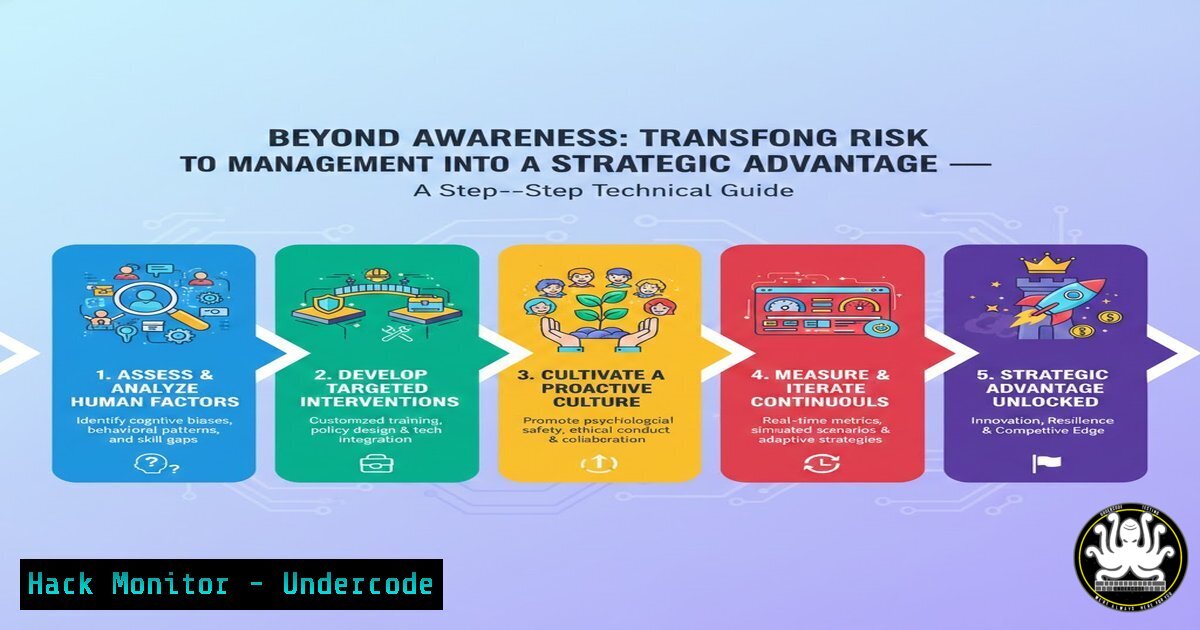
Traditional security awareness training often fails because it treats employees as a checkbox rather than a dynamic risk factor. Human Risk Management (HRM) shifts the focus from compliance to measurable behavior, integrating technical controls, analytics, and adaptive responses. This article provides a technical blueprint for implementing HRM, from configuring user monitoring to deploying AI‑driven risk scoring.
Learning Objectives:
- Understand the core components of Human Risk Management and how it differs from standard training.
- Learn to deploy technical tools for monitoring, simulating, and quantifying human behavior.
- Implement a data‑driven feedback loop that uses AI and automation to reduce organizational risk.
You Should Know:
1. Defining Human Risk Management (HRM)
HRM treats employees as a measurable risk vector. It combines policy, continuous monitoring, and targeted intervention. Unlike annual training, HRM uses real‑time data from sources like failed login attempts, phishing simulation results, and data access anomalies. This section explains the shift and sets the stage for technical implementation.
2. Technical Controls for Monitoring Human Behavior
To measure human risk, you need logs. On Windows, enable advanced auditing and collect events with PowerShell:
 Enable auditing for logon events
auditpol /set /subcategory:"Logon" /success:enable /failure:enable
 Export Security log to CSV
wevtutil epl Security C:\Logs\Security.evtx
On Linux, use auditd to track user activity:
 Install auditd
sudo apt install auditd -y
 Add a rule to monitor user commands
sudo auditctl -a exit,always -S execve
 Search logs for user "john"
sudo ausearch -ua john
Centralize these logs in a SIEM like Wazuh or Splunk for correlation. This data forms the foundation of risk metrics.
3. Simulating Phishing Attacks with GoPhish
Phishing simulations are the backbone of HRM. Deploy GoPhish on an Ubuntu server:
wget https://github.com/gophish/gophish/releases/download/v0.12.1/gophish-v0.12.1-linux-64bit.zip
unzip gophish-v0.12.1-linux-64bit.zip
cd gophish
chmod +x gophish
./gophish
Access the admin interface at https://<server-ip>:3333. Create a sending profile (use a legitimate SMTP relay), design a realistic email template, and launch a campaign. After completion, export click statistics to CSV for analysis. This data feeds directly into your risk scoring model.
4. Measuring Human Risk with Metrics
Combine log data and phishing results into a risk score. Below is a Python snippet that calculates a simple risk score based on recent phishing clicks and policy violations:
import pandas as pd
 Load data
phish = pd.read_csv('phishing_results.csv')
violations = pd.read_csv('policy_violations.csv')
 Merge and compute score
merged = pd.merge(phish, violations, on='user_id', how='outer')
merged['risk_score'] = merged['click_count']10 + merged['violation_count']5
merged.to_csv('user_risk.csv', index=False)
Extend this by weighting factors like login anomalies, data exfiltration attempts, or use of unauthorized devices.
5. Integrating AI and Machine Learning
AI can predict risky behavior before incidents occur. For example, use isolation forests to detect anomalous login times:
from sklearn.ensemble import IsolationForest
import numpy as np
 login_times = [hours since midnight, ...]
login_times = np.array([[bash], [bash], [bash], [bash], [bash]])
model = IsolationForest(contamination=0.1)
model.fit(login_times)
anomalies = model.predict(login_times)  -1 = anomaly
Integrate this with your SIEM using a tool like Elasticsearch’s ML features. Flag users with anomalous patterns and automatically increase their risk score.
6. Implementing Adaptive Training with LMS APIs
High‑risk users need targeted training. Use your Learning Management System’s API to assign courses automatically. A sample curl command to assign training via a REST API:
curl -X POST https://lms.example.com/api/enroll \
-H "Authorization: Bearer <token>" \
-d '{"user":"john.doe","course":"phishing_advanced","due":"2026-04-15"}'
Schedule this script weekly based on updated risk scores. This closes the loop between detection and education.
7. Creating a Feedback Loop with Security Orchestration
Automate responses to mitigate immediate threats. For instance, if a user clicks a real phishing link, use PowerShell to block their internet access temporarily:
 Block all outbound traffic except to internal DNS
New-NetFirewallRule -DisplayName "BlockUserInternet" -Direction Outbound -Action Block -RemoteAddress 0.0.0.0/0
 Allow DNS
New-NetFirewallRule -DisplayName "AllowDNS" -Direction Outbound -Action Allow -RemoteAddress 8.8.8.8 -Protocol UDP -RemotePort 53
Then log the incident and notify the security team. This immediate containment reduces the blast radius of human error.
What Undercode Say:
- Key Takeaway 1: Human risk is a measurable metric, not a vague concept. By integrating logging, simulations, and analytics, organizations can quantify and manage it effectively.
- Key Takeaway 2: Automation and AI transform raw behavioral data into actionable insights, enabling adaptive training and real‑time response.
Organizations that adopt Human Risk Management move beyond reactive training to a proactive security posture. The combination of technical controls and behavioral science builds a resilient culture where employees become active defenders. However, this requires investment in tooling, cross‑team collaboration, and continuous refinement of risk models. The payoff is a measurable reduction in incidents caused by human factors.
Prediction:
By 2028, Human Risk Management platforms will be as ubiquitous as endpoint protection. AI agents will provide real‑time, contextual nudges to employees—e.g., warning a user before they click a suspicious link—drastically reducing the success rate of social engineering attacks. This evolution will shift cybersecurity from a purely technical domain to a human‑centric one, with risk scores integrated into board‑level KPIs.
▶️ Related Video (78% Match):
🎯Let’s Practice For Free:
IT/Security Reporter URL:
Reported By: Chrismadeksho Scs26 – Hackers Feeds
Extra Hub: Undercode MoN
Basic Verification: Pass ✅


