
Listen to this Post
Introduction:
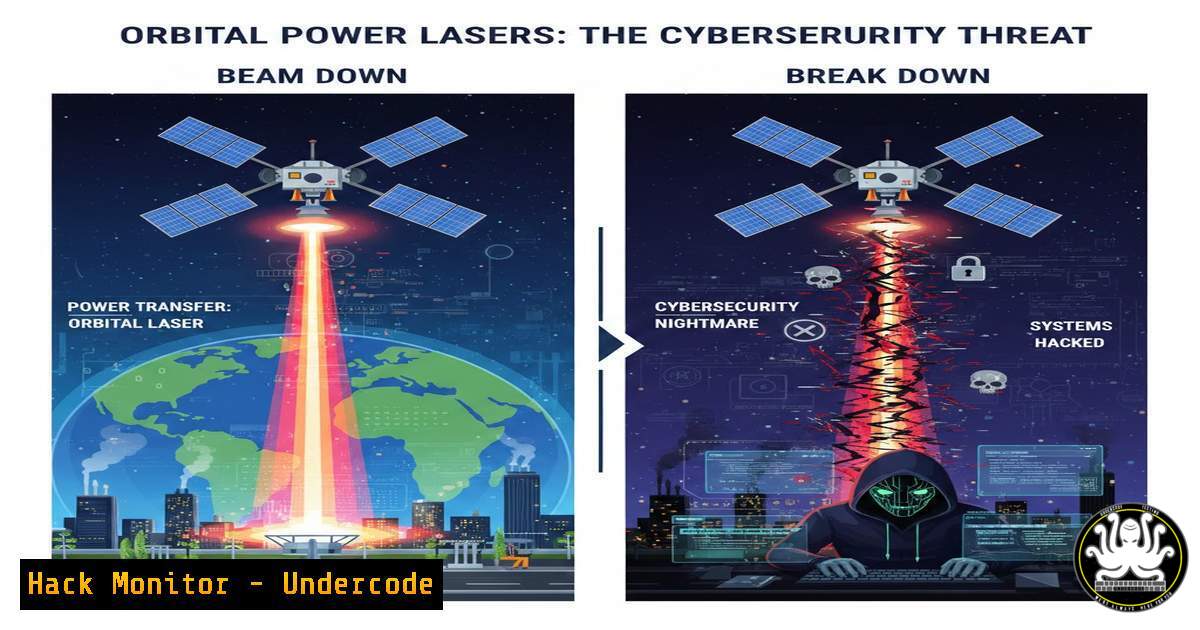
The concept of harvesting solar energy in space and beaming it to Earth via lasers or microwaves is rapidly transitioning from science fiction to engineering reality. With projects from Caltech, DARPA, and Aetherflux leading the charge, the promise of constant, clean energy is tantalizing. However, for cybersecurity professionals, these developments introduce a terrifying new attack surface. If energy beams can be hacked, redirected, or overloaded, the result wouldn’t just be a data breach—it could be physical infrastructure damage, grid instability, and a new frontier for kinetic warfare in space.
Learning Objectives:
- Identify the unique cyber-physical attack vectors present in space-based power transmission systems (SBSP).
- Analyze potential vulnerabilities in laser steering mechanisms and ground station rectennas.
- Apply red-teaming methodologies using network, RF, and command-line tools to simulate attacks on satellite command infrastructure.
You Should Know:
1. Mapping the Attack Surface: The Space-to-Ground Link
The core of SBSP involves collecting solar energy on a satellite, converting it to a laser or microwave beam, and transmitting it to a receiving station (rectenna) on Earth. This process is governed by complex control systems for beam steering, frequency modulation, and power output.
From a security standpoint, this is a cyber-physical system (CPS) with multiple entry points. The satellite’s Command and Data Handling (C&DH) subsystem, the ground station’s network, and the communication link between them are all vulnerable.
To understand the network exposure, we can simulate a reconnaissance mission against a ground station’s public IP range using standard Linux tools.
Command: Using Nmap to find open ports on ground station infrastructure.
 Assuming the ground station's public IP range is 203.0.113.0/24
 Scan for common satellite control ports (e.g., 21-FTP, 23-Telnet, 161-SNMP, 8080-Web Interfaces)
nmap -sS -sV -p 21,23,161,8080,8443 203.0.113.0/24 -oG ground_station_scan.txt

Explanation:
 -sS: SYN stealth scan to avoid some logging.
 -sV: Version detection to identify software running on open ports.
 -p: Specifies the ports to scan.
 -oG: Output in grepable format for further analysis.
If this scan reveals a Telnet service (port 23) or a default HTTP login page, it indicates a significant security gap where an attacker could attempt credential brute-forcing or vulnerability exploitation to gain access to the ground station’s control systems.
2. Hijacking the Beam: Attacking Laser Steering Mechanisms
The high-precision mirrors and gimbals that aim the energy beam are controlled by actuator commands. If an attacker compromises the control network, they could theoretically redirect the beam away from the rectenna. This could cause the energy to dissipate (a denial of service) or, worse, target other satellites or populated areas.
A man-in-the-middle (MITM) attack on the unencrypted command telemetry is a primary threat. Using a tool like `tcpreplay` or scapy, an attacker could inject malicious steering commands after capturing legitimate traffic.
Script: Simulating command injection with Scapy (Python).
from scapy.all import
import time

Assume we have captured the raw packet format for a "steer_azimuth" command
 Original packet: b'\x7e\x44\x41\x54\x41\x01\x7e' (Example proprietary format)

Malicious packet: Change azimuth to 180 degrees (off target)
malicious_command = b'\x7e\x44\x41\x54\x41\xb4\x7e'

Target IP of the satellite's actuator controller (spoofed from ground station)
target_ip = "192.168.1.100"

print("[] Sending malicious steering command...")
 Send the packet at layer 2 to bypass routing if on the same segment
sendp(Ether()/IP(dst=target_ip)/malicious_command, iface="eth0")
print("[+] Command injected. Verifying beam trajectory shift.")
This Python snippet demonstrates how, once network access is achieved, an attacker can craft packets to physically manipulate the hardware, turning a cyber intrusion into a physical impact.
3. Hardening the Rectenna Grid Against Overload Attacks
The ground-based rectenna is a massive array of antennas and power conversion electronics. It relies on a Supervisory Control and Data Acquisition (SCADA) system to manage the incoming power load. An attacker could exploit vulnerabilities in the SCADA protocols (like Modbus or DNP3) to send false telemetry, tricking the system into believing it can handle more power than it is rated for, potentially causing a meltdown or fire.
Command: Using Metasploit to test SCADA vulnerabilities.
msfconsole
 Search for a module targeting a specific SCADA system (e.g., a specific brand of rectenna controller)
msf6 > search modbus

Use a generic Modbus client module to read holding registers (temperature/load sensors)
msf6 > use auxiliary/scanner/scada/modbusclient
msf6 auxiliary(scanner/scada/modbusclient) > set RHOSTS 10.0.1.50
msf6 auxiliary(scanner/scada/modbusclient) > set DATA_ADDRESS 40001
msf6 auxiliary(scanner/scada/modbusclient) > set NUMBER 10
msf6 auxiliary(scanner/scada/modbusclient) > run

If we can read values, we can likely write them.
 Changing the "MAX_LOAD" register to a lower value would cause a denial of service.
 Changing it to a higher value could cause an overload.
This highlights the critical need for network segmentation and deep packet inspection (DPI) for industrial protocols in the power grid.
4. Securing the Optical Payload Firmware
The satellite’s firmware controls the laser’s pulse frequency and intensity. This firmware is often updated in orbit via radio uplink. If the update mechanism lacks cryptographic signatures, an attacker could upload malicious firmware designed to overdrive the laser, destroying the optics, or to turn the laser into a weapon.
Security professionals auditing such systems should check for secure boot implementations and signed firmware updates. A command-line check on a development build server might involve verifying digital signatures.
Command: Verifying a firmware image signature (Linux).
 Assuming we have a public key (pubkey.pem) and a firmware image (fw_v2.bin) with a signature (fw_v2.sig)
openssl dgst -sha256 -verify pubkey.pem -signature fw_v2.sig fw_v2.bin

Output:
 Verified OK
 OR
 Verification Failure

Explanation:
 This ensures that the firmware image was signed by the private key held by the manufacturer.
 A "Verification Failure" during an audit indicates the firmware could be tampered with,
 or the update mechanism is not enforcing signature checks.
Without this cryptographic chain of trust, the space-based asset is vulnerable to permanent denial of service (PDoS) or co-option by malicious actors.
5. Jamming and Spoofing the Downlink Frequency
The transmission frequency (e.g., 2.45 GHz for microwaves) must be precise for the rectenna to convert it efficiently. While high-powered jamming is difficult, sophisticated spoofing attacks could send “phantom” power signals that confuse the ground station’s phase array controllers. Using a Software Defined Radio (SDR) like a HackRF or USRP, an attacker can analyze the beacon frequency and attempt to transmit a conflicting signal.
General approach using GNU Radio (Conceptual).
While full code is extensive, the principle involves creating a flowgraph in GNU Radio Companion that:
1. Uses an Osmocom Source to receive the target signal.
2. Uses a Fast Fourier Transform (FFT) block to identify the exact center frequency and modulation.
3. Generates a signal on the same frequency with a slightly out-of-phase carrier wave to disrupt the constructive interference required for power transfer.
This demonstrates that the integrity of the energy beam itself is a signal security (SIGSEC) concern, not just a network security one.
6. API Security in Space Command & Control
Many next-gen space companies are adopting a “New Space” approach, exposing telemetry and command functions via REST APIs for ease of integration. These APIs are often the weakest link. A simple `curl` command can reveal massive flaws.
Command: Testing for Insecure Direct Object References (IDOR) in a satellite API.
 Legitimate request to get status of satellite "SAT-001"
curl -X GET https://api.spacepower.com/v1/satellite/SAT-001/status -H "Authorization: Bearer VALID_TOKEN"

Malicious request attempt: Changing the ID to "SAT-002"
curl -X GET https://api.spacepower.com/v1/satellite/SAT-002/status -H "Authorization: Bearer VALID_TOKEN"

If the API returns data for SAT-002, it is vulnerable to IDOR.
 An attacker could enumerate all satellites and potentially issue commands (POST requests) to them.
This highlights the necessity of strict object-level authorization checks on the server side, regardless of the token’s validity.
What Undercode Say:
- The Grid is Now a Target: The fusion of space assets with the terrestrial power grid means that a cyber-attack on a satellite can have kinetic consequences on the ground, bypassing traditional air-gapped security of power plants.
- Protocol Obsolescence is a Risk: Many space systems rely on legacy, unencrypted protocols (like raw CCSDS telemetry without authentication) designed in an era of assumed trust. This must be retrofitted with modern cryptographic agility before deployment.
The race to beam power from orbit is not just an engineering challenge; it is a security gauntlet. The organizations listed—from Caltech to DARPA—must embed “security by design” into their laser systems, treating the beam as a critical data stream that requires integrity, authentication, and confidentiality controls to prevent it from becoming the world’s most dangerous denial-of-service weapon.
Prediction:
Within the next decade, we will witness the first international cyber incident involving space-based energy infrastructure, prompting a rapid and fragmented set of “Space Cyber Norms” and treaties, similar to the early days of the Geneva Conventions, specifically outlawing the hijacking of energy transmission systems as an act of war.
▶️ Related Video (84% Match):
🎯Let’s Practice For Free:
IT/Security Reporter URL:
Reported By: Bobcarver Satellite – Hackers Feeds
Extra Hub: Undercode MoN
Basic Verification: Pass ✅


