
Listen to this Post
Introduction:
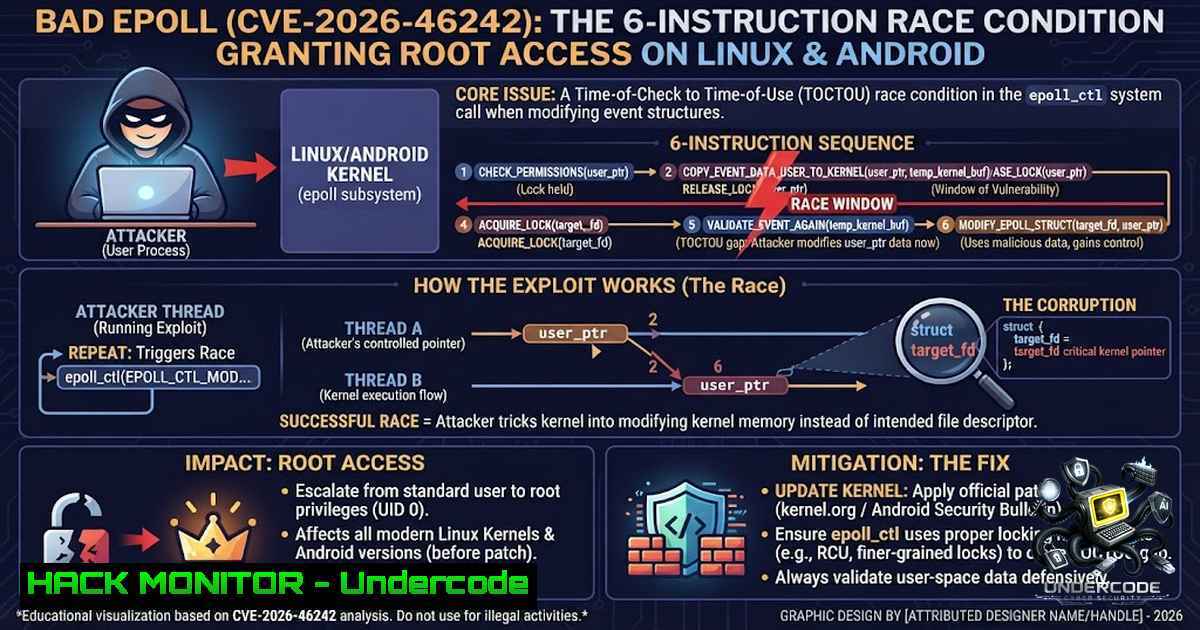
A newly disclosed Linux kernel flaw dubbed “Bad Epoll” (CVE-2026-46242) allows an unprivileged local user to escalate to root on Linux servers, desktops, and Android devices. The vulnerability resides in the kernel’s epoll subsystem—a core I/O event notification mechanism that cannot be disabled or unloaded. With a CVSS severity score of 7.8 (High), this use-after-free (UAF) race condition has been confirmed to achieve a 99% success rate on vulnerable systems, making it one of the most reliable local privilege escalation (LPE) exploits in recent memory.
Learning Objectives:
- Understand the technical root cause of the Bad Epoll vulnerability and the race condition in the kernel’s epoll subsystem
- Learn how to identify vulnerable systems and apply the official patch or distribution backports
- Master detection techniques using auditing tools, KASAN, and eBPF to identify potential exploitation attempts
- Implement mitigation strategies and hardening measures for Linux servers and Android devices
You Should Know:
- Technical Deep Dive: The ep_remove() Use-After-Free Race Condition
The Bad Epoll vulnerability stems from a flawed implementation in the `ep_remove()` function (via ep_remove_file()). The kernel code clears `file->f_ep` under `file->f_lock` but continues using the `@file` object inside the critical section during `hlist_del_rcu()` and spin_unlock().
A concurrent `__fput()` call can observe a transient NULL value, skip eventpoll_release_file(), and proceed straight to f_op->release, which frees the watched `struct eventpoll` while `ep_remove()` still believes it holds a valid reference. The subsequent `hlist_del_rcu()` then scribbles into freed `kmalloc-192` memory, corrupting kernel memory.
Because `struct file` uses SLAB_TYPESAFE_BY_RCU, the freed slot can be recycled by alloc_empty_file(), reinitializing `f_lock` and `f_ep` while `ep_remove()` is still nominally inside that lock. The upshot is an attacker-controllable `kmem_cache_free()` against the wrong slab cache.
Step-by-step technical breakdown of the exploit chain:
- Setup: The attacker creates four epoll file descriptors grouped into two pairs
- Trigger: Closing one pair triggers the race condition while the other becomes the victim object
- Race Window: The collision window is approximately six machine instructions wide—the exploit retries without crashing until the race succeeds
- UAF Write: An 8-byte UAF write corrupts a file object via a cross-cache attack
- Memory Read: The attacker gains arbitrary kernel memory read access through `/proc/self/fdinfo`
6. Privilege Escalation: A return-oriented programming (ROP) chain hijacks control flow to spawn a root shell
Detection Commands (Linux):
 Check kernel version - vulnerable if 6.4 <= version < patched
uname -r

Check if patch is applied (look for commit a6dc643c6931)
zgrep -i "a6dc643c6931" /proc/config.gz || dmesg | grep -i "a6dc643c6931"

Monitor for suspicious epoll activity using auditd
auditctl -a always,exit -S epoll_ctl -S epoll_wait -k bad_epoll_monitor

Check for KASAN reports (if enabled)
dmesg | grep -i "KASAN.epoll"

Monitor for unusual file descriptor activity
lsof -1 | grep -i epoll | wc -l
2. Affected Systems and Patch Status
The vulnerability affects mainline Linux kernels from version 6.4 onward, introduced by a single commit in April 2023. Older 6.1-based kernels (including some Android devices like the Pixel 8) are not affected.
Distribution Status:
- Ubuntu: Vulnerable on 26.04 LTS, 25.10, and 24.04 LTS; not affected on 22.04 LTS and earlier
- Debian: Tracking CVE-2026-46242 with patches in progress
- Android: Approximately two-thirds of Android 10+ devices are potentially affected
The patch that fully resolves the issue is upstream commit a6dc643c6931. The fix pins `@file` via `epi_fget()` at the top of ep_remove(), ensuring the file cannot reach refcount zero during the critical section. If the pin fails, the path takes the slow path and blocks safely.
Patch Application Commands:
 For source-based kernels (pull and apply patch)
cd /usr/src/linux
git fetch origin
git cherry-pick a6dc643c6931
make -j$(nproc) && make modules_install && make install

For Debian/Ubuntu
sudo apt update && sudo apt upgrade linux-image-$(uname -r)

For Red Hat/Fedora
sudo dnf update kernel

Verify patch applied
grep "a6dc643c6931" /boot/System.map-$(uname -r) 2>/dev/null || echo "Patch not applied"
3. Android and Chrome Sandbox Implications
What makes Bad Epoll exceptionally dangerous is its ability to be triggered from inside Chrome’s renderer sandbox, which blocks almost every other kernel bug. This means an attacker who compromises a Chrome renderer process (via a separate browser vulnerability) can chain it with Bad Epoll for full kernel code execution without leaving the sandbox.
Unlike most Linux privilege-escalation bugs that cannot reach Android due to architectural differences, Bad Epoll works on Android because epoll is a core kernel component that cannot be disabled or unloaded. The exploit can be triggered directly from userspace without requiring external modules or privileged system calls.
Android-Specific Detection:
 Check Android kernel version (via adb)
adb shell uname -r

Check if Android device is patched
adb shell getprop ro.build.version.security_patch

Monitor epoll syscalls on Android (requires root or debug build)
adb shell strace -e trace=epoll_ctl,epoll_wait -p $(pidof com.android.chrome)
4. The AI Connection: Why Mythos Missed It
The vulnerability carries a fascinating backstory: Anthropic’s AI model Mythos recently found a different bug in the same 2,500-line epoll code path (now tracked as CVE-2026-43074), which was fixed earlier in 2026. Bad Epoll was the second, harder-to-spot flaw that Mythos missed.
Researcher Jaeyoung Chung offers two likely reasons for this miss:
1. Narrow timing window: The race window is only about six machine instructions wide, making the exact sequence difficult to visualize even when staring at the code
2. Minimal runtime evidence: Once the first bug is patched, Bad Epoll’s memory error usually does not trip KASAN (the kernel’s main bug detector), leaving little runtime evidence that anything is wrong
This highlights a critical limitation of current AI-assisted code auditing: race conditions and subtle concurrency bugs remain notoriously difficult to detect through static analysis alone.
5. Step-by-Step Mitigation and Hardening Guide
Since epoll cannot be turned off without breaking core OS and browser functionality, there is no workaround. Administrators must apply the upstream patch or await distribution backports.
Immediate Actions:
Step 1: Identify vulnerable systems
 Scan all Linux servers and workstations
for host in $(cat hosts.txt); do
ssh $host "uname -r | grep -E '^6.[4-9]|^7.' && echo 'VULNERABLE: $host'"
done
Step 2: Apply kernel updates
 For Ubuntu/Debian
sudo apt update && sudo apt full-upgrade -y
sudo reboot

For RHEL/CentOS/Fedora
sudo dnf update kernel -y
sudo reboot

For Arch Linux
sudo pacman -Syu linux
sudo reboot
Step 3: Enable kernel hardening features
 Enable KASAN for development/testing environments
 Add to kernel command line: kasan=on

Enable kernel address space layout randomization (KASLR)
 Add to kernel command line: kaslr

Enable SELinux/AppArmor in enforcing mode
sudo setenforce 1  SELinux
sudo aa-enforce /etc/apparmor.d/  AppArmor
Step 4: Deploy runtime detection
 Using eBPF to monitor epoll syscalls
sudo bpftrace -e 'kprobe:epoll_ctl { @[bash] = count(); }'

Using Falco for behavioral monitoring
sudo falco -r /etc/falco/falco_rules.yaml | grep -i epoll

Monitor for abnormal process privilege changes
auditctl -a always,exit -S execve -k priv_esc
ausearch -k priv_esc -ts recent
Step 5: Restrict local user privileges
 Remove unnecessary sudo privileges
visudo

Limit shell access for service accounts
usermod -s /usr/sbin/nologin service_account

Use capabilities instead of setuid binaries
setcap -r /path/to/binary
6. Exploitation Reliability and Public Availability
Chung’s exploit achieves roughly 99% reliability on tested systems by widening the race window and retrying without crashing the kernel. The exploit uses four epoll objects grouped into two pairs; closing one pair triggers the race while the other becomes the victim object.
The full technical writeup and proof-of-concept code are publicly available on GitHub (github.com/J-jaeyoung/bad-epoll). As of July 4, 2026, CVE-2026-46242 is not on CISA’s Known Exploited Vulnerabilities list, and there is no confirmed in-the-wild exploitation. However, with public PoC available, the window for safe patching is rapidly closing.
What Undercode Say:
- Key Takeaway 1: The Bad Epoll vulnerability represents a convergence of multiple concerning trends: AI-assisted code auditing missed a critical race condition, the flaw affects both Linux and Android (bypassing typical sandbox restrictions), and public exploit code is already available. Organizations must prioritize patching immediately.
-
Key Takeaway 2: The six-instruction race window is a masterclass in exploitation sophistication. Chung’s ability to achieve 99% reliability without crashing the kernel demonstrates that even “difficult to exploit” race conditions can become practical threats with sufficient research effort. This raises the bar for what defenders must consider “exploitable.”
-
Analysis: The AI connection is particularly noteworthy. Mythos found one bug in the epoll code but missed the sibling flaw. This underscores that while AI is becoming increasingly capable at finding vulnerabilities, it is not a silver bullet—especially for subtle concurrency bugs that leave minimal runtime evidence. The fact that Bad Epoll rarely triggers KASAN means that even advanced memory error detection tools may fail to catch it. Organizations should view AI-assisted auditing as a complement to, not a replacement for, human expertise and comprehensive testing methodologies. The 2,500-line epoll code path that introduced two separate race conditions from a single 2023 commit raises serious questions about code review processes in critical kernel subsystems.
Prediction:
-
+1 The public disclosure and rapid patch availability will likely accelerate kernel update adoption across enterprises, improving overall security posture for Linux environments. The attention drawn to epoll subsystem security may prompt additional audits, uncovering and fixing other latent vulnerabilities.
-
-1 The public availability of working exploit code, combined with the vulnerability’s ability to bypass Chrome’s renderer sandbox, creates a significant window of opportunity for threat actors. Expect to see Bad Epoll incorporated into exploit kits and weaponized within 30-60 days, particularly targeting cloud environments and Android devices with delayed patch cycles.
-
-1 The AI miss highlights a troubling gap in automated vulnerability detection. As organizations increasingly rely on AI for code auditing, this case demonstrates that sophisticated race conditions can evade even frontier AI models. Attackers may begin targeting these “AI-blind spots” with renewed focus.
-
+1 The Google kernelCTF program’s success in surfacing this vulnerability (with a $71,337+ payout) validates the bug bounty model for critical kernel security. Continued investment in similar programs will be essential for identifying and fixing complex concurrency bugs before they are exploited in the wild.
-
-1 Android users face a particularly challenging situation. With approximately two-thirds of Android 10+ devices potentially affected and OEM patch timelines varying significantly, a substantial portion of the Android ecosystem may remain vulnerable for months. This creates a persistent attack surface that nation-state actors and sophisticated cybercriminal groups are likely to exploit.
▶️ Related Video (78% Match):
https://www.youtube.com/watch?v=0_n0uAYFk7s
🎯Let’s Practice For Free:
🎓 Live Courses & Certifications:
Join Undercode Academy for Verified Certifications
🚀 Request a Custom Project:
Secure, high-velocity infrastructure and disruptive technological engineering. Contact our engineering team for high-tier development and proprietary systems:
[email protected]
💎 Smart Architecture | 🛡️ Secure by Design | ⭐ Trusted by Thousands
IT/Security Reporter URL:
Reported By: Cybersecuritynews Share – Hackers Feeds
Extra Hub: Undercode MoN
Basic Verification: Pass ✅


