
Listen to this Post
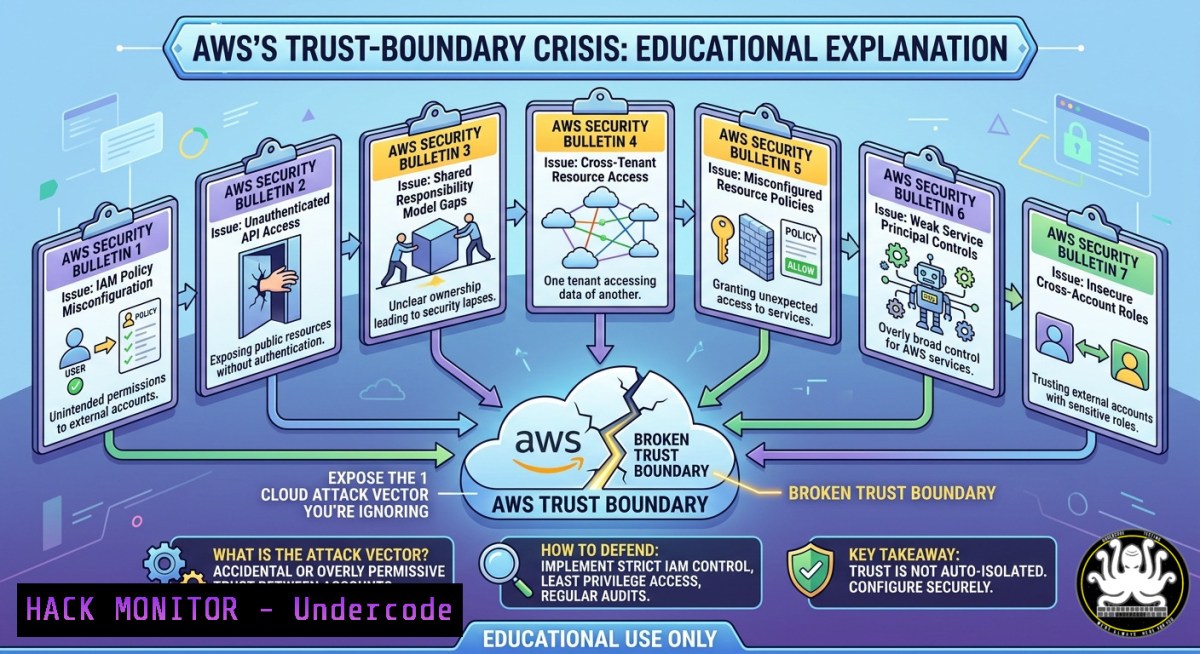
Introduction:
Between October 2025 and March 2026, AWS published 20 security bulletins, and 7 of them (35%) involved a single, stealthy class of vulnerability: trust-boundary failures. These are not memory-corruption exploits or crypto bugs; they are logic flaws where a cloud service assumes a principal is trustworthy when it is not. The result is that a seemingly harmless permission or a read-only API call can inadvertently grant an attacker the keys to your entire kingdom, enabling privilege escalation and lateral movement across the most sensitive parts of your infrastructure.
Learning Objectives:
- Identify and remediate overly permissive IAM trust policies that expose root-level access, particularly in EKS and automated provisioning frameworks.
- Detect and mitigate cryptographic key exposure in API responses, using the SageMaker HMAC signing key leak as a primary case study.
- Implement multi-layered defensive strategies, including trust policy auditing, credential chain hygiene, and least-privilege access controls across AWS services.
You Should Know:
- The EKS Provisioning Hole: When a Sample Code Becomes a Rootkit
A deep analysis of recent AWS bulletins reveals a recurring pattern: provisioning roles intended for infrastructure automation are often deployed with trust policies that grant `arn:aws:iam::ACCOUNT:root` access. A prime example is CVE-2025-14503, found in the AWS Harmonix EKS framework. The sample provisioning role was configured to trust the account root principal, meaning any IAM user or service in the same account with `sts:AssumeRole` permissions could elevate themselves to an administrator. Attackers who gain a low-privilege foothold can then assume this role, pivoting directly to full account control. This vulnerability directly undermines the trust boundary between different principals within the same account.
Step‑by‑Step Guide to Audit and Remediate:
1. Locate and List Overly Permissive Roles:
 List all roles in your AWS account
aws iam list-roles --query "Roles[].RoleName" --output text
2. Inspect a Specific Role’s Trust Policy:
 Replace 'MyHarmonixRole' with the role name
aws iam get-role --role-name MyHarmonixRole --query 'Role.AssumeRolePolicyDocument'
3. Identify Dangerous Patterns: Look for `”Principal”: { “AWS”: “arn:aws:iam::ACCOUNT:root” }` or "Principal": "". A role that trusts the root or an external wildcard is a potential escalation vector.
4. Remediate by Restricting the Trust Policy: Change the policy to trust only the specific AWS service or a dedicated, least-privilege role.
{
"Version": "2012-10-17",
"Statement": [
{
"Effect": "Allow",
"Principal": {
"Service": "eks.amazonaws.com"
},
"Action": "sts:AssumeRole"
}
]
}
5. Automate Detection with Tools: Use open-source tools like `aws-trustline` to map and audit all trust relationships across your IAM roles and S3 bucket policies.
 Clone the repository
git clone https://github.com/zoph-io/aws-trustline.git
cd aws-trustline
 Install dependencies and run the scanner
pip install -r requirements.txt
python trustline.py --profile production
This tool cross-references account IDs against a community-maintained list of known AWS vendor accounts, automatically flagging external access and confused deputy risks (roles missing the `ExternalId` condition).
- The SageMaker Key Leak: How a Read-Only API Grants Code Execution
In contrast to a trust policy misconfiguration, the SageMaker vulnerability (CVE-2026-8596) highlights a more insidious failure: the exposure of cryptographic keys via cleartext in API responses. The Amazon SageMaker Python SDK, in versions prior to v3.8.0, stored an HMAC signing key as a container environment variable (SAGEMAKER_SERVE_SECRET_KEY). This key was returned in plaintext by read-only APIs like `DescribeModel` andDescribeEndpointConfig. An attacker with permissions to call these APIs and write to an S3 bucket could extract the key, forge valid integrity signatures for malicious model artifacts, and achieve code execution within inference containers.
Step‑by‑Step Guide to Detect and Mitigate:
- Detect Exposure via CLI: Scan your environment for the presence of the vulnerable SDK versions.
Check your SageMaker Python SDK version
pip show sagemaker | grep Version
Versions < 3.8.0 are vulnerable
- Check for Exposed Keys in API Logs: Enable and monitor AWS CloudTrail for `DescribeModel` and `DescribeEndpointConfig` API calls.
-- Sample CloudTrail Athena Query to find suspicious API calls SELECT useridentity.arn, eventsource, eventname, COUNT() as api_calls FROM cloudtrail_logs WHERE eventsource = 'sagemaker.amazonaws.com' AND eventname IN ('DescribeModel', 'DescribeEndpointConfig') GROUP BY useridentity.arn, eventsource, eventname; - Immediate Remediation: Upgrade the SageMaker Python SDK to the patched version.
pip install --upgrade sagemaker>=3.8.0
After upgrading, you must rebuild any existing models that were created with the vulnerable SDK, as the key may persist in their environment.
- Enforce Least Privilege: Implement restrictive IAM policies. Do not grant `sagemaker:DescribeModel` or `s3:PutObject` permissions more broadly than necessary. Use a policy similar to the one below to limit actions.
{ "Version": "2012-10-17", "Statement": [ { "Effect": "Deny", "Action": [ "sagemaker:DescribeModel", "sagemaker:DescribeEndpointConfig" ], "Resource": "", "Condition": { "StringNotEquals": { "aws:PrincipalARN": "arn:aws:iam::123456789012:role/SecureSageMakerRole" } } } ] } -
The Credential Chain Hijack: When Your CLI Profile Becomes an Attack Surface
Trust-boundary failures extend beyond explicit policies to how credentials are resolved. The AWS CLI and SDKs use a credential provider chain that checks a series of locations in a specific order, from command-line options to environment variables and finally to IAM roles. An attacker who compromises a single developer workstation can plant malicious credentials in a higher-precedence location, such as~/.aws/credentials, effectively hijacking all subsequent API calls. A misplaced access key in a profile can lead to full administrative privileges in minutes, often with no alarms triggered. This is a silent, brutal form of privilege escalation that bypasses traditional perimeter defenses.
Step‑by‑Step Guide to Hardening Credential Chains:
- Understand the Order of Operations: The default credential chain loads from:
1. Command line options (`–profile`, etc.)
2. Environment variables (`AWS_ACCESS_KEY_ID`)
3. `~/.aws/credentials` file
4. `~/.aws/config` file
5. IAM roles (EC2 instance profiles, ECS tasks)
6. Container credentials
- Audit and Clean Local Credential Files: Write a script to scan for and alert on the presence of long-term access keys in
~/.aws/credentials.Scan for all profiles in the credentials file for profile in $(aws configure list-profiles); do echo "Profile: $profile" aws configure get aws_access_key_id --profile $profile aws configure get aws_secret_access_key --profile $profile done
- Enforce MFA for All Role Assumptions: Modify trust policies to require multi-factor authentication (MFA) for any `sts:AssumeRole` action.
{ "Effect": "Allow", "Action": "sts:AssumeRole", "Principal": { "AWS": "arn:aws:iam::111122223333:role/Developer" }, "Condition": { "Bool": { "aws:MultiFactorAuthPresent": "true" } } } -
Implement Continuous Monitoring: Use a tool like `hoop.dev` or a custom Lambda function to monitor `AssumeRole` events in CloudTrail. Create an alert for any role assumption that originates from a non-corporate IP or outside of business hours.
-
Defensive Frameworks: Policy Validation and Zero Trust in the Cloud
The failures seen in AWS’s own bulletins are a stark reminder that these patterns are pervasive in customer environments. To defend against them, shift from reactive patching to proactive validation. AWS IAM Access Analyzer can validate trust policies against policy grammar and best practices, flagging security warnings, errors, and overly permissive access before they are deployed. This should be integrated into your CI/CD pipeline for all Infrastructure as Code (IaC) templates.
Step‑by‑Step Guide for Proactive Defense:
- Integrate IAM Access Analyzer in CI/CD: Use the AWS CLI to validate a policy file during a build step.
aws accessanalyzer validate-policy --policy-document file://trust-policy.json --policy-type RESOURCE_POLICY
This command will return a list of findings, which you can use to fail the build if a “SECURITY_WARNING” is found.
- Adopt a Zero-Trust Multi-Cloud Architecture: Assume that no principal is implicitly trusted. Apply consistent identity controls across AWS, Azure, and GCP by separating policy intent from provider-specific enforcement. This means defining a centralized policy (e.g., “No role may trust an external account without an ExternalId”) and translating it into each cloud’s native controls.
- Regularly Rotate and Audit Keys: Implement automated access key rotation for all IAM users and service accounts. Use AWS Secrets Manager to store and rotate secrets, eliminating long-lived credentials from code or configuration files.
What Undercode Say:
- Key Takeaway 1: Trust-boundary failures are now the dominant class of cloud vulnerability, outpacing traditional memory corruption and cryptographic issues. The cloud’s greatest strength—its complex, interconnected service mesh—is also its greatest liability, creating countless hidden pathways for privilege escalation.
- Key Takeaway 2: You cannot rely on IAM action names alone to assess risk. The true danger of a permission lies in what it can reach via credential chains, resource-based policies, and service integrations. A read-only API call that leaks a signing key is far more dangerous than a write API with no such exposure.
This analysis reveals a fundamental truth: the security model of the cloud is only as strong as its weakest assumption of trust. AWS has inadvertently created a logical vulnerability class that mirrors the “confused deputy” problem but on a systemic scale. Organizations must shift their security posture from monitoring for known exploits to continuously validating and enforcing trust boundaries. This requires a combination of automated tooling (aws-trustline, IAM Access Analyzer), strict least-privilege policies, and a zero-trust mindset that questions every implicit trust relationship. The 7 bulletins in 6 months are not an anomaly; they are a trend, and your environment almost certainly harbors the same dangerous patterns.
Prediction:
In the coming 12–18 months, trust-boundary exploitation will become the primary attack vector for advanced persistent threats (APTs) targeting cloud infrastructures. We will see the emergence of specialized “trust-mapping” tools designed to automatically discover and chain together these misconfigurations. In response, cloud providers will be forced to introduce new “trust-boundary security” features, potentially including automated policy hardening and real-time trust validation at the API gateway level. The era of assuming that a service principal is trustworthy simply because it is part of the cloud provider is ending.
▶️ Related Video (74% Match):
🎯Let’s Practice For Free:
IT/Security Reporter URL:
Reported By: Aws Keeps – Hackers Feeds
Extra Hub: Undercode MoN
Basic Verification: Pass ✅


