Listen to this Post
Introduction:
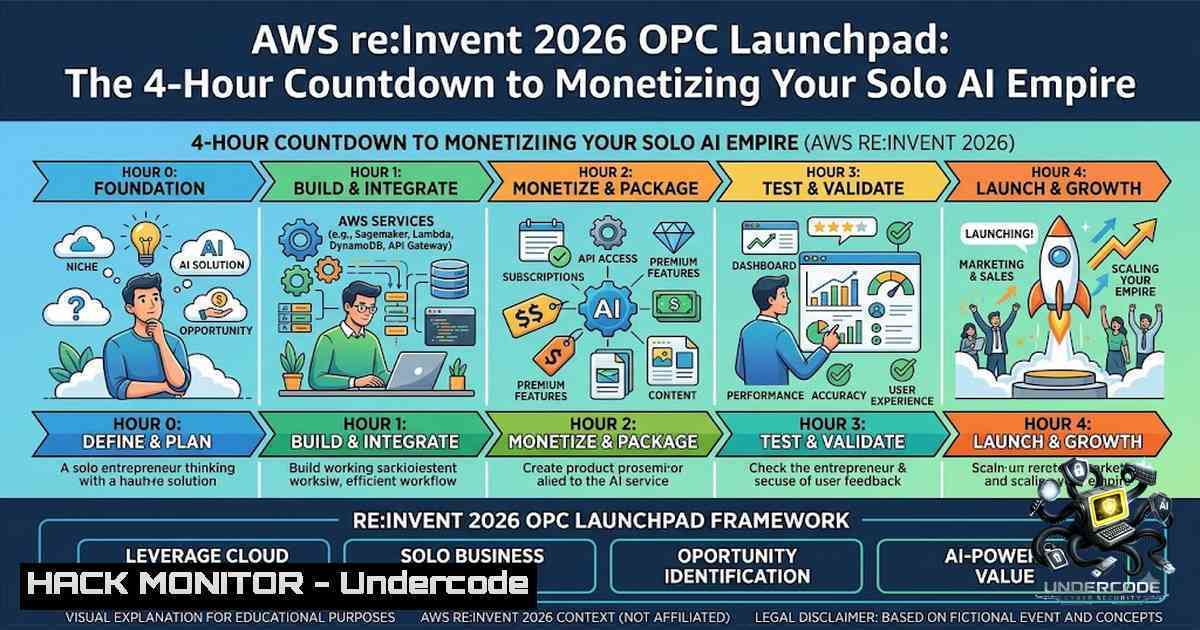
The barrier to entry for AI innovation has collapsed to the cost of a GPU instance, yet the path to production-grade monetization remains fraught with security pitfalls and architectural debt. AWS has officially opened its acceleration programme for One-Person Companies (OPCs) and lean AI teams, closing in less than 4 hours. This initiative represents a critical junction for solopreneurs: how to move from a Jupyter Notebook proof-of-concept to a hardened, scalable, and billing-ready service without enterprise overhead. For the security-conscious developer, this is a race against time to implement non-1egotiable infrastructure controls.
Learning Objectives:
- Master the AWS IAM least-privilege configuration for single-operator environments to prevent catastrophic credential leaks.
- Implement serverless API security patterns using AWS WAF and Lambda Authorizers to mitigate prompt injection and DDoS threats.
- Automate cloud hardening using Infrastructure as Code (IaC) with AWS CDK and Python to ensure compliance and reduce human error.
- Integrate Chinese AI ecosystem models (e.g., DeepSeek, Qwen) securely into AWS infrastructure while managing data sovereignty and encryption requirements.
You Should Know:
- The 4-Hour IAM Hardening Sprint (Identity and Access Management)
When operating a One-Person Company, the default “Root User” habits from personal accounts are the number one vector for financial ruin. With only 4 hours to apply, the first technical task is abandoning the root user entirely and establishing a highly restrictive administrative profile.
– Step 1: Log in as Root and immediately enable Multi-Factor Authentication (MFA) using a hardware key (FIDO2) or authenticator app. Do not rely on SMS.
– Step 2: Create an “Admin” user with programmatic access. Attach a policy that explicitly denies action if the request lacks MFA authentication.
– Step 3: Set up an IAM Role for EC2 and Lambda instances. Never hard-code credentials in environment variables or code repositories.
– Linux Command (Verify IAM permissions via CLI):
aws iam get-user --profile your-admin-profile
aws sts get-caller-identity
– Windows Command (PowerShell):
Get-IAMUser -ProfileName your-admin-profile
Get-STSCallerIdentity
– Code Snippet (CDK IAM Policy):
self.role = iam.Role(self, "OPCExecutionRole",
assumed_by=iam.ServicePrincipal("lambda.amazonaws.com"),
managed_policies=[iam.ManagedPolicy.from_aws_managed_policy_name("AWSLambdaBasicExecutionRole")]
)
self.role.add_to_policy(iam.PolicyStatement(
effect=iam.Effect.DENY,
actions=[""],
conditions={"Bool": {"aws:MultiFactorAuthPresent": "false"}},
resources=[""]
))
- Securing the API Gateway and WAF Against AI-Specific Threats
Your AI gateway is the front door to your intellectual property. Without Web Application Firewall (WAF) configurations tailored to Large Language Models (LLMs), you are susceptible to prompt extraction and excessive billing attacks. AWS WAF now supports body inspection for JSON payloads, which is essential for intercepting malicious requests before they hit your model endpoint.
– Step 1: Deploy AWS WAF with a rate-based rule to limit requests per IP to 100 requests per 5 minutes.
– Step 2: Implement a custom SQL/NoSQL injection detection rule—while not specific to AI, it protects your vector databases.
– Step 3: Configure API Gateway usage plans and API keys to enforce throttling limits, protecting you from “Denial of Wallet” attacks where malicious actors overload your inference endpoints.
– Linux Command (Testing Throttling with cURL):
for i in {1..20}; do curl -X POST https://your-api-id.execute-api.region.amazonaws.com/prod/invoke -H "Content-Type: application/json" -d '{"prompt": "Hello World"}' & done
- Multi-Cloud Integration: Bridging AWS with the Chinese AI Ecosystem
The post emphasizes that “Grasping Chinese unlocks more ecosystem perks.” For technical execution, this translates to integrating Chinese foundational models (available via platforms like ModelScope) into AWS SageMaker or Bedrock. This requires setting up a secure VPC with a NAT gateway to route traffic to Chinese endpoints while ensuring data encryption in transit.
– Step 1: Create a VPC with public and private subnets. Place your Lambda or EC2 instances in the private subnet.
– Step 2: Deploy a Proxy configuration or use AWS PrivateLink to connect to external Chinese cloud APIs securely.
– Step 3: Configure S3 Cross-Region Replication only for non-sensitive data to optimize latency, or utilize AWS DataSync for secure data migration between regions.
– Linux Command (Testing Latency to Chinese Endpoints):
ping api.deepseek.com -c 4
curl -o /dev/null -s -w 'Total: %{time_total}s\n' https://api.deepseek.com/v1/models
4. CI/CD Pipeline Security: Guarding Your Model Weights
For a lean team, automating deployment via GitHub Actions or GitLab CI is non-1egotiable. However, storing model weights or configuration files in public repositories is a fatal error. Use AWS Secrets Manager to pull API keys and environment variables directly into the build pipeline.
– Step 1: Store your Hugging Face or OpenAI API keys in AWS Secrets Manager.
– Step 2: In your buildspec.yml, retrieve the secret using the AWS CLI.
– Step 3: Implement S3 Server-Side Encryption (SSE-KMS) for storing training datasets. Ensure bucket policies block public access.
– Code Snippet (.gitlab-ci.yml):
deploy:
script:
- aws secretsmanager get-secret-value --secret-id prod/api-keys --query SecretString --output text > .env
- zip -r function.zip .
- aws lambda update-function-code --function-1ame myOPCApp --zip-file fileb://function.zip
5. Observability and Cost-Aware Monitoring
Without a dedicated operations team, you need to implement automated anomaly detection for billing and performance. Set up AWS Budget Alerts at 50%, 85%, and 100% of your forecasted spending. Additionally, leverage CloudWatch Logs Insights to query for common error patterns (e.g., 429 Throttling or 503 Overloaded).
– Step 1: Create a CloudWatch Alarm that triggers when invocation errors exceed 10% in a 5-minute window.
– Step 2: Configure an SNS topic to email you or send SMS alerts.
– Linux Command (Monitoring Logs):
aws logs describe-log-groups
aws logs filter-log-events --log-group-1ame /aws/lambda/yourFunction --filter-pattern "ERROR"
6. Zero-Trust Networking for Containerized Workloads
If your application runs on ECS Fargate or EKS, implement a service mesh (like App Mesh) to enforce mutual TLS (mTLS) between microservices. This ensures that even if a container is compromised, lateral movement is prohibited.
– Step 1: Enable AWS VPC Traffic Mirroring to analyze traffic anomalies.
– Step 2: Apply security groups with the strictest rules: only allow inbound port 443 from the ALB, and allow outbound only to specific port 443 for external API calls.
– Windows Command (Testing Network Routes):
Test-1etConnection -ComputerName your-alb-endpoint -Port 443
What Undercode Say:
- Key Takeaway 1: The “Chinese ecosystem” advantage isn’t just linguistic; it requires a distinct technical stack for compliance and integration. Leveraging AWS’s global infrastructure to bridge to Chinese models gives OPCs a unique arbitrage opportunity in model diversity, but requires rigorous VPC and PrivateLink configuration.
- Key Takeaway 2: Speed of deployment (the 4-hour deadline) forces a direct correlation between automation and security. Those who succeed will have already codified their security policies via Infrastructure as Code, moving from reactive “firefighting” to proactive “security-as-code.” The future of OPCs is not agile; it is resilient, automated, and cryptographically sound.
Prediction:
- +1 The 4-hour accelerator will be a blueprint for future cloud vendor programmes, normalizing rapid, compliant scaling for micro-teams and challenging traditional enterprise procurement timelines.
- -1 The emphasis on security in the first week will be a make-or-break metric; expect a wave of OPCs to suffer data breaches or billing shocks due to misconfigured S3 buckets or overly permissive IAM roles, leading to a market correction in “serverless security” tools.
▶️ Related Video (80% Match):
🎯Let’s Practice For Free:
🎓 Live Courses & Certifications:
Join Undercode Academy for Verified Certifications
🚀 Request a Custom Project:
Secure, high-velocity infrastructure and disruptive technological engineering. Contact our engineering team for high-tier development and proprietary systems:
[email protected]
💎 Smart Architecture | 🛡️ Secure by Design | ⭐ Trusted by Thousands
IT/Security Reporter URL:
Reported By: https://lnkd.in/p/exseWYkh – Hackers Feeds
Extra Hub: Undercode MoN
Basic Verification: Pass ✅


