Listen to this Post
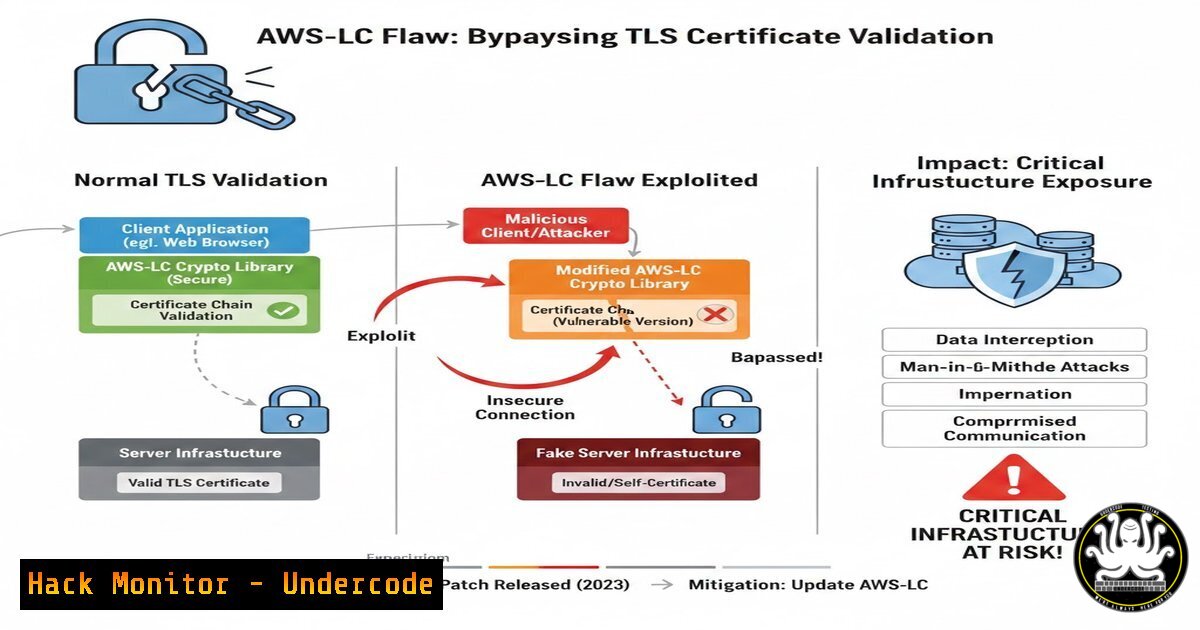
Introduction:
A critical vulnerability in Amazon’s AWS-LC cryptographic library (CVE‑2026‑3336) allows unauthenticated attackers to bypass TLS certificate validation entirely, breaking the chain of trust for PKCS7 signed objects . This flaw, alongside related signature bypass and timing side‑channel issues, exposes applications that rely on AWS-LC to forged signatures and tampered data, threatening software supply chains and secure communications. Understanding these cryptographic failures is essential for any organization using AWS services or embedding AWS-LC in their products.
Learning Objectives:
- Analyze the technical mechanisms behind CVE‑2026‑3336, CVE‑2026‑3338, and CVE‑2026‑3337 in AWS-LC.
- Identify vulnerable versions and attack surfaces where PKCS7 validation can be subverted.
- Implement detection and mitigation strategies using Linux/Windows commands and code examples.
- Apply hardening techniques for CI/CD pipelines and cryptographic verification processes.
- Evaluate the broader supply chain implications of cryptographic library flaws.
You Should Know:
- Anatomy of the PKCS7 Certificate Chain Bypass (CVE‑2026‑3336)
The vulnerability resides in the `PKCS7_verify()` function of AWS-LC versions 1.41.0 up to (but not including) 1.69.0 . When processing a PKCS7 object with multiple signers, the function fails to validate the certificate chains of all signers—only the final signer’s chain is properly checked. An attacker can craft a multi‑signer payload where intermediate signers use invalid or untrusted certificates, yet the library returns a successful verification.
Step‑by‑step exploitation scenario:
- Attacker creates a PKCS7 signed data object with two signers.
- The first signer’s certificate chain is invalid (e.g., self‑signed, expired, or issued by an untrusted CA).
- The second (final) signer’s chain is valid.
- When the victim application calls
PKCS7_verify(), the function only validates the final signer’s chain and ignores the first. - The application trusts the entire object, believing all signers are authenticated.
Impact: Attackers can inject malicious code into signed software updates, forge S/MIME emails, or tamper with certificate enrollment payloads .
Detection on Linux:
 Check your installed AWS-LC version (if installed via package manager)
apt list --installed | grep aws-lc
 Or for systems where it's compiled from source, search for the library
find /usr -name "aws-lc" -type f 2>/dev/null
 Use ldd to inspect binaries linked against AWS-LC
ldd /path/to/your/binary | grep -i aws-lc
Detection on Windows (PowerShell):
 Search for AWS-LC DLLs
Get-ChildItem -Path C:\ -Filter aws-lc.dll -Recurse -ErrorAction SilentlyContinue
 Check running processes for loaded modules
Get-Process | ForEach-Object { $<em>.Modules } | Where-Object { $</em>.ModuleName -like "aws-lc" }
2. Signature Validation Bypass via Authenticated Attributes (CVE‑2026‑3338)
A related flaw (CVE‑2026‑3338) exists in the same `PKCS7_verify()` function: improper validation of Authenticated Attributes . PKCS7 objects can include signed attributes (like content type or message digest) that are covered by the signature. In vulnerable versions, an attacker can manipulate these attributes or omit them entirely while still passing verification.
Exploitation mechanics:
- The function fails to enforce that all required authenticated attributes are correctly signed.
- Attackers can strip security‑critical attributes (e.g., signing time, policy constraints) without invalidating the signature.
- This can lead to acceptance of messages that appear to have been signed with different policies or at different times.
Mitigation commands (Linux):
 Upgrade to patched version
git clone https://github.com/aws/aws-lc.git
cd aws-lc
git checkout v1.69.0
mkdir build && cd build
cmake -DCMAKE_BUILD_TYPE=Release ..
make -j$(nproc)
sudo make install

Verify the installed version
aws-lc --version  (if version flag is supported)
 Alternatively, check the shared library version
strings /usr/local/lib/libaws-lc.so | grep -E "1.[0-9]+.[0-9]+"
3. Timing Side‑Channel in AES-CCM (CVE‑2026‑3337)
This medium‑severity vulnerability (CVSS 5.9) affects AES-CCM decryption when using the EVP CIPHER API (EVP_aes__ccm) . The implementation exhibits observable timing differences between valid and invalid authentication tags, allowing a remote attacker to determine tag validity through timing analysis. This leaks enough information to potentially forge authentication tags or decrypt messages.
Impact: Applications using AES-CCM for authenticated encryption (e.g., IoT devices, Bluetooth, secure storage) are at risk of message forgery.
Code example demonstrating constant‑time comparison (safe):
/ Constant-time memory comparison to avoid timing leaks /
int constant_time_memcmp(const void a, const void b, size_t n) {
const volatile unsigned char va = a;
const volatile unsigned char vb = b;
unsigned char result = 0;
for (size_t i = 0; i < n; i++) {
result |= va[bash] ^ vb[bash];
}
return result; // returns 0 if equal, non‑zero otherwise
}
The patched AWS-LC v1.69.0 replaces non‑constant‑time operations with safe alternatives.
4. Identifying Vulnerable Components in Your Environment
Because AWS-LC can be statically linked or embedded, simple version checks may not suffice. Use Software Bill of Materials (SBOM) tools to detect vulnerable instances.
Linux command to find statically linked binaries:
 Search for strings indicating AWS-LC in binaries
grep -r -l "AWS-LC" /usr/bin /usr/sbin /opt 2>/dev/null
 Use objdump to find specific symbols (e.g., PKCS7_verify)
objdump -T /path/to/binary | grep PKCS7_verify
Windows PowerShell for binary analysis:
 Use strings equivalent from Sysinternals
strings -n 8 C:\Path\to\binary.exe | Select-String "AWS-LC"
 Check imports
dumpbin /imports C:\Path\to\binary.exe | Select-String "aws-lc"
Container scanning (Docker):
docker run --rm -v /var/run/docker.sock:/var/run/docker.sock aquasec/trivy image your-image:tag | grep CVE-2026-3336
5. Remediation and Hardening Steps
Immediate actions:
- Upgrade all instances of AWS-LC to v1.69.0 or later .
- Rebuild any statically linked applications.
- Update dependencies: `aws-lc-sys` to v0.38.0, `aws-lc-sys-fips` to v0.13.12 .
For environments where immediate upgrade is impossible (temporary workarounds):
– For CVE‑2026‑3337 only: Replace vulnerable AES-CCM usage with EVP AEAD APIs designed for Bluetooth or Matter profiles, as suggested by AWS . However, note that this is not a full mitigation and upgrade is strongly preferred.
Add regression tests to your CI/CD pipeline:
 Example test using OpenSSL command line to verify PKCS7 validation
openssl smime -verify -in malicious.p7m -CAfile trusted-ca.pem -out /dev/null
 Expected: verification should fail for multi‑signer attacks
What Undercode Say:
- Cryptographic libraries are the bedrock of infrastructure trust; a single overlooked edge case in a verification loop can unravel the security of entire systems.
- Supply chain attacks increasingly target open‑source crypto components—organizations must maintain accurate SBOMs and treat library updates as critical patches, not routine maintenance.
- The PKCS7 multi‑signer bypass demonstrates that complex standards with decades of legacy baggage remain fertile ground for vulnerabilities; defense requires rigorous fuzzing and formal verification, not just code review.
- Timing side‑channels are not just theoretical—they can be exploited in real-world network conditions, especially in IoT and embedded contexts where jitter is low and attackers can collect many samples.
Prediction:
In the coming months, we will see a wave of attacks targeting the software supply chain through similar cryptographic validation flaws. Automated scanners will emerge that specifically probe for multi‑signer PKCS7 weaknesses, and adversaries will weaponize this technique to backdoor unsigned updates. Organizations that fail to inventory and patch embedded crypto libraries will face breaches originating from trusted, signed artifacts—eroding confidence in code signing as a security control. The industry will respond by pushing for memory‑safe languages and formally verified crypto implementations, but the transition will take years, leaving a window of opportunity for attackers.
▶️ Related Video (82% Match):
🎯Let’s Practice For Free:
IT/Security Reporter URL:
Reported By: Tamilselvan S – Hackers Feeds
Extra Hub: Undercode MoN
Basic Verification: Pass ✅


