Listen to this Post
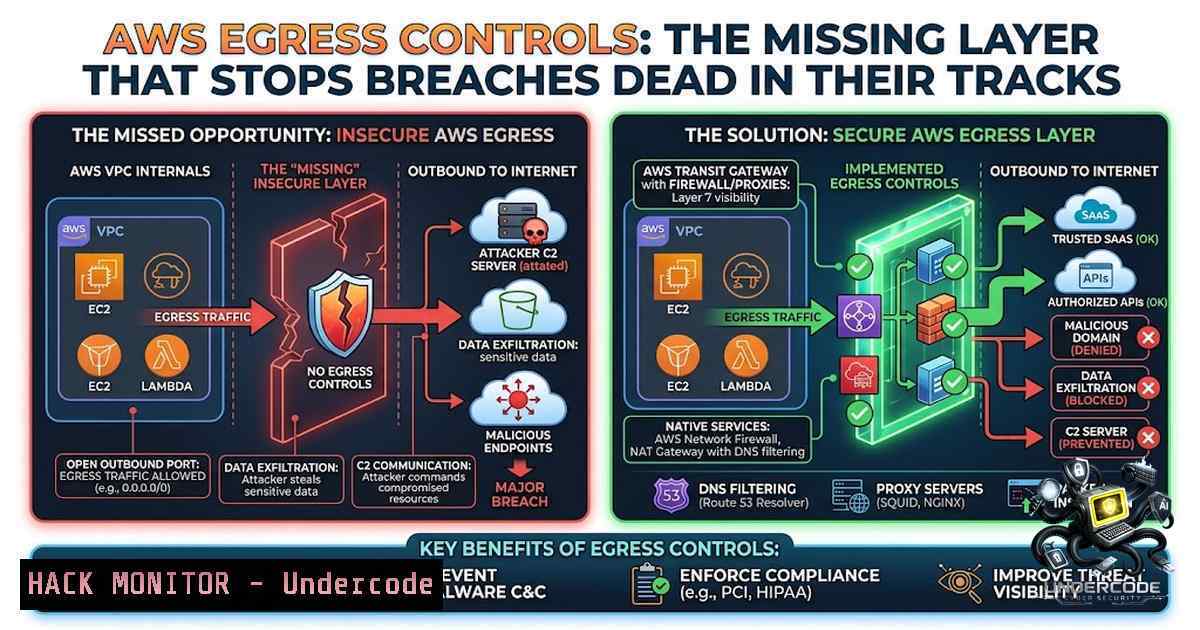
Introduction:
Organizations pour massive resources into blocking attackers at the front door—web application firewalls, identity policies, and network access control lists guard the perimeter with obsessive precision. Yet most cloud environments leave the back door wide open, allowing unrestricted outbound traffic by default to avoid breaking application dependencies. This blind spot is precisely what attackers exploit: once inside, they rely on unfiltered egress to establish command-and-control channels and exfiltrate sensitive data before security teams even realize a breach occurred. AWS recently detailed a comprehensive framework for locking down outbound traffic, and the implications extend far beyond traditional workloads into the rapidly expanding domain of autonomous AI agents.
Learning Objectives:
- Understand why outbound traffic is the single most overlooked attack vector in cloud security
- Master AWS’s hub-and-spoke architecture for centralized egress inspection
- Implement DNS firewalls, data perimeters, and behavioral monitoring to stop data exfiltration
- Apply zero-trust egress principles to both traditional workloads and AI-driven systems
- Deploy practical Linux and Windows commands for testing and enforcing egress controls
- The Egress Blind Spot: Why Your Outbound Traffic Is an Open Invitation
The conventional security mindset fixates on inbound threats. Firewalls block malicious requests, WAFs filter SQL injection attempts, and IAM policies restrict who can access what. But outbound traffic? That’s usually allowed to flow freely—after all, your applications need to call external APIs, download updates, and communicate with third-party services.
Attackers know this. When vulnerabilities like React2Shell (CVE-2025-55182) emerge, exploitation campaigns launch within hours. A successful remote code execution gives the attacker a foothold, and from there, they immediately establish outbound connections to exfiltrate data. Because outbound traffic isn’t monitored with the same rigor, this exfiltration blends into normal network activity and often goes undetected until a compliance audit forces an investigation.
Linux Command – Monitor Outbound Connections in Real-Time:
sudo tcpdump -i eth0 'dst net ! 10.0.0.0/8 and dst net ! 172.16.0.0/12 and dst net ! 192.168.0.0/16' -1
This captures all outbound traffic destined for public IPs, helping you spot unexpected connections.
Windows Command – View Active Outbound Connections:
netstat -ano | findstr ESTABLISHED
Combine with `tasklist` to map PIDs to processes and identify suspicious outbound sessions.
- The AI Agent Problem: A New Class of Exfiltration Risk
Agentic AI systems are transforming how organizations operate, but they also introduce entirely new exfiltration vectors. AI agents natively require outbound access to interact with third-party tools, APIs, and external data sources—making them high-value targets for attackers.
The OWASP Top 10 for Agent-Based Applications highlights critical threats:
- Agent Goal Hijack: Attackers quietly manipulate an autonomous AI agent to send sensitive data to an external endpoint.
- Unexpected Code Execution: An attacker forces the agent to generate reverse shells, effectively turning the AI system into a beachhead for deeper compromise.
Because AI agents are designed to communicate outward, their outbound activity demands the same rigorous constraints as any critical application workload—if not more.
Practical Step – Restrict AI Agent Outbound Destinations:
For Linux-based AI workloads, use iptables to whitelist only required endpoints:
iptables -A OUTPUT -d api.openai.com -j ACCEPT
iptables -A OUTPUT -d your-internal-api.com -j ACCEPT
iptables -A OUTPUT -j DROP
For Windows, use the Windows Firewall with Advanced Security to create outbound allow rules for specific IPs or FQDNs.
3. AWS’s Hub-and-Spoke Architecture: Centralized Egress Inspection
AWS recommends a centralized hub-and-spoke network architecture to efficiently inspect outbound traffic. Application workloads reside in isolated spoke VPCs, and all internet-bound traffic routes through a central AWS Transit Gateway. This model allows organizations to inspect traffic seamlessly as they scale, transforming outbound blind spots into highly monitored checkpoints.
Implementation Steps:
- Deploy a Transit Gateway in your network account to serve as the central routing hub.
- Attach spoke VPCs to the Transit Gateway and configure route tables to direct all `0.0.0.0/0` traffic through the hub.
- Place inspection appliances (such as third-party firewalls or AWS Network Firewall) in the hub VPC to filter outbound traffic.
- Enable VPC Flow Logs on the Transit Gateway to capture all traffic metadata for analysis.
AWS CLI Command – Create a Transit Gateway Route Table:
aws ec2 create-transit-gateway-route-table \
--transit-gateway-id tgw-1234567890abcdef0 \
--tag-specifications 'ResourceType=transit-gateway-route-table,Tags=[{Key=Name,Value=egress-inspection}]'
- Three Layers of Egress Defense: DNS, Data Perimeters, and Anomaly Detection
Securing outbound traffic requires a deliberate mix of preventive and detective controls.
Layer 1: Route 53 Resolver DNS Firewall
DNS tunneling remains a favored technique for attackers to bypass traditional firewalls. The DNS Firewall blocks malicious domain resolution, preventing attackers from using DNS queries as a covert channel.
Layer 2: Data Perimeters with Service Control Policies (SCPs) and VPC Endpoint Policies
Stolen credentials are useless if they can’t transfer data to external storage. SCPs restrict API access at the organizational level, while VPC endpoint policies limit which services and resources can be accessed from within your VPC.
Layer 3: Amazon GuardDuty for Behavioral Anomalies
GuardDuty monitors for unexpected DNS exfiltration attempts and unusual API calls. It identifies patterns that deviate from normal behavior, flagging potential compromise before data leaves your environment.
Quick Wins to Get Started:
- Enable DNS Firewall with a blocklist for known malicious domains
- Turn on GuardDuty for baseline monitoring across all accounts
- Review and tighten VPC endpoint policies to enforce least-privilege access
- Zero-Trust Egress: From Blind Spot to Monitored Checkpoint
Organizations can adopt these measures in phases, starting with quick wins like enabling DNS firewalls and GuardDuty. The ultimate goal is a zero-trust egress model that limits the blast radius of any breach.
Progressive Adoption Strategy:
- Phase 1: Enable DNS Firewall and GuardDuty across all production accounts
- Phase 2: Implement VPC endpoint policies and SCPs to restrict data transfers
- Phase 3: Deploy hub-and-spoke architecture with full egress inspection
- Phase 4: Enforce application-level outbound controls using service mesh or sidecar proxies
Linux Command – Test Egress Policy Effectiveness:
curl -v --connect-timeout 5 https://unauthorized-endpoint.example.com
If your egress controls are working, this connection should timeout or be rejected.
Windows PowerShell – Test Outbound Restrictions:
Test-1etConnection -ComputerName unauthorized-endpoint.example.com -Port 443
6. Practical Lab: Building an Egress-Controlled Environment
For hands-on learning, set up a minimal egress-controlled environment:
Step 1: Create a VPC with private subnets and a NAT gateway.
Step 2: Deploy an EC2 instance in the private subnet.
Step 3: Configure the NAT gateway’s route table to route through a Network Firewall.
Step 4: Create firewall rules that block all outbound traffic except to approved domains.
Step 5: Test by attempting `curl` to external sites—only whitelisted domains should succeed.
Terraform Snippet for Egress Rules:
resource "aws_networkfirewall_rule_group" "egress" {
capacity = 100
name = "egress-rules"
type = "STATEFUL"
rule_group {
rules_source {
stateful_rule {
action = "PASS"
header {
protocol = "TCP"
source = "0.0.0.0/0"
source_port = "0-65535"
destination = "203.0.113.0/24"
destination_port = "443"
}
rule_option {
keyword = "sid:1"
}
}
stateful_rule {
action = "DROP"
header {
protocol = "TCP"
source = "0.0.0.0/0"
source_port = "0-65535"
destination = "0.0.0.0/0"
destination_port = "0-65535"
}
rule_option {
keyword = "sid:2"
}
}
}
}
}
What Undercode Say:
- Egress is the new perimeter. While inbound security gets the budget and attention, outbound controls are where breaches are actually stopped. Attackers don’t break in through the front door—they walk out the back with your data.
-
AI agents demand a new security paradigm. Traditional workload security assumes predictable outbound patterns. AI agents are inherently unpredictable, making behavioral baselining and strict allowlisting non-1egotiable.
-
AWS provides the blueprint, but execution is everything. The hub-and-spoke architecture, DNS Firewall, and GuardDuty are powerful tools, but they require deliberate configuration and ongoing tuning. Security is not a one-time setup—it’s a continuous cycle of monitoring, detection, and refinement.
-
Start small, scale fast. Don’t wait for a breach to prioritize egress. Enable DNS Firewall and GuardDuty today—these are low-effort, high-impact controls that immediately reduce your attack surface.
-
The blast radius matters more than the breach. Zero-trust egress doesn’t prevent every compromise, but it ensures that when a compromise occurs, the damage is contained. That’s the difference between a minor incident and a catastrophic data leak.
Prediction:
-
+1 Over the next 18 months, egress controls will transition from a “nice-to-have” to a mandatory compliance requirement, driven by both regulatory pressure and insurance underwriting standards.
-
+1 AI-specific security frameworks will emerge, with egress controls as a foundational pillar—mirroring how OWASP transformed web application security over the past decade.
-
-1 Organizations that delay implementing egress controls will face increasingly sophisticated exfiltration campaigns, as attackers shift focus from gaining entry to perfecting extraction techniques.
-
+1 The convergence of cloud-1ative security tools and AI observability platforms will create unified dashboards that correlate outbound traffic patterns with AI agent behavior, enabling real-time threat detection at scale.
-
-1 Legacy applications with hardcoded external dependencies will pose the greatest challenge, forcing organizations to choose between refactoring code or accepting residual egress risk—a tension that will define cloud security strategy for years to come.
▶️ Related Video (82% Match):
https://www.youtube.com/watch?v=0b-tQjzxB7g
🎯Let’s Practice For Free:
🎓 Live Courses & Certifications:
Join Undercode Academy for Verified Certifications
🚀 Request a Custom Project:
Secure, high-velocity infrastructure and disruptive technological engineering. Contact our engineering team for high-tier development and proprietary systems:
[email protected]
💎 Smart Architecture | 🛡️ Secure by Design | ⭐ Trusted by Thousands
IT/Security Reporter URL:
Reported By: Varshu25 Aws – Hackers Feeds
Extra Hub: Undercode MoN
Basic Verification: Pass ✅


