Listen to this Post
Introduction:
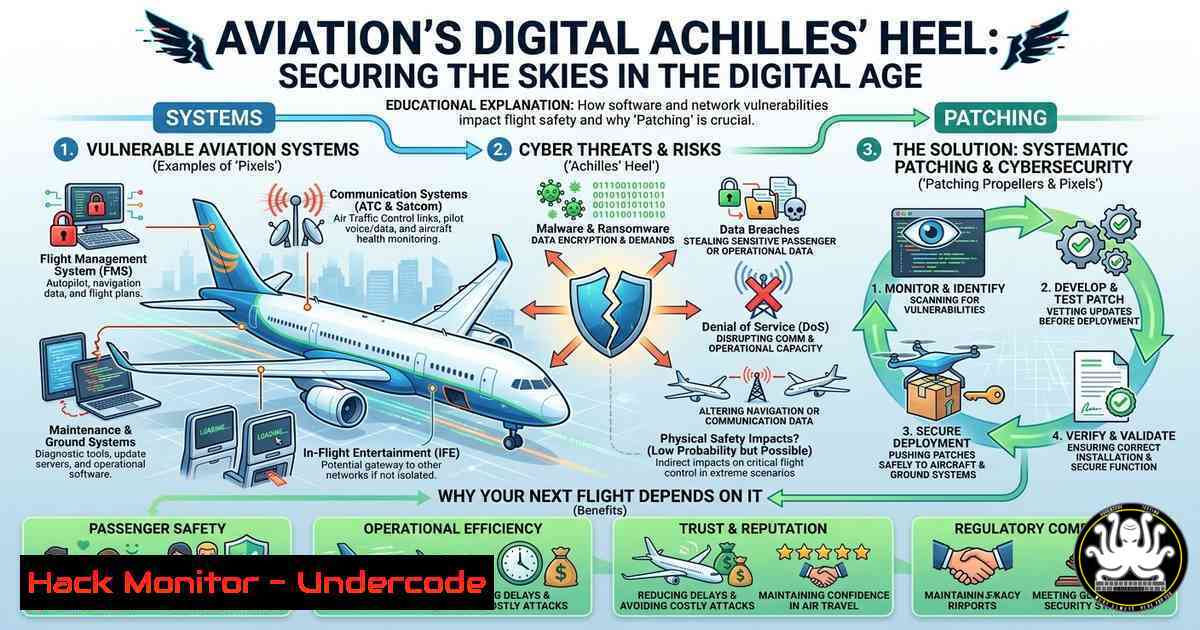
As aviation technology evolves, the gap between mechanical engineering marvels—like the intricate propeller systems seen in modern turboprops—and the digital networks that control them is shrinking. This convergence, while efficient, creates a sprawling attack surface where legacy protocol vulnerabilities meet modern API loopholes. For cybersecurity professionals, understanding how to secure these interconnected systems is no longer optional; it is a matter of public safety and operational continuity.
Learning Objectives:
- Understand the threat landscape targeting aviation maintenance networks and onboard infotainment (IFE) systems.
- Learn to configure firewall rules and intrusion detection for Operational Technology (OT) environments.
- Master command-line techniques for auditing system integrity across Linux and Windows-based aviation ground support equipment.
You Should Know:
- Mapping the Attack Surface: From Prop Governors to Cloud APIs
Modern aircraft are flying data centers. The same network that monitors propeller pitch (like the systems Dr. Ismail Durgin discusses) often shares a backbone with passenger Wi-Fi and maintenance logging. Attackers increasingly target ground support systems (GSE) to pivot into airline operational networks. A compromised API at a maintenance provider like Turkish Technic could allow an attacker to upload malicious firmware updates.
Step‑by‑step guide: Network Mapping for OT Environments
Before hardening, you must enumerate.
- Linux (Reconnaissance – Authorized Testing Only): Use `nmap` to identify devices on the maintenance floor. `sudo nmap -sS -O 192.168.1.0/24` (Stealth SYN scan to identify OS). `sudo nmap -sU -p 161 –script snmp-brute
` to check for default SNMP strings on avionics test equipment. - Windows (Auditing): Use `arp -a` to view the local ARP cache and identify connected devices. Follow up with `netstat -ano | findstr :
` to see active connections on management workstations.
2. Hardening the Ground Station: Linux Server Security
The servers that process flight plans and weather data are critical. Often, these run on Linux distributions with outdated kernels.
Step‑by‑step guide: Securing a Ubuntu Ground Station
- Update and Patch: `sudo apt update && sudo apt upgrade -y` (Ensure all repository signatures are verified).
- Firewall Configuration (UFW): Restrict access to only necessary IPs.
`sudo ufw default deny incoming`
`sudo ufw default allow outgoing`
`sudo ufw allow from 10.10.10.0/24 to any port 22 comment ‘Allow SSH from internal maintenance network’`
– Audit User Access: `sudo awk -F: ‘($3>=1000)&&($1!=”nobody”){print $1}’ /etc/passwd` (Lists all human users). Immediately disable dormant accounts with sudo passwd -l <username>.
3. Windows Endpoint Hardening for Maintenance Terminals
Engineers use Windows-based laptops to diagnose engine control units (ECUs). These devices are high-value targets.
Step‑by‑step guide: PowerShell for Security Hygiene
- Check for Suspicious Services: Run PowerShell as Administrator. `Get-Service | Where-Object {$_.Status -eq “Running” -and $_.Name -like “Remote”}` (Identifies running remote services that might be unnecessary).
- Review Scheduled Tasks for Persistence: Attackers love to hide here.
Get-ScheduledTask | Where-Object {$_.State -eq "Ready" -and $_.TaskPath -notlike "Microsoft"}. - Registry Hardening (LSA Protection): `New-ItemProperty -Path “HKLM:\SYSTEM\CurrentControlSet\Control\Lsa” -Name “RunAsPPL” -Value 00000001 -PropertyType DWORD` (Prevents unauthorized processes from accessing LSASS memory).
4. API Security in Aviation Supply Chains
Referring to the post shares from industry professionals, the supply chain includes software vendors. APIs connecting parts inventory (like BE AERO) to procurement must be secure.
Step‑by‑step guide: Testing API Endpoint Hardness
Use `curl` to test for common misconfigurations on a test server (Never on live production without authorization).
– Check for Information Disclosure:
`curl -X GET https://api.aviationsupply.com/v1/parts -H “Authorization: Bearer
Look for `Server` headers revealing versions or verbose error messages.
– Rate Limiting Test: Write a simple bash loop to see if the API blocks after too many requests.
`for i in {1..100}; do curl -X POST https://api.aviationsupply.com/v1/search -d ‘{“query”:”engine”}’ -H “Content-Type: application/json” -H “Authorization: Bearer
If you receive `200 OK` for all 100 requests, rate limiting is likely absent—a major vector for brute-force attacks.
5. Cloud Hardening for Aviation Data Lakes
Airlines store petabytes of telemetry data in the cloud. Misconfigured S3 buckets or Azure blobs can leak sensitive flight data.
Step‑by‑step guide: Auditing Cloud Permissions (Azure Example)
- Using Azure CLI: `az storage account list –query “[?enableHttpsTrafficOnly == null]” -o table` (Find storage accounts not enforcing HTTPS).
- Check for Public Access:
az storage account show --name <account-name> --query "allowBlobPublicAccess". Iftrue, this is a risk. - Network Segmentation: Ensure the aviation data lake is behind a Private Endpoint. Verify with:
az network private-endpoint list --query "[?contains(connections[].privateLinkServiceConnectionState.status, 'Approved')]".
6. Vulnerability Exploitation Simulation (Theoretical)
To understand mitigation, one must understand the attack chain. Imagine a vulnerability in the propeller synchrophaser software (the system ensuring all propellers turn at the exact same speed).
Conceptual Exploitation:
If the software accepts unauthenticated UDP packets on port 5008 (a common range for industrial control), a simple Python script could spoof sensor data, causing the propellers to fall out of sync. Mitigation involves strict ingress filtering at the switch level (MAC Address binding) and disabling unnecessary UDP ports.
7. Incident Response: Isolating Compromised Avionics Buses
If a breach is suspected, immediate containment is required without causing physical damage.
Step‑by‑step guide: Network Segmentation under Duress
- Linux (Containment): Immediately block traffic to the affected subnet.
`sudo iptables -A INPUT -s 192.168.100.50 -j DROP`
`sudo iptables -A FORWARD -s 192.168.100.50 -j DROP`
- Windows: Use `netsh advfirewall` to create a blocking rule.
`netsh advfirewall firewall add rule name=”BLOCK_AVIONICS_ALERT” dir=in interface=any action=block remoteip=192.168.100.50`
What Undercode Say:
- Key Takeaway 1: The physical and digital realms in aviation are inextricably linked. A vulnerability in a seemingly mundane maintenance laptop is a direct threat to the mechanical integrity of the aircraft.
- Key Takeaway 2: Defense in depth is paramount. Relying solely on network segregation is insufficient. Every endpoint (Linux ground station, Windows diagnostic tool, cloud API) must be hardened using the specific command-line and configuration tools available to that platform.
The lines between mechanical engineering (as celebrated in the original posts) and cybersecurity have fully blurred. The professionals who understand both the torque of a propeller and the syntax of a firewall rule will define the future of safe flight. Security is not just an IT metric; it is a component of airworthiness.
Prediction:
Within the next 24 months, we will see the first major insurance claim denial for an airline following a ransomware attack, specifically citing “failure to maintain basic cyber hygiene on ground support equipment” as a violation of policy. This will force the industry to treat cybersecurity updates with the same regulatory rigor as airframe maintenance logs.
▶️ Related Video (80% Match):
🎯Let’s Practice For Free:
IT/Security Reporter URL:
Reported By: Pervaneli U%C3%A7ak – Hackers Feeds
Extra Hub: Undercode MoN
Basic Verification: Pass ✅


