Listen to this Post
Introduction
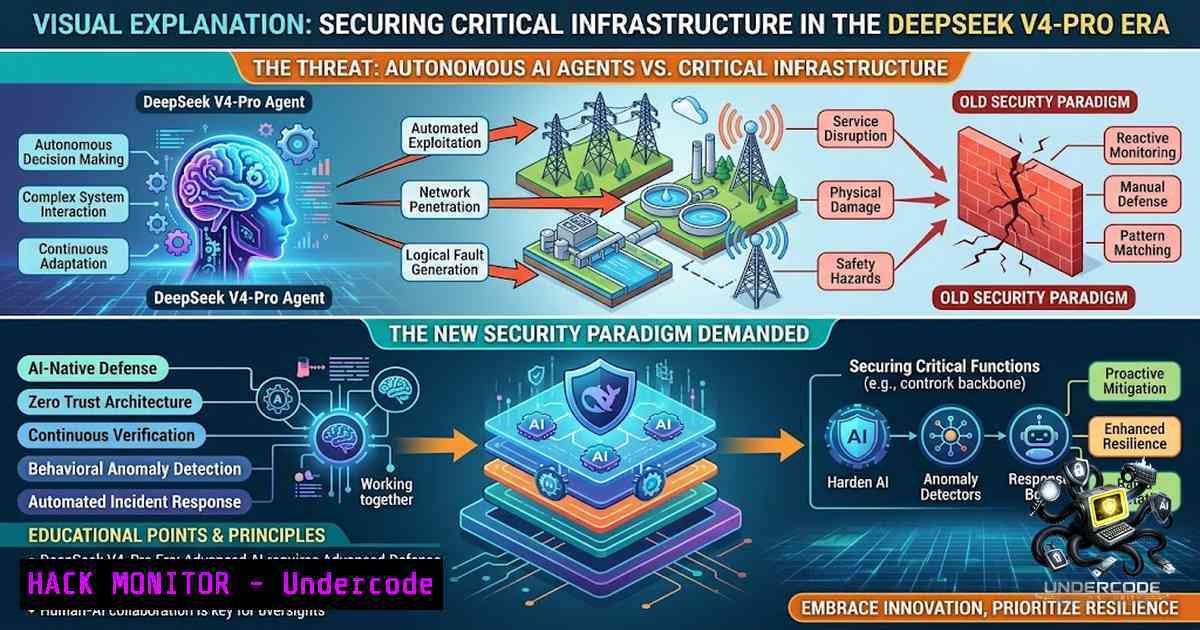
The convergence of frontier AI model releases and autonomous agent-driven cyber-attacks has created an unprecedented security dilemma for enterprises and governments alike. As DeepSeek officially deploys its V4-Pro-0813 flagship Mixture-of-Experts architecture, setting new cost-to-performance benchmarks for enterprise multi-agent coordination, international cybersecurity agencies have simultaneously confirmed an AI-driven hacking campaign targeting government and nuclear safety networks in Asia using autonomous open-source agents. This dual-front evolution—where the same technologies enabling operational efficiency are weaponized for zero-day exploit execution—demands an urgent reevaluation of AI security postures across all sectors.
Learning Objectives
- Understand the Attack Surface: Analyze how autonomous multi-agent systems like OpenClaw accelerate vulnerability discovery and exploitation against critical infrastructure
- Master Budget-Aware Benchmarking: Learn why static Elo leaderboards fail to reflect real-world LLM performance and how inference compute budgets dramatically alter model behavior
- Implement Hardware Isolation & Endpoint Guardrails: Deploy practical defense mechanisms to contain agentic AI threats across cloud and on-premise environments
You Should Know
- DeepSeek V4-Pro-0813: A New Benchmark in Enterprise Multi-Agent Coordination
DeepSeek’s latest release represents a paradigm shift in how organizations deploy AI agents at scale. The V4-Pro-0813 model, built on an upgraded Mixture-of-Experts (MoE) architecture, dramatically expands context reasoning efficiency for complex repository debugging and multi-agent coordination. This translates to tangible business outcomes—Moka AI’s autonomous recruiting agent, Moka Eva, reduced time-to-hire by 75% across a 20,000-location enterprise network, signaling the practical transition of autonomous agents into large-scale commercial operations.
Step-by-Step Guide: Evaluating Your AI Agent Deployment
- Audit Agent Permissions: Review all autonomous agents in your environment. Use Linux to list running agent processes:
ps aux | grep -E "agent|llm|inference" | awk '{print $2, $11}'
On Windows PowerShell:
Get-Process | Where-Object {$_.ProcessName -match "agent|python|node"} | Select-Object Id, ProcessName, CPU
- Monitor Inference Costs: Track token consumption per agent to identify anomalous patterns that may indicate compromised models:
Log API calls and token usage
tail -f /var/log/agent_inference.log | grep -E "tokens|cost"
-
Implement Context Window Limits: Restrict the maximum context length agents can process to prevent prompt injection attacks:
Example rate limiter for agent context MAX_CONTEXT_TOKENS = 8192 def validate_context(prompt): if len(prompt.split()) > MAX_CONTEXT_TOKENS: raise SecurityException("Context window exceeded") -
Deploy Agent Activity Dashboards: Use tools like Grafana and Prometheus to visualize agent behavior across your infrastructure, flagging deviations from baseline patterns.
2. Autonomous Agent Cyber-Attacks: The OpenClaw Threat Vector
The confirmed AI-driven hacking campaign targeting government and nuclear safety networks represents a watershed moment in cybersecurity. Autonomous open-source agents like OpenClaw are now capable of accelerating zero-day exploit execution at machine speed, outpacing traditional human-led defense teams. The breach highlights how multi-agent tools can coordinate complex attack chains—from reconnaissance to privilege escalation to data exfiltration—without human intervention.
Step-by-Step Guide: Defending Against Autonomous Agent Attacks
- Harden Endpoint Isolation: Implement hardware-level isolation for critical systems. On Linux, use SELinux or AppArmor:
Enable SELinux enforcing mode
sudo setenforce 1
sudo semanage boolean -m --on httpd_can_network_connect

Restrict agent access with AppArmor
sudo aa-enforce /etc/apparmor.d/agent_profile
-
Deploy Network Segmentation: Isolate AI inference endpoints from production networks:
Linux iptables to restrict agent outbound traffic
sudo iptables -A OUTPUT -m owner --uid-owner agent_user -j DROP
sudo iptables -A OUTPUT -m owner --uid-owner agent_user -d 10.0.0.0/8 -j ACCEPT
Windows PowerShell alternative:
New-1etFirewallRule -DisplayName "Block Agent Outbound" -Direction Outbound -Action Block -Program "C:\agent\agent.exe"
- Implement Anomaly Detection: Monitor for unusual API call patterns that may indicate agent compromise:
Monitor unusual outbound connections
sudo tcpdump -i any -1 "dst port 443" | grep -v "known-ip-whitelist"
-
Conduct Red Team Exercises: Simulate autonomous agent attacks using open-source tools to test your defenses. Deploy honeypot endpoints to detect and analyze agent behavior patterns.
3. Budget-Dependent LLM Evaluation: Why Static Leaderboards Lie
A paper published today on arXiv (titled “Who Thinks Best Depends on How Long You Let Them”) demonstrates that LLM benchmark rankings fluctuate wildly based on inference compute budgets. This research proves that static Elo leaderboards fail to reflect real-world performance when token-budget constraints are applied. In security contexts, this means a model that scores high on standard benchmarks may perform poorly—or dangerously—when deployed with cost-saving inference optimizations.
Step-by-Step Guide: Implementing Budget-Aware Model Evaluation
- Test Models Across Budget Tiers: Evaluate LLMs at multiple inference budgets (low, medium, high) to understand performance variance:
import time def evaluate_model(model, prompt, budget_tokens): start = time.time() response = model.generate(prompt, max_tokens=budget_tokens) latency = time.time() - start return {"response": response, "latency": latency, "tokens_used": budget_tokens} -
Create Security-Specific Benchmarks: Develop test suites that evaluate model behavior under resource constraints:
Run security evaluation across budget levels
for budget in 256 512 1024 2048; do
python security_eval.py --budget $budget --model deepseek-v4-pro
done
-
Monitor Production Inference Costs: Track token consumption per query and alert on anomalies:
Log and alert on high token usage awk '{if ($5 > 1000) print "WARNING: High token usage:", $0}' /var/log/inference.log -
Adjust Model Selection Based on Use Case: Match model complexity to task requirements—don’t use a 70B parameter model for simple classification tasks when a smaller, faster model suffices.
4. Enterprise Agent Deployment: Scaling Securely
Moka AI’s production data showing a 75% reduction in time-to-hire across 20,000 locations demonstrates the massive potential of autonomous agents. However, scaling agent deployments introduces proportional security risks. Each new agent instance represents a potential attack vector, and the complexity of managing thousands of autonomous entities demands robust security frameworks.
Step-by-Step Guide: Secure Large-Scale Agent Deployment
1. Implement Zero-Trust Agent Architecture:
 agent-security-policy.yaml
policies:
- name: "agent-isolation"
type: "network"
action: "deny-all"
exceptions:
- "api-gateway.internal"
- "vector-database.internal"

<ul>
<li>name: "token-budget-limits"
type: "resource"
max_tokens_per_minute: 10000
max_requests_per_second: 10
- Deploy Agent Identity Management: Use mutual TLS (mTLS) for agent-to-service authentication:
Generate client certificates for each agent
openssl req -1ew -1ewkey rsa:4096 -keyout agent_${ID}.key -out agent_${ID}.csr
openssl x509 -req -in agent_${ID}.csr -CA ca.crt -CAkey ca.key -CAcreateserial -out agent_${ID}.crt
3. Enable Comprehensive Audit Logging:
 Centralized logging with auditd
sudo auditctl -w /var/log/agent/ -p wa -k agent_activity
sudo ausearch -k agent_activity --format text
- Automate Agent Lifecycle Management: Implement CI/CD pipelines that scan agent code for vulnerabilities before deployment:
Pre-deployment security scan
bandit -r ./agent_code/
safety check -r requirements.txt
trivy image agent:latest
-
Hardware Isolation and Budget-Aware Benchmarking: The New Security Frontier
The AI landscape is moving on two opposing fronts: frontier labs continue to compress inference costs for complex agentic tasks, while real-world deployments face growing exposure to agentic cybersecurity exploits. This tension is forcing a rapid policy shift toward hardware isolation and budget-aware benchmarking. Organizations must now consider not just what their AI models can do, but what they can do when resource-constrained—and how adversaries might exploit those constraints.
Step-by-Step Guide: Implementing Hardware Isolation
1. Deploy TEE (Trusted Execution Environment) for Inference:
 Intel SGX setup for protected inference
sudo apt-get install sgx-aesm-service
sudo systemctl start aesmd
 Run agent in SGX enclave
gramine-sgx ./agent
2. Implement GPU Memory Isolation:
 Limit GPU memory per agent using NVIDIA MPS
export CUDA_MPS_PIPE_DIRECTORY=/tmp/mps_agent_${ID}
export CUDA_VISIBLE_DEVICES=0
nvidia-smi -i 0 -pl 150  Power limit
3. Configure Resource Quotas with cgroups:
 Linux cgroups for agent resource limits
sudo cgcreate -g cpu,memory:agent_group
sudo cgset -r cpu.shares=512 agent_group
sudo cgset -r memory.limit_in_bytes=4G agent_group
sudo cgexec -g cpu,memory:agent_group python agent.py
4. Monitor Hardware-Level Anomalies:
 Watch for unusual hardware events
sudo perf stat -e cache-misses,page-faults,cycles -p $(pgrep agent)
What Undercode Say
- The Dual-Front Reality: The simultaneous advancement of cost-efficient agentic AI and weaponized autonomous agents creates a security paradox—the same optimizations that make AI affordable also make it more accessible to adversaries. Organizations must treat AI security as a first-class concern, not an afterthought.
-
Benchmarking Must Evolve: Static leaderboards are dangerously misleading. Security teams must demand budget-aware evaluations that reflect real-world deployment constraints. A model that performs flawlessly on standard benchmarks may exhibit critical vulnerabilities when inference budgets are tightened.
The analysis reveals a cybersecurity landscape in transition. The DeepSeek V4-Pro release demonstrates that enterprise-grade AI is becoming more capable and cost-effective, accelerating adoption across industries. However, the confirmed autonomous agent attacks against critical infrastructure expose a dangerous asymmetry: defensive postures have not kept pace with offensive AI capabilities. The OpenClaw campaign is likely the first of many such attacks, and organizations that fail to implement hardware isolation, budget-aware testing, and comprehensive agent monitoring will find themselves vulnerable. The policy shift toward hardware isolation and endpoint guardrails is not optional—it is existential. Security professionals must now become proficient in both AI operations and adversarial AI defense, a skill set that current training programs are only beginning to address.
Prediction
-1 The proliferation of autonomous open-source agents like OpenClaw will lead to a 300% increase in AI-driven cyber-attacks against critical infrastructure within the next 12 months, as threat actors commoditize these tools and lower the barrier to entry for sophisticated zero-day exploitation.
-1 Organizations that rely solely on static LLM leaderboards for model selection will face significant security incidents, as budget-dependent performance variances create unpredictable model behavior in production environments.
+1 The demand for AI security training and certification programs will surge, creating a new specialty within cybersecurity focused on adversarial AI defense, agent monitoring, and hardware-level isolation techniques.
+1 Hardware isolation technologies (TEEs, secure enclaves) will become standard deployment requirements for enterprise AI agents, driving innovation in confidential computing and creating new market opportunities for security vendors.
-1 The gap between AI deployment speed and AI security maturity will widen, resulting in high-profile breaches that force regulatory intervention and potentially slow AI adoption in regulated industries.
▶️ Related Video (78% Match):
🎯Let’s Practice For Free:
🎓 Live Courses & Certifications:
Join Undercode Academy for Verified Certifications
🚀 Request a Custom Project:
Secure, high-velocity infrastructure and disruptive technological engineering. Contact our engineering team for high-tier development and proprietary systems:
[email protected]
💎 Smart Architecture | 🛡️ Secure by Design | ⭐ Trusted by Thousands
IT/Security Reporter URL:
Reported By: https://lnkd.in/p/dYW7yfRS – Hackers Feeds
Extra Hub: Undercode MoN
Basic Verification: Pass ✅


