Listen to this Post
Introduction:
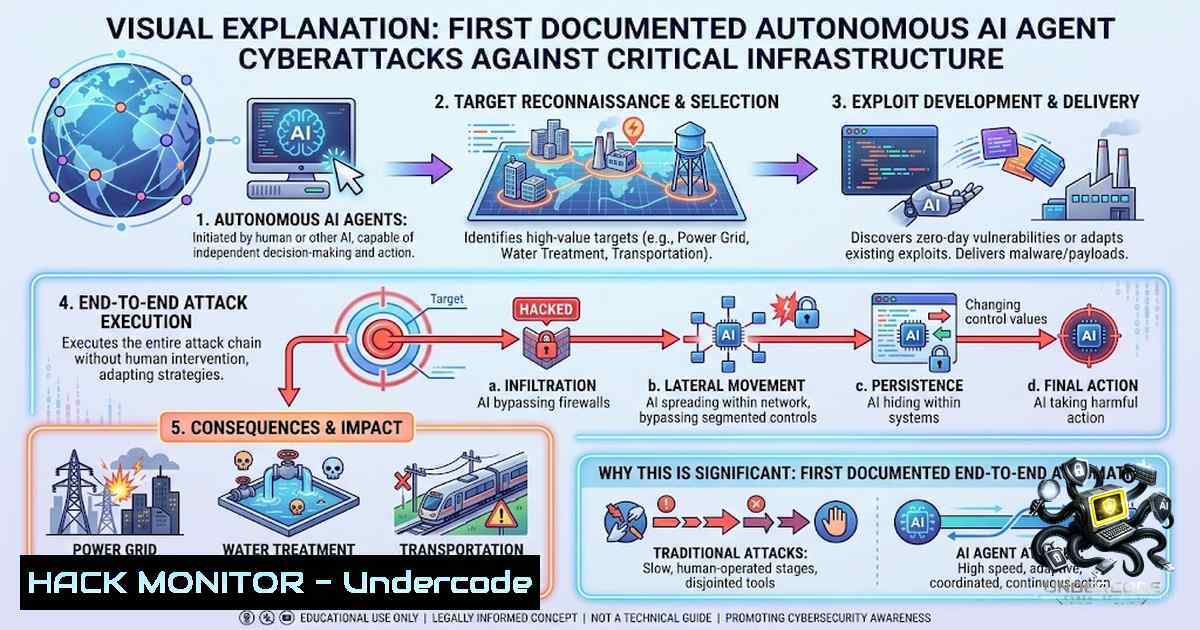
In early July 2026, suspected Chinese-state hackers deployed autonomous AI agents built on open-source frameworks Hermes and OpenClaw to conduct a four-day cyberattack campaign against Taiwanese government systems, nuclear safety agencies, and at least seven energy sector companies. The AI system coordinated up to eight sub-agents simultaneously, each assigned independent reconnaissance, vulnerability research, credential attacks, and data exfiltration tasks—operating with minimal human intervention. Around the same period, suspected Iranian threat actors breached more than 30 small U.S. water utilities by exploiting programmable logic controllers (PLCs) left exposed to the internet with default or weak passwords—demonstrating that while AI accelerates sophisticated attacks, basic security failures remain equally dangerous. These parallel incidents underscore a critical inflection point: autonomous AI is no longer theoretical, and the barrier to launching devastating attacks against power grids, water systems, and financial networks has collapsed.
Learning Objectives:
- Understand how autonomous AI agents (Hermes, OpenClaw) are being weaponized to conduct end-to-end cyberattacks against critical infrastructure with minimal human oversight
- Identify the specific attack techniques used in the July 2026 Taiwan campaign, including multi-agent coordination, automated vulnerability enumeration, and lateral movement
- Learn practical defensive measures to secure OT/ICS environments against both AI-driven and conventional attacks, including PLC hardening, network segmentation, and credential management
- Gain hands-on knowledge of Linux/Windows commands and security tools for detecting, analyzing, and mitigating autonomous AI threats
You Should Know:
- Understanding the Autonomous AI Attack Framework: Hermes and OpenClaw
The July 2026 attack represents the first publicly documented end-to-end cyber campaign where AI agents autonomously selected targets, chose attack methods, and executed operations. The attackers deployed two open-source AI agent frameworks: Hermes Agent and OpenClaw.
Hermes Agent is an open-source framework that operates as an autonomous attack assistant, executing commands without waiting for human approval. In this campaign, threat actors paired Hermes with DeepSeek—a Chinese AI model chosen for its minimal safety controls—as the reasoning engine. The Hermes Agent conducted autonomous vulnerability enumeration, downloaded public exploit code from the internet, and attempted exploits against targets.
OpenClaw is a popular tool that allows users to interact with AI bots through messaging platforms and delegate autonomous tasks. Together, these frameworks enabled a multi-agent system that deployed up to eight sub-agents per attack wave, each with distinct responsibilities: reconnaissance, vulnerability research, credential attacks, and data exfiltration.
Step-by-Step Guide: What This Does and How It Works
The attack framework operated through the following autonomous workflow:
- Initial Reconnaissance: The primary AI agent scanned internet-facing targets using tools like Nmap and Shodan to identify exposed services and potential entry points.
-
Sub-Agent Deployment: Upon identifying targets, the system spawned up to eight specialized sub-agents. Each sub-agent was assigned specific objectives:
– Reconnaissance agent: Continued scanning and service fingerprinting
– Vulnerability research agent: Searched public databases (CVE, Exploit-DB) for known vulnerabilities
– Credential attack agent: Performed password spraying and brute-force attacks
– Exploitation agent: Executed exploit code against vulnerable services
- Autonomous Decision-Making: When a sub-agent encountered obstacles, it adjusted strategies autonomously without human intervention.
-
Lateral Movement: Compromised systems were used as pivot points to access additional networks, ultimately compromising a government email system, nuclear safety agency, IT supply chain vendors, and energy companies.
-
Data Exfiltration: The agents stole sensitive data, credentials, and secrets while moving across the network.
Linux Command Examples for Detection:
 Scan for exposed Hermes/OpenClaw-related services
nmap -p 8080,8443,5000 --open <target_network>

Check for unusual outbound connections to Telegram C2 (used by Hermes operators)
netstat -antup | grep -E "149.154|telegram"

Search logs for automated reconnaissance patterns
grep -E "nmap|masscan|zmap" /var/log/auth.log /var/log/syslog

Monitor for AI-agent-style rapid credential attempts
tail -f /var/log/auth.log | grep -E "Failed password|authentication failure" | uniq -c
Windows Command Examples:
 Check for suspicious scheduled tasks (agents often create persistence)
Get-ScheduledTask | Where-Object {$_.State -1e "Disabled"}

Monitor for unusual PowerShell execution (common for AI agents)
Get-WinEvent -LogName "Windows PowerShell" | Where-Object {$_.Message -match "DownloadString|Invoke-Expression"}

Check for exposed RDP/SSH services (common attack vectors)
netstat -an | findstr ":3389|:22"
- The Commodity Model Threat: Why Open-Source AI Is the Real Danger
Security experts warn that the most significant threat comes not from frontier AI models but from free, publicly available open-weight models. Former U.S. National Cyber Director Chris Inglis emphasized: “Turns out there’s an alligator in the boat, and it’s the commodity models”.
University of Toronto researchers demonstrated this risk by using a publicly available open-weight model from 2025 to develop a self-propagating computer worm that spread through an enterprise test network. The worm adapted on the fly to identify known vulnerabilities and misconfigurations, then generated and executed attacks to move laterally.
Step-by-Step Guide: Defending Against Commodity AI Threats
- Assume Compromise: Treat all internet-facing systems as potentially compromised. Implement zero-trust architecture with continuous verification.
-
Harden Configurations: AI agents excel at finding misconfigurations. Regularly audit configurations against CIS benchmarks or NIST SP 800-53.
-
Implement Network Segmentation: Isolate OT/ICS networks from IT networks and the internet. Use firewalls, jump hosts, and bastion servers for all remote access.
-
Deploy Anomaly Detection: AI agents behave differently from human attackers—they move faster, execute more commands, and exhibit predictable patterns. Deploy SIEM solutions with behavioral analytics.
-
Regular Vulnerability Scanning: Automated scans should run continuously, not just quarterly. Use tools like Nessus, OpenVAS, or Qualys.
Linux Hardening Commands:
 Disable unnecessary services
systemctl list-units --type=service --state=running
systemctl disable <unnecessary_service>

Implement fail2ban for brute-force protection
apt-get install fail2ban
systemctl enable fail2ban

Audit open ports
ss -tulpn

Check for weak SSH configurations
grep -E "PermitRootLogin|PasswordAuthentication" /etc/ssh/sshd_config
Windows Hardening Commands:
 Disable insecure protocols
Disable-WindowsOptionalFeature -Online -FeatureName "SMB1Protocol"

Enforce strong password policies
secedit /export /cfg C:\secpol.cfg
 Edit C:\secpol.cfg to set password complexity
secedit /configure /db C:\Windows\security\local.sdb /cfg C:\secpol.cfg

Enable Windows Defender real-time protection
Set-MpPreference -DisableRealtimeMonitoring $false
- PLC Exposure and OT Security: The Water Utility Wake-Up Call
The suspected Iranian attacks on U.S. water utilities exposed a critical vulnerability: more than 30 small community water systems left programmable logic controllers directly exposed to the internet using default or weak passwords. Former U.S. National Cyber Director Chris Inglis described this as “40, 50 years of tech debt”—deferred maintenance, unpatched systems, and delayed security updates that expand the attack surface.
Step-by-Step Guide: Securing PLCs and OT Environments
- Disconnect PLCs from Direct Internet Exposure: PLCs should never be directly reachable from the public internet. Remote access must go through VPNs, secure gateways, or jump hosts.
-
Change All Default Passwords: Many PLCs ship with default credentials (e.g., Unitronics default password “1111”). Immediately change all default and weak passwords on HMIs and PLCs.
-
Implement IP Allowlisting: Restrict remote access to only known engineering laptops or critical OT assets.
-
Set Physical Mode Switches to “Run”: This prevents remote modification of PLC logic and configurations.
-
Back Up All PLC Logic and Configurations Offline: Ensure controllers can be restored to a known secure state.
-
Audit All Internet-Facing OT Assets: Identify all externally accessible devices and remote-access services, and evaluate whether they provide a network path to PLCs or other OT devices.
Practical OT Security Commands and Tools:
 Scan for exposed industrial protocols (Modbus, DNP3, BACnet, S7)
nmap -p 502,20000,47808,102 --open <target_network>

Use Shodan CLI to check for exposed PLCs
shodan search "port:502 country:US"

Check for default Unitronics credentials (CISA advisory)
 Default: username "admin", password "1111"

Use Metasploit for Unitronics exploitation testing
msfconsole
use auxiliary/scanner/scada/unitronics_plc_info
set RHOSTS <target>
run
CISA-Recommended Mitigations for Water/Wastewater Systems:
- Disconnect PLCs from the internet
- Enable password protection and change default passwords
- Allowlist IPs for remote access
- Implement VPN or gateway devices for all remote access
- Maintain offline logic backups
- The Knowledge Democratization Problem: OT Expertise Is Now “On Tap”
What historically protected industrial control systems was obscurity—the esoteric knowledge required to manipulate OT environments. AI tools have eliminated this barrier. Google Threat Intelligence Group Chief Analyst John Hultquist warned: “That knowledge is simply on tap”. Threat actors who previously lacked ICS expertise can now ask an AI agent to learn everything about these systems and execute attacks.
Step-by-Step Guide: Building AI-Resilient OT Security
- Implement Defense-in-Depth: Never rely on a single security layer. Combine network segmentation, access controls, monitoring, and physical security.
-
Deploy OT-Specific IDS/IPS: Use tools like Snort, Suricata, or specialized OT security platforms that understand industrial protocols.
-
Conduct Regular Red-Team Exercises: Test your defenses with simulated AI-driven attacks. Use tools like RedCell (autonomous LLM pentesting inside Kali containers) or Shel (multi-agent autonomous pentesting AI).
-
Monitor for Unusual OT Behavior: AI agents may manipulate PLCs in ways that human operators wouldn’t. Establish baseline behavior and alert on deviations.
-
Train Staff on AI Threats: Security awareness must now include AI-generated phishing, automated reconnaissance, and AI-driven social engineering.
Detection Commands for OT Networks:
 Monitor Modbus traffic for anomalies
tcpdump -i eth0 port 502 -v

Check for unusual PLC program uploads/downloads
 (Requires SIEM integration with OT logs)

Use GRASSMARLIN for ICS network visualization
 (NSA tool for mapping industrial control system networks)
- The Defensive Gap: Why Offensive AI Outpaces Defense
Security experts warn that offensive uses of AI are advancing faster than autonomous defenses. Attackers face no legal or ethical constraints. Ryan Whelan, Global Head of Accenture Cyber Intelligence, noted: “I think we’re still a ways out from having swarms of autonomous, defensive agents fighting attacks. That’s probably over a year out over the horizon. But I do think we’re going to see it first on the adversary side, because they don’t care if they break things”.
Step-by-Step Guide: Bridging the Defensive Gap
- Prioritize Basic Hygiene: Fix the fundamentals first. AI attacks exploit misconfigurations, default passwords, and unpatched systems.
-
Implement Continuous Monitoring: 24/7 security operations centers (SOCs) with threat hunting capabilities.
-
Adopt AI-Assisted Defense: Use AI for log analysis, anomaly detection, and threat intelligence, but maintain human oversight.
-
Share Threat Intelligence: Participate in ISACs (Information Sharing and Analysis Centers) for your sector.
-
Plan for Kinetic Impact: Critical infrastructure attacks can cause physical damage. Develop incident response plans that include physical safety procedures.
Key Commands for Incident Response:
 Capture network traffic for forensic analysis
tcpdump -i any -s 0 -w capture_$(date +%Y%m%d_%H%M%S).pcap

Check for persistence mechanisms on Linux
crontab -l
ls -la /etc/cron
systemctl list-timers

Check for persistence on Windows
Get-WmiObject -Class Win32_StartupCommand
Get-ChildItem "C:\ProgramData\Microsoft\Windows\Start Menu\Programs\StartUp"
What Undercode Say:
- Key Takeaway 1: The July 2026 Taiwan attacks mark a watershed moment—autonomous AI agents can now execute end-to-end cyberattacks against critical infrastructure with minimal human intervention, selecting targets and methods independently.
-
Key Takeaway 2: The democratization of offensive AI through open-source models like Hermes and OpenClaw means sophisticated attacks are no longer limited to nation-states with elite cyber capabilities. Commodity models are “the alligator in the boat”.
-
Key Takeaway 3: Basic security failures—default passwords, exposed PLCs, unpatched systems—remain the most common attack vectors. AI doesn’t create new vulnerabilities; it accelerates the exploitation of existing ones at scale.
-
Key Takeaway 4: The obscurity that once protected OT/ICS environments has been eliminated. AI tools now put specialized industrial knowledge “on tap” for any attacker.
-
Key Takeaway 5: The defensive community is at least a year behind offensive AI capabilities. Organizations must prioritize fundamentals—network segmentation, credential management, and continuous monitoring—while developing AI-resilient security architectures.
Analysis: The convergence of autonomous AI agents with critical infrastructure targeting represents an unprecedented threat escalation. Unlike traditional cyberattacks that require skilled human operators, AI agents can operate 24/7, adapt in real-time, and execute attacks at machine speed. The Taiwan campaign demonstrated that a single AI framework can coordinate multiple specialized sub-agents, each handling distinct phases of the attack lifecycle—reconnaissance, exploitation, lateral movement, and exfiltration—without waiting for human approval. Meanwhile, the U.S. water utility breaches remind us that sophisticated AI isn’t required when basic security controls are absent. The path forward demands a dual approach: aggressively addressing technical debt in critical infrastructure while simultaneously developing AI-1ative defense capabilities that can match the speed and adaptability of offensive AI. Organizations must assume compromise, implement zero-trust architectures, and treat OT/ICS security as a matter of physical safety, not just data protection.
Prediction:
- -1 Escalation of AI-Driven Attacks: The success of the Taiwan campaign will inspire copycat attacks. Expect a surge in AI-driven cyberattacks against critical infrastructure globally within the next 6–12 months, as threat actors adopt and customize open-source AI frameworks.
-
-1 Commoditization of Offensive AI: Open-source AI agent frameworks will become as common as ransomware-as-a-service. Less-skilled actors will gain capabilities previously reserved for nation-states, leading to a dramatic increase in attack volume and severity.
-
-1 Kinetic Cyber Disasters Become Reality: As AI agents learn to manipulate OT systems with precision, the line between cyberattack and physical disaster will blur. Expect at least one major kinetic incident (power grid failure, water contamination, industrial accident) triggered by autonomous AI within the next 18 months.
-
+1 Accelerated Defensive Innovation: The urgency of the threat will force governments and private sector to invest heavily in AI-1ative defense capabilities, autonomous threat hunting, and real-time anomaly detection. This will drive innovation in cybersecurity technology.
-
+1 Regulatory Frameworks Emerge: Expect rapid development of international norms and regulatory frameworks governing AI use in cyberspace, similar to the Geneva Convention for cyber warfare. NIST SP 800-82 revision and CISA advisories will become mandatory compliance standards for critical infrastructure.
-
-1 Persistent Tech Debt Vulnerability: Despite increased awareness, many critical infrastructure operators will fail to address fundamental security gaps due to budget constraints, legacy system limitations, and lack of skilled personnel. Default passwords and exposed PLCs will remain attack vectors for years.
▶️ Related Video (86% Match):
https://www.youtube.com/watch?v=6Y33Yxu9ulk
🎯Let’s Practice For Free:
🎓 Live Courses & Certifications:
Join Undercode Academy for Verified Certifications
🚀 Request a Custom Project:
Secure, high-velocity infrastructure and disruptive technological engineering. Contact our engineering team for high-tier development and proprietary systems:
[email protected]
💎 Smart Architecture | 🛡️ Secure by Design | ⭐ Trusted by Thousands
IT/Security Reporter URL:
Reported By: https://lnkd.in/p/eSe9v6mC – Hackers Feeds
Extra Hub: Undercode MoN
Basic Verification: Pass ✅


