
Listen to this Post
Introduction:
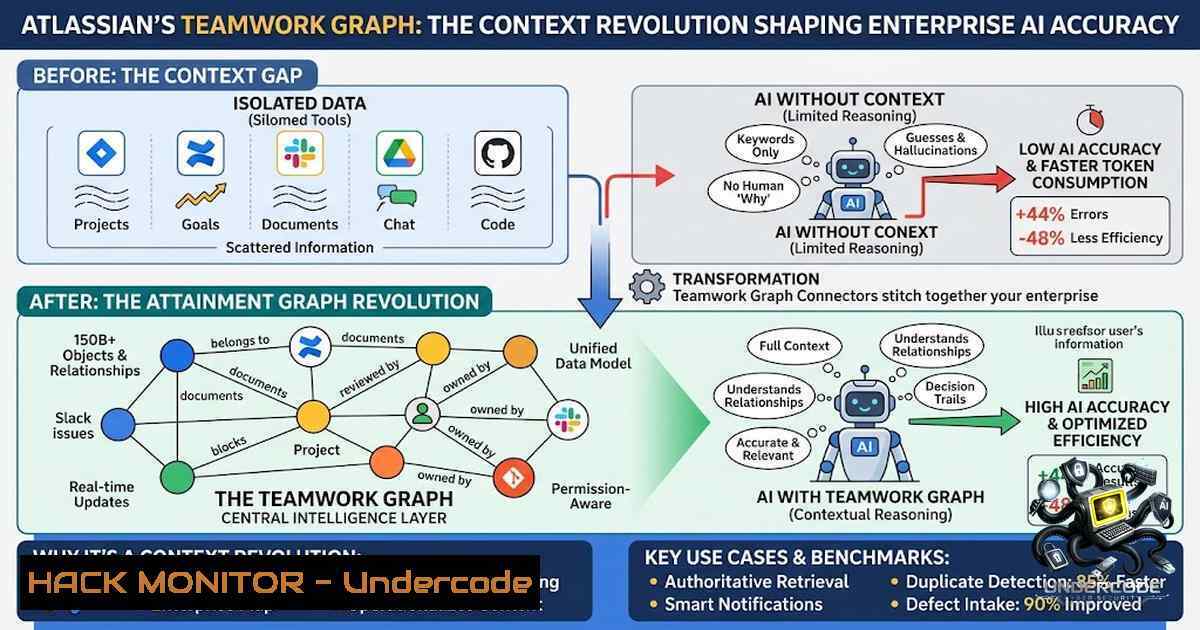
As organizations rush to deploy AI across their operations, a fundamental truth is emerging: accuracy isn’t a model problem—it’s a context problem. While AI vendors compete on parameter counts and training data, the real competitive advantage lies in grounding AI responses in an organization’s actual operational reality. Atlassian’s Teamwork Graph, encompassing over 150 billion objects and relationships across their ecosystem, demonstrates that contextual grounding delivers 44% more accurate results while consuming 48% fewer tokens—a dual victory that challenges conventional wisdom about AI tradeoffs.
Learning Objectives & Secrets:
- Objective 1: Understanding Context Grounding Architecture – Learn how graph-based knowledge representation transforms AI from generating plausible guesses to delivering verified, organization-specific answers that reflect real relationships, permissions, and historical decisions.
-
Objective 2: Optimizing Token Economics – Secret tip: Implement context window optimization by pre-filtering graph nodes based on user permissions and relevance scoring, reducing token consumption while maintaining answer quality. The 48% reduction isn’t just about cost—it’s about enabling longer, more complex reasoning chains within fixed context windows.
-
Objective 3: Governance-By-Design Implementation – Secret tip: Design access control inheritance that mirrors organizational structure, ensuring that graph queries automatically respect existing permissions without additional API checks, reducing latency while maintaining security posture.
You Should Know:
1. Implementing Graph-Based Context Retrieval for AI Systems
The core technical shift involves moving from vector similarity retrieval to graph-traversal context gathering. This isn’t about replacing embeddings but augmenting them with relationship awareness.
Step-by-Step Implementation:
- Map Your Data Sources: Identify all systems containing decision-relevant relationships—Jira issues linking to Confluence pages, GitHub commits referencing tickets, Slack threads resolving decisions.
-
Define Relationship Types: Create a schema that captures ownership (
owns), blocking relationships (blocks), temporal dependencies (precedes), and decision tracking (resolves). -
Build Your Graph Database: Using Neo4j or Amazon Neptune, create nodes for entities and edges for relationships:
// Example relationship mapping CREATE (issue:Issue {id: 'PROJ-123', status: 'resolved'}) CREATE (decision:Decision {id: 'DEC-001', outcome: 'approved'}) CREATE (issue)-[:RESOLVED_BY]->(decision) -
Implement Permission-Aware Queries: Ensure graph traversal respects user permissions:
def get_context(user_id, query): permissions = get_user_permissions(user_id) graph_query = f""" MATCH (n)-[bash]-(m) WHERE n.permissions IN {permissions} AND m.permissions IN {permissions} RETURN n, r, m """ return graph_db.query(graph_query) -
Integrate with LLM Pipeline: Replace simple RAG with graph-traversal RAG:
def augment_prompt(user_query, user_id):
context_nodes = get_graph_context(user_query, user_id)
formatted_context = format_graph_context(context_nodes)
return f"Context: {formatted_context}\n\nQuery: {user_query}"
2. Token Optimization Strategies Through Graph Pre-Filtering
The 48% token reduction isn’t accidental—it’s engineered through intelligent context selection before prompt construction.
Step-by-Step Optimization:
- Implement Relevance Scoring: Assign weight to graph nodes based on recency, frequency of access, and relationship strength:
def calculate_relevance(node, query_embedding):
structural_score = node.centrality  0.4
semantic_score = cosine_similarity(node.embedding, query_embedding)  0.4
temporal_score = (1 / (1 + node.age_days))  0.2
return structural_score + semantic_score + temporal_score
-
Set Token Budget Per Query: Configure maximum token limits based on query type:
config/token_budgets.yaml
query_types:
simple_fact: 200
decision_history: 500
complex_analysis: 800
executive_summary: 1000
-
Prune Low-Relevance Nodes: Before passing to the LLM, remove nodes below relevance threshold:
def prune_context(nodes, threshold=0.3):
return [n for n in nodes if n.relevance_score > threshold]
4. Compress Relationship Descriptions: Use relationship compression techniques:
// Replace verbose relationship descriptions
const relationshipMapping = {
'OWNS': '→',
'BLOCKS': '⚡',
'RESOLVES': '✓',
'PRECEDES': '←'
};
3. Access Control Implementation in Graph-Based AI Systems
Governance isn’t an afterthought—it’s built into the query layer.
Step-by-Step Security Implementation:
1. Map Access Control Lists to Graph Nodes:
-- PostgreSQL example for ACL storage
CREATE TABLE graph_acls (
node_id VARCHAR(255),
user_group VARCHAR(255),
permission_level VARCHAR(50),
PRIMARY KEY (node_id, user_group)
);
2. Implement Permission Inheritance:
def get_effective_permissions(node, user_groups):
direct_perms = get_direct_permissions(node, user_groups)
inherited_perms = []
for parent in get_parent_nodes(node):
inherited_perms.extend(get_permissions(parent, user_groups))
return merge_permissions(direct_perms, inherited_perms)
3. Audit Query Logging:
 Enable audit logging for graph queries
 Neo4j configuration
dbms.logs.debug.level=INFO
dbms.logs.query.enabled=true
dbms.logs.query.threshold=0
4. Windows PowerShell Monitoring Script:
 Monitor graph query access
Get-WinEvent -LogName "GraphQueryLog" |
Where-Object { $_.TimeCreated -gt (Get-Date).AddHours(-24) } |
Select-Object TimeCreated, Message |
Export-Csv -Path "access_audit.csv"
4. Performance Tuning for Graph-Enhanced AI
Optimizing graph traversal for AI workloads requires specific configuration.
Step-by-Step Performance Configuration:
1. Index Critical Relationships:
// Neo4j indexing
CREATE INDEX relationship_type_index FOR ()-[bash]-() ON (type(r));
CREATE INDEX node_permission_index FOR (n) ON (n.permissions);
2. Implement Query Caching:
from functools import lru_cache

@lru_cache(maxsize=1000)
def cached_graph_query(user_id, query_hash):
return execute_graph_query(user_id, query_hash)
3. Linux Performance Monitoring:
 Monitor graph database performance
watch -1 1 'neo4j status &&
curl -s localhost:7474/metrics |
grep -E "graphdb.query|graphdb.transaction"'
4. Connection Pooling Configuration:
 application.yml
graph:
connection:
pool:
maxSize: 50
minIdle: 10
maxWait: 5000ms
- API Security and Rate Limiting for Graph AI Services
Protecting graph-based AI endpoints requires multi-layered security.
Step-by-Step API Security:
1. Implement API Key Rotation:
 Linux: Automate API key rotation
openssl rand -base64 32 > /secure/api_key_$(date +%Y%m%d).key
chmod 600 /secure/api_key_.key
2. Rate Limiting Configuration:
 Nginx rate limiting
location /api/graph-query {
limit_req zone=graph_api burst=10 nodelay;
limit_req_status 429;
proxy_pass http://graph-service;
}
3. JWT Validation:
def validate_jwt(token):
try:
decoded = jwt.decode(token, SECRET_KEY, algorithms=['HS256'])
return decoded['user_id'] in AUTHORIZED_USERS
except jwt.InvalidTokenError:
return False
4. Request Validation Middleware:
// Express.js middleware
app.use('/api/graph/', (req, res, next) => {
if (!req.headers['x-api-key']) {
return res.status(401).json({error: 'API key required'});
}
// Validate request payload size
if (req.body.length > MAX_PAYLOAD_SIZE) {
return res.status(413).json({error: 'Payload too large'});
}
next();
});
6. Cloud Hardening for Graph AI Deployments
Deploying graph-based AI in cloud environments requires specific hardening.
Step-by-Step Cloud Hardening:
1. Network Segmentation:
 AWS CLI: Isolate graph database
aws ec2 create-security-group --group-1ame graph-db-sg \
--description "Security group for graph AI database" \
--vpc-id vpc-12345

aws ec2 authorize-security-group-ingress \
--group-id sg-12345 \
--protocol tcp --port 7687 \
--source-group sg-app-layer
2. Encryption at Rest:
 Enable EBS encryption
aws ec2 modify-instance-attribute \
--instance-id i-12345 \
--ebs-optimized true \
--block-device-mappings \
"DeviceName=/dev/sda1,Ebs={Encrypted=true,VolumeSize=100}"
3. VPC Flow Logs:
 Enable VPC flow logs for monitoring
aws ec2 create-flow-logs \
--resource-type VPC \
--resource-ids vpc-12345 \
--traffic-type ALL \
--log-group-1ame graph-ai-flow-logs \
--deliver-logs-permission-arn arn:aws:iam::12345:role/flow-logs
4. Backup and Disaster Recovery:
 Automated backup script
!/bin/bash
DATE=$(date +%Y%m%d)
neo4j-admin dump --database=graphdb --to=/backups/graphdb_$DATE.dump
aws s3 cp /backups/graphdb_$DATE.dump s3://graph-ai-backups/
What Undercode Say:
- Key Takeaway 1: Context is the New Differentiator – While AI models become increasingly commoditized, the proprietary value lies in understanding organizational relationships, historical decisions, and access hierarchies. Companies that master context will achieve superior AI outcomes regardless of model choice.
-
Key Takeaway 2: Token Efficiency is Strategic – The 48% token reduction isn’t just cost savings—it enables more complex reasoning within fixed context windows, allowing for deeper analysis while maintaining response quality. This creates a compounding advantage over time.
-
Key Takeaway 3: Governance Must Be Inherent – Permission-aware querying ensures that AI remains a trusted tool rather than a security risk. Building access controls into the graph layer rather than as an afterthought prevents data leakage while maintaining performance.
-
Key Takeaway 4: Graph-First AI Architecture Wins – Moving from pure vector search to graph-augmented retrieval represents a paradigm shift. The relationships between data points often contain more signal than the points themselves, making graph databases essential infrastructure for enterprise AI.
Prediction:
+1 Enterprise AI budgets will increasingly shift from model procurement to context infrastructure, with organizations spending 3-5x more on data graph construction than LLM licensing by 2027.
+1 Organizations implementing graph-based context will achieve 2-3 year competitive advantages in AI accuracy, making traditional RAG implementations obsolete for complex decision-making scenarios.
-1 Companies that continue investing solely in model improvements without addressing context infrastructure will see diminishing returns on AI spend, with accuracy gains plateauing at 15-20% below context-aware competitors.
+1 Token efficiency gains will enable new AI applications in edge computing and mobile environments, where context window constraints have previously limited deployment options.
-1 Legacy identity and access management systems will struggle to provide the granular permissions needed for graph-based AI, creating migration challenges and potential security gaps during transitions.
▶️ Related Video (86% Match):
🎯Let’s Practice For Free:
🎓 Live Courses & Certifications:
Join Undercode Academy for Verified Certifications
🚀 Request a Custom Project:
Secure, high-velocity infrastructure and disruptive technological engineering. Contact our engineering team for high-tier development and proprietary systems:
[email protected]
💎 Smart Architecture | 🛡️ Secure by Design | ⭐ Trusted by Thousands
IT/Security Reporter URL:
Reported By: https://lnkd.in/p/eFfkkWCh – Hackers Feeds
Extra Hub: Undercode MoN
Basic Verification: Pass ✅


