Listen to this Post
Introduction:
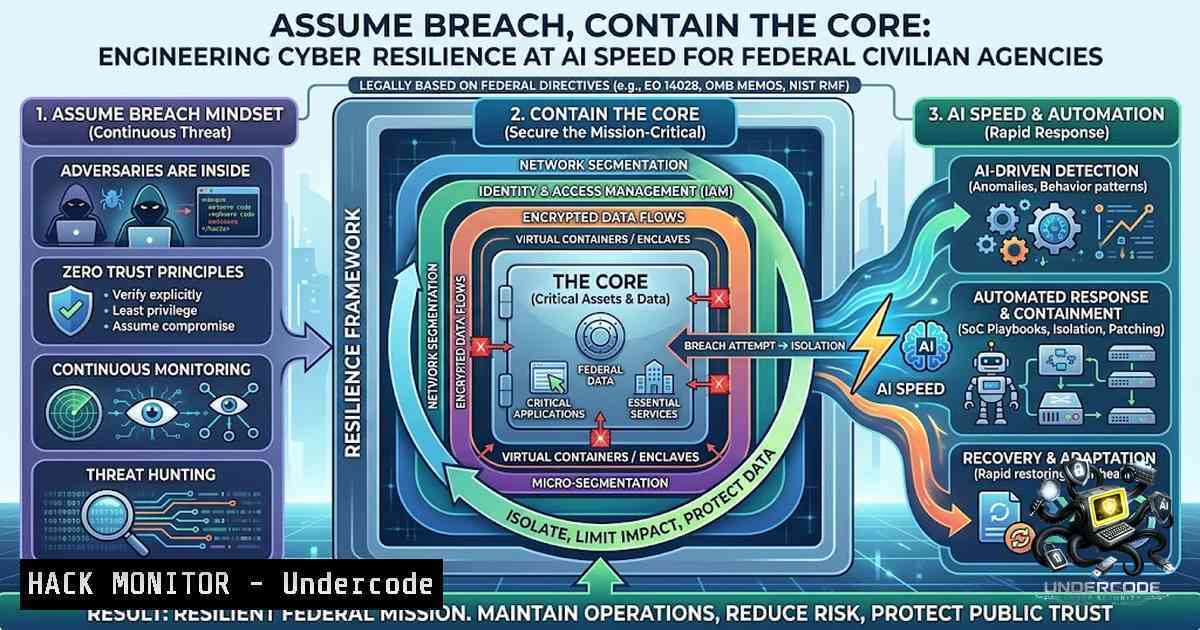
The cybersecurity paradigm for federal civilian agencies is undergoing a fundamental shift from perimeter-centric prevention to mission-centric survivability. The “assume breach” mindset—once a theoretical exercise—has become an operational imperative as AI-powered adversaries compress attack timelines from days to minutes. This article explores how agencies can operationalize cyber resilience through AI-enabled defense, zero trust architecture, and proactive adversary emulation, ensuring mission continuity even when prevention fails.
Learning Objectives:
- Understand the “assume breach” mindset and its implications for federal civilian agency cyber strategy
- Master the three pillars of AI-speed cyber defense: Attack to Defend, Advanced Zero Trust, and AI-Enabled Cyber Operations
- Learn practical implementation techniques including Linux/Windows commands, cloud hardening, and API security controls
- Explore Booz Allen’s Vellox product suite and its role in automating threat detection, malware analysis, and adversary emulation
You Should Know:
- The Cybersecurity Speed Gap: Why Prevention Alone Is Structurally Insufficient
The fundamental problem facing federal agencies today is the widening gap between how fast attackers act and how quickly defenders can respond. According to Imran Umar, senior vice president of cyber defense at Booz Allen, attackers can now discover and weaponize vulnerabilities in minutes instead of weeks. Many vulnerabilities are exploited within 24 hours of public disclosure—often before organizations even know they’re exposed. Meanwhile, most defense strategies still operate on human timelines: alerts reviewed in hours, decisions routed across teams, containment delayed until there’s confidence to act.
This speed gap is exacerbated by developments like Anthropic’s Mythos, which accelerate existing attack paths and enable adversaries to operate at greater scale. In this environment, prevention alone is structurally insufficient. When adversary breakout times shrink to minutes or seconds, waiting for alerts, investigations, or human decision-making gives attackers more time to spread.
Step-by-Step: Closing the Speed Gap with Continuous Validation
To operate at AI speed, organizations must shift from periodic assessments to continuous validation:
- Deploy adversary emulation platforms that behave like autonomous attackers to identify vulnerabilities before they are exploited
- Implement automated vulnerability scanning with tools like `Nessus` or `OpenVAS` on a continuous (not quarterly) basis
- Establish threat intelligence feeds that provide real-time indicators of compromise (IoCs) mapped to the MITRE ATT&CK framework
- Create automated containment triggers that activate when evidence meets predefined thresholds, enabling response on partial information
Linux Command: Continuous File Integrity Monitoring
 Deploy AIDE (Advanced Intrusion Detection Environment) for baseline integrity
sudo aide --init
sudo mv /var/lib/aide/aide.db.new.gz /var/lib/aide/aide.db.gz
 Schedule daily integrity checks
sudo crontab -e
 Add: 0 2    /usr/bin/aide --check | mail -s "AIDE Daily Report" [email protected]
Windows Command: PowerShell for Suspicious Process Detection
 Detect newly created processes with network connections
Get-Process | Where-Object {$<em>.StartTime -gt (Get-Date).AddMinutes(-5)} |
ForEach-Object { Get-1etTCPConnection -OwningProcess $</em>.Id -ErrorAction SilentlyContinue }
 Log to Windows Event Log
Write-EventLog -LogName Security -Source "ThreatHunting" -EventId 5000 -Message "Suspicious process detected"
2. Attack to Defend: Proactive Adversary Emulation
“Attack to Defend” is a proactive approach that uses continuous validation, adversary emulation, and control testing to uncover weaknesses and attack paths before attackers do. Rather than waiting for threats to emerge, organizations apply the same techniques adversaries use to strengthen defenses. This approach operationalizes through adversary emulation platforms that behave like autonomous attackers to identify vulnerabilities, then maps these attack paths to implement defensive tradecraft that protects critical assets.
Step-by-Step: Implementing Attack-to-Defend Operations
- Establish a red team capability that continuously tests defenses using adversary tradecraft
- Map attack paths using tools like BloodHound to visualize Active Directory attack vectors
- Prioritize remediation based on critical asset exposure rather than CVSS scores alone
- Validate defensive controls through automated breach and attack simulation (BAS) platforms
Linux Command: Network Attack Path Mapping
 Use Nmap to discover lateral movement paths
nmap -sS -p- --open -T4 192.168.1.0/24 -oA network_discovery
 Parse results for open SMB/RDP ports (common lateral movement vectors)
grep -E "445/tcp|3389/tcp" network_discovery.gnmap | cut -d' ' -f2
Windows Command: Active Directory Attack Path Analysis
 Install BloodHound collector
Import-Module .\SharpHound.ps1
Invoke-BloodHound -CollectionMethod All -Domain agency.local -OutputDirectory C:\BloodHound
 Analyze results for high-privilege attack paths
 Look for: Paths from low-privilege users to Domain Admins
3. Advanced Zero Trust Architecture for AI Environments
Zero trust is the second essential component of AI-speed defense. Partial implementations won’t keep pace with AI-powered attacks. Zero trust must extend to every entity on the network, including traditional applications, AI-enabled applications, and the infrastructure that powers them. In AI environments, the challenge is that non-human actors are increasingly making or triggering decisions. AI agents need identities, context-aware access controls, and continuous validation just like human users. Every API should authenticate automated agents before allowing them to connect, act, or move data.
Step-by-Step: Implementing Zero Trust for AI Workloads
- Enforce strict, data-centric access controls with least privilege and micro-segmentation
- Implement identity management for non-human actors (service accounts, API keys, AI agents)
- Deploy continuous authentication using conditional access policies that evaluate risk in real-time
- Accelerate detection and response for defensive cyber operations through integrated security stacks
Linux Command: Micro-Segmentation with iptables
 Create isolated network segments for AI workloads
 Allow only specific AI model traffic (port 5000 for Flask APIs)
iptables -A INPUT -p tcp --dport 5000 -s 10.0.1.0/24 -j ACCEPT
iptables -A INPUT -p tcp --dport 5000 -j DROP
 Log and drop all other traffic
iptables -A INPUT -j LOG --log-prefix "ZERO_TRUST_DROP: "
iptables -A INPUT -j DROP
Windows Command: AppLocker for AI Application Control
 Enforce AppLocker rules for AI executables
New-AppLockerPolicy -RuleType Exe -User Everyone -Path C:\AI_Models.exe -Action Deny
Set-AppLockerPolicy -Policy $policy -Merge
 Audit AI service accounts
Get-WmiObject Win32_Service | Where-Object {$_.StartName -like "ai"} |
Select-Object Name, StartName, State
4. AI-Enabled Cyber Operations: Automation at Machine Speed
The third approach shifts cyber operations from manual response to automated, AI-speed detection and containment. At AI speed, teams cannot rely on linear workflows; detection, investigation, and response must occur in parallel. Organizations must be prepared to act on partial information, using automated containment triggers when evidence meets predefined thresholds.
Booz Allen’s Vellox product suite exemplifies this approach:
- Vellox Reverser™ is an autonomous malware reverse engineering product that delivers deep analysis in minutes, evaluating hundreds of functions and flagging malicious behaviors
- Vellox Ranger™ is an AI-powered detection engineering product that autonomously maps environments to surface and stop adversary activity, reducing dwell time and cutting false positives
- Vellox Striker™ emulates the AI-powered adversary so cyber defense teams can assess critical security gaps
Step-by-Step: Automating Malware Analysis with Vellox Reverser
- Ingest suspicious binaries into the Vellox Reverser platform (built on AWS Lambda and Amazon Bedrock)
- Automated analysis evaluates functions, identifies malicious patterns, and maps to MITRE ATT&CK
- Generate comprehensive reports with indicators of compromise and deployable defensive measures
- Integrate findings into SIEM and threat hunting workflows for proactive defense
Linux Command: Automated Malware Analysis Script
!/bin/bash
 Automated malware triage script
SUSPICIOUS_DIR="/opt/suspicious"
REPORT_DIR="/opt/reports"
for file in $SUSPICIOUS_DIR/; do
 Extract strings and check for known IoCs
strings $file | grep -E "cmd.exe|powershell|wget|curl|base64" > $REPORT_DIR/$(basename $file)_strings.txt
 Check file hashes against VirusTotal (requires API key)
sha256sum $file >> $REPORT_DIR/hashes.txt
 Submit to sandbox (Cuckoo or custom)
 cuckoo submit $file
done
Windows Command: PowerShell for Automated Threat Hunting
 Automated threat hunting script for suspicious PowerShell activity
Get-WinEvent -FilterHashtable @{LogName='Microsoft-Windows-PowerShell/Operational'; ID=4104} |
Where-Object {$_.Message -match "Invoke-Expression|IEX|DownloadString"} |
Select-Object TimeCreated, Message |
Export-Csv -Path "C:\ThreatHunting\suspicious_ps.csv" -1oTypeInformation
- API Security and Cloud Hardening for AI-Enabled Systems
As federal agencies adopt AI and cloud technologies, API security becomes critical. AI agents and automated systems increasingly interact through APIs, creating new attack surfaces that require specialized security controls.
Step-by-Step: API Security Hardening
- Authenticate every API call with OAuth 2.0 or mutual TLS (mTLS)
- Implement rate limiting to prevent abuse and denial-of-service attacks
- Validate input and output schemas to prevent injection attacks
- Monitor API behavior for anomalies using AI-driven analytics
Linux Command: API Gateway Rate Limiting with NGINX
 /etc/nginx/nginx.conf
http {
limit_req_zone $binary_remote_addr zone=api_limit:10m rate=10r/s;
server {
location /api/ {
limit_req zone=api_limit burst=20 nodelay;
proxy_pass http://ai_backend;
proxy_set_header X-Forwarded-For $proxy_add_x_forwarded_for;
}
}
}
Windows Command: IIS API Request Filtering
 Configure IIS request filtering for API protection
Add-WebConfigurationProperty -Filter "system.webServer/security/requestFiltering/verbs" -1ame "." -Value @{verb="POST";allowed="true"}
Add-WebConfigurationProperty -Filter "system.webServer/security/requestFiltering/fileExtensions" -1ame "." -Value @{fileExtension=".json";allowed="true"}
 Enable logging for API abuse detection
Set-WebConfigurationProperty -Filter "system.applicationHost/sites/siteDefaults/logFile" -1ame "logExtFileFlags" -Value "Date,Time,ClientIP,UserName,SiteName,ComputerName,ServerIP,Method,UriStem,UriQuery,HttpStatus,Win32Status,TimeTaken,ServerPort,UserAgent,Referer,HttpSubStatus"
6. Cloud Hardening for AI Workloads
Cloud environments hosting AI workloads require specialized hardening to prevent data exfiltration and model theft. Booz Allen’s partnership with AWS enables secure AI deployment at scale.
Step-by-Step: Cloud Security for AI Systems
- Implement cloud-1ative security controls (AWS GuardDuty, Azure Defender, GCP Security Command Center)
- Encrypt data at rest and in transit using customer-managed keys (CMK)
- Enforce least-privilege IAM policies for AI service accounts
- Deploy Web Application Firewalls (WAF) to protect AI inference endpoints
Linux Command: Cloud Instance Hardening (Ubuntu)
 Harden cloud instance for AI workloads
 Disable root SSH login
sudo sed -i 's/PermitRootLogin yes/PermitRootLogin no/' /etc/ssh/sshd_config
 Install and configure Fail2ban
sudo apt-get install fail2ban -y
sudo systemctl enable fail2ban
 Configure UFW for minimal exposure
sudo ufw default deny incoming
sudo ufw default allow outgoing
sudo ufw allow ssh
sudo ufw allow 443/tcp  HTTPS for AI API
sudo ufw enable
Windows Command: Azure/AWS Windows Instance Hardening
 Windows Server cloud hardening
 Disable unnecessary services
Set-Service -1ame "RemoteRegistry" -StartupType Disabled
 Configure Windows Firewall for AI workloads
New-1etFirewallRule -DisplayName "Block all inbound except HTTPS" -Direction Inbound -Action Block
New-1etFirewallRule -DisplayName "Allow HTTPS" -Direction Inbound -LocalPort 443 -Protocol TCP -Action Allow
 Enable advanced audit logging
auditpol /set /subcategory:"Logon" /success:enable /failure:enable
What Undercode Say:
- Assume Breach Is Not a Buzzword—It’s an Operating Model: The shift from “prevent everything” to “survive when breached” requires fundamental changes in architecture, policy, and culture. Agencies must design for failure, not just for prevention.
- AI Amplifies Both Attack and Defense: While AI enables faster, more sophisticated attacks, it also provides defenders with the tools to close the speed gap through automation, continuous validation, and autonomous response.
The “assume breach” mindset represents a maturation of cybersecurity thinking—from an idealized state of perfect prevention to a realistic acknowledgment that intrusions are inevitable. This shift is not about abandoning prevention but about building resilience that ensures mission continuity even when prevention fails. The key insight is that AI doesn’t break security because it’s faster or smarter; it breaks security because it exposes how fragile today’s security assumptions become at machine speed.
For federal civilian agencies, this means moving beyond compliance-driven checkbox security to outcome-based resilience. The question is no longer “are we secure?” but “can we survive a breach and continue our mission?” This requires clarity about what matters most, understanding how access and connectivity actually function, knowing where an attacker could move laterally, and implementing controls that stop that movement before a single compromise becomes broader mission disruption.
Prediction:
- +1 The “assume breach” mindset will become mandated through federal policy and frameworks (e.g., CISA’s CDM program, OMB’s Zero Trust strategy) within 12–24 months, driving widespread adoption of AI-enabled cyber defense capabilities across all federal civilian agencies.
- +1 AI-powered cyber defense tools like Vellox will commoditize advanced threat detection and response, making expert-grade capabilities accessible to smaller agencies and state/local governments, democratizing cyber resilience.
- -1 The cybersecurity skills gap will widen as AI-speed operations require new skill sets—prompt engineering for security, AI agent orchestration, and automated threat hunting—that most federal IT workforces currently lack.
- -1 Adversaries will increasingly target AI models and training data themselves, shifting the attack surface from infrastructure to the AI supply chain, requiring new defensive paradigms beyond traditional cybersecurity.
- +1 Public-private partnerships like Booz Allen’s collaboration with OpenAI will accelerate secure AI deployment, creating a feedback loop between model developers and frontline practitioners that enables both to move at the speed of technological change.
References & Resources:
- Booz Allen Cybersecurity: https://www.boozallen.com/expertise/cybersecurity.html
- Vellox Reverser (30-day trial): https://www.boozallen.com/expertise/products/vellox-reverser.html
- Closing the Cybersecurity Speed Gap (White Paper): https://www.boozallen.com/insights/cyber/closing-the-cybersecurity-speed-gap.html
- Zero Trust Solutions: https://www.boozallen.com/expertise/cybersecurity/zero-trust-solutions.html
- Career Opportunity: Cyber Solutions Architect Director, McLean, VA (R0238119)
▶️ Related Video (78% Match):
🎯Let’s Practice For Free:
🎓 Live Courses & Certifications:
Join Undercode Academy for Verified Certifications
🚀 Request a Custom Project:
Secure, high-velocity infrastructure and disruptive technological engineering. Contact our engineering team for high-tier development and proprietary systems:
[email protected]
💎 Smart Architecture | 🛡️ Secure by Design | ⭐ Trusted by Thousands
IT/Security Reporter URL:
Reported By: Raynordahlquist Boozallen – Hackers Feeds
Extra Hub: Undercode MoN
Basic Verification: Pass ✅


