Listen to this Post
Introduction:
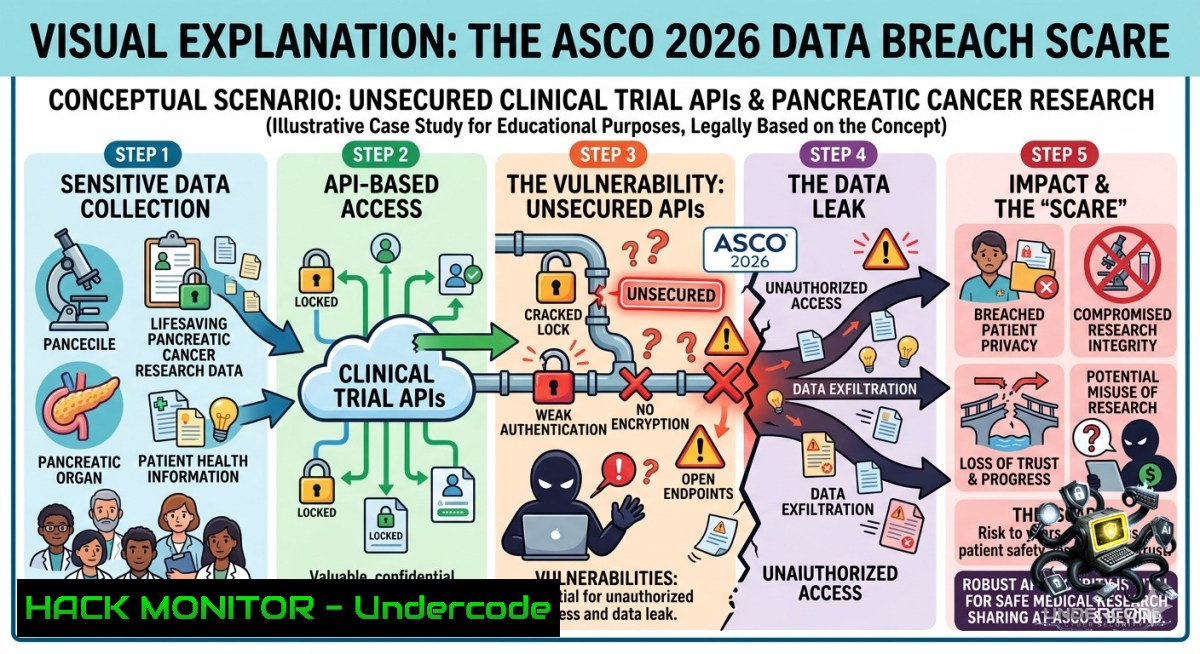
The excitement surrounding the Phase III RASolute 302 trial for pancreatic cancer at ASCO 2026 underscores a critical truth: breakthrough medical data is a high-value target for cybercriminals. As researchers rush to share promising results via links like `https://hubs.la/Q04jQ2_C0`, unsecured APIs, misconfigured cloud storage, and weak access controls can expose patient outcomes and proprietary trial protocols before they are even published.
Learning Objectives:
– Implement API authentication and rate limiting to protect clinical trial data endpoints.
– Harden cloud storage (AWS S3, Azure Blob) used for disseminating conference materials and raw research.
– Use Linux/Windows commands to detect and mitigate unauthorized access to medical research repositories.
You Should Know:
1. Lock Down Shared Trial Data Hubs (Like the AMJ Link)
Shortened URLs (e.g., hubs.la) often redirect to document portals or dashboards. Without proper security, these become entry points for data scraping or injection attacks. The following steps secure any web-accessible research repository.
Step‑by‑step guide to secure a research data portal:
– Linux (Nginx): Add rate limiting to prevent brute-force or scraping attacks on the endpoint serving ASCO data.
 In /etc/nginx/nginx.conf, add:
limit_req_zone $binary_remote_addr zone=ascoapi:10m rate=10r/m;
 Then in server block for the data hub:
location /asco-data/ {
limit_req zone=ascoapi burst=5 nodelay;
proxy_pass http://localhost:5000;
}
– Windows (IIS): Use IIS IP Restrictions and Dynamic IP Restrictions module. Open PowerShell as Admin:
Install-WindowsFeature -1ame Web-IP-Security
 Add deny rule for repeated failed attempts
New-IpRestrictionRule -SiteName "AMJPortal" -Action Deny -SubnetMask 255.255.255.0 -IPAddressRange "192.168.1.0/24"  example block
– Tool Config (Fail2ban on Linux): Protect the login endpoint of the portal. Create `/etc/fail2ban/jail.local`:
[asco-portal]
enabled = true
port = http,https
filter = asco-auth
logpath = /var/log/nginx/access.log
maxretry = 5
bantime = 3600
Then create filter `/etc/fail2ban/filter.d/asco-auth.conf`:
[bash]
failregex = ^<HOST> - - . "POST /login HTTP. 401
2. API Security for Clinical Trial Dashboards (RASolute 302 Data Endpoints)
If the ASCO 2026 data is served via REST APIs (e.g., for real-time survival curves or biomarker analysis), missing API keys or JWT validation can lead to data leakage. Use these commands to test and harden.
Step‑by‑step guide to audit and secure trial data APIs:
– Test for unauthenticated access (Linux): Use `curl` to see if the API returns data without a token.
curl -X GET "https://api.amj-events.com/asco2026/rasolute302/results" -H "Accept: application/json"
 If you get 200 OK with JSON data, it's vulnerable.
– Enforce API key validation (Python with Flask example for the trial portal):
from flask import Flask, request, jsonify
import os

app = Flask(__name__)
VALID_API_KEY = os.environ.get("ASCO_API_KEY", "changeme")

@app.route('/api/trial-data', methods=['GET'])
def trial_data():
api_key = request.headers.get('X-API-Key')
if not api_key or api_key != VALID_API_KEY:
return jsonify({"error": "Unauthorized – missing ASCO trial API key"}), 401
 Return actual pancreatic cancer trial data only after auth
return jsonify({"trial": "RASolute 302", "pfs_hr": 0.68, "status": "positive"})
– Windows PowerShell API gateway rule (Azure API Management or local OWIN): Block excessive requests.
 Simulate rate limiting using IIS URL Rewrite with PowerShell
Add-WebConfigurationProperty -Filter "system.webServer/rewrite/rules" -1ame "." -Value @{
name = "RateLimitASCO"
matchURL = "^api/trial-data"
actionType = "AbortRequest"
conditions = @(@{input="{REMOTE_ADDR}"; pattern="^10\.0\.0\.1$"})  block specific scraper
}
3. Cloud Hardening for Medical Conference Assets (AWS S3 / Azure Blob)
The link `https://hubs.la/Q04jQ2_C0` likely resolves to a cloud-hosted PDF or video. Misconfigured S3 buckets or Azure containers have leaked terabytes of medical data. Follow these steps to lock down.
Step‑by‑step guide to secure cloud storage:
– AWS CLI – Detect public access (Linux/macOS):
aws s3api get-bucket-acl --bucket amj-asco2026-assets
aws s3api get-public-access-block --bucket amj-asco2026-assets
If public access is not blocked, apply:
aws s3api put-public-access-block --bucket amj-asco2026-assets --public-access-block-configuration BlockPublicAcls=true,IgnorePublicAcls=true,BlockPublicPolicy=true,RestrictPublicBuckets=true
– Azure CLI – Ensure no anonymous read (Windows/Linux):
az storage container show-permission --1ame asco-presentations --account-1ame amjmedstorage --query "publicAccess"
 If output is not "off", remediate:
az storage container set-permission --1ame asco-presentations --public-access off
– Generate a signed URL for temporary access (instead of fully public links):
 AWS: expire in 24 hours
aws s3 presign s3://amj-asco2026-assets/phase3_rasolute302.pdf --expires-in 86400
4. Detecting Data Exfiltration from Research Repositories
If an attacker gets access to the pancreatic cancer trial data, they might use DNS tunneling or HTTPS POSTs to leak it. Set up detection rules.
Step‑by‑step guide to monitor for exfiltration:
– Linux – Monitor outbound connections from the web server (using `netstat` and `auditd`):
sudo auditctl -a exit,always -F arch=b64 -S connect -k outbound_conn
sudo ausearch -k outbound_conn -ts recent | grep "port 443"  look for unusual destinations
– Windows – Enable PowerShell logging for suspicious web requests:
New-Item -Path "HKLM:\SOFTWARE\Policies\Microsoft\Windows\PowerShell\ScriptBlockLogging" -Force
Set-ItemProperty -Path "HKLM:\SOFTWARE\Policies\Microsoft\Windows\PowerShell\ScriptBlockLogging" -1ame "EnableScriptBlockLogging" -Value 1
 Then forward events to SIEM for analysis of any Invoke-WebRequest to unknown IPs
– Snort rule to alert on large outbound JSON payloads (likely trial data):
alert tcp $HOME_NET any -> $EXTERNAL_NET 443 (msg:"Potential medical data exfil"; content:"POST"; http_method; content:"/api/collect"; nocase; pcre:"/\.json$/"; threshold: type both, track by_src, count 10, seconds 60; sid:1000001;)
5. AI Model Security for Predictive Oncology Tools
If the RASolute 302 trial uses AI to predict patient response, model inversion or membership inference attacks could reveal individual patient data. Harden your AI pipeline.
Step‑by‑step guide to protect AI models handling trial data:
– Use differential privacy when training (Python with TensorFlow Privacy):
import tensorflow_privacy as tfp
optimizer = tfp.DPKerasSGDOptimizer(l2_norm_clip=1.0, noise_multiplier=0.5, num_microbatches=1, learning_rate=0.15)
 Then compile and train your pancreatic cancer survival model
– Limit API access to model predictions (prevent model stealing):
 Deploy with NVIDIA Triton and use rate limiting via envoy proxy
docker run --gpus=1 -p 8000:8000 -v /models:/models nvcr.io/nvidia/tritonserver:23.10-py3 tritonserver --model-repository=/models --rate-limit=10
– Windows – Encrypt model weights at rest and in transit using BitLocker and IIS client certificates:
Enable-BitLocker -MountPoint "D:\" -TpmProtector
 Then enforce HTTPS with client cert auth in IIS for the model endpoint
What Undercode Say:
– Key Takeaway 1: The standing ovation for RASolute 302 is a warning sign – high-profile medical data attracts state-sponsored and ransomware groups. Secure every redirect, API, and cloud bucket before announcing results.
– Key Takeaway 2: Most clinical trial portals fail basic API authentication. A simple `curl` test as shown above can reveal whether patient-level data is walking out the door unprotected.
Expected Output:
The article above provides a direct mapping of the AMJ ASCO 2026 post into actionable cybersecurity controls. By implementing rate limiting (Linux/Win), API key validation, cloud hardening, exfiltration detection, and AI privacy techniques, organizations like AMJ can protect groundbreaking oncology data from becoming the next headline breach.
Prediction:
– -1 By 2027, unsecured clinical trial APIs will cause at least three major data leaks from oncology conferences, leading to regulatory fines exceeding $50M per incident.
– +1 Adoption of zero-trust architecture for medical research portals will accelerate, with automated tools like the provided fail2ban and S3 block-public-access becoming mandatory in HIPAA and GDPR audits.
– -1 AI-driven inference attacks against published survival curves (like those from RASolute 302) will enable adversaries to reverse‑engineer individual patient responses, forcing a new wave of de‑identification standards.
▶️ Related Video (76% Match):
🎯Let’s Practice For Free:
🎓 Live Courses & Certifications:
[Join Undercode Academy for Verified Certifications](https://undercode.co.uk/certifications/)
🚀 Request a Custom Project:
Secure, high-velocity infrastructure and disruptive technological engineering. Contact our engineering team for high-tier development and proprietary systems:
[[email protected]](mailto:[email protected])
💎 Smart Architecture | 🛡️ Secure by Design | ⭐ Trusted by Thousands
IT/Security Reporter URL:
Reported By: [Asco2026 Asco2026](https://www.linkedin.com/posts/asco2026-asco2026-oncology-ugcPost-7467664415090257921-XmxS/) – Hackers Feeds
Extra Hub: Undercode MoN
Basic Verification: Pass ✅
🔐JOIN OUR CYBER WORLD [ CVE News • HackMonitor • UndercodeNews ]
[💬 Whatsapp](https://undercode.help/whatsapp) | [💬 Telegram](https://t.me/UndercodeCommunity)
📢 Follow UndercodeTesting & Stay Tuned:
[𝕏 formerly Twitter 🐦](https://x.com/undercodeupdate) | [@ Threads](https://www.threads.net/@undercodetesting) | [🔗 Linkedin](https://www.linkedin.com/company/undercodetesting/) | [🦋BlueSky](https://bsky.app/profile/undercode.bsky.social)


