
Listen to this Post
Introduction:
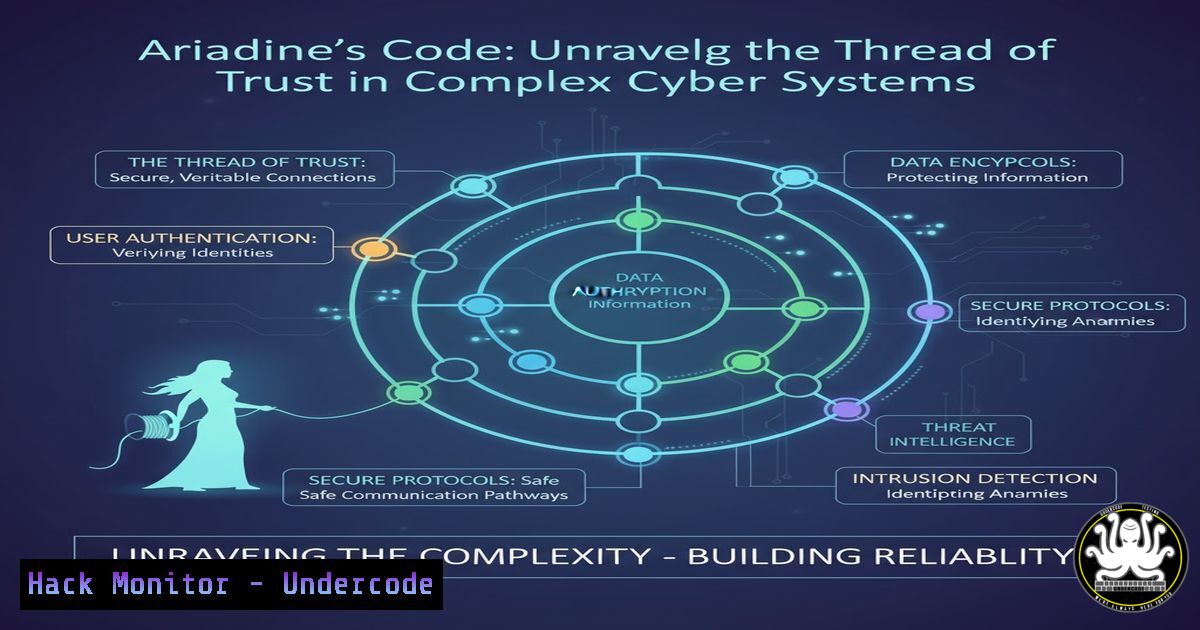
In the labyrinth of modern enterprise architecture, the ancient metaphor of Ariadne’s Thread is more relevant than ever. Just as the thread guided Theseus through the Minotaur’s maze, cybersecurity professionals must weave resilient paths through complex systems to ensure trust, governance, and endurance. This article explores how principles of orientation and trust translate into technical controls, from zero-trust network segmentation to cryptographic chain-of-custody verification, ensuring that even the most intricate digital ecosystems remain navigable and secure.
Learning Objectives:
- Understand how to apply the “Ariadne’s Thread” metaphor to system governance and secure architecture design.
- Learn to implement cryptographic verification methods to establish trust chains across distributed systems.
- Master practical commands and configurations for network segmentation, API security, and cloud hardening.
You Should Know:
- Weaving the Thread: Establishing Chain of Trust with PKI and TLS
In complex systems, trust cannot be assumed; it must be verifiable. The “thread” in a digital context is often a Public Key Infrastructure (PKI), where every certificate ties back to a root of trust. To verify the chain of a remote server, you can use OpenSSL to trace the certificate path.
Step‑by‑step guide: Validating a Certificate Chain
 Linux/macOS: Retrieve and display the full certificate chain of a website
openssl s_client -connect example.com:443 -showcerts </dev/null 2>/dev/null | openssl x509 -text

To verify the chain against a root CA store
openssl verify -CAfile /etc/ssl/certs/ca-certificates.crt -untrusted intermediate.crt server.crt
What this does: The first command establishes a connection and prints all certificates presented by the server, allowing you to visually inspect the chain. The second command programmatically verifies that the server certificate is signed by a trusted root via the intermediate certificate, ensuring no break in the thread of trust.
- Navigating the Labyrinth: Network Segmentation with Linux Firewalls
To prevent lateral movement (the Minotaur in the maze), strict segmentation is required. Using `iptables` ornftables, you can create isolated zones.
Step‑by‑step guide: Isolating a DMZ Network
 Flush existing rules (use with caution)
sudo iptables -F
sudo iptables -t nat -F
sudo iptables -t mangle -F

Set default policies
sudo iptables -P INPUT DROP
sudo iptables -P FORWARD DROP
sudo iptables -P OUTPUT ACCEPT

Allow established connections
sudo iptables -A INPUT -m conntrack --ctstate ESTABLISHED,RELATED -j ACCEPT

Allow SSH from management network (192.168.1.0/24)
sudo iptables -A INPUT -p tcp --dport 22 -s 192.168.1.0/24 -j ACCEPT

Allow web traffic only to DMZ server (10.0.0.10)
sudo iptables -A FORWARD -d 10.0.0.10 -p tcp --dport 80 -j ACCEPT
sudo iptables -A FORWARD -d 10.0.0.10 -p tcp --dport 443 -j ACCEPT
sudo iptables -A FORWARD -m conntrack --ctstate ESTABLISHED,RELATED -j ACCEPT
What this does: This creates a basic segmented environment where only specific traffic is allowed to reach critical assets, mimicking the guided path of Ariadne’s thread.
- Hardening the Entrance: API Security and Rate Limiting
APIs are the gateways to modern systems. Using a reverse proxy like Nginx, you can implement governance by throttling requests and validating tokens.
Step‑by‑step guide: Nginx Configuration for API Governance
 In /etc/nginx/sites-available/api-gateway
server {
listen 443 ssl;
server_name api.undercode.test;

ssl_certificate /etc/ssl/certs/api.undercode.crt;
ssl_certificate_key /etc/ssl/private/api.undercode.key;

location /api/ {
 Limit requests to 5 per second
limit_req zone=api_limit burst=10 nodelay;

Validate JWT token before proxying
auth_jwt "API Realm";
auth_jwt_key_file /etc/nginx/keys/jwt_public.key;

proxy_pass http://backend_servers;
proxy_set_header Host $host;
proxy_set_header X-Real-IP $remote_addr;
}
}

In the http block of nginx.conf
limit_req_zone $binary_remote_addr zone=api_limit:10m rate=5r/s;
What this does: This configuration enforces a strict governance policy. Every request is authenticated via JWT and rate-limited, ensuring that no single entity can flood the system and break the orientation.
- Verifying the Path: Log Auditing with Windows PowerShell
On Windows systems, maintaining an auditable trail is crucial for governance. Using PowerShell, you can query security logs to ensure the thread remains unbroken.
Step‑by‑step guide: Querying Security Logs for Anomalies
 PowerShell (Run as Administrator)
 Search for failed logon attempts (Event ID 4625) in the last 24 hours
$StartTime = (Get-Date).AddDays(-1)
Get-WinEvent -FilterHashtable @{LogName='Security'; ID=4625; StartTime=$StartTime} |
Select-Object TimeCreated, Message |
Format-List

Export to CSV for analysis
Get-WinEvent -FilterHashtable @{LogName='Security'; ID=4625; StartTime=$StartTime} |
Export-Csv -Path "C:\audit\failed_logons.csv" -NoTypeInformation
What this does: This command extracts the digital breadcrumbs left by attackers or misconfigured services, allowing administrators to trace back any unauthorized attempts to navigate the system.
5. Enduring Design: Immutable Infrastructure with Terraform
To ensure systems endure, they must be reproducible. Infrastructure as Code (IaC) provides the blueprint, or thread, for rebuilding complex environments.
Step‑by‑step guide: Terraform Configuration for a Secure AWS VPC
 main.tf
provider "aws" {
region = "us-east-1"
}

resource "aws_vpc" "main" {
cidr_block = "10.0.0.0/16"
enable_dns_support = true
enable_dns_hostnames = true

tags = {
Name = "Ariadne-VPC"
Governance = "Managed"
}
}

resource "aws_security_group" "web_sg" {
name = "web_sg"
description = "Allow HTTPS inbound"
vpc_id = aws_vpc.main.id

ingress {
description = "HTTPS from Internet"
from_port = 443
to_port = 443
protocol = "tcp"
cidr_blocks = ["0.0.0.0/0"]
}

egress {
from_port = 0
to_port = 0
protocol = "-1"
cidr_blocks = ["0.0.0.0/0"]
}
}

Apply with: terraform init && terraform apply
What this does: This code creates a Virtual Private Cloud (VPC) with a tightly controlled security group, ensuring that every deployment follows the same governed path, preventing configuration drift.
- Exploitation and Mitigation: SQL Injection (The Minotaur’s Strike)
Complex systems are vulnerable if the thread is broken by poor input validation. Here is a simple demonstration and mitigation.
Step‑by‑step guide: Exploiting and Fixing a Vulnerable PHP Login
// VULNERABLE CODE - DO NOT USE
$user = $_POST['username'];
$pass = $_POST['password'];
$sql = "SELECT  FROM users WHERE username = '$user' AND password = '$pass'";
$result = mysqli_query($conn, $sql);

// Exploit Payload: ' OR '1'='1' --

// MITIGATED CODE - Parameterized Query
$stmt = $conn->prepare("SELECT  FROM users WHERE username = ? AND password = ?");
$stmt->bind_param("ss", $user, $pass);
$stmt->execute();
$result = $stmt->get_result();
What this does: The vulnerable code allows an attacker to bypass authentication by injecting SQL. The mitigated version uses prepared statements, ensuring that user input is treated as data, not executable code, preserving the integrity of the system’s logic.
What Undercode Say:
- Key Takeaway 1: Trust in complex systems is not a static state but a verifiable chain. Implementing cryptographic verification (PKI, JWT) at every junction ensures the thread remains intact and unbroken by malicious actors.
- Key Takeaway 2: Governance is enforced through automation and policy-as-code. Manual configurations are the threads that fray; immutable infrastructure and strict firewall rules create a resilient, navigable maze that confounds attackers.
- Analysis: The metaphor of Ariadne’s Thread highlights a fundamental shift in cybersecurity: from building impenetrable walls (a flawed concept) to designing systems that are inherently traceable and auditable. In a world of zero-trust, every packet, user, and API call must carry its own thread of proof. The technical implementations above—ranging from OpenSSL verification to Terraform scripts—provide the practical means to weave this thread. By focusing on orientation and governance, we transform our networks from dark labyrinths into well-lit, patrolled corridors where every deviation is immediately visible and every path leads back to a trusted source.
Prediction:
As systems grow increasingly complex with AI-driven orchestration and multi-cloud architectures, the “Ariadne’s Thread” concept will evolve into autonomous governance. We will see the rise of AI-powered security “sherpas” that not only trace the path but predict where the maze will shift, automatically re-weaving trust chains in real-time to counteract zero-day threats before they breach the inner sanctum.
▶️ Related Video (86% Match):
🎯Let’s Practice For Free:
IT/Security Reporter URL:
Reported By: Teresafritschi Trust – Hackers Feeds
Extra Hub: Undercode MoN
Basic Verification: Pass ✅


