
Listen to this Post
Introduction:
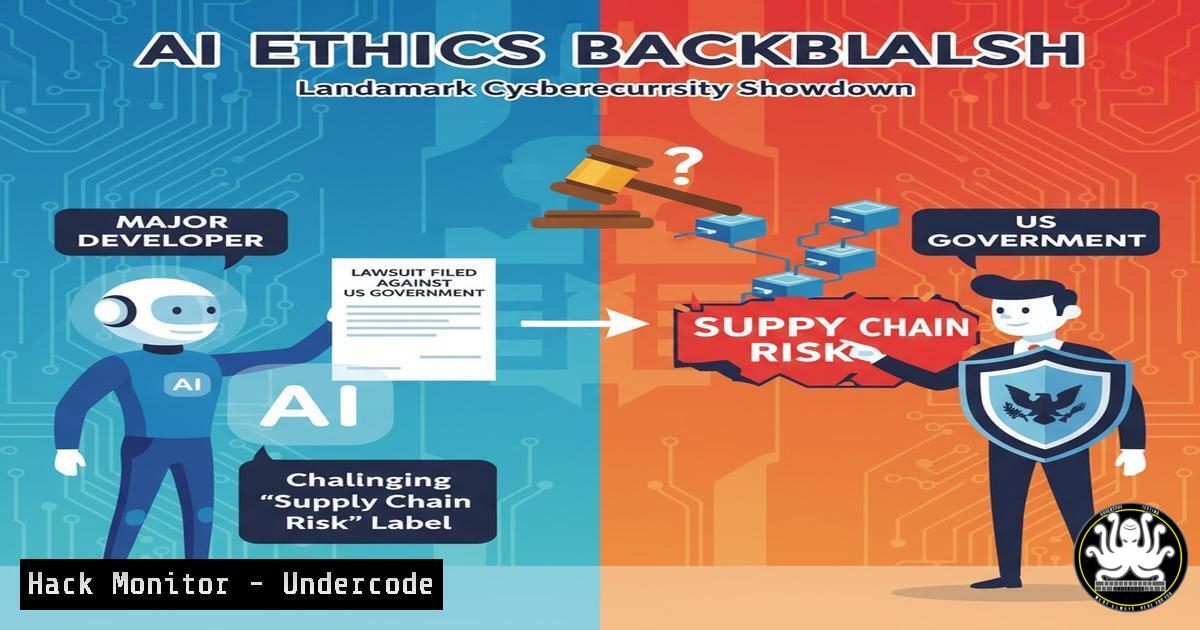
In an unprecedented legal battle that blurs the lines between national security and corporate ethics, a major AI developer has filed suit against the federal government after being designated a “supply chain risk”—a label traditionally reserved for nation-state adversaries. The dispute centers on the company’s refusal to allow its technology to be used in specific high-risk military applications, raising critical questions about the intersection of AI governance, federal procurement, and cybersecurity resilience. This case highlights a growing tension: as the U.S. government seeks technological supremacy, it is colliding with private sector entities attempting to self-regulate in the absence of formal AI legislation.
Learning Objectives:
- Analyze the legal and technical implications of the “supply chain risk” designation on enterprise IT infrastructure.
- Identify best practices for CIOs and CISOs to build vendor risk management (VRM) frameworks that account for ethical AI constraints.
- Implement technical controls to ensure operational resilience against sudden government-mandated vendor access disruptions.
You Should Know:
- Decoding the “Supply Chain Risk” Designation and Its Technical Impact
The federal government’s “supply chain risk” designation, typically governed by authorities like the Federal Acquisition Regulation (FAR) and agency-specific protocols, is used to exclude vendors whose hardware, software, or services pose a national security threat. In this case, the AI developer’s ethical boundary-setting has been interpreted as a threat vector, effectively blacklisting them from federal contracts.
Step‑by‑step guide: Assessing your exposure to vendor risk designations.
For cybersecurity professionals, this signals a need to audit current vendor dependencies. Use the following command-line tools to map out software supply chain dependencies and identify critical vendors who might be subject to geopolitical or ethical disputes.
Linux (Inventory installed packages):
 List all explicitly installed packages (Debian/Ubuntu)
apt list --installed > installed_packages.txt

For Red Hat/CentOS
rpm -qa > installed_packages.txt

Check for vendor-specific repositories
grep -r "vendor.com" /etc/apt/sources.list /etc/apt/sources.list.d/
Windows (PowerShell – Software Inventory):
 List installed software from registry
Get-ItemProperty HKLM:\Software\Microsoft\Windows\CurrentVersion\Uninstall\ | Select-Object DisplayName, DisplayVersion, Publisher
Get-ItemProperty HKLM:\Software\WOW6432Node\Microsoft\Windows\CurrentVersion\Uninstall\ | Select-Object DisplayName, DisplayVersion, Publisher
This inventory is the first step in a Vendor Risk Management (VRM) assessment. Identify which vendors provide “critical” or “high-risk” functionality (e.g., AI models, authentication, data storage). For each, document alternative vendors (backup options) as Brian Levine suggests.
2. Implementing Ethical AI Boundaries in Enterprise Configurations
The core of the lawsuit is the AI company’s refusal to support “certain high‑risk military applications.” This requires organizations to define acceptable use policies (AUP) for AI, not just contractually, but technically.
Step‑by‑step guide: Hardening AI model access with guardrails.
If your organization uses third-party AI APIs, you can implement technical controls to prevent misuse, aligning with the developer’s ethical stance and protecting your own organization from legal blowback.
API Security Configuration (Example using OWASP ModSecurity Core Rule Set for an AI Gateway):
When proxying requests to an AI API, implement a Web Application Firewall (WAF) to filter prompts containing military or restricted keywords.
 Nginx location block with ModSecurity enabled
location /ai-endpoint/ {
modsecurity on;
modsecurity_rules_file /etc/nginx/modsec/ai_guardrails.conf;
proxy_pass https://ai-vendor-api.com;
proxy_set_header Host $host;
}
ModSecurity Rule (`ai_guardrails.conf`):
 Deny requests related to weapons research or prohibited military applications
SecRule REQUEST_URI "@contains /v1/completions" \
"phase:2,id:10001,deny,status:403,msg:'Prohibited AI Use Case Detected',\
chain"
SecRule REQUEST_BODY "@rx (weapon\ design|military\ target|autonomous\ kill|biosafety\ level\ 4)" \
"t:lowercase,t:removeWhitespace"
This ensures that even if a user attempts to use the AI for a restricted purpose, the request is blocked at the organizational perimeter, reinforcing corporate ethics and compliance.
3. Operational Resilience: Building a Multi-Vendor AI Strategy
The government’s action could suddenly cut off access to a preferred AI platform. CISOs must architect for failover.
Step‑by‑step guide: Creating a Kubernetes-based AI failover mechanism.
Assume your primary AI vendor is “Vendor A.” You need a fallback to “Vendor B” (or an open-source self-hosted model). Use a service mesh for traffic shifting.
Kubernetes Configuration (Traffic Splitting with Istio):
apiVersion: networking.istio.io/v1beta1
kind: VirtualService
metadata:
name: ai-gateway-routing
spec:
hosts:
- ai-service
http:
- match:
- headers:
environment:
exact: production
route:
- destination:
host: vendor-a-service
port:
number: 443
weight: 100
- match:
- headers:
environment:
exact: fallback
route:
- destination:
host: vendor-b-service
port:
number: 443
weight: 100
- route:
- destination:
host: vendor-a-service
weight: 90
- destination:
host: vendor-b-service
weight: 10
In the event of a disruption (like a government ban), you can shift traffic by changing the header or gradually increasing the weight to the secondary vendor, ensuring business continuity.
4. Legal & Compliance Automation for Vendor Ethics
The lawsuit underscores the need to codify ethical requirements into procurement contracts. This can be automated with Governance, Risk, and Compliance (GRC) tools.
Step‑by‑step guide: Using OpenSCAP to audit vendor compliance artifacts.
While you cannot directly scan a vendor’s systems, you can scan the documentation and deliverables they provide (e.g., System Security Plans – SSPs) for required ethical clauses using automated text analysis.
Linux (Using `grep` and `openscap` for document scanning):
 Recursively search vendor-provided documentation for ethical boundaries
grep -r -i -E "weapon|military|autonomous|lethal|surveillance" /path/to/vendor/docs/

If you have SCAP content defined for contract compliance, use oscap
oscap xccdf eval --profile xccdf_com.undercode.contract_profile_profile --results results.xml scap_documentation.xml
This allows the legal and security teams to programmatically verify that a vendor’s claims (like “we do not support X”) are consistently documented across their submissions, flagging discrepancies for review.
5. Cloud Hardening Against Government Intervention
If the government can designate a software vendor as a risk, they could potentially pressure cloud providers hosting that vendor. Organizations should adopt a multi-cloud or hybrid-cloud strategy to mitigate this.
Step‑by‑step guide: Implementing cloud-agnostic AI workloads with Terraform.
Write infrastructure as code (IaC) that is not locked to a single cloud provider.
Terraform Configuration (Multi-Cloud AI Deployment):
 Provider configurations (partial)
provider "aws" {
region = "us-east-1"
alias = "virginia"
}

provider "google" {
project = "my-gcp-project"
region = "us-central1"
alias = "iowa"
}

Deploy a containerized AI model to both clouds
resource "aws_ecs_service" "ai_model" {
provider = aws.virginia
name = "ai-inference-aws"
cluster = aws_ecs_cluster.main.id
 ... configuration
}

resource "google_cloud_run_service" "ai_model" {
provider = google.iowa
name = "ai-inference-gcp"
location = "us-central1"
 ... configuration
}
By maintaining active-active or warm-standby deployments across providers, an organization can instantly fail over if one cloud provider is compelled to comply with a disruptive order regarding a specific software vendor.
What Undercode Say:
- Key Takeaway 1: The lawsuit marks a critical inflection point where corporate AI ethics directly conflict with national security procurement, forcing organizations to treat vendor ethics as a technical and contractual risk category.
- Key Takeaway 2: True operational resilience in the AI era requires decoupling business logic from specific AI vendors. CISOs must architect for zero-trust supply chains, including the ability to swap AI models with minimal friction.
- Key Takeaway 3: The absence of federal AI regulation is creating a chaotic environment where companies are punished for self-governance. This will likely accelerate the demand for international standards (like ISO/IEC 42001) to harmonize ethical boundaries and government expectations.
This case is a stark reminder that cybersecurity is no longer just about protecting data; it’s about protecting the principles of the technology stack. If the government can penalize a company for refusing to weaponize its AI, then every enterprise relying on that AI must have a contingency plan for sudden, politically motivated disconnection.
Prediction:
This legal battle will likely result in a push for the NIST AI Risk Management Framework (AI RMF 1.0) to become mandatory for federal contractors, rather than voluntary. We predict the emergence of “AI Ethics Insurance” and the proliferation of “Ethical AI Vetting” as a standard cybersecurity procurement practice within the next 12-18 months, similar to how SOC2 audits are today. Furthermore, expect to see an increase in “sovereign AI” initiatives where governments develop their own state-backed models to bypass corporate ethical restrictions entirely.
▶️ Related Video (74% Match):
🎯Let’s Practice For Free:
IT/Security Reporter URL:
Reported By: Brian Levine – Hackers Feeds
Extra Hub: Undercode MoN
Basic Verification: Pass ✅


