
Listen to this Post
Introduction
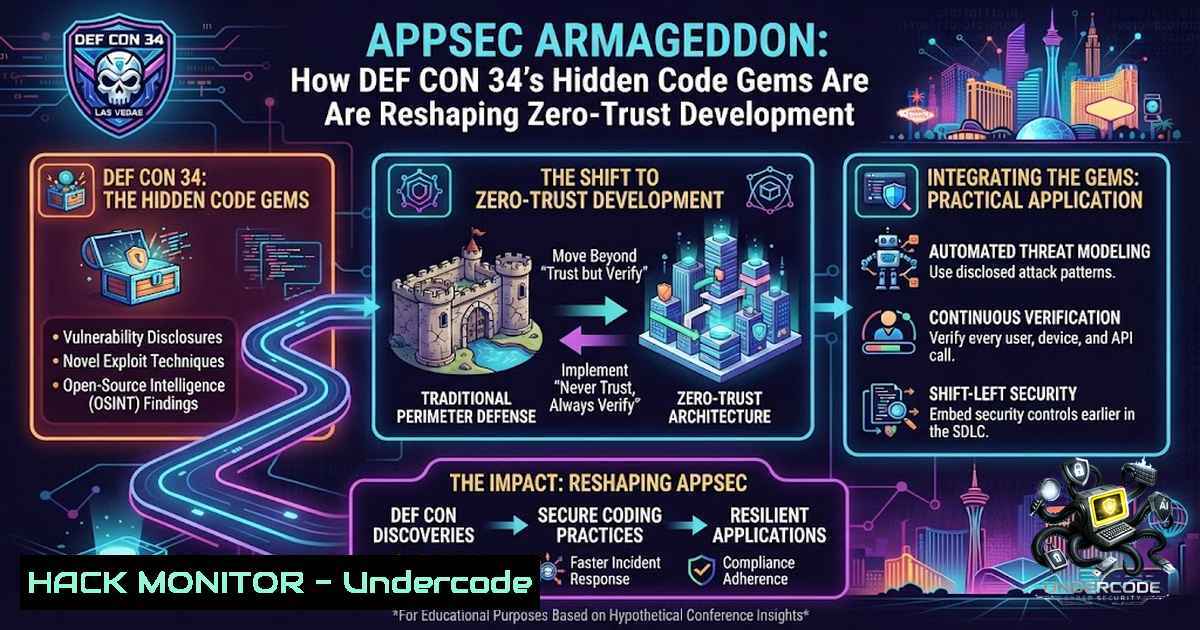
The intersection of artificial intelligence and application security has reached a critical inflection point, with modern development pipelines increasingly becoming the frontline battleground for cyber warfare. As highlighted in recent AppSec community shares from DEF CON 34, the traditional “build then fix” paradigm is being rapidly replaced by a more aggressive, AI-driven security posture that embeds protection directly into the developer workflow. This shift, championed by industry thought leaders like Abhinav Verma, marks a pivotal evolution where security is no longer a gatekeeper but an integral component of the continuous integration and continuous delivery (CI/CD) ecosystem.
Learning Objectives
- Master the implementation of AI-powered static application security testing (SAST) tools within existing CI/CD pipelines.
- Understand how to leverage behavioral analysis to detect and mitigate zero-day vulnerabilities in cloud-1ative environments.
- Develop proficiency in applying zero-trust principles to API gateways and container orchestration platforms.
You Should Know
- The New Frontier of SAST: AI-Driven Vulnerability Discovery
The modern threat landscape requires moving beyond signature-based detection to predictive analytics. AI-enhanced SAST tools now utilize large language models to comprehend code context, significantly reducing false positives and identifying complex logic flaws that traditional scanners miss. For instance, tools like Semgrep and CodeQL have evolved to include machine learning models trained on millions of open-source commits to detect “business logic” vulnerabilities that standard regex patterns cannot catch. To integrate this into your workflow, developers must move beyond simple pre-commit hooks and incorporate these scanners into pull request workflows, automatically blocking merges if critical severities are detected.
Step-by-Step Guide: Integrating an AI-Powered SAST Tool
- Step 1: Select a tool that supports ML-based rule generation, such as Semgrep or Snyk Code.
- Step 2: Configure the tool to run as a pipeline job. For a Linux-based CI runner, use the following command to run a baseline scan:
Install Semgrep CLI
pip install semgrep
Run deep scan with AI-assisted triage
semgrep ci --deep --config auto --sarif-output semgrep.sarif
- Step 3: In Windows environments (e.g., Azure DevOps), utilize a similar approach via PowerShell:
Install Semgrep via pip in Windows
python -m pip install semgrep
Execute scan and output results
semgrep ci --config auto --json-output semgrep_results.json
- Step 4: Parse the SARIF file to automatically create issues in your ticketing system (Jira/GitHub Issues) using REST APIs, ensuring every vulnerability is triaged with AI-prioritized severity scores.
- Step 5: Integrate a “fail the build” mechanism if critical vulnerabilities are found. In Jenkins, this can be handled with:
sh 'semgrep ci --config auto'
if (currentBuild.result == 'UNSTABLE') { error 'Build failed due to security issues.' }
2. Hardening the API Perimeter with Behavioral Analysis
Post-DEF CON discussions emphasize that APIs remain the most exploited attack surface, often bypassing traditional Web Application Firewalls (WAFs). The shift towards “Behavioral API Security” involves establishing a baseline of normal traffic patterns and utilizing anomaly detection to identify credential stuffing and parameter tampering. This moves security from reactive blocklisting to proactive anomaly scoring. To effectively secure APIs, organizations must deploy ingress controllers capable of mTLS and integrate them with observability stacks like OpenTelemetry to trace distributed requests and detect malicious payloads hidden within encrypted traffic.
Step-by-Step Guide: Configuring a Behavioral WAF and mTLS for APIs
– Step 1: Deploy a service mesh (e.g., Istio) on Kubernetes to enforce mTLS between services.
– Step 2: Install a behavioral analysis tool like ModSecurity with the OWASP Core Rule Set (CRS), but augment it with anomaly scoring thresholds. In Linux:
 Install ModSecurity
sudo apt-get install libapache2-mod-security2
 Enable detection only mode to baseline traffic
sudo a2enmod security2
sudo systemctl restart apache2
– Step 3: Configure the “Anomaly Scoring” in /etc/modsecurity/overrides.conf:
SecDefaultAction "phase:1,log,auditlog,deny,status:403,tag:'anomaly-score',severity:CRITICAL"
SecRule REQUEST_URI "@contains /admin" "id:123,phase:1,deny,msg:'Admin Access Detected'"
– Step 4: For Windows Server with IIS, use the ModSecurity ISAPI filter. Implement a PowerShell script to monitor events and trigger alerts on anomaly score deviations:
 Check event log for ModSecurity anomalies
Get-WinEvent -LogName "ModSecurity" | Where-Object { $_.Message -match "Anomaly Score" } | Send-MailMessage -To "[email protected]" -Subject "API Anomaly Alert"
– Step 5: Generate mTLS certificates using `openssl` and enforce them in your ingress definition to ensure only authenticated services interact with the API gateway.
- Container Security: From Image Scanning to Runtime Defense
The technical content extracted from the community post highlights a critical gap: most teams focus on image scanning but neglect runtime security. The next frontier involves leveraging eBPF (Extended Berkeley Packet Filter) for deep kernel monitoring to detect container escapes and cryptojacking in real-time. Modern tooling like Falco and Tetragon enables security teams to define aggressive behavioral rules, such as monitoring for abnormal syscalls or process executions inside pods.
Step-by-Step Guide: Implementing eBPF-Based Runtime Security
- Step 1: Install Falco on your Kubernetes cluster using Helm:
helm repo add falcosecurity https://falcosecurity.github.io/charts
helm install falco falcosecurity/falco --set ebpf.enabled=true
- Step 2: Create a custom Falco rule to detect “shells” spawning in production containers (a common sign of compromise). Edit
/etc/falco/falco_rules.local.yaml:</li> <li>rule: Shell in Production Container desc: Detect shell binary executed in production condition: container and proc.name in (bash, sh, zsh) and container.name startswith "prod-" output: Shell spawned in production container (user=%user.name container=%container.id) priority: CRITICAL tags: [container, mitre_execution]
- Step 3: For Windows containers, focus on detecting similar behavior using Sysmon and Event Tracing for Windows (ETW). Create a script to capture process creation events and cross-reference them with threat intelligence feeds.
- Step 4: Set up an automated alerting system using `falcoctl` to forward events to Slack or a SIEM:
falcoctl submit --type slack --slack-webhook-url https://hooks.slack.com/...
- Exploiting and Mitigating Prompt Injection in AI-Assisted Coding
As AI copilots become ubiquitous, a new vulnerability emerges: prompt injection and poisoning of the training data supply chain. Attackers are manipulating public code repositories to introduce hidden flaws that AI models learn and subsequently replicate in generated code. This “Backdoor AI” attack is a primary concern highlighted by the AppSec community. Defending against this requires implementing rigorous code integrity checks and using tools to verify the provenance of imported libraries, ensuring they haven’t been poisoned.
Step-by-Step Guide: Defending Against AI Code Injection Risks
- Step 1: Implement Software Bill of Materials (SBOM) generation for every build. Use `syft` to create a comprehensive SBOM:
Generate SBOM in JSON format
syft dir:. -o json > sbom.json
- Step 2: Scan the SBOM against vulnerability databases to check for known “bad” packages associated with supply chain attacks.
- Step 3: Enforce code signing and verified commits. Use GPG signing in Linux to ensure the authenticity of code before it enters the pipeline:
git config --global commit.gpgsign true
git commit -S -m "Signed commit to prevent tampering"
- Step 4: In Windows environments, use PowerShell to validate file hashes against a trusted repository of checksums before allowing execution:
$expectedHash = "3A..." ; $hash = (Get-FileHash -Algorithm SHA256 .\binary.exe).Hash ; if ($hash -1e $expectedHash) { throw "Hash mismatch!" } - Step 5: Integrate semantic analysis tools that can detect AI-generated code patterns that deviate from organizational coding standards, flagging potential backdoors.
What Undercode Say
- Key Takeaway 1: The convergence of AI and AppSec is not just about automation but about “contextual understanding.” Security tools must now analyze the ‘intent’ of the code, not just the syntax, to catch sophisticated logic bombs.
- Key Takeaway 2: Zero-trust must extend to the development environment. Treating internal developers as ‘untrusted’ until verified via continuous behavioral monitoring is the new baseline for security.
- Analysis: The DEF CON 34 discussions underscore a paradigm shift away from perimeter defenses towards a “data-centric” security model. The emphasis on eBPF and behavioral monitoring indicates that security is moving deeper into the kernel and application layers. We are entering an era where the attack surface is defined by data flow, not IP addresses, making traditional network segmentation obsolete. The reliance on AI necessitates a “Trust but Verify” approach, where every code suggestion is scrutinized through the lens of potential adversarial poisoning. This requires a massive upskilling of DevSecOps teams to understand both machine learning models and low-level system calls, bridging the gap between data science and cybersecurity.
Prediction
- +1: The integration of AI in SAST will lead to a 40% reduction in false positives over the next two years, significantly accelerating DevOps velocity.
- -1: The sophistication of AI-assisted exploitation will outpace defensive AI, leading to a wave of zero-day exploits targeting the software supply chain within the next 18 months.
- +1: Enterprise adoption of eBPF-based monitoring will expand beyond security to become a standard observability layer, unifying security and performance monitoring under a single data plane.
- -1: As large language models are trained on massive public datasets, the risk of unintentional exposure of proprietary code or configuration secrets within these models will pose a significant privacy crisis for major corporations, requiring immediate legal and technical containment strategies.
▶️ Related Video (82% Match):
🎯Let’s Practice For Free:
🎓 Live Courses & Certifications:
Join Undercode Academy for Verified Certifications
🚀 Request a Custom Project:
Secure, high-velocity infrastructure and disruptive technological engineering. Contact our engineering team for high-tier development and proprietary systems:
[email protected]
💎 Smart Architecture | 🛡️ Secure by Design | ⭐ Trusted by Thousands
IT/Security Reporter URL:
Reported By: Secureabhinavverma Defcon34 – Hackers Feeds
Extra Hub: Undercode MoN
Basic Verification: Pass ✅


