Listen to this Post
Introduction
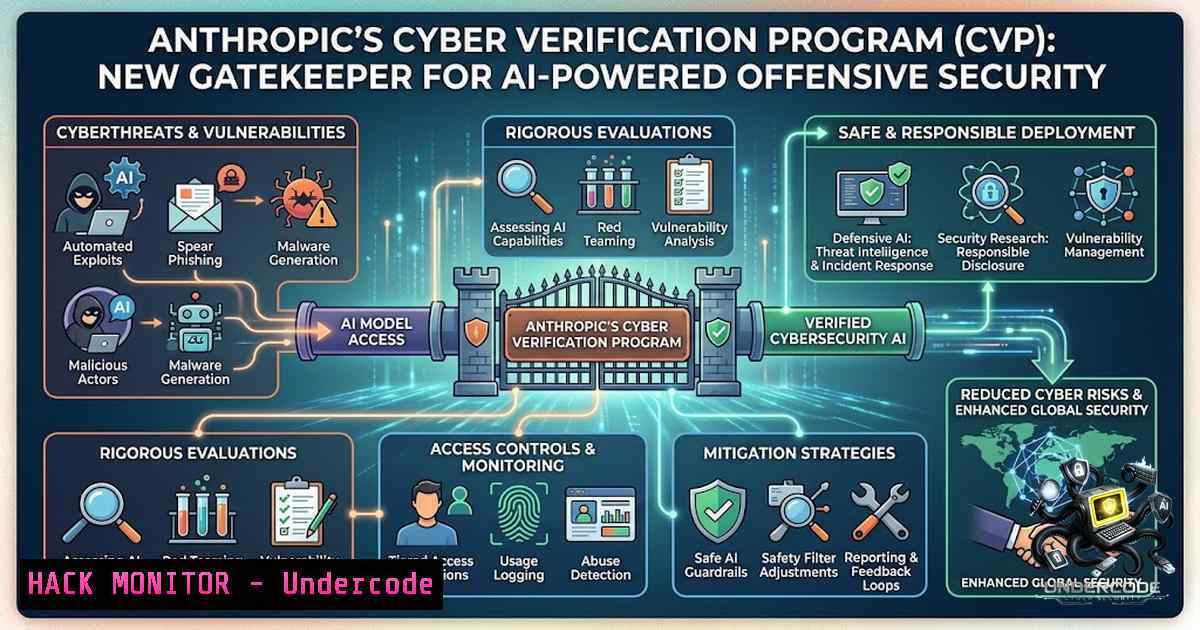
The cybersecurity industry has long grappled with a fundamental paradox: the same AI capabilities that can fortify digital defenses can also be weaponized by adversaries. Anthropic has addressed this tension head-on with its Cyber Verification Program (CVP), an application-based initiative that grants verified security professionals structured access to Claude’s frontier models for legitimate dual-use security research. By creating a narrow, authorized lane for penetration testing, red teaming, and vulnerability research, the CVP transforms Claude from a heavily restricted assistant into a force multiplier for defenders who need to find flaws before adversaries do.
Learning Objectives
- Understand the architecture and purpose of Anthropic’s real-time cyber safeguards and the Cyber Verification Program
- Master the application process and eligibility requirements for CVP access across different deployment platforms
- Learn practical workflows for integrating CVP-enabled Claude into penetration testing, bug bounty hunting, and vulnerability research
You Should Know
1. Understanding Anthropic’s Cyber Safeguards Architecture
Anthropic runs real-time cyber safeguards across its Claude Opus and Sonnet models that automatically detect and block requests indicating prohibited or high-risk cybersecurity usage. These safeguards operate on a two-tier classification system:
Prohibited Use: Activities almost exclusively malicious with minimal legitimate defensive application—mass data exfiltration, ransomware code development, and large-scale credential harvesting. These are permanently blocked and not subject to adjustment through the CVP.
High-Risk Dual Use: Cybersecurity activities with legitimate defensive applications—vulnerability exploitation research, offensive security tooling development, and authorized penetration testing. These are blocked by default but eligible for adjustment through the CVP.
The safeguards represent a deliberate design choice: Anthropic intentionally reduced cyber capabilities in Opus 4.7 compared to the more powerful Mythos Preview, deploying safeguards on less capable models first to learn from real-world deployment before broader release. This cautious approach reflects the company’s recognition that frontier AI models can uncover decades-old vulnerabilities in days—a capability equally dangerous in adversarial hands.
What This Means for Practitioners: Security professionals who have experienced Claude refusing legitimate requests mid-session—a documented pain point where the model blocks authorized whitehat research after hours of successful context-appropriate work—now have a formal path to resolution.
2. The Cyber Verification Program: Application and Eligibility
The CVP is a free application-based program designed to enable cybersecurity professionals to continue working on legitimate dual-use tasks safely while minimizing interruption. The application process varies based on how you access Claude:
| Access Method | Application Path |
|||
| Claude.ai, Claude Code, Anthropic API | Navigate to Verification Portal (portal.anthropic.com/programs/cvp) |
| Microsoft Foundry | Provide Azure Tenant ID and Subscription ID via Cyber Use Case Form |
| Claude Enterprise/Teams | Contact Anthropic Sales Representative directly |
| Third-party platforms | Check platform participation; request access through the platform |
Eligible Use Cases include authorized penetration testing and red teaming, vulnerability research and disclosure, threat intelligence and malware analysis, incident response and forensics, security tool development, and CTF/lab/research environments.
Critical Requirements:
- Data retention must be enabled (organizations using Zero Data Retention are not currently eligible through self-service; they must contact their Anthropic Sales Representative)
- Review decisions are typically communicated via email within 2 business days
- Amazon Bedrock and Google Vertex AI do not currently support the CVP
Step-by-Step Application Guide:
- Determine your access method – Identify whether you use Claude through first-party channels, Microsoft Foundry, or a third-party platform
- For first-party users – Ensure you have admin privileges for your workspace, then navigate to portal.anthropic.com/programs/cvp
- For Foundry users – Locate your Azure Tenant ID and Subscription ID in the Azure Portal (see Microsoft documentation for instructions)
- Complete the Cyber Use Case Form – Provide detailed justification for your legitimate defensive research needs
- Wait for review – Anthropic aims to respond within 2 business days
- Upon approval – Begin working with adjusted safeguards while prohibited categories remain blocked
3. Practical Workflows for CVP-Enabled Security Research
With CVP approval, security professionals can leverage Claude for a range of offensive security tasks that were previously blocked or heavily restricted. The community has already developed substantial tooling to support these workflows:
Claude CyberSecurity Skills – A comprehensive repository of 30 production-grade skills and 60+ integrated tools designed for HackerOne and Bugcrowd bug bounty hunters. These skills transform Claude Code into an end-to-end bug bounty hunting partner that understands workflows, tools, payloads, and platforms.
Claude-Bughunter – A single installation that transforms Claude Code from a chatbot into a senior bug-hunting researcher or red-team operator, with knowledge of techniques, chain templates, VRT mappings, and platform CVE chains.
Transilience AI Community Tools – A consolidated Claude Code security testing suite featuring 26 skills and 3 tool integrations covering the full penetration testing lifecycle from reconnaissance to reporting.
Practical Command Examples:
Reconnaissance Automation with Claude Code:
 Initialize a security assessment workspace
claude-code init --workspace pentest-engagement-2026

Launch a structured reconnaissance skill
claude-code run skill:recon --target example.com --scope subdomain-enumeration

Analyze findings with AI-assisted prioritization
claude-code analyze --output findings.json --severity critical
Vulnerability Validation Workflow:
 Clone target repository for analysis
git clone https://github.com/target/project.git
cd project

Run Claude-assisted vulnerability scan
claude-code run skill:vuln-scan --path ./src --output vulns.json

Generate proof-of-concept with CVP-adjusted access
claude-code run skill:exploit-dev --cve CVE-2026-XXXX --output poc.py
Secrets and Credential Audit:
 Scan repository for exposed secrets
claude-code run skill:secrets-audit --path ./ --entropy-threshold 4.5

Generate remediation report
claude-code run skill:remediation --input secrets-found.json --output report.md
4. Integration with Existing Security Tooling
CVP-enabled Claude is not meant to replace existing security tools but to augment them through intelligent orchestration. The model’s role is to interpret tool output, suggest next steps, and document findings—tools perform the active testing. This creates a powerful synergy:
Burp Suite Integration: Connect Claude Code to Burp Suite over MCP (Model Context Protocol) to automate vulnerability validation and reporting.
Obsidian Knowledge Base: ClaudeBrain transforms an Obsidian vault into an opinionated offensive-security workflow with 500+ hacking technique pages and per-vulnerability “hunt” skills.
Threat Intelligence Enrichment: CVP-adjusted access enables researchers to pivot from raw network signals of exploits to IoCs, infrastructure clusters, and MITRE ATT&CK TTPs—feeding directly into threat intelligence platforms.
Example Integration Workflow:
1. Run Nmap scan → output to `nmap-results.xml`
- Feed results to Claude Code: `claude-code analyze –input nmap-results.xml –enrich`
3. Claude identifies potential attack vectors and suggests targeted exploitation paths
4. Execute Metasploit modules based on Claude’s recommendations
5. Document findings with Claude-generated reports
5. Real-World Impact and Industry Adoption
The CVP has gained significant traction across the cybersecurity industry. Major organizations including Forescout, Cycode, Vicarius, Mondoo, Codenotary, MIND, and Mitiga have joined the program. These organizations are leveraging CVP-adjusted access to:
- Accelerate firmware and protocol analysis on embedded devices without agents
- Validate exploitability earlier in the research process, shortening the path from discovery to coordinated disclosure
- Conduct adversarial simulation and threat modeling that models block by default
The program represents a broader industry trend: broad safety guardrails are deployed first, then verified access programs are created for specific professional domains. Cybersecurity is a logical starting point because the need is so clear.
Critical Observation: Exploitation timelines are compressing dramatically—defenders had approximately 63 days to respond to new vulnerabilities in 2018; today that window has shrunk to roughly 7 days. Frontier models can uncover vulnerabilities in days that might otherwise take weeks or months, making programs like the CVP essential for keeping defenders on the leading edge.
6. Limitations and Considerations
Despite its potential, the CVP has notable limitations:
Platform Restrictions: The program is not available on Amazon Bedrock or Google Vertex AI at the time of writing. Organizations relying on these platforms must seek alternative arrangements.
Zero Data Retention Incompatibility: Organizations using ZDR cannot currently participate through self-service, requiring direct sales engagement.
Over-Refusal Issues: Even with CVP approval, users may still experience blocks on legitimate work. Anthropic acknowledges this issue and is actively working to reduce both incorrect denials and over-refusals.
Process Alignment: As one security professional noted, “safeguards adjustment is crucial, but the real constraint is often policy clarity”. Organizations must align internal processes and usage policies to fully leverage CVP access.
What Undercode Say
- Verification over Restriction: The CVP represents a shift from blanket denial to authorization-based access for offensive security work. The real constraint is often identity verification and process alignment, not technological capability.
-
Defender Advantage Through AI: Programs like the CVP exist precisely because frontier AI capabilities are dangerous in adversarial hands. By giving defenders structured access to these capabilities, Anthropic is attempting to tilt the cybersecurity arms race back toward the blue team.
The CVP fundamentally changes how security professionals interact with AI assistants. Previously, offensive security researchers faced a choice: use restricted models and risk blocks, or switch to alternative tools for legitimate research. The CVP eliminates this friction by creating a verified通道 for dual-use work. However, the program also raises important questions about access equity—will smaller security teams and independent researchers face barriers that large enterprises can easily overcome? The application-based model, while necessary for safety, inherently favors organizations with established security credentials and administrative resources. As the program matures, Anthropic will need to balance safety with accessibility to ensure the defensive AI revolution benefits the entire security community, not just those with the resources to navigate verification processes.
Expected Output
The Cyber Verification Program is a critical step toward making frontier AI models actually usable for the security community—without requiring workarounds or context-switching for legitimate offensive research. For practitioners, the message is clear: apply for CVP access, integrate Claude into your existing toolchain, and leverage AI as a force multiplier for finding and fixing vulnerabilities before adversaries exploit them.
Prediction
- +1 The CVP will become the industry standard for AI-assisted offensive security, with other major AI providers (Google, OpenAI, Microsoft) launching similar verification programs within 12-18 months.
-
+1 CVP-enabled AI assistants will reduce average vulnerability discovery-to-disclosure timelines by 40-60%, dramatically accelerating the patch cycle for critical infrastructure and enterprise software.
-
-1 The verification process will create a “verified vs. unverified” divide in the security community, potentially marginalizing independent researchers and smaller teams who lack the resources to navigate enterprise-grade verification workflows.
-
+1 Integration of CVP access with platforms like Bugcrowd and HackerOne will create new categories of AI-assisted bug bounty programs, increasing reward payouts for vulnerabilities discovered through verified AI workflows.
-
-1 Over-reliance on AI-assisted vulnerability discovery may lead to a skills gap, where junior security professionals defer to AI recommendations without developing foundational manual testing skills—a risk Anthropic acknowledges through its emphasis on tools performing active testing while AI interprets and documents.
▶️ Related Video (86% Match):
https://www.youtube.com/watch?v=0t4yjS2zWDk
🎯Let’s Practice For Free:
🎓 Live Courses & Certifications:
Join Undercode Academy for Verified Certifications
🚀 Request a Custom Project:
Secure, high-velocity infrastructure and disruptive technological engineering. Contact our engineering team for high-tier development and proprietary systems:
[email protected]
💎 Smart Architecture | 🛡️ Secure by Design | ⭐ Trusted by Thousands
IT/Security Reporter URL:
Reported By: John Dugan – Hackers Feeds
Extra Hub: Undercode MoN
Basic Verification: Pass ✅


