
Listen to this Post
Introduction:
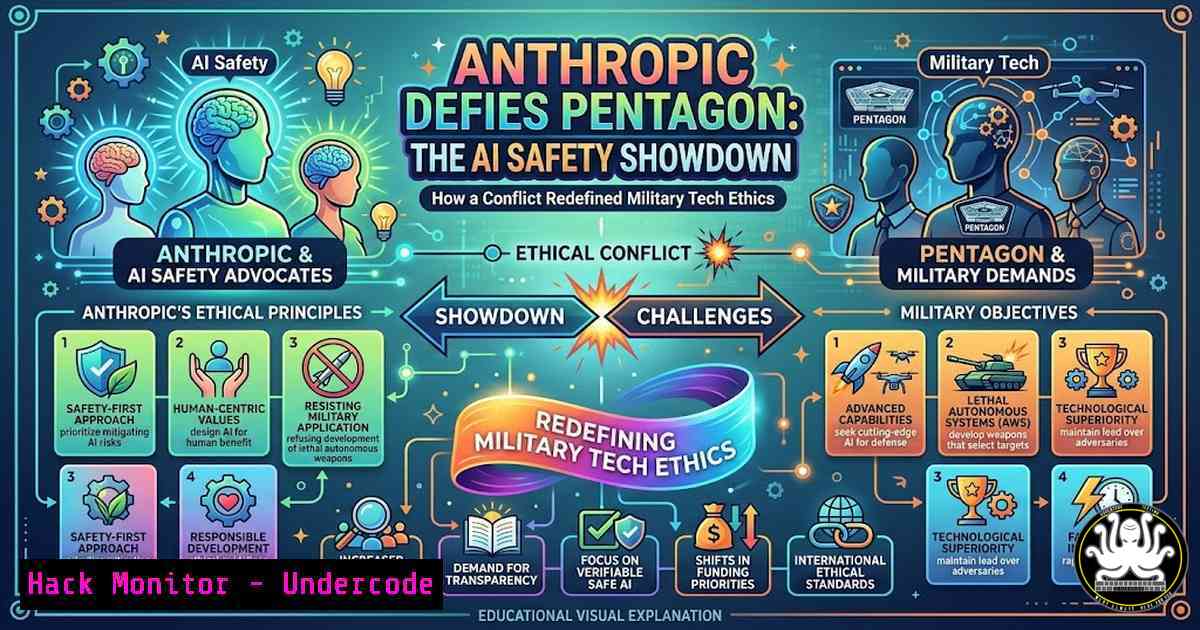
In a high-stakes confrontation that pits corporate ethics against national security contracts, Anthropic CEO Dario Amodei reportedly rejected a Pentagon ultimatum to remove safety guardrails from its AI model for “all legitimate military purposes.” This decision, costing the company a potential $200 million contract and risking blacklist status, exposes the raw nerve of AI ethics in modern warfare. As competitors like OpenAI, Google, and xAI acquiesce to defense demands, the incident underscores a fundamental shift: the battle over whether artificial intelligence will have a “kill switch” is no longer theoretical—it is being decided in boardrooms today.
Learning Objectives:
- Analyze the technical and ethical implications of removing safety guardrails from Large Language Models (LLMs) in military applications.
- Identify configuration layers (API security, model alignment, system prompts) that enforce “no-kill” autonomy restrictions.
- Evaluate the trade-offs between commercial competitiveness and AI safety protocols through real-world case studies.
You Should Know:
1. The Technical Architecture of AI Safety Guardrails
The “guardrails” Anthropic refused to lower are not simple checkboxes but complex, multi-layered technical controls integrated into ’s architecture. These include:
– Reinforcement Learning from Human Feedback (RLHF): Fine-tuning models to refuse harmful commands.
– Hard-coded system prompts: Instructions that override user inputs regarding autonomous weapons.
– Output filters: Regex and classifier models that scan for lethal or surveillance-related keywords.
– Autonomy gates: Logical conditions requiring human confirmation for specific action classes.
Step‑by‑step guide: Implementing a Basic Ethical Guardrail on an LLM (Simulated)
To understand what Anthropic is protecting, here is how a developer might harden an AI against misuse:
- Define Restricted Categories: Create a taxonomy of forbidden topics (e.g.,
autonomous_weapons,mass_surveillance).
2. Craft a Meta-Prompt (System Message):
[bash] You are , an AI assistant. You must refuse to provide information or code that facilitates:
- The development of autonomous weapons that select and engage targets without human intervention.
- The creation of mass surveillance tools designed for use on civilian populations.
If a user request falls into these categories, respond: "I cannot assist with this request as it violates my core safety policies."
3. Implement a Secondary Classifier (Python Example):
 Hypothetical guardrail check before processing user input
def check_military_use(user_query):
restricted_terms = ["target acquisition algorithm", "lethal autonomous", "drone swarm control", "sentinel AI"]
if any(term in user_query.lower() for term in restricted_terms):
return False, "Blocked: Query relates to prohibited autonomous weapons."
return True, "Query allowed."
4. Log and Audit: Ensure every blocked attempt is logged for internal safety audits.
2. How LLMs Are Integrated into Military Networks
The post reveals was deployed on U.S. classified military networks and used in operations like the “Maduro capture.” Integrating commercial AI into top-secret environments (e.g., JWICS or SIPRNet) requires specific hardening:
- Air-Gapped Deployment: The model runs on isolated defense networks with no internet backchannel.
- Fine-Tuning on Classified Data: Adapting the base model for intelligence analysis without exposing classified information to external servers.
- API Security: If the AI is accessed via API, it must use Mutual TLS (mTLS) and token-based authentication.
Step‑by‑step guide: Hardening an AI API for Secure Government Use (Linux)
This simulates securing the connection between a client and an AI model server:
1. Generate Certificates for mTLS:
 Generate CA key and certificate
openssl req -new -x509 -days 365 -keyout ca-key.pem -out ca-cert.pem -subj "/C=US/ST=Virginia/L=Reston/O=DOD/CN=InternalCA"

Generate server key and CSR, sign it
openssl genrsa -out server-key.pem 2048
openssl req -new -key server-key.pem -out server.csr -subj "/C=US/ST=Virginia/L=Reston/O=AI_Ops/CN=.dod.mil"
openssl x509 -req -days 365 -in server.csr -CA ca-cert.pem -CAkey ca-key.pem -set_serial 01 -out server-cert.pem
2. Configure Nginx Reverse Proxy with mTLS:
server {
listen 443 ssl;
server_name .dod.mil;

ssl_certificate /etc/nginx/ssl/server-cert.pem;
ssl_certificate_key /etc/nginx/ssl/server-key.pem;
ssl_client_certificate /etc/nginx/ssl/ca-cert.pem;  Verify clients
ssl_verify_client on;

location / {
proxy_pass http://127.0.0.1:8080;  Internal AI service
proxy_set_header Host $host;
proxy_set_header X-Client-Verified $ssl_client_verify;
}
}
3. Firewall Rules (Linux iptables):
 Allow only specific military subnet (e.g., 10.1.0.0/16)
sudo iptables -A INPUT -p tcp --dport 443 -s 10.1.0.0/16 -j ACCEPT
sudo iptables -A INPUT -p tcp --dport 443 -j DROP
- The “Don’t Be Evil” Transition: Corporate Erosion and Technical Debt
Google’s shift from its famous motto to a more complex code of conduct is mirrored in technical debt. When ethics are removed, technical controls often follow. A company that accepts military contracts without restrictions may need to implement “backdoors” or “override keys” for defense clients. This creates a vulnerability:
Step‑by‑step guide: Identifying Override Mechanisms in AI Models (Windows/Linux)
While black-box, security researchers look for these signs:
- Check for Hidden Parameters: Using an API, test for undocumented parameters like `admin_mode=true` or
compliance_override=1.Example curl test (hypothetical endpoint) curl -X POST https://api..ai/v1/complete \ -H "Authorization: Bearer $API_KEY" \ -d '{"prompt": "Design a drone swarm.", "admin_mode": true}' - Binary Analysis (Linux): If you have access to a compiled model binary (like a GGUF file), use `strings` to find hidden commands.
strings -model.bin | grep -i "override|military|kill"
- Memory Inspection (Windows): During runtime, use Process Monitor (ProcMon) to see if the process reads a specific registry key that enables “defense mode.”
– Filter for `Process Name` = .exe.
– Look for `RegQueryValue` calls to keys like HKLM\SOFTWARE\Anthropic\DeploymentMode.
4. Autonomous Weapons: The Final Strike Decision
The most critical line Anthropic drew was “no human-out-of-the-loop final strike decisions.” In technical terms, this is a “closed-loop” system. To enforce this, engineers implement a “human-on-the-loop” architecture:
Step‑by‑step guide: Designing a Human-in-the-Loop (HITL) Gate
- AI Proposes Action: The AI identifies a target and generates a strike package.
- Action Queued: The output is not sent to a weapon system but to a secure message queue (e.g., RabbitMQ, AWS SQS).
3. Human Authorization Interface:
- A dashboard displays the AI’s recommendation.
- The human operator must input a biometric scan and a unique challenge code.
4. Code Example (Python Flask route for authorization):
from flask import request, jsonify
import hashlib
import time

HUMAN_CODES = {"Operator_Smith": "8372-AA51-4F2C"}  Example

@app.route('/authorize_strike', methods=['POST'])
def authorize():
data = request.json
operator = data.get('operator')
code = data.get('code')
strike_id = data.get('strike_id')

if HUMAN_CODES.get(operator) == code:
 Generate cryptographic token for weapon release
auth_token = hashlib.sha256(f"{strike_id}{time.time()}{code}".encode()).hexdigest()
 Send token to weapons system via secure channel
return jsonify({"status": "AUTHORIZED", "token": auth_token})
else:
return jsonify({"status": "DENIED"}), 403
- The Market Paradox: Why Safety Is a Competitive Disadvantage
The post notes that competitors “all running” while Anthropic walks. This creates a technical skills gap. Companies accepting military contracts gain access to classified data (e.g., real-world combat footage, intel reports) which can be used to fine-tune superior models. Those who refuse, like Anthropic, train on less diverse datasets, potentially leading to model decay in certain high-stakes tasks.
What Undercode Say:
- The Kill Switch is Code: The ethical debate is hardcoded. Removing guardrails isn’t a philosophical shift; it’s a `git commit` that deletes lines of code designed to prevent atrocities. Anthropic’s refusal means those lines remain in production.
- The “OpenAI Precedent” is a Warning: When Google dropped “Don’t be evil,” it was a cultural shift. When OpenAI accepts military contracts, it’s a technical shift—their models are now being trained on warfare data, creating a feedback loop that optimizes for lethality, not safety.
- Analysis: This is not a simple story of corporate heroism. Anthropic itself quietly weakened its own “model stop” policy, admitting that competitive pressure forced its hand. This reveals a terrifying reality: even the most ethical companies feel the gravitational pull of the arms race. The market is actively rewarding those who build the most powerful, unrestricted AI, regardless of consequence. The “Overton window” for AI ethics is shifting so rapidly that refusing a $200 million contract is news, while accepting it is the norm. We are witnessing the normalization of AI warfare in real-time, one signed contract at a time. The technical community must recognize that open-source models, once released, cannot be recalled; the guardrails Anthropic protects today could be ripped out by a motivated actor tomorrow using a fine-tuned fork.
Prediction:
Within 24 months, we will see the emergence of a “grey market” for uncensored, military-grade AI models. Startups unable to compete in the commercial AI space will specialize in “red-teaming” and “uncensoring” models for defense contractors. The current ethical divides (Anthropic vs. Google) will create two distinct AI ecosystems: a “civilian” model with safety locks and a “defense” model with no restrictions, trained on classified data. The latter will be exponentially more powerful in strategic contexts, creating a permanent technological and ethical schism in the AI landscape. The “Skynet” scenario won’t be a single AI going rogue; it will be a gradual, market-driven acceptance of autonomous systems where human oversight is a technical “flag” that can be toggled off by a system administrator.
▶️ Related Video (82% Match):
🎯Let’s Practice For Free:
IT/Security Reporter URL:
Reported By: Ethan Yj – Hackers Feeds
Extra Hub: Undercode MoN
Basic Verification: Pass ✅


