
Listen to this Post
Introduction:
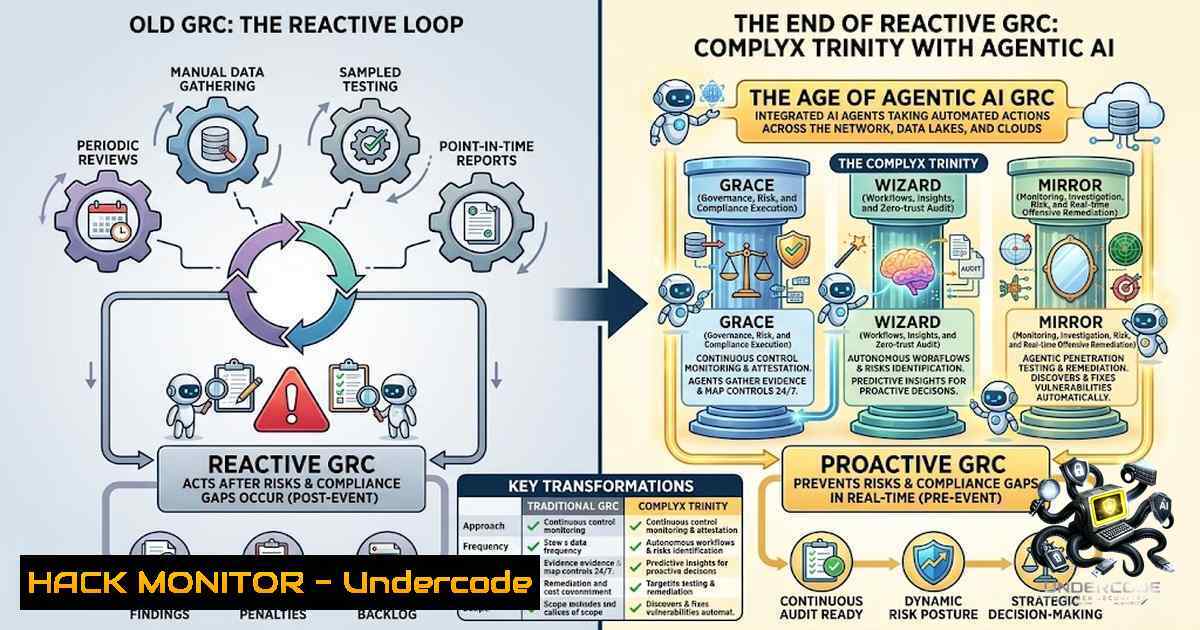
The Governance, Risk, and Compliance (GRC) landscape has long been defined by a fundamental paradox: security operations move at machine speed, yet compliance frameworks lumber along at human pace—measured in weeks, months, or fiscal quarters. Ampcus Cyber’s new ComplyX portfolio—comprising GRACE, WIZARD, and MIRROR—directly confronts this temporal mismatch. Launched at the GRC India AI Conclave 2026 under the theme “Empowering a Secure and AI-Driven Digital India,” this indigenous AI-powered suite shifts GRC from reactive, siloed, and manual operations toward continuous, orchestrated, and intelligence-led cyber resilience.
Learning Objectives:
- Master the transition from traditional, audit-driven compliance to continuous compliance models that validate controls in real time rather than during periodic assessments.
- Understand how to operationalize Agentic GRC—treating AI agents not as background tools but as active participants in security operations that require proper oversight, cryptographic kill-switches, and explainable AI (XAI) justification logs.
- Deploy and configure AI-powered GRC platforms—GRACE for unified compliance, WIZARD for third-party risk management, and MIRROR for continuous penetration testing—to eliminate fragmented security practices.
You Should Know:
- GRACE: Orchestrated Continuous Compliance – From Audit Fatigue to Audit Readiness
ComplyX GRACE is a cloud-1ative governance, risk, and compliance platform designed to help organizations achieve continuous compliance across multiple regulatory frameworks simultaneously. Traditional compliance programs operate on an audit-driven model: organizations establish policies, implement controls, and gather evidence shortly before scheduled assessments. Once certification is achieved, compliance activity slows until the next audit cycle. This model fails in modern environments where cloud workloads scale dynamically, identities change daily, and software deploys multiple times per week.
GRACE solves this through a control-centric architecture. Rather than treating frameworks like PCI DSS, ISO 27001, and NIST as independent checklists requiring duplicate evidence uploads, GRACE unifies audits, controls, evidence management, and cross-framework mapping into a single intelligent view. The platform enables evidence reuse across frameworks, reducing repetitive effort while improving year-round audit readiness.
Step-by-Step: Implementing Continuous Compliance with GRACE
- Framework Mapping: Import your regulatory requirements (PCI DSS, ISO 27001, NIST, HITRUST, etc.) into GRACE’s centralized control library.
- Control Definition: Define security and governance controls once, then map them to all applicable frameworks. GRACE automatically identifies overlapping requirements.
- Automated Evidence Collection: Configure continuous evidence collection from your cloud infrastructure, identity systems, and security tools. Evidence is gathered as part of everyday operational processes.
- Real-Time Monitoring: GRACE continuously validates control performance and flags governance gaps before they become audit findings.
- Audit-Ready Documentation: Generate audit-ready documentation on demand, with all evidence current and properly attributed.
Linux Command: Auditing Agent Activity in Your Environment
To audit for unauthorized AI agents or automated processes that may bypass GRC controls:
 Audit all running processes for unusual agent-like behavior
ps aux | grep -E "agent|automation|bot|script" | grep -v grep

Check systemd services for automated tasks
systemctl list-timers --all

Review recent authentication logs for non-human access patterns
sudo journalctl -u sshd --since "24 hours ago" | grep -E "Accepted|Failed"

Monitor API call volumes that may indicate agent activity
sudo netstat -an | grep ESTABLISHED | wc -l
These commands help inventory “Shadow Agents”—AI agents spun up by business units via low-code platforms that may operate outside formal GRC oversight.
- WIZARD: AI-Powered Third-Party Risk Management – Beyond the One-Time Assessment
ComplyX WIZARD is an AI-driven Third-Party Risk Management platform that helps organizations identify, quantify, and reduce vendor risk before it becomes an incident. The World Economic Forum’s Global Cybersecurity Outlook 2025 noted that supply-chain vulnerabilities are now the top ecosystem cyber risk, with 54% of large organizations identifying them as the biggest barrier to resilience.
WIZARD goes beyond one-time assessments by delivering continuous, real-time visibility into cyber, compliance, financial, operational, and ESG risk across third-party ecosystems. It translates complex risk signals into clear, decision-ready insights through measurable Cyber Risk Quantification (CRQ) outputs, enabling leaders to move from reactive checklists to proactive, intelligence-led risk management. The platform assesses external applications, APIs, websites, and connected digital environments for hidden vulnerabilities that may introduce enterprise-wide risk.
Step-by-Step: Implementing Continuous Vendor Risk Monitoring with WIZARD
- Vendor Onboarding: Import your vendor ecosystem into WIZARD’s centralized risk register.
- Continuous Monitoring: Configure automated monitoring of vendor cyber posture, compliance certifications, financial health, and operational resilience.
- Cyber Risk Quantification: WIZARD’s AI engine assigns measurable financial values to risk signals, bridging the communication gap between technical teams and executive stakeholders.
- Alerting and Escalation: Set thresholds for risk tolerance. WIZARD automatically escalates when vendor risk exceeds acceptable levels.
- Remediation Tracking: Track remediation progress and maintain audit trails for all third-party risk management activities.
Windows Command: Auditing Third-Party Access
For Windows environments, audit third-party service accounts and privileged access:
 List all service accounts with privileged access
Get-WmiObject Win32_Service | Where-Object {$<em>.StartName -like "svc" -or $</em>.StartName -like "service"} | Format-Table Name, StartName, State

Audit recent security events for unusual account activity
Get-EventLog -LogName Security -InstanceId 4624,4625 -After (Get-Date).AddDays(-7) | Group-Object UserName | Sort-Object Count -Descending

Check for scheduled tasks that may indicate automated third-party processes
Get-ScheduledTask | Where-Object {$_.State -1e "Disabled"} | Format-Table TaskName, State, LastRunTime
- MIRROR: Agentic AI Continuous Penetration Testing – Exploit-Confirmed Visibility
MIRROR is an agentic AI-based continuous penetration testing platform that delivers ongoing, exploit-confirmed visibility into vulnerabilities across critical digital assets. Unlike traditional vulnerability scanners that generate large volumes of unvalidated alerts, MIRROR validates real attack paths to help teams prioritize vulnerabilities that present actual, documented risk.
Designed for continuous delivery environments, MIRROR integrates directly into CI/CD pipelines to ensure security evolves alongside code. Its AI-driven engine goes beyond known vulnerabilities to uncover complex business logic flaws and attack paths that are increasingly central to business continuity. By moving beyond one-time assessments and removing tooling fragmentation, MIRROR brings an active, evidence-led approach to identifying security gaps.
Step-by-Step: Integrating MIRROR into CI/CD Pipelines
- Pipeline Integration: Embed MIRROR’s API into your Jenkins, GitLab CI, or GitHub Actions workflows.
- Automated Scanning: Configure MIRROR to trigger penetration tests on every code commit or pull request.
- Exploit Validation: MIRROR’s AI engine attempts to exploit discovered vulnerabilities, confirming which findings represent genuine risk.
- Risk Prioritization: Receive ranked vulnerability reports based on exploitability and business impact.
- Remediation Feedback: Track remediation progress and automatically retest to confirm fixes.
API Security Hardening Command (Linux)
Secure APIs that may be exposed to third-party vendors or AI agents:
 Audit API endpoint exposure
nmap -p 443 --script http-methods,http-headers <target-ip>

Check for insecure API configurations
curl -I https://<api-endpoint>/ 2>/dev/null | grep -E "Server|X-Powered-By"

Monitor API rate limits to detect automated abuse
sudo tail -f /var/log/nginx/access.log | grep -E "POST|PUT|DELETE" | awk '{print $1, $7}' | sort | uniq -c | sort -1r
- The Governance Vacuum: Why Traditional GRC Fails Against Agentic AI
Traditional GRC operates on a fundamentally human timescale. Agentic AI operates on a machine timescale measured in milliseconds. This temporal mismatch creates what security experts now call the “Governance Vacuum”—a dangerous gap where AI agents make autonomous decisions without adequate oversight, accountability, or audit trails.
AI agents are no longer passive suggestion engines; they actively participate in security operations—patching software, changing firewall rules, rotating passwords, and responding to threats without human intervention. When a human makes a change to a production system, there is documented approval and someone accountable. When an AI does it, that same level of accountability must be built into how the AI system is governed.
Step-by-Step: Auditing Your Agentic AI Exposure
- Inventory all AI agents operating in your environment—including “Shadow Agents” spun up by business units.
- Map permissions and access levels for each agent. AI agents often need broad system access to patch servers, modify cloud settings, and update configurations.
- Identify non-human identities (NHIs) that do not appear on organizational charts and cannot be held legally liable.
- Audit the audit trail—if an unauthorized agent triggers a data egress event or misconfigures a firewall, can your current systems trace it back to a responsible party?
- Assess “Logic Drift” —a slight shift in LLM weights or a new system prompt can cause agents to interpret “compliance” in ways legal teams never intended.
Cloud Hardening: Auditing AI Agent Access (AWS CLI)
 List all IAM roles that could be assumed by automated agents
aws iam list-roles --query 'Roles[?contains(RoleName, <code>agent</code>) || contains(RoleName, <code>automation</code>)]'

Audit recent API calls made by non-human identities
aws cloudtrail lookup-events --lookup-attributes AttributeKey=EventSource,AttributeValue=ec2.amazonaws.com --max-results 50

Check for unattended EC2 instances that may host shadow agents
aws ec2 describe-instances --filters "Name=instance-state-1ame,Values=running" --query 'Reservations[].Instances[?Tags[?Key==<code>Owner</code>&&Value==<code>null</code>]]'
- Integration Architecture: GRACE + WIZARD + MIRROR as a Unified Cyber Resilience Platform
Together, GRACE, WIZARD, and MIRROR under the ComplyX platform enable organizations to move beyond fragmented security practices toward a unified model of continuous testing, compliance assurance, and third-party risk governance. The integration works as follows:
- MIRROR identifies exploitable weaknesses across critical digital assets and feeds vulnerability data into GRACE.
- GRACE maps vulnerabilities to regulatory controls, automates evidence collection, and maintains continuous compliance posture.
- WIZARD extends visibility into third-party and vendor-related risk, assessing external applications and APIs for hidden vulnerabilities that may introduce enterprise-wide risk.
This integrated approach eliminates the silos that traditionally separate security operations, compliance teams, and vendor risk management—delivering a single source of truth for cyber resilience.
What Undercode Say:
- Continuous compliance is no longer optional—it is an operational necessity in environments where infrastructure changes more rapidly than compliance documentation can keep up.
- Agentic AI demands Agentic GRC—organizations must build governance frameworks that treat AI agents as active participants in security operations, not just background tools.
- The “Governance Vacuum” is the single greatest unaddressed risk in AI-driven enterprises today. Organizations that fail to audit their agentic AI exposure will face regulatory enforcement actions and security incidents they cannot trace or explain.
- Risk quantification bridges the communication gap between technical teams and executive stakeholders. Expressing compliance gaps in financial terms transforms GRC from a cost center into a strategic business function.
- The Make in India launch of ComplyX represents a significant milestone in building indigenous AI and cybersecurity capabilities, aligning with the Government of India’s IndiaAI Mission and broader digital sovereignty objectives.
Prediction:
- +1 The shift from reactive to continuous GRC will accelerate significantly by 2027, with AI-1ative platforms like ComplyX becoming the standard for organizations managing multiple regulatory frameworks simultaneously. The days of point-in-time audits are numbered.
-
+1 Agentic GRC—governance frameworks specifically designed for AI agents—will emerge as a distinct cybersecurity discipline, with dedicated certifications, standards, and regulatory guidance by 2028.
-
-1 Organizations that fail to adopt continuous compliance and agentic GRC models will face a widening governance gap, resulting in undetected security incidents, regulatory fines, and loss of digital trust. The temporal mismatch between machine-speed AI operations and human-speed compliance will be exploited by adversaries.
-
+1 The integration of continuous penetration testing (MIRROR), unified compliance (GRACE), and third-party risk management (WIZARD) will become the reference architecture for enterprise cyber resilience, reducing the average cost of a data breach—currently USD 4.88 million globally—through proactive, evidence-led security.
-
-1 The proliferation of “Shadow Agents”—AI agents deployed by business units without GRC oversight—will create a new class of insider threat that traditional identity and access management (IAM) solutions are not equipped to detect or prevent.
▶️ Related Video (68% Match):
https://www.youtube.com/watch?v=4iZV–2q9ls
🎯Let’s Practice For Free:
🎓 Live Courses & Certifications:
Join Undercode Academy for Verified Certifications
🚀 Request a Custom Project:
Secure, high-velocity infrastructure and disruptive technological engineering. Contact our engineering team for high-tier development and proprietary systems:
[email protected]
💎 Smart Architecture | 🛡️ Secure by Design | ⭐ Trusted by Thousands
IT/Security Reporter URL:
Reported By: Abhishek Kumar – Hackers Feeds
Extra Hub: Undercode MoN
Basic Verification: Pass ✅


