Listen to this Post
Introduction:
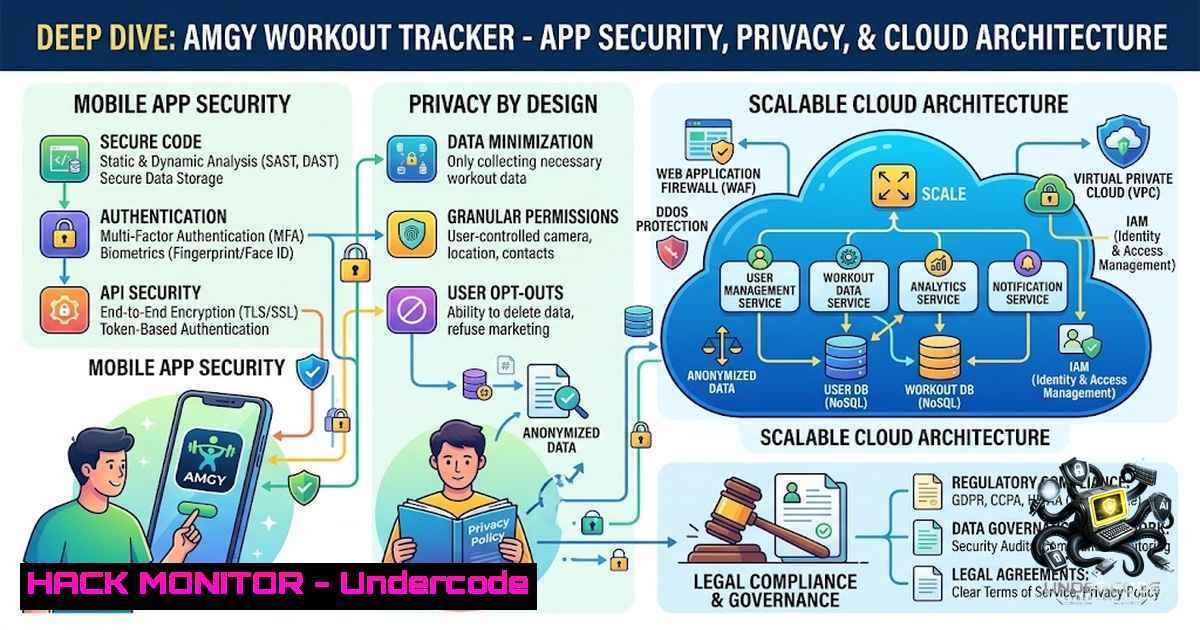
The launch of AMGY, a minimalist workout tracker developed by AI Engineer Anas Msimir, represents more than just another fitness app—it’s a case study in modern mobile application development, cloud security, and data privacy engineering. As fitness applications increasingly handle sensitive health data, understanding the security architecture, API design patterns, and cloud infrastructure behind such apps becomes critical for developers, security professionals, and end-users alike. This article explores the technical foundations of AMGY and provides actionable security hardening guidance applicable to any mobile-first application.
Learning Objectives:
- Understand mobile application security architecture and data protection mechanisms for health and fitness apps
- Implement secure API authentication, row-level security, and encryption best practices
- Apply OWASP Mobile Top 10 mitigation strategies and cloud infrastructure hardening techniques
- Master privacy-by-design principles and compliance requirements for handling sensitive user data
You Should Know:
- Secure Authentication and Session Management in Mobile Apps
AMGY implements email and password authentication with hashed credentials managed by the auth provider. This approach, while standard, requires careful implementation to prevent common vulnerabilities. The OWASP Mobile Top 10 identifies insecure authentication as a critical risk, particularly when apps store credentials locally or fail to implement proper session management.
Step-by-Step Guide to Implementing Secure Mobile Authentication:
- Use OAuth 2.0 with PKCE (Proof Key for Code Exchange) for third-party authentication flows. This prevents authorization code interception attacks.
- Implement short-lived JWT tokens with expiration windows of 1 hour or less, combined with secure refresh token rotation.
- Store credentials exclusively in secure hardware-backed storage—iOS Keychain for Apple devices, Android Keystore for Android—never in UserDefaults or SharedPreferences.
- Enforce biometric authentication (Face ID/Touch ID) as an additional layer for sensitive actions like viewing workout history or personal records.
- Implement account lockout policies after 5 failed login attempts and require email verification before granting full access.
Linux Command for Testing Authentication Endpoints:
 Test JWT token expiration and validation
curl -X POST https://api.amgy.app/auth/login \
-H "Content-Type: application/json" \
-d '{"email":"[email protected]","password":"securepass"}' \
-w "\nHTTP Status: %{http_code}\n"

Verify token signature and expiration
jwt_decode() { echo $1 | cut -d. -f2 | base64 -d 2>/dev/null | jq .; }
Windows PowerShell Equivalent:
 Test API authentication with Invoke-RestMethod
$body = @{email="[email protected]"; password="securepass"} | ConvertTo-Json
Invoke-RestMethod -Uri "https://api.amgy.app/auth/login" -Method Post -Body $body -ContentType "application/json"
2. Data Encryption and Row-Level Security (RLS)
AMGY’s privacy policy indicates that user data is protected by row-level security and syncs across devices via user accounts. Row-level security ensures that database queries return only data belonging to the authenticated user, preventing unauthorized access even if API endpoints are compromised.
Step-by-Step Guide to Implementing Row-Level Security:
- Design database tables with a `user_id` foreign key that references the authenticated user’s unique identifier.
- Enable RLS on PostgreSQL (or equivalent on other databases) using policies that restrict data access:
-- Enable RLS on the workouts table
ALTER TABLE workouts ENABLE ROW LEVEL SECURITY;</li>
</ol>

-- Create policy to restrict access to own data
CREATE POLICY user_workout_policy ON workouts
USING (user_id = current_setting('app.current_user_id')::uuid);
3. Encrypt sensitive data at rest using AES-256-GCM. For health and fitness data, field-level encryption adds an extra layer of protection.
4. Implement TLS 1.3 for all data in transit, enforcing App Transport Security (ATS) on iOS to prevent insecure HTTP connections.
5. Use certificate pinning to prevent man-in-the-middle attacks by hardcoding the server’s public key hash in the app.Verification Commands:
 Check TLS configuration
openssl s_client -connect api.amgy.app:443 -tls1_3

Verify certificate chain
openssl s_client -connect api.amgy.app:443 -showcerts

Test RLS with different user contexts (PostgreSQL)
SET app.current_user_id = 'user-uuid-here';
SELECT  FROM workouts; -- Should only return user's data
3. API Security and Rate Limiting
Mobile apps depend heavily on backend APIs, making them prime targets for abuse. AMGY’s architecture likely includes RESTful or GraphQL endpoints for workout logging, friend challenges, and coach modes. Without proper security controls, these APIs can be exploited for data scraping, brute-force attacks, or denial of service.
Step-by-Step Guide to API Hardening:
- Implement API key rotation and restrictions—never hardcode API keys in the mobile app bundle. Use runtime fetching from a secure backend service.
- Apply rate limiting per user and per IP address to prevent brute-force and DoS attacks. A typical limit is 100 requests per minute per user.
- Validate all inputs on the server side, not just the client. Reject malformed JSON, enforce data type constraints, and sanitize strings to prevent injection attacks.
- Implement proper CORS policies to restrict which domains can access your APIs.
- Log all API requests with user IDs, timestamps, and IP addresses for forensic analysis.
Nginx Rate Limiting Configuration:
 /etc/nginx/nginx.conf
http {
limit_req_zone $binary_remote_addr zone=api_limit:10m rate=100r/m;
limit_req_zone $binary_remote_addr zone=login_limit:10m rate=10r/m;

server {
location /api/ {
limit_req zone=api_limit burst=20 nodelay;
proxy_pass http://backend:3000;
}
location /api/auth/login {
limit_req zone=login_limit burst=5 nodelay;
proxy_pass http://backend:3000;
}
}
}
Linux Command for API Security Testing:
 Test rate limiting with Apache Bench
ab -1 200 -c 10 https://api.amgy.app/api/workouts

Check for SQL injection vulnerabilities with sqlmap
sqlmap -u "https://api.amgy.app/api/exercises?muscle=chest" --batch --level=2

Monitor API logs in real-time
tail -f /var/log/nginx/access.log | grep "POST /api"
4. Privacy by Design and Data Minimization
AMGY’s privacy practices indicate that health and fitness data, contact info, and identifiers are collected and linked to user identities, while diagnostics are collected but not linked. This aligns with privacy-by-design principles, but developers must go further to ensure compliance with regulations like GDPR and CCPA.
Step-by-Step Guide to Privacy Implementation:
- Conduct a Data Privacy Impact Assessment (DPIA) to identify all data collected, its purpose, and retention periods.
- Implement data minimization—collect only what’s necessary. For a workout tracker, this means exercise logs, body weight, and basic profile info—not location data or contacts unless explicitly required.
- Provide clear user consent dialogs with granular options for data collection and sharing.
- Enable full account deletion from within the app, as AMGY does, and ensure all associated data is permanently removed from databases and backups.
- Implement data anonymization for analytics—use aggregated, non-identifiable data for product improvement.
GDPR Compliance Checklist Commands:
 Search for hardcoded sensitive data in codebase
grep -r "password|secret|key|token" --include=".swift" --include=".js" .

Check for unencrypted data in logs
grep -r "email|phone|address" /var/log/app/.log

Database query to identify users for data export (PostgreSQL)
COPY (SELECT  FROM users WHERE user_id = 'target_uuid') TO '/tmp/user_data_export.json';
5. Cloud Infrastructure Hardening and Monitoring
AMGY’s backend infrastructure, hosted on cloud platforms, must be secured against attacks ranging from DDoS to data breaches. The 2025 State of Cloud Security Report emphasizes shared responsibility—developers must secure their applications even when cloud providers secure the underlying infrastructure.
Step-by-Step Guide to Cloud Hardening:
- Implement Identity and Access Management (IAM) with least-privilege principles. Use service accounts with minimal permissions for each microservice.
- Enable Security Information and Event Management (SIEM) logging for all cloud resources, with alerts for anomalous behavior.
- Use Web Application Firewalls (WAF) to filter malicious traffic before it reaches your APIs.
- Regularly scan for vulnerabilities using tools like OWASP ZAP or commercial SAST/DAST solutions.
- Implement disaster recovery with automated backups and geo-redundant storage.
AWS CLI Commands for Cloud Security:
 List IAM roles and policies
aws iam list-roles --query 'Roles[].RoleName'

Check S3 bucket public access
aws s3api get-bucket-public-access-block --bucket amgy-app-data

Enable CloudTrail for audit logging
aws cloudtrail create-trail --1ame amgy-audit-trail --s3-bucket-1ame amgy-logs

Monitor for unauthorized API calls
aws cloudwatch get-metric-statistics --1amespace AWS/CloudTrail \
--metric-1ame UnauthorizedCallCount --start-time 2026-07-21T00:00:00Z \
--end-time 2026-07-22T00:00:00Z --period 3600 --statistics Sum
6. Mobile App Binary Hardening and Anti-Tampering
Mobile apps are vulnerable to reverse engineering, code injection, and runtime manipulation. AMGY’s binary, like all iOS apps, should incorporate protections against these threats.
Step-by-Step Guide to Binary Hardening:
- Apply code obfuscation to make reverse engineering more difficult. For iOS, use LLVM’s obfuscation passes or commercial tools.
- Strip debug symbols from release builds to remove unnecessary information for attackers.
- Implement anti-tamper checks that verify the app’s integrity at launch, detecting if the binary has been modified.
- Detect jailbroken/rooted devices and respond appropriately—either by limiting functionality or refusing to run.
- Use runtime application self-protection (RASP) to monitor for suspicious method hooks or dynamic instrumentation.
Xcode Build Settings for Hardening:
 Strip debug symbols in Release configuration
 Set STRIP_STYLE = all in Build Settings

Enable code signing and entitlements
codesign -s "iPhone Distribution: AME" --entitlements AMGY.entitlements AMGY.app

Verify binary protections
otool -l AMGY.app/AMGY | grep -A 5 LC_ENCRYPTION_INFO
7. Secure Third-Party Dependency Management
Modern apps rely on numerous third-party libraries for functionality like analytics, networking, and UI components. Each dependency introduces potential vulnerabilities.
Step-by-Step Guide to Dependency Security:
- Maintain a Software Bill of Materials (SBOM) listing all dependencies and their versions.
- Regularly scan dependencies for known vulnerabilities using tools like Snyk, Dependabot, or OWASP Dependency Check.
- Pin dependency versions to specific, verified releases rather than using wildcard or latest versions.
- Review dependency permissions—ensure libraries only request necessary device permissions.
- Monitor for supply chain attacks by verifying package integrity using checksums or digital signatures.
Dependency Scanning Commands:
 Scan Swift Package Manager dependencies
swift package show-dependencies --format json | jq '.'

Check for vulnerabilities in CocoaPods
pod outdated
pod deintegrate && pod install --repo-update

Use OWASP Dependency Check for iOS
dependency-check --scan ./AMGY.xcodeproj --format HTML --out ./reports
What Undercode Say:
- Security is not a feature—it’s a foundation. AMGY’s implementation of row-level security, encrypted authentication, and privacy-by-design demonstrates that even indie developers can build secure applications when security is prioritized from day one.
- The fitness app market is a prime target for data breaches. With 138K user photos exposed in a recent fitness app breach and Garmin Connect vulnerabilities leaking location data, the stakes for health data security are exceptionally high.
- Privacy regulations are tightening. Apps handling health data must comply with GDPR, CCPA, and increasingly stringent regional laws. AMGY’s transparent privacy policy and account deletion feature are steps in the right direction.
- The shared responsibility model applies to everyone. Cloud providers secure the infrastructure, but developers must secure their applications, APIs, and data. AMGY’s use of row-level security and encrypted sync is commendable.
- Third-party dependencies are the weakest link. With supply chain attacks on the rise, developers must rigorously audit and monitor their dependencies. The OWASP Mobile Top 10 now includes insecure supply chain as a critical risk.
Prediction:
- +1 The demand for privacy-first fitness applications will surge, with users increasingly choosing apps like AMGY that offer transparent data practices and no ad tracking. This trend will pressure larger fitness platforms to adopt similar privacy standards.
- +1 AI-powered workout personalization will become the next frontier, with apps using secure, on-device machine learning to analyze user performance without exposing sensitive data to the cloud.
- -1 Regulatory scrutiny on health data will intensify, potentially leading to significant fines for non-compliant apps. Developers must invest in compliance early or face existential risks.
- -1 The rise of API abuse and automated scraping will force apps to implement increasingly sophisticated rate limiting and bot detection, increasing operational costs and complexity.
- +1 Open-source security tools and frameworks will continue to mature, making enterprise-grade security accessible to indie developers and small teams, democratizing app security.
- -1 Mobile app binary reverse engineering will become more sophisticated, requiring developers to adopt advanced obfuscation and anti-tampering techniques to protect intellectual property and user data.
- +1 The integration of hardware-backed security (Secure Enclave, Trusted Execution Environments) will become standard for sensitive operations like biometric authentication and cryptographic key storage, raising the baseline for mobile security.
- -1 The convergence of fitness data with insurance and employment decisions will create new privacy risks, as workout and health data could be used to discriminate against users. Stronger legal protections will be needed.
▶️ Related Video (78% Match):
🎯Let’s Practice For Free:
🎓 Live Courses & Certifications:
Join Undercode Academy for Verified Certifications
🚀 Request a Custom Project:
Secure, high-velocity infrastructure and disruptive technological engineering. Contact our engineering team for high-tier development and proprietary systems:
[email protected]
💎 Smart Architecture | 🛡️ Secure by Design | ⭐ Trusted by ThousandsIT/Security Reporter URL:
Reported By: Anas Ai – Hackers Feeds
Extra Hub: Undercode MoN
Basic Verification: Pass ✅🔐JOIN OUR CYBER WORLD [ CVE News • HackMonitor • UndercodeNews ]
📢 Follow UndercodeTesting & Stay Tuned:


