Listen to this Post
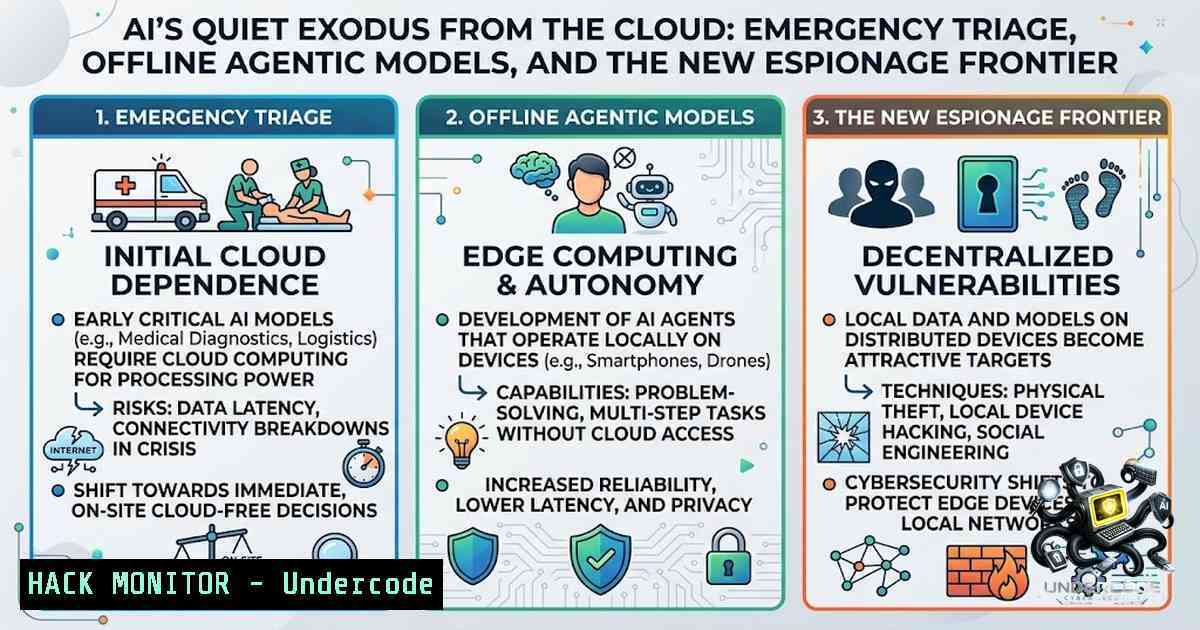
Introduction:
A fundamental shift is underway in the artificial intelligence landscape: intelligence is quietly leaving the cloud and migrating to local, offline, on-device environments. This transformation, highlighted by three recent developments, signals a new era where AI is embedded directly into the fabric of emergency response, personal computing, and even cyber-espionage. The implications of this trend are profound, reshaping who controls AI, how it is audited, and who ultimately becomes vulnerable to its misuse.
Learning Objectives:
- Understand the technical underpinnings and operational logic of three distinct, real-world AI deployments, from public safety to cyber-espionage.
- Learn the practical commands and tools required to deploy and secure local Large Language Models (LLMs) on consumer and enterprise hardware.
- Analyze the security implications and future attack vectors introduced by the proliferation of offline, unmonitored AI systems.
You Should Know:
- Carbyne’s AI-Powered 911 Triage: Technical Implementation and Deployment
The Orleans Parish Communication District (OPCD) in New Orleans is testing Carbyne’s AI Emergency Call Triage to address a critical challenge: duplicate reports of motor vehicle accidents overwhelming human dispatchers. The system is not designed to replace human judgment but to filter out redundant calls, ensuring that life-threatening emergencies receive immediate attention. It draws a virtual perimeter of 100 meters around an accident scene. When a call originates from within this geofence, an automated voice asks if the caller is reporting that specific crash. If the caller is merely passing by, the system confirms help is on the way and allows them to hang up. Callers involved in the crash or reporting a new emergency are immediately transferred to a human operator. The AI integrates directly with the existing computer-aided dispatch (CAD) system. To mitigate accent misrecognition—a documented failure mode in voice AI—the OPCD trained the system for three months on local recordings, including complex street names and Cajun French accents. The results have been significant, with duplicate call volume dropping by over 30%, effectively saving the equivalent workload of two full-time dispatchers per shift. The system also features real-time two-way AI translation, which has reduced processing times by up to 70%.
- Deploying Meta’s Muse Glimmer: A Step-by-Step Guide for Local, Offline AI
Meta has released Muse Glimmer, a 30-billion-parameter open-weight model under the Apache 2.0 license, designed to run powerful AI agents entirely offline on a single consumer GPU or Mac. This represents a clear strategic move to put advanced AI capabilities directly into the hands of users. The model supports text and image inputs, understands over 100 languages, and can perform multi-step tasks like tool calling, code writing, and file management. The model’s weights are available on Hugging Face.
Step-by-Step Deployment (Linux/macOS) using `llama.cpp`:
Step 1: Download the Model
Navigate to the Meta Muse Glimmer page on Hugging Face (huggingface.co/meta-models/Muse-Glimmer-30B) and download the quantized GGUF version suitable for your hardware. For a 24GB VRAM GPU (e.g., RTX 3090/4090), you will need the K-Quant-17GB version, which compresses the model to under 20GB with only a ~1% drop in performance.
Step 2: Install `llama.cpp`
On Linux/macOS, open a terminal and run:
git clone https://github.com/ggerganov/llama.cpp
cd llama.cpp
make
Step 3: Run the Model
Execute the model using the `llama-cli` tool (formerly main). For optimal performance, the DFlash speculative decoding technique can be used. A sample command is:
./llama-cli -m /path/to/muse-glimmer-q4_K_M.gguf -p "Your prompt here" -1 256 -1gl 100 -fa
– -m: Specifies the path to the model file.
– -p: Your input prompt.
– -1: The maximum number of tokens to generate.
– -1gl: Number of layers to offload to the GPU (use `-1` to offload all layers).
– -fa: Enables Flash Attention for faster processing.
Step 4: (Optional) Use LM Studio
For a user-friendly experience on Windows, macOS, or Linux, download LM Studio. Within the app, search for “Muse Glimmer,” download the appropriate quantized version, and start a local chat session without any command-line interaction.
- The Espionage Angle: Kimsuky’s Offline AI Attack Stack
The same technology that empowers privacy-focused personal assistants is being weaponized by state-sponsored threat actors. The North Korean-linked hacking group Kimsuky has been observed operating local LLM environments entirely offline using open-source tools like Ollama, GPT4All, and Msty. By running these models on their own infrastructure without an internet connection, they avoid leaving any detectable traces with commercial AI providers. This setup allows them to generate highly polished, natural-language phishing documents and process stolen files. The group is currently focused on “accumulating technologies and capabilities” rather than training their own models. Their attack flow is sophisticated, involving spear-phishing campaigns where malicious LNK files in ZIP archives execute obfuscated PowerShell loaders. These payloads have been observed abusing Git-based repositories for command-and-control (C2) infrastructure. For security professionals, this underscores the critical need for behavior-based EDR detection and threat hunting for suspicious local LLM frameworks and PowerShell abuse.
Security Hardening: Detecting Local LLM Frameworks
Shadow AI deployments, where employees or adversaries run unmonitored local LLMs, pose significant data exfiltration risks. IT and security teams can hunt for these tools using endpoint detection and response (EDR) solutions.
Example Detection Queries:
- Process Creation (Windows): Monitor for processes that create the `ollama.exe` or `gpt4all.exe` executables.
- File Creation: Alert on the creation of `.gguf` or `.bin` model files in user directories, which are common formats for local LLMs.
- Network Connections (Linux/macOS): Use `lsof -i` or `netstat -tulpn` to check if any unexpected local services are running on ports like 11434 (default for Ollama), which could indicate a rogue instance.
- PowerShell Monitoring: Search for encoded PowerShell commands (
-EncodedCommand) or suspicious `IEX` (Invoke-Expression) calls, which are hallmarks of Kimsuky’s attack chain.
4. Cloud-to-Edge Security: The Attack Surface Expands
The migration of AI from the cloud to the edge dramatically expands the attack surface. With powerful models like Muse Glimmer running locally, the threat of model poisoning, adversarial attacks, and intellectual property theft becomes more acute. A compromised local AI agent could be manipulated into exfiltrating sensitive personal or corporate data, acting as an unwitting insider. Traditional security perimeters are rendered obsolete when the AI operates entirely offline, bypassing cloud-based security controls and Data Loss Prevention (DLP) solutions. Organizations must now treat local AI models as they would any other endpoint application, requiring rigorous patch management, access control, and continuous monitoring for anomalous behavior.
- The New Frontier: Offline AI Obfuscation and Governance Challenges
The offline nature of these deployments introduces a critical governance and oversight challenge. With no cloud API logs to audit, how does an organization or nation-state verify that AI is not being used maliciously? The Kimsuky case illustrates this perfectly: their setup is entirely “untraceable” to commercial providers. Similarly, while OPCD’s use of Carbyne’s AI is transparent and audited, the broader trend points to a future where AI operates in the shadows. For blue teams, this means adapting to a world where the AI is not a service to be monitored but an application to be contained.
What Undercode Say:
- Key Takeaway 1: The “personal superintelligence” vision is no longer theoretical. Meta’s Muse Glimmer, with its permissive license and local execution, puts the power of a state-of-the-art AI agent on a personal computer, democratizing access but also decentralizing control.
- Key Takeaway 2: The dual-use nature of local LLMs is undeniable. The very tools that enable privacy and low-latency processing (Ollama, GPT4All) are being co-opted by advanced threat actors for espionage, creating a new, invisible battleground in cybersecurity.
Prediction:
- +1 The proliferation of powerful, offline AI models will accelerate innovation in privacy-preserving technologies and edge computing, leading to a new wave of “on-device” applications that are more responsive and less dependent on network connectivity.
- -1 The shift to offline AI will create a “security blind spot” of unprecedented scale. Threat actors will increasingly deploy local AI to automate and refine attacks, making detection and attribution significantly more difficult for defenders and law enforcement.
- -1 The lack of centralized oversight for these models will intensify the “arms race” between offensive and defensive AI, with attackers using offline models to generate more convincing and adaptive phishing campaigns, while defenders struggle to monitor these systems.
▶️ Related Video (76% Match):
🎯Let’s Practice For Free:
🎓 Live Courses & Certifications:
Join Undercode Academy for Verified Certifications
🚀 Request a Custom Project:
Secure, high-velocity infrastructure and disruptive technological engineering. Contact our engineering team for high-tier development and proprietary systems:
[email protected]
💎 Smart Architecture | 🛡️ Secure by Design | ⭐ Trusted by Thousands
IT/Security Reporter URL:
Reported By: https://lnkd.in/p/es4DvT-r – Hackers Feeds
Extra Hub: Undercode MoN
Basic Verification: Pass ✅


