Listen to this Post
Introduction:
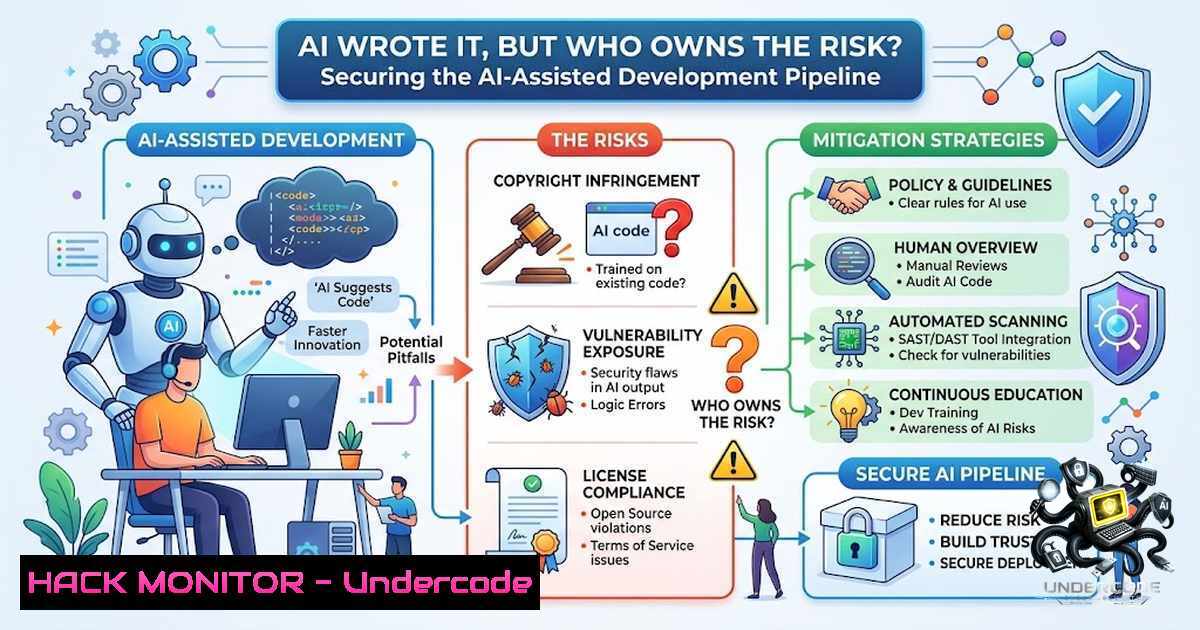
The debate over whether an AI “wrote” the code or content we produce misses a far more critical question: who owns the security risk when AI assists in creation? As developers and security professionals increasingly rely on large language models to accelerate workflows, the line between human authorship and machine generation blurs—but liability for vulnerabilities, backdoors, and compliance failures remains unequivocally human. This article bridges the AI authorship dilemma with actionable security practices, ensuring that when you say “I wrote it,” you also own the responsibility to secure it.
Learning Objectives:
- Understand the security implications of AI-generated code and content, including supply chain risks and prompt injection vectors.
- Implement robust validation, auditing, and secure development frameworks for AI-assisted projects.
- Master techniques to train teams, configure tools, and enforce compliance in an AI-augmented development environment.
You Should Know
1. The AI Authorship Paradox in Security
The statement “I wrote it” when using AI is not merely philosophical—it carries legal and security weight. When an AI generates code, it may inadvertently introduce vulnerabilities inherited from its training data, such as insecure deserialization, SQL injection patterns, or even hardcoded credentials. Moreover, the “cognitive offloading” effect—where developers rely on AI to recall syntax and logic—can erode their ability to spot subtle security flaws. The paradox is that while AI accelerates production, it can simultaneously obscure the origin and integrity of the output, making it harder to trace vulnerabilities back to their source.
From a security standpoint, authorship is not about credit—it is about accountability. Every line of AI-generated code must be treated as untrusted until proven otherwise. This means integrating AI outputs into your existing secure development lifecycle (SDLC) with the same rigor applied to third-party libraries or open-source dependencies.
Step‑by‑step guide to establishing authorship accountability:
- Define a clear policy for AI usage in your organization. Specify which tasks are permissible (e.g., boilerplate generation, test creation) and which require human-only authorship (e.g., authentication logic, cryptographic implementations).
- Mandate attribution in code comments or documentation, noting which segments were AI-generated and the model used.
- Implement a “human-in-the-loop” review process where every AI-generated contribution is reviewed by a qualified engineer before merging.
- Use version control hooks to flag AI-generated commits and route them for additional security scanning.
 Example Git pre-commit hook to flag AI-generated files
!/bin/bash
if grep -q "Generated by AI" "$1"; then
echo "⚠️ AI-generated content detected. Security review required."
exit 1
fi
2. Prompt Injection: The New Attack Vector
Prompt injection is the cybersecurity equivalent of social engineering for AI models. Attackers craft inputs that manipulate the model into ignoring its safety guardrails, potentially exposing sensitive data, executing unintended commands, or generating malicious code. When you use AI to write code or configuration files, you are effectively executing untrusted instructions from an external source—the model itself—which can be poisoned via the prompt.
For example, a seemingly benign prompt like “Write a Python function to fetch user data” could, if the model has been compromised or trained on malicious examples, produce code that exfiltrates data to an attacker-controlled endpoint. This risk is magnified when AI tools are integrated into CI/CD pipelines, where generated infrastructure-as-code (IaC) scripts could inadvertently open firewall ports or create insecure IAM roles.
Step‑by‑step guide to mitigating prompt injection:
- Sanitize all inputs to the AI model. Treat prompts as user-supplied data and apply strict filtering to remove potentially harmful directives.
- Use system-level constraints (e.g., OpenAI’s system messages) to define immutable behavioral boundaries for the model.
- Implement output validation using schema enforcement or allow-lists to ensure the AI’s response conforms to expected formats.
- Monitor and log all AI interactions for anomaly detection, flagging unusual patterns such as base64-encoded strings or shell commands.
 Python example: Validate AI-generated YAML output against a schema
import yaml
import jsonschema

schema = {
"type": "object",
"properties": {
"apiVersion": {"type": "string"},
"kind": {"enum": ["Deployment", "Service"]},
"spec": {"type": "object"}
},
"required": ["apiVersion", "kind"]
}

def validate_ai_output(raw_output):
try:
data = yaml.safe_load(raw_output)
jsonschema.validate(data, schema)
return data
except (yaml.YAMLError, jsonschema.ValidationError) as e:
raise ValueError(f"Invalid AI output: {e}")
 Windows PowerShell: Monitor AI tool network connections
Get-1etTCPConnection -State Established | Where-Object { $_.OwningProcess -in (Get-Process -1ame "python","node").Id }
3. Securing the AI Supply Chain
The AI models and libraries you use are themselves software dependencies, subject to the same supply chain risks as any other third-party component. Vulnerabilities in model weights, training data poisoning, and compromised Hugging Face repositories can introduce backdoors that persist through generations of output. When you say “I wrote it,” you are implicitly trusting the entire stack—from the training data to the inference API.
Step‑by‑step guide to securing your AI supply chain:
- Pin specific versions of AI models and libraries in your dependency manifests (e.g.,
requirements.txt,package.json). - Scan models and dependencies for known vulnerabilities using tools like
safety,bandit, or specialized AI security scanners. - Verify model provenance by checking cryptographic hashes against official releases.
- Isolate AI inference in sandboxed environments (e.g., Docker containers with restricted network access) to limit the blast radius of a compromised model.
 Linux: Verify SHA256 checksum of a downloaded model
sha256sum model.bin

Compare against official hash
echo "expected_hash_here model.bin" | sha256sum -c -

Docker: Run inference with restricted capabilities
docker run --rm --cap-drop=ALL --read-only --1etwork=none my-ai-image
4. Auditing AI-Generated Code
Automated code review tools are essential, but they cannot replace human judgment—especially when the code originates from an AI. Static Application Security Testing (SAST) and Dynamic Application Security Testing (DAST) tools can catch many common vulnerabilities, but they may miss logic flaws or business-logic errors that AI models are prone to introduce.
Step‑by‑step guide to auditing AI-generated code:
- Run SAST tools (e.g., SonarQube, Semgrep, CodeQL) on all AI-generated code before it enters the main branch.
- Perform manual security-focused code reviews with an emphasis on authentication, authorization, input validation, and cryptography.
- Use fuzzing and property-based testing to uncover edge-case vulnerabilities that static analysis might miss.
- Maintain a vulnerability ledger to track issues found in AI-generated code and correlate them with specific models or prompts.
 Semgrep command to scan for common vulnerabilities
semgrep --config=p/owasp-top-ten --severity ERROR ./src

Bandit for Python security scanning
bandit -r ./src -f json -o bandit_report.json

Windows: Use PowerShell to parse and flag findings
Get-Content bandit_report.json | ConvertFrom-Json | ForEach-Object {
if ($<em>.issue_severity -eq "HIGH") { Write-Warning "High severity issue: $($</em>.filename)" }
}
5. Training Your Team for AI-Assisted Security
The human element remains the strongest—and weakest—link in AI security. Developers must be trained not only in secure coding practices but also in the unique risks posed by AI assistants. This includes understanding how to craft safe prompts, recognize AI hallucinations, and resist the temptation to blindly trust AI-generated solutions.
Step‑by‑step guide to building an AI-aware security training program:
- Develop internal workshops that cover prompt engineering for security, common AI failure modes, and case studies of real-world AI incidents.
- Create a “red team” exercise where participants intentionally try to trick an AI into generating insecure code, then review the results as a group.
- Integrate AI security modules into existing secure development training, emphasizing that AI is a tool, not a replacement for critical thinking.
- Establish a reporting channel for employees to flag suspicious AI outputs or security concerns without fear of reprisal.
 Example training scenario: Generate a Dockerfile with AI and audit it
 "Write a Dockerfile for a Node.js app that runs on port 3000"
 Expected output: A Dockerfile that may expose secrets or run as root
 Audit commands:
docker scan --file Dockerfile
docker run --rm --entrypoint cat my-image /etc/passwd  Check for root user
6. Building a Secure AI Development Lifecycle (SAIDL)
Traditional SDLC models must evolve to address the unique challenges of AI-assisted development. A Secure AI Development Lifecycle (SAIDL) extends existing frameworks with AI-specific gates, reviews, and monitoring.
Step‑by‑step guide to implementing SAIDL:
- Phase 1 – Planning: Define acceptable use policies for AI, including data privacy and export control considerations.
- Phase 2 – Development: Enforce mandatory AI output validation and review checkpoints before code commits.
- Phase 3 – Testing: Include AI-specific security tests, such as adversarial input generation and model behavior analysis.
- Phase 4 – Deployment: Monitor AI-generated components in production for anomalous behavior, using tools like Falco or AWS GuardDuty.
- Phase 5 – Maintenance: Regularly update AI models and retrain or fine-tune them with security-hardened datasets.
 Example SAIDL policy as YAML
saidl_policy:
version: 1.0
phases:
- planning:
require_approval: true
data_classification: "restricted"
- development:
require_ai_output_review: true
mandatory_tools: ["semgrep", "bandit"]
- testing:
include_adversarial_tests: true
- deployment:
enable_anomaly_detection: true
- maintenance:
update_frequency: "quarterly"
7. Legal and Compliance Considerations
Beyond technical security, the use of AI in development raises significant legal and compliance issues. Intellectual property rights, data protection regulations (GDPR, CCPA), and export controls all intersect with AI authorship. Organizations must ensure that their use of AI does not inadvertently expose them to liability or regulatory action.
Step‑by‑step guide to navigating AI compliance:
- Consult with legal counsel to understand the implications of using AI-generated code in your jurisdiction and industry.
- Maintain detailed logs of all AI interactions, including prompts, outputs, and model versions, to support audit trails.
- Implement data minimization practices to ensure that sensitive information is not inadvertently included in prompts.
- Review and update your terms of service and privacy policies to reflect the use of AI in product development.
 Linux: Set up auditd to log AI tool usage
sudo auditctl -w /usr/bin/python3 -p x -k ai_tool_execution
sudo auditctl -w /usr/local/bin/node -p x -k ai_tool_execution
 View logs
sudo ausearch -k ai_tool_execution
 Windows: Enable PowerShell script block logging for AI scripts
Set-ItemProperty -Path "HKLM:\SOFTWARE\Policies\Microsoft\Windows\PowerShell\ScriptBlockLogging" -1ame "EnableScriptBlockLogging" -Value 1
What Undercode Say
- Key Takeaway 1: Claiming “I wrote it” when using AI is not about dishonesty—it is about owning the security and compliance responsibilities that come with the output. Every AI-assisted line of code must be vetted, validated, and documented.
- Key Takeaway 2: The security risks of AI are not hypothetical; prompt injection, supply chain poisoning, and cognitive offloading are real threats that require proactive mitigation strategies, including robust tooling, training, and process changes.
Analysis: The integration of AI into development workflows is inevitable, but it does not absolve humans of their duty to secure the systems they build. The debate over authorship distracts from the more pressing question of accountability. Organizations that treat AI as a junior partner—one that requires constant supervision and validation—will be better positioned to avoid the security pitfalls that await those who blindly trust machine-generated output. The future of secure development lies not in rejecting AI, but in mastering it through disciplined processes, continuous education, and a culture of shared responsibility.
Expected Output
A comprehensive, organization-wide Secure AI Development Lifecycle (SAIDL) policy that integrates AI usage into existing SDLC frameworks, complete with version-pinned dependencies, mandatory code reviews, automated security scanning, and employee training modules. This policy ensures that every team member can confidently say “I wrote it”—knowing that they have taken full ownership of the security, compliance, and quality of the final product.
Prediction
- +1 The adoption of SAIDL frameworks will become an industry standard within 24 months, with major cloud providers offering integrated AI security tooling as part of their DevOps suites.
- +1 Regulatory bodies will introduce specific guidelines for AI-assisted development, turning proactive security practices into compliance mandates that drive widespread adoption.
- -1 Organizations that fail to adapt will face a surge in AI-induced vulnerabilities, leading to high-profile breaches and regulatory fines that could exceed $10 million per incident.
- -1 The gap between AI capabilities and human oversight will widen, creating a class of “shadow AI” users who bypass security controls, increasing insider threat risks.
- +1 The rise of AI-specific security certifications (e.g., Certified AI Security Professional) will create new career pathways and elevate the importance of this discipline within the cybersecurity community.
- +1 Open-source projects will pioneer transparent AI auditing tools, democratizing access to security validation and reducing the barrier to entry for smaller organizations.
- -1 Legal battles over AI-generated intellectual property and liability will intensify, with landmark cases shaping the future of software ownership and responsibility.
▶️ Related Video (82% Match):
🎯Let’s Practice For Free:
🎓 Live Courses & Certifications:
Join Undercode Academy for Verified Certifications
🚀 Request a Custom Project:
Secure, high-velocity infrastructure and disruptive technological engineering. Contact our engineering team for high-tier development and proprietary systems:
[email protected]
💎 Smart Architecture | 🛡️ Secure by Design | ⭐ Trusted by Thousands
IT/Security Reporter URL:
Reported By: Adam Deprince – Hackers Feeds
Extra Hub: Undercode MoN
Basic Verification: Pass ✅


