Listen to this Post
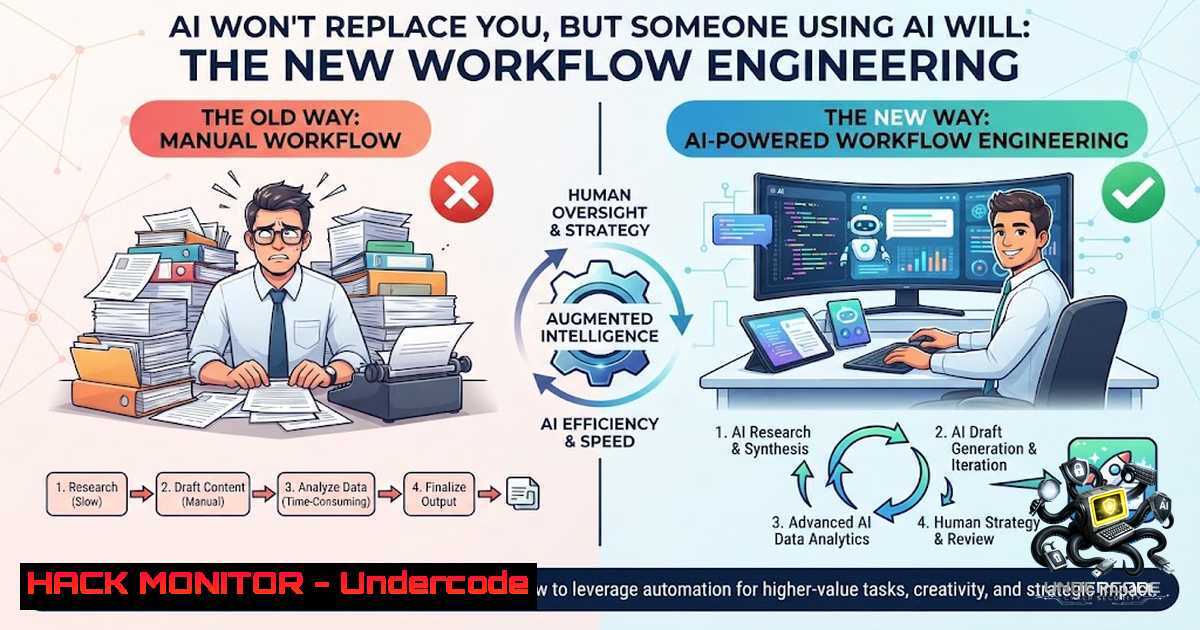
Introduction:
The modern professional landscape is no longer defined by mastering a single tool or programming language, but by the ability to architect efficient workflows that leverage artificial intelligence. As AI tools rapidly evolve from novelty to necessity, the competitive edge shifts from knowing how to code to knowing which tool solves which problem, effectively compressing the gap between an idea and its execution.
Learning Objectives:
- Understand the paradigm shift from software expertise to workflow expertise and problem-solving with AI.
- Learn to identify, select, and integrate the right AI tools for coding, automation, content creation, and business growth.
- Acquire practical command-line and API integration skills to build and optimize AI-powered workflows.
You Should Know:
- AI-Assisted Coding: From Zero to Prototype in Minutes
The post highlights a stark contrast: someone says “I’m not good at coding” while another person opens Cursor and Claude Code, builds the first version, and keeps moving. This is the reality of AI-assisted development. These tools do not eliminate the need for skill, but they dramatically reduce the barrier to entry.
Step‑by‑step guide:
- Set Up Your Environment: Install Cursor (an AI-first code editor) or continue using VS Code with the Claude or GitHub Copilot extension.
- Define the Problem: Clearly articulate what you want to build. Instead of “make a website,” say “create a single-page React app that displays a to-do list with local storage.”
- Generate the Code: Use the AI’s chat interface to generate the initial boilerplate. For example, in Cursor, you can use the command palette (
Cmd+Shift+1on Mac or `Ctrl+Shift+1` on Windows) and select “AI: Generate Code”. - Iterate and Debug: Run the code. If you encounter an error, copy and paste the error message directly into the AI chat and ask for a fix.
- Refine and Document: Use the AI to add comments and refactor the code for better readability and performance.
Linux Command (for setting up a Node.js project):
mkdir my-ai-app && cd my-ai-app
npm init -y
npm install react react-dom
npx create-react-app .
Windows Command (PowerShell):
New-Item -ItemType Directory -Path .\my-ai-app
cd .\my-ai-app
npm init -y
npm install react react-dom
npx create-react-app .
2. Automating Workflows with n8n and Flowise
The post recommends n8n and Flowise for building AI agents and automations. These open-source tools allow you to create complex, node-based workflows without writing extensive code, connecting APIs, databases, and AI models.
Step‑by‑step guide:
- Install n8n: The easiest way is to run it via Docker. This ensures it works consistently across Linux, Windows, and Mac.
docker run -it --rm --1ame n8n -p 5678:5678 n8nio/n8n
- Access the Editor: Open your browser and go to `http://localhost:5678`.
3. Create a Workflow: Drag a “Webhook” node to trigger the workflow. Configure it to listen for incoming HTTP requests.
4. Add an AI Node: Drag an “HTTP Request” node or use the “OpenAI” node if available. Configure it to send a prompt to an AI model (e.g., GPT-4).
5. Process the Response: Add a “Function” node to parse the AI’s response and extract the data you need.
6. Connect to a Database: Add a “Postgres” or “MySQL” node to save the results.
7. Activate and Test: Click “Activate” and send a test request to your webhook URL.Windows Command (for Docker Desktop):
Ensure Docker Desktop is installed and running, then use the same Docker command in PowerShell or Command Prompt.
3. API Security and Hardening for AI Integrations
When integrating AI tools via APIs (e.g., OpenAI, Claude, or custom models), security is paramount. Exposing API keys or failing to validate inputs can lead to data breaches or financial abuse.
Step‑by‑step guide:
1. Environment Variables: Never hardcode API keys. Use environment variables.
– Linux/macOS: `export OPENAI_API_KEY=”your-key-here”`
– Windows (Command Prompt): `set OPENAI_API_KEY=your-key-here`
– Windows (PowerShell): `$env:OPENAI_API_KEY=”your-key-here”`
2. Input Validation: Always sanitize and validate user inputs before sending them to an AI model to prevent prompt injection attacks. Use a library like `express-validator` in Node.js.
3. Rate Limiting: Implement rate limiting on your endpoints to prevent abuse. In Express.js, you can use express-rate-limit.
const rateLimit = require('express-rate-limit');
const limiter = rateLimit({
windowMs: 15  60  1000, // 15 minutes
max: 100 // limit each IP to 100 requests per windowMs
});
app.use('/api/', limiter);
4. Audit Logs: Keep detailed logs of all API calls, including timestamps, user IDs, and the prompts sent, for forensic analysis if a breach occurs.
4. Cloud Hardening for AI Applications
Deploying AI applications on the cloud (AWS, Azure, GCP) requires specific hardening measures to protect your models and data.
Step‑by‑step guide:
- Identity and Access Management (IAM): Create separate IAM roles for different services. For example, an EC2 instance running your AI app should only have permissions to read from a specific S3 bucket, not delete it.
- Network Security: Use Virtual Private Cloud (VPC) to isolate your AI infrastructure. Place your database and AI model servers in private subnets with no direct internet access.
- Data Encryption: Encrypt data at rest (using AWS KMS or Azure Key Vault) and in transit (using TLS/SSL).
- Vulnerability Scanning: Regularly scan your container images for vulnerabilities using tools like Trivy or Clair.
trivy image my-ai-app:latest
5. AI-Powered Content Creation and Brand Consistency
The post mentions tools like Gamma, Canva AI, Taplio, and AuthoredUp for creating presentations and growing on LinkedIn. The next differentiator will be accuracy, originality, and brand consistency.
Step‑by‑step guide:
- Define Your Brand Voice: Use a tool like ChatGPT or Claude to analyze your existing content and generate a “brand voice” document.
- Create a Content Calendar: Use Teal or a similar tool to plan your posts.
- Generate Visuals: Use Canva AI or Uizard to create consistent visual templates for your posts.
- Automate Scheduling: Use Taplio or AuthoredUp to schedule your posts for optimal engagement times.
- Analyze Performance: Use the analytics provided by these tools to see what resonates with your audience and iterate.
Linux Command (for bulk image processing with ImageMagick):
 Resize all images in a folder to a standard width for social media
for img in .png; do convert $img -resize 1200x630 ${img%.png}_social.png; done
6. Research and Learning Acceleration with AI
NotebookLM and ChatGPT are recommended for faster learning. These tools can summarize complex documents, generate study guides, and even create podcasts from your notes.
Step‑by‑step guide:
- Upload Source Material: Upload PDFs, websites, or YouTube transcripts to NotebookLM.
- Generate a Summary: Ask the AI to provide a “briefing document” or “study guide” based on the uploaded material.
- Create a Quiz: Ask the AI to generate a set of questions to test your understanding.
- Synthesize Information: Combine insights from multiple sources by asking the AI to find connections and contradictions between them.
7. Building an Online Business with AI
Shopify Magic and Durable AI are mentioned for building an online business. These tools can generate product descriptions, emails, and even entire websites.
Step‑by‑step guide:
- Generate a Business Idea: Use ChatGPT or Gemini to brainstorm business ideas based on your skills and market trends.
- Build a Website: Use Durable AI to generate a fully functional website in minutes.
- Create Product Listings: Use Shopify Magic to write compelling product descriptions and SEO metadata.
- Automate Customer Support: Use Zapier or Make to connect your store to an AI chatbot that can answer common questions.
What Undercode Say:
- Key Takeaway 1: The fundamental shift is from “tool proficiency” to “problem-solving proficiency.” The most valuable skill is not knowing a specific AI tool, but understanding the problem and selecting the right combination of tools to solve it efficiently.
- Key Takeaway 2: AI is a great accelerator, but it does not replace the need for critical thinking, accuracy, and brand consistency. Professionals who can verify AI outputs and maintain a unique voice will stand out.
Analysis:
The post brilliantly captures the zeitgeist of the current AI revolution. It moves the conversation away from the fear of being replaced by AI to the reality of being replaced by someone who uses AI effectively. The emphasis on workflow over individual tools is crucial; it encourages a systems-thinking approach. However, it also implicitly highlights a new set of risks. As workflows become more complex and interconnected, the attack surface for cyber threats expands. A vulnerability in a single tool or API could compromise an entire automated pipeline. Therefore, the advice to “understand inputs, outputs, and risks” is not just a productivity tip but a fundamental security principle. The future belongs to those who can not only build these workflows but also secure them.
Prediction:
- +1 The democratization of development through AI will lead to an explosion of innovation, with more people able to bring their ideas to life.
- -1 This rapid development will also lead to a surge in insecure applications and workflows, as speed is prioritized over security, creating a goldmine for cybercriminals.
- -1 The demand for “AI Security Engineers” and “Prompt Injection Specialists” will skyrocket as organizations scramble to protect their AI investments from novel attack vectors.
- +1 The focus on workflow expertise will give rise to a new role: the “AI Workflow Architect,” a professional who designs, builds, and secures end-to-end AI-powered business processes.
- -1 Over-reliance on AI tools may erode fundamental skills (e.g., raw coding, writing) in the long term, creating a dependency that could be risky if these tools become unavailable or compromised.
▶️ Related Video (82% Match):
🎯Let’s Practice For Free:
🎓 Live Courses & Certifications:
Join Undercode Academy for Verified Certifications
🚀 Request a Custom Project:
Secure, high-velocity infrastructure and disruptive technological engineering. Contact our engineering team for high-tier development and proprietary systems:
[email protected]
💎 Smart Architecture | 🛡️ Secure by Design | ⭐ Trusted by Thousands
IT/Security Reporter URL:
Reported By: Rathanuday Someone – Hackers Feeds
Extra Hub: Undercode MoN
Basic Verification: Pass ✅


