
Listen to this Post
Introduction:
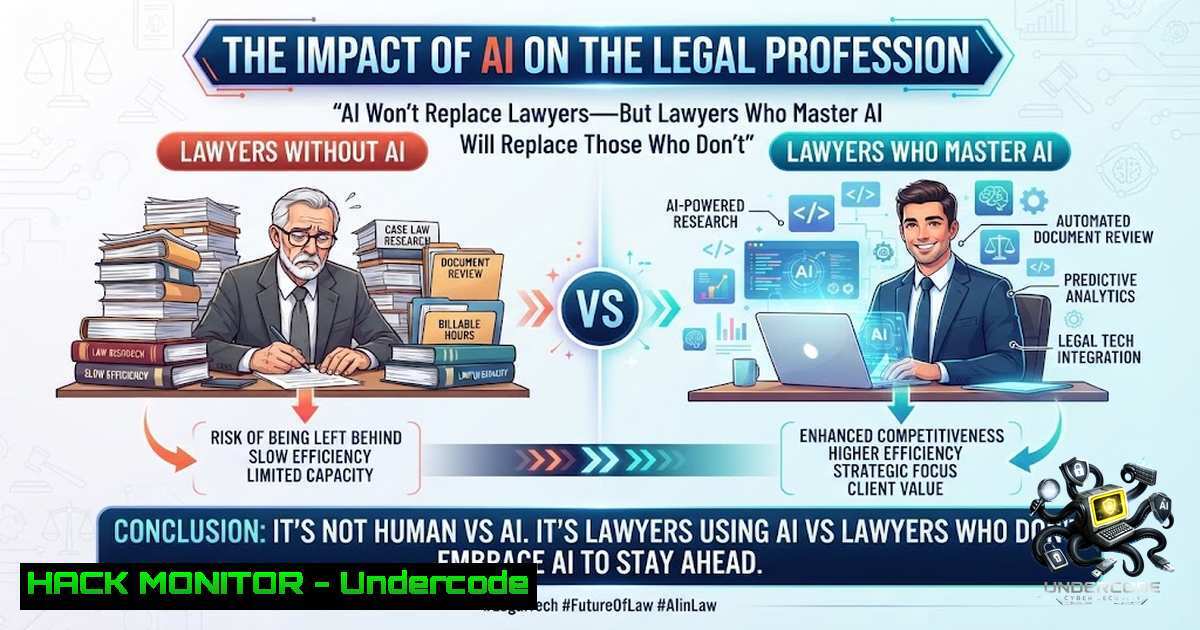
The debate over whether artificial intelligence will replace lawyers has reached a fever pitch across professional networks. Rachel Bender, a legal tech builder, puts it bluntly: “AI is not going to make lawyers obsolete. Ever.” Yet corporate legal AI adoption more than doubled in one year, jumping from 23 percent to 52 percent—a statistic that demands attention. The truth lies not in replacement but in transformation: AI is reshaping how legal services are delivered, creating a widening gap between professionals who embrace these tools and those who ignore them. For cybersecurity, IT, and legal professionals alike, understanding this shift is no longer optional—it is survival.
Learning Objectives:
- Understand the core distinction between AI augmentation and AI replacement in professional services
- Identify cybersecurity and data privacy risks inherent in AI-powered legal workflows
- Master practical commands and configurations for securing AI tool deployments across Linux and Windows environments
- Develop a strategic framework for integrating AI tools while maintaining professional judgment and ethical standards
- The Augmentation Reality: What AI Actually Does in Practice
The most common misconception is that AI replaces legal judgment. In reality, AI excels at the repetitive, time-consuming tasks that should never have required a Juris Doctor in the first place. As Omar Haroun observes, “AI amplifies lawyer capabilities, it doesn’t replace lawyer thinking”. Current AI applications in law include drafting first versions of contracts, summarizing case law and lengthy filings, streamlining due diligence and document review, and making in-house legal teams faster at repetitive work.
However, the technology comes with significant limitations. AI systems can produce confident-sounding text that contains factual errors, misquoted citations, or reasoning that won’t hold up under scrutiny. They hallucinate case law, misread statutes, and can be biased due to content controls implemented by providers. As one practitioner notes, “AI ends up wasting my time because I have to confirm every word, sentence, and source”.
Step‑by‑step guide for auditing AI output quality:
- Establish a verification workflow – Never accept AI-generated legal text without human review. Create a mandatory checklist that includes source verification, citation checking, and factual cross-referencing.
- Implement version control – Use `git` or similar tools to track changes between AI-generated drafts and human-edited versions. Command: `git log –oneline –graph –all` to visualize the revision history.
- Run automated citation checks – On Linux, use `grep -r “citation” ./documents/` to flag all cited sources for manual verification. On Windows PowerShell:
Select-String -Path .\documents\ -Pattern "citation". - Maintain an error log – Document every hallucination or error discovered. Command:
echo "$(date): Hallucination detected in contract clause X" >> ai_error_log.txt. -
The Cybersecurity Imperative: Protecting Client Data in the AI Era
The most underappreciated risk in AI-powered legal work is data security. Lawyers can inadvertently expose confidential client information when using AI chatbots because these systems often store the data input into them. A 2026 breach at a major legal research provider reportedly traced to one automated account that could read nearly every secret in that account, exposing data tied to 21,000 enterprise customers, including law firms.
The LexisNexis Cybersecurity and AI 2025 Report found that 24% of legal professionals cited AI-generated threats such as deepfakes and synthetic email scans as their second biggest concern after phishing. As generative AI subsumes routine legal activities previously done by junior lawyers and paralegals, there will be fewer people in the organization with the skills to detect and respond to these threats.
Step‑by‑step guide for securing AI tool deployments:
- Implement data loss prevention (DLP) – On Linux, configure `auditd` to monitor file access:
sudo auditctl -w /path/to/client_documents/ -p rwxa -k client_data_access
sudo ausearch -k client_data_access
On Windows, use PowerShell to enable detailed object access auditing:
auditpol /set /subcategory:"File System" /success:enable /failure:enable
-
Deploy network monitoring – Use Wireshark or tcpdump to inspect traffic between AI tools and external APIs:
sudo tcpdump -i eth0 -w ai_traffic.pcap port 443
-
Enforce multi-factor authentication – Require MFA for all AI platform access. On Linux PAM systems, configure
pam_google_authenticator. On Windows, enforce through Azure AD Conditional Access policies. -
Conduct regular security audits – Run vulnerability scans using OpenVAS on Linux:
sudo gvm-cli --gmp-username admin --gmp-password password socket --xml "<get_tasks/>"
-
Establish an AI usage policy – Define which data categories can be processed by AI tools and which must remain offline. Document all approved tools and their security certifications.
-
The Skills Gap: Why Training Matters More Than Technology
The consensus across the legal profession is clear: the lawyers who learn to use AI will replace the lawyers who don’t. Louise Hall-Strutt reframes the question: “What happens when another lawyer becomes twice as efficient as me?” This is not about technology replacing professionals—it is about professionals who leverage technology outperforming those who do not.
Training was identified as a key priority, both in terms of teaching staff about the use of AI and in respect of coaching associates on how to integrate these tools effectively. Firms winning with AI aren’t chasing tools—they’re tightening the gaps between intake, follow-up, and judgment.
Step‑by‑step guide for building AI literacy:
- Start with prompt engineering – Learn to craft effective prompts. Use this template:
 + [bash] + [bash] + [bash]</code>. Example: “You are a senior corporate attorney. Draft a non-disclosure agreement for a technology startup. Include standard confidentiality, non-compete, and return-of-property clauses. Format as a formal legal document.”</p></li>
<li><p>Practice with open-source models – Deploy a local LLM using Ollama on Linux:
[bash]
curl -fsSL https://ollama.com/install.sh | sh
ollama pull llama3.2
ollama run llama3.2 "Summarize this legal document: [paste text]"

On Windows, use WSL2 to run the same commands or use LM Studio for a GUI-based approach.
-
Create a knowledge base – Build a searchable repository of legal precedents using Elasticsearch:
sudo apt-get install elasticsearch
sudo systemctl start elasticsearch
curl -X PUT "localhost:9200/legal_precedents"
-
Set up automated document review – Use Python with the `transformers` library to flag potential issues:
from transformers import pipeline classifier = pipeline("text-classification", model="legal-bert") result = classifier("This clause may violate anti-trust regulations...") print(result) -
Measure productivity gains – Track time spent on tasks before and after AI integration. Use `time` command on Linux:
time python document_review.py. On Windows PowerShell:Measure-Command { python document_review.py }.
4. The Accountability Problem: Who Bears Responsibility?
One of the most critical distinctions between AI and human lawyers is accountability. As Gurneet Kaur notes, “AI can suggest. But it can’t be liable.” When an AI tool provides incorrect legal advice or hallucinates a case citation, there is no professional liability attached to the algorithm—the responsibility falls entirely on the human who relied on it.
Courts around the globe have been relatively lenient so far, imposing mild sanctions. However, in 2026, given that AI literacy and usage grow rapidly, blunders will not be tolerated anymore. Suspension and even disbarment will likely become the new reality for negligent legal professionals.
Step‑by‑step guide for maintaining accountability:
- Document AI usage – Maintain detailed logs of when and how AI tools are used. On Linux:
logger "AI tool X used for document Y on $(date)". On Windows:Write-EventLog -LogName Application -Source "AI Usage" -EntryType Information -EventId 1 -Message "AI tool used". -
Implement human-in-the-loop verification – Require dual sign-off for any AI-generated output. Use digital signatures: `gpg --sign document.pdf` on Linux or `Set-AuthenticodeSignature` on Windows.
-
Create an error response protocol – Define steps to take when an AI error is discovered, including client notification, corrective action, and process improvement.
-
Conduct regular ethical audits – Review AI usage against professional conduct rules. Use automated compliance checking:
Linux script to flag potential ethical violations
grep -i "confidential" ./ai_outputs/ && echo "WARNING: Confidential data may have been processed by AI"
5. The Commercial Reality: Value Over Billable Hours
AI is forcing a fundamental rethink of the legal business model. For decades, law firms built their economics around time spent rather than value delivered. AI allows lawyers to deliver high-quality work in a fraction of the time once required—good for clients, good for access to justice, but deeply uncomfortable for a business model built on billable hours.
The concern among many practitioners is not whether AI will replace lawyers, but whether it will devalue legal services—creating a deflationary effect across the market with lower salaries and wages. The firms that thrive will be those that pivot from selling time to selling outcomes.
Step‑by‑step guide for value-based pricing:
- Analyze current workflows – Use process mining tools to identify time sinks. On Linux, use
sysstat:sudo apt-get install sysstat sar -u 1 10
-
Calculate AI efficiency gains – Measure time saved per task type. Create a spreadsheet comparing pre-AI and post-AI completion times.
-
Develop outcome-based pricing models – Structure fees around deliverables rather than hours. Use project management tools like Jira or Trello to track milestones.
-
Communicate value to clients – Create reports showing efficiency gains and cost savings. Use data visualization:
python -c "import matplotlib.pyplot as plt; plt.plot([1,2,3], [10,8,5]); plt.savefig('efficiency.png')".
6. The Future of Legal Education and Training
As AI reshapes the profession, legal education must evolve. The traditional model of training junior lawyers through grunt work—document review, due diligence, basic research—is being disrupted. Some argue that AI is an unfit replacement for this grunt work because it lacks a “moral compass”. Others see it as an opportunity to redirect training toward higher-value skills: judgment, strategy, persuasion, and client management.
The path forward requires re-conceptualizing what it means to be a lawyer. Law departments and law firms must retain human expertise, increase their assessment of and emphasis on candidates’ ‘soft skills,’ and find ways to upskill their existing workforce to excel in the critical areas where AI cannot compete.
Step‑by‑step guide for upskilling legal teams:
- Assess current AI literacy – Survey team members on their familiarity with AI tools. Use a simple scoring system: 1=Unaware, 5=Expert.
-
Design a tiered training program – Basic: prompt engineering and tool usage. Intermediate: workflow integration and output verification. Advanced: AI governance and risk management.
-
Create sandbox environments – Set up isolated testing environments where team members can experiment without risk. Use Docker:
docker run -it --rm python:3.9-slim bash
pip install transformers torch
-
Establish mentorship programs – Pair AI-savvy professionals with those less experienced. Track progress through regular check-ins.
-
Measure training effectiveness – Use pre- and post-training assessments. Command: `diff pre_training.csv post_training.csv` to measure improvement.
What Undercode Say:
-
AI is not a substitute for judgment – The core of legal practice—judgment, strategy, persuasion, emotional intelligence—cannot be automated. AI tools are powerful assistants, not replacements.
-
The real threat is complacency – Lawyers who ignore AI will be left behind not because of technology, but because they failed to evolve. The winners will be those learning how to use AI first.
Analysis:
The data paints a clear picture: AI adoption in legal services is accelerating rapidly, with corporate adoption more than doubling in a single year. Yet the technology remains immature for high-stakes litigation, plagued by hallucinations, bias, and security vulnerabilities. The professionals who thrive will be those who develop deep AI literacy—not just knowing which buttons to press, but understanding the technology’s limitations, risks, and strategic applications. This requires investment in training, robust governance frameworks, and a willingness to rethink traditional business models. The firms that get this right will deliver better outcomes for clients while building sustainable competitive advantages. Those that don’t will find themselves obsolete—not because AI replaced them, but because their competitors did.
Prediction:
- +1 AI will democratize access to legal services, making basic legal assistance available to millions who previously could not afford it.
- -1 The next 24–36 months will see a wave of professional liability cases as lawyers are held accountable for AI-generated errors they failed to catch.
- +1 New job categories will emerge—AI legal ethics officers, prompt engineers specializing in law, and AI governance specialists—creating opportunities for跨界 professionals.
- -1 The erosion of billable hours as the primary revenue model will cause significant disruption, potentially leading to consolidation and job losses in traditional law firms.
- +1 Cybersecurity will become a core competency for legal professionals, with AI-powered threat detection becoming standard practice.
- -1 The skills gap will widen dramatically, creating a two-tier profession where AI-literate lawyers command premium rates while others struggle to remain relevant.
▶️ Related Video (82% Match):
🎯Let’s Practice For Free:
🎓 Live Courses & Certifications:
Join Undercode Academy for Verified Certifications
🚀 Request a Custom Project:
Secure, high-velocity infrastructure and disruptive technological engineering. Contact our engineering team for high-tier development and proprietary systems:
[email protected]
💎 Smart Architecture | 🛡️ Secure by Design | ⭐ Trusted by Thousands
IT/Security Reporter URL:
Reported By: Ruth O - Hackers Feeds
Extra Hub: Undercode MoN
Basic Verification: Pass ✅


